

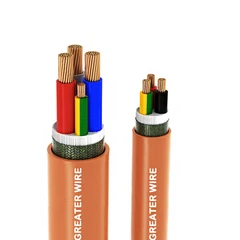
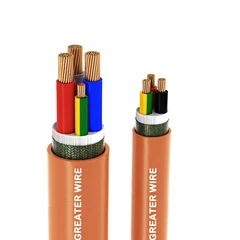

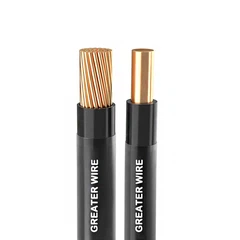
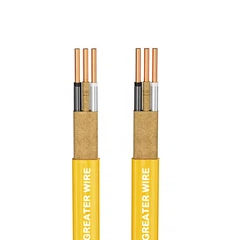
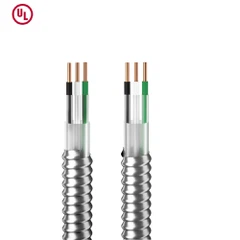
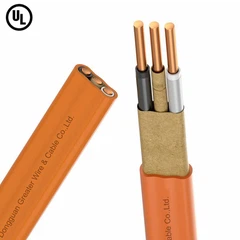
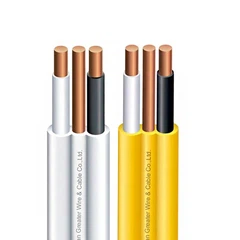
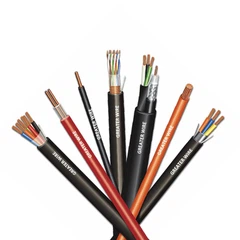
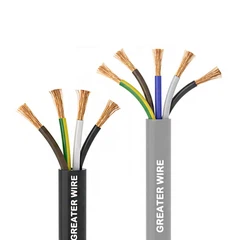
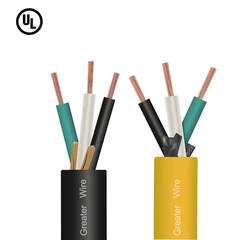
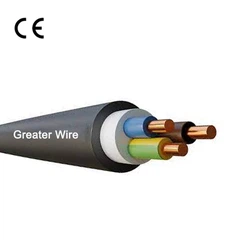
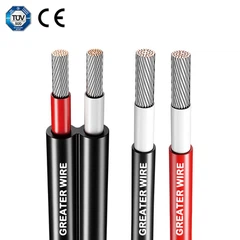

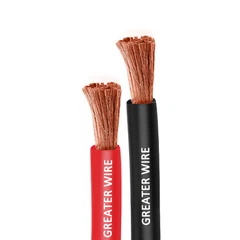
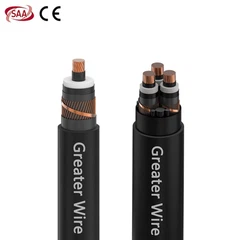
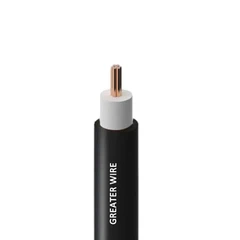
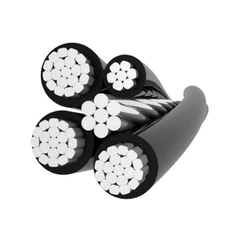


12.7/22Kv copper medium voltage cable, the insulation layer material has excellent electrical insulation performance and chemical stability. It can maintain its insulation performance in high temperature environment and has good resistance to ultraviolet rays and moisture. The thickness of the insulation layer is designed based on the rated voltage and use the environment of the cable to ensure that it will not cause electric shock or leakage under high voltage.
Min. installation temperature: 0°C
Operating temperature: -25°C to +90°C
Application
12.7/22 kV 3 core copper medium voltage cable is widely used in urban and regional distribution networks, particularly in areas where reliability and high load capacity are critical. Featuring copper conductors for excellent conductivity and mechanical strength, this cable is ideal for providing uninterrupted power supply in urban substations, airport power distribution systems, subway lines, and large commercial complexes.

Feature

• Conductor: Stranded Compacted Circular Copper conductor as per AS/NZS 1125
• Conductor Screen: Extruded Semi-conductive compound
• Insulation: XLPE
• Insulation Screen: Extruded Semi-conductive compound
• Longitudinal Water blocking: Water blocking tape below copper screen (Optional)
• Metallic Insulation Screen: Copper Wire Screen + helically applied copper tape (E/F current capacity – Based on requirement)
• binder tape/sheath over assembled cores
• Metallic Sheath: Lead Alloy (optional)
• Outer Sheath: Extruded Polyvinyl Chloride, Colour: Black
• Insect attack Protection: Polyamide Nylon (optional)
(Alternative Sheath: PVC+HDPE Composite Sheath or PVC + Nylon + HDPE (composite sheath with anti-termite properties) or LSZH Outer sheath, and parameters will change accordingly)
Certification
12.7/22kV 3 core copper medium voltage cable is SAA certified, with certification numbers: SAA242046 and SAA250307 (available on the certification website). SAA-certified cables meet strict standards throughout the entire supply chain, including design, manufacturing, and final performance. The certification body thoroughly verifies cable quality through type testing, sampling tests, and factory inspections. This multi-faceted review system ensures that the cable meets standard requirements for service life, transmission efficiency, and safety protection. When purchasing and installing this cable, users can be assured of the authoritative certification and guaranteed quality and specifications, eliminating the need to worry about substandard products being used in projects.

Package

Factory

Dongguan Greater Wire & Cable Co., Ltd., is located in Dongguan City, Guangdong province. It integrates R&D, production, sales and maintenance, focusing on various wires and cables, and providing customized solutions for large-scale infrastructure such as airports, hospitals, factories, and schools in many regions around the world. With advanced production equipment and processes, complete testing equipment, and strong technical strength, the company has developed rapidly after years of hard work and the support of global customers, and has won a high reputation and market share in overseas markets.
Case

Partner
FAQ
Q: How to identify the insulation performance of cables?
1. Identification of insulation material types: The thermal insulation performance of cables is usually closely related to their insulation materials. Common high thermal insulation materials include cross-linked polyethylene (XLPE), ethylene propylene rubber (EPR), polyvinyl chloride (PVC), etc. These materials are stable at high temperatures and have good thermal insulation effects.
Sheath material: The outer sheath material also affects the thermal insulation performance. For example, some cables use high-temperature resistant silicone rubber, fluoroplastics (such as FEP, PTFE) and other materials to provide better thermal insulation performance.
2. Temperature marking of temperature resistance grade: Generally, the outer sheath of the cable will be marked with a temperature resistance grade, such as 70°C, 90°C, 105°C, etc., which indicates that the cable can operate safely for a long time at this temperature. The higher the temperature resistance grade, the better the thermal insulation performance. Some cables will indicate the short-term extreme temperature resistance, such as 250°C, which can help determine its stability under short-term high temperature exposure.
3. Relevant standards and certifications: Cables that meet international standards are generally marked with their insulation and temperature resistance grades. These standards specify the performance requirements of cables under high temperature and load. Some cables carry fire resistance certifications, such as the UL fireproof mark or the IEC test pass mark. Such cables usually have excellent insulation and fire resistance.
4. Experimental test method: By placing the cable in a high temperature environment for a certain period of time, observing the physical changes and electrical performance changes of the insulation layer, if the cable can remain stable, its thermal insulation performance is good. Use professional equipment to test the thermal resistance coefficient of the cable. Cables with low thermal resistance coefficients can better isolate heat.
5. Insulation thickness: Cables with thicker insulation layers usually have higher thermal insulation performance. You can check the insulation thickness by consulting the cable specification or cutting the cross section. Some high thermal insulation cables use a multi-layer structure, such as an inner XLPE layer plus an outer PVC sheath, which can significantly enhance the thermal insulation effect.
6. Thermal conductivity of the material: Some thermal insulation materials have poor thermal conductivity, which helps to isolate heat. If the thermal conductivity of the insulation material is low (such as ceramic insulation or silicone), then its thermal insulation performance will be better.
7. Rated current carrying capacity: The current carrying capacity is related to the thermal insulation performance of the cable. Cables with good thermal insulation performance can maintain a lower external temperature at higher currents.
Q: How can I get a sample?
Q: Do you support OEM?
Hot Tags: 12.7/22kv 3 core copper medium voltage cable, China 12.7/22kv 3 core copper medium voltage cable manufacturers, suppliers, factory


|
No. of
Cores
|
Core Cross
sectional
Area
|
Nominal Diameter
|
||
|
Under
metallic
screen
|
Under
metallic
screen
|
Overall
|
||
|
No.
|
mm2
|
mm
|
mm
|
mm
|
| 3 | 35 | 21.1 | 22.6 | 54.0 |
| 3 | 50 | 22.2 | 23.7 | 57.0 |
| 3 | 70 | 23.9 | 25.4 | 60.0 |
| 3 | 95 | 25.4 | 26.9 | 64.0 |
| 3 | 120 | 27 | 28.5 | 67.0 |
| 3 | 150 | 28.4 | 29.9 | 71.0 |
| 3 | 185 | 30.1 | 31.6 | 75.0 |
| 3 | 240 | 32.4 | 33.9 | 80.0 |
| 3 | 300 | 34.4 | 35.9 | 84.0 |
| 3 | 400 | 37.2 | 38.7 | 91.0 |
| 3 | 500 | 40.6 | 42.1 | 99.0 |
|
No.of Cores
|
Core Cross sectional Area
|
Max. DC Resistance at 20˚C
|
Max. AC Resistance at 90˚C
|
Approx. Capacitance
|
Approx. Inductance
|
Approx.
Reactance |
Continuous Current Rating
|
||
| Buried direet in ground |
In a buried duct
|
In Air
|
|||||||
|
No.
|
mm2
|
Ω/km
|
Ω/km
|
µF/km
|
mH/km
|
Ω/km
|
Amps
|
||
| 3 | 35 | 0.524 | 0.668 | 0.16 | 0.625 | 0.196 | 153 | 133 | 170 |
| 3 | 50 | 0.387 | 0.494 | 0.17 | 0.604 | 0.190 | 181 | 158 | 204 |
| 3 | 70 | 0.268 | 0.342 | 0.2 | 0.569 | 0.179 | 221 | 193 | 253 |
| 3 | 95 | 0.193 | 0.246 | 0.22 | 0.551 | 0.173 | 262 | 231 | 304 |
| 3 | 120 | 0.153 | 0.196 | 0.24 | 0.533 | 0.167 | 298 | 264 | 351 |
| 3 | 150 | 0.124 | 0.159 | 0.26 | 0.521 | 0.164 | 334 | 297 | 398 |
| 3 | 185 | 0.0991 | 0.127 | 0.28 | 0.509 | 0.160 | 377 | 336 | 455 |
| 3 | 240 | 0.0754 | 0.097 | 0.31 | 0.496 | 0.156 | 434 | 390 | 531 |
| 3 | 300 | 0.0601 | 0.078 | 0.33 | 0.484 | 0.152 | 489 | 441 | 606 |
| 3 | 400 | 0.047 | 0.062 | 0.37 | 0.473 | 0.149 | 553 | 501 | 696 |
| 3 | 500 | 0.0366 | 0.049 | 0.41 | 0.462 | 0.145 | 632 | 574 | 800 |
| 20 | 25 | 35 | 40 | 45 | 50 | 55 | 60 |
| 1.08 | 1.04 | 0.96 | 0.91 | 0.87 | 0.82 | 0.76 | 0.71 |
| 10 | 15 | 25 | 30 | 35 | 40 | 45 | 50 |
| 1.07 | 1.04 | 0.96 | 0.93 | 0.89 | 0.85 | 0.80 | 0.76 |
|
No.of Cores
|
Core Cross sectional Area
|
Max. pulling tension on conductor
|
Charging Current per phase
|
Zero sequence impedance
|
Electric Stress at Conductor Screen
|
Short circuit rating of Phase conductor
|
| No. | mm² | kN | Amps/Km | Ohms/Km | kV/mm | kA, I sec |
| 3 | 35 | 2.45 | 0.64 | 1.83 | 3.7 | 5.0 |
| 3 | 50 | 3.5 | 0.68 | 1.65 | 3.5 | 7.2 |
| 3 | 70 | 4.9 | 0.8 | 1.50 | 3.4 | 10.0 |
| 3 | 95 | 6.65 | 0.88 | 1.41 | 3.2 | 13.6 |
| 3 | 120 | 8.4 | 0.96 | 1.36 | 3.1 | 17.1 |
| 3 | 150 | 10.5 | 1.04 | 1.32 | 3.1 | 21.4 |
| 3 | 185 | 12.95 | 1.12 | 1.29 | 3.0 | 26.4 |
| 3 | 240 | 16.8 | 1.24 | 1.26 | 2.9 | 34.3 |
| 3 | 300 | 21 | 1.32 | 1.24 | 2.9 | 42.8 |
| 3 | 400 | 28 | 1.48 | 1.22 | 2.8 | 56.9 |
| 3 | 500 | 35 | 1.64 | 1.21 | 2.7 | 71.5 |


