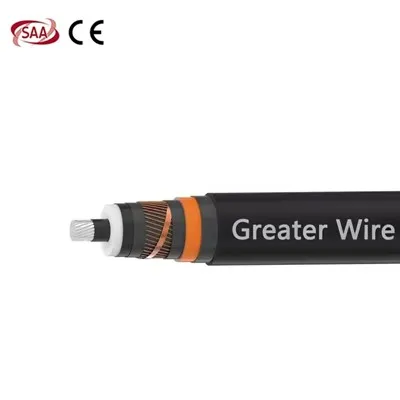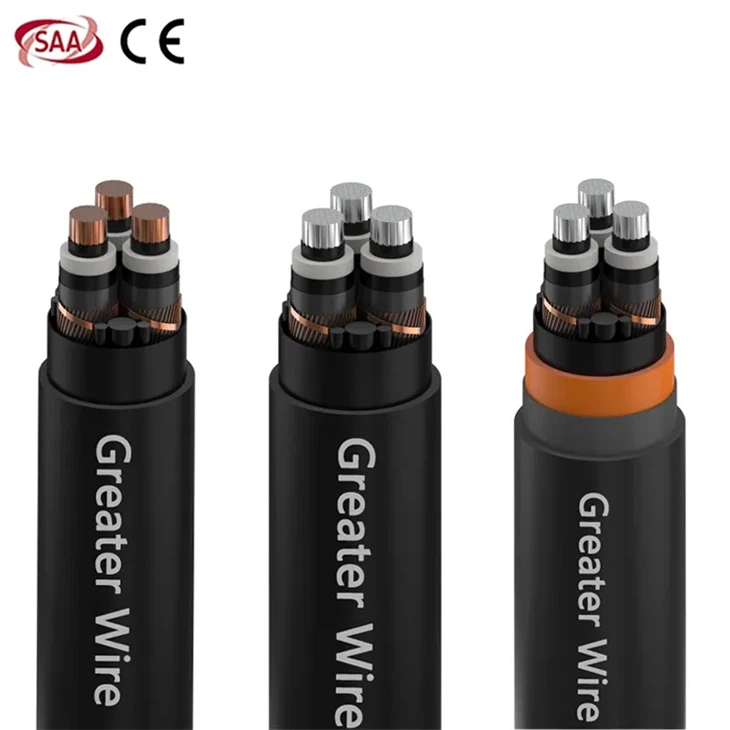

1.9/3.3kV 3 Core Anti-Termite aluminum MV cable is rated as waterproof to AD7/AD8 standards, it can be immersed in water or exposed to high humidity without affecting its performance. The waterproof material integrated into the cable prevents water penetration, making it suitable for underground or underwater applications that require frequent exposure to wet environments.
Min. installation temperature: 0°C
Operating temperature: -25°C to +90°C
Emergency operating temperature: 105°C
Max. Short Circuit Temperature: 250°C
Application
1.9/3.3kV MV aluminum cable is a robust, heavy-duty power solution designed for stationary high-voltage power distribution circuits in challenging environments. It is ideal for stable or semi-portable power transmission across underground mines, open excavation sites, tunnels, pipelines, and conduit systems while remaining within the rated voltage limit. It is suited for direct burial in both moist and dry environments and offers reliable performance in diverse installation settings.

Feature

• Conductor: Stranded Compacted Circular aluminium conductor as per AS/NZS 1125
• Conductor Screen: Extruded Semi-conductive compound
• Insulation: XLPE
• Insulation Screen: Extruded Semi-conductive compound
• Longitudinal Water blocking : Water blocking tape above and below copper screen (Optional)
• Metallic Insulation Screen: Copper Wire Screen + helically applied copper tape
• binder tape / sheath over assembled cores
Composite sheath
• Inner layer : Extruded Polyvinyl Chloride, Colour: Orange
• Termite Protection: Polyamide (Nylon -12)
• Outer layer: HDPE (Black)
Certification
Medium voltage cables have passed various performance tests and obtained SAA certification, with certification numbers: SAA242046 and SAA250307 (available on the certification website). SAA certification ensures full traceability of the cables, from raw material selection to final delivery. Each batch of cables is linked to certification records, allowing contractors and project owners to verify their authenticity directly through the SAA platform. This traceability not only enhances confidence in the cable's provenance but also ensures that the cables meet strict Australian and international quality standards for electrical performance, insulation integrity, and long-term safety and reliability.

Package

Factory

Greater Wire manufacturer has become an experienced expert in the field of wire and cable production for more than 20 years. The use of state-of-the-art automated production facilities allows us to consistently engineer wires and cables with the highest precision and uncompromising quality. We are your loyal partner for quality wire and cable solutions.
Case

Partner
FAQ
Q: What are the main applications of 3 core aluminum conductor medium voltage cables?
Q: What is the difference in performance between aluminum conductors and copper conductors?
1. Copper has better conductivity than aluminum, about 1.6 times that of aluminum. With the same cross-sectional area, copper conductors can carry higher currents and are suitable for applications that require high conductivity.
2. Aluminum conductors are relatively light, about one-third of copper conductors, which makes aluminum conductors more convenient to transport and install, especially in long-distance power transmission and overhead lines.
3. The cost of aluminum is generally lower than that of copper, so aluminum conductors tend to be more economical in large-scale applications. 4. Aluminum forms an oxide film when exposed to air, which protects the conductor from further corrosion. Although copper performs well in some environments, it may corrode when exposed to humid or corrosive environments for a long time.
5. Aluminum has a greater thermal expansion coefficient than copper, which means that aluminum conductors will expand more than copper conductors when the temperature changes, which may affect the stability of the connection point.
6. The connection point of copper conductors is more stable in long-term use, while aluminum conductors may have loose connections at high temperatures or frequent thermal cycles, so specially designed connection methods are required.
7. Copper has poor anti-oxidation performance and may oxidize after long-term use, affecting its conductivity. The oxide film of aluminum conductors is relatively more stable.
Q: Can medium voltage cables be used in wet or humid environments?
Hot Tags: three core anti-termite 1.9/3.3kv mv aluminum cable, China three core anti-termite 1.9/3.3kv mv aluminum cable manufacturers, suppliers, factory, 600V UL1015 MTW Hook Up Wire, ac cable, NM B Wire, rubber cable, HO5V-K, SAA Approval SDI Cable


|
No. of
Cores
|
Core Cross
sectional
Area
|
Nominal Diameter
|
||
|
Under
metallic
screen
|
Under
metallic
screen
|
Overall
|
||
|
No.
|
mm2
|
mm
|
mm
|
mm
|
| 3 | 16 | 11.8 | 13.3 | 33.0 |
| 3 | 25 | 13.1 | 14.6 | 36.0 |
| 3 | 35 | 14.1 | 15.6 | 38.0 |
| 3 | 50 | 15.2 | 16.7 | 41.0 |
| 3 | 70 | 16.8 | 18.3 | 44.0 |
| 3 | 95 | 18.4 | 19.9 | 48.0 |
| 3 | 120 | 20 | 21.5 | 52.0 |
| 3 | 150 | 21.3 | 22.8 | 55.0 |
| 3 | 185 | 23 | 24.5 | 59.0 |
| 3 | 240 | 25.3 | 26.8 | 64.0 |
| 3 | 300 | 27.5 | 29.0 | 69.0 |
| 3 | 400 | 30.2 | 31.7 | 75.0 |
| 3 | 500 | 34 | 35.5 | 84.0 |
|
No.of Cores
|
Core Cross sectional Area
|
Max. DC Resistance at 20˚C
|
Max. AC Resistance at 90˚C
|
Approx. Capacitance
|
Approx. Inductance
|
Approx.
Reactance |
Continuous Current Rating
|
||
| Buried direet in ground |
In a buried duct
|
In Air
|
|||||||
|
No.
|
mm2
|
Ω/km
|
Ω/km
|
µF/km
|
mH/km
|
Ω/km
|
Amps
|
||
| 3 | 16 | 1.91 | 2.449 | 0.26 | 0.605 | 0.190 | 78 | 67 | 84 |
| 3 | 25 | 1.2 | 1.539 | 0.3 | 0.571 | 0.180 | 100 | 87 | 110 |
| 3 | 35 | 0.868 | 1.113 | 0.34 | 0.553 | 0.174 | 119 | 103 | 132 |
| 3 | 50 | 0.641 | 0.822 | 0.38 | 0.536 | 0.168 | 140 | 122 | 158 |
| 3 | 70 | 0.443 | 0.568 | 0.43 | 0.507 | 0.159 | 171 | 150 | 196 |
| 3 | 95 | 0.32 | 0.411 | 0.49 | 0.493 | 0.155 | 203 | 179 | 236 |
| 3 | 120 | 0.253 | 0.325 | 0.55 | 0.478 | 0.150 | 232 | 205 | 273 |
| 3 | 150 | 0.206 | 0.265 | 0.59 | 0.470 | 0.148 | 260 | 231 | 309 |
| 3 | 185 | 0.164 | 0.211 | 0.65 | 0.461 | 0.145 | 294 | 262 | 355 |
| 3 | 240 | 0.125 | 0.161 | 0.73 | 0.451 | 0.142 | 340 | 305 | 415 |
| 3 | 300 | 0.1 | 0.129 | 0.81 | 0.442 | 0.139 | 384 | 346 | 475 |
| 3 | 400 | 0.778 | 0.101 | 0.9 | 0.434 | 0.136 | 438 | 398 | 552 |
| 3 | 500 | 0.0605 | 0.079 | 0.93 | 0.428 | 0.135 | 505 | 460 | 646 |
| 20 | 25 | 35 | 40 | 45 | 50 | 55 | 60 |
| 1.08 | 1.04 | 0.96 | 0.91 | 0.87 | 0.82 | 0.76 | 0.71 |
| 10 | 15 | 25 | 30 | 35 | 40 | 45 | 50 |
| 1.07 | 1.04 | 0.96 | 0.93 | 0.89 | 0.85 | 0.80 | 0.76 |
|
No.of Cores
|
Core Cross sectional Area
|
Max. pulling tension on conductor
|
Charging Current per phase
|
Zero sequence impedance
|
Electric Stress at Conductor Screen
|
Short circuit rating of Phase conductor
|
| No. | mm² | kN | Amps/Km | Ohms/Km | kV/mm | kA, I sec |
| 3 | 16 | 0.8 | 0.16 | 3.61 | 1.3 | 1.4 |
| 3 | 25 | 1.25 | 0.18 | 2.70 | 1.2 | 2.3 |
| 3 | 35 | 1.75 | 0.2 | 2.27 | 1.2 | 3.1 |
| 3 | 50 | 2.5 | 0.23 | 1.98 | 1.1 | 4.5 |
| 3 | 70 | 3.5 | 0.26 | 1.73 | 1.1 | 6.2 |
| 3 | 95 | 4.75 | 0.29 | 1.57 | 1.1 | 8.5 |
| 3 | 120 | 6 | 0.33 | 1.48 | 1.1 | 10.7 |
| 3 | 150 | 7.5 | 0.35 | 1.42 | 1.1 | 13.4 |
| 3 | 185 | 9.25 | 0.39 | 1.37 | 1.1 | 16.5 |
| 3 | 240 | 12 | 0.44 | 1.32 | 1.0 | 21.4 |
| 3 | 300 | 15 | 0.48 | 1.29 | 1.0 | 26.8 |
| 3 | 400 | 20 | 0.54 | 1.26 | 1.0 | 35.5 |
| 3 | 500 | 25 | 0.56 | 1.24 | 0.9 | 44.7 |