























Many contractors see "PVC jacket" on an MC cable and assume it can be buried directly in the ground. That is a costly mistake. In most cases, standard PVC jacketed MC cable is not rated for direct burial – unless the jacket is explicitly marked "Direct Burial" or the cable carries a specific listing (e.g., UL 1569 with additional burial rating). This guide explains when direct burial is actually a good choice, and which XHHW-2 PVC jacketed MC cables might be suitable – always verify the actual marking.
1. The Core Question: Can You Directly Bury PVC Jacketed MC Cable?
The short answer: rarely. A standard PVC jacket provides moisture resistance against splashing water, humidity, and rain – not against continuous soil contact, ground water, or rock abrasion. True direct burial cables have thicker jackets, water‑blocking fillers, or specialized compounds. Without the explicit "Direct Burial" marking on the jacket, assume do not bury.
Customer pain point: Buyers often ask, "When can I use this cable for direct burial?" The honest answer: only when the cable is listed and marked for it. For industrial and commercial projects that truly need underground runs, you must check the product specification first.
2. Which XHHW-2 PVC Jacketed MC Cables Might Be Considered?
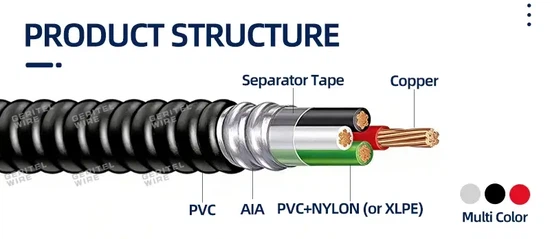
If a manufacturer has obtained a direct burial rating for their XHHW-2 PVC jacketed MC cable, it will be clearly printed on the jacket. Among large‑conductor cables commonly used for underground feeders, 3 conductor XHHW-2 MC cable with ground PVC jacket and 4 conductor XHHW-2 MC cable with ground PVC jacket (sizes like 250 kcmil, 350 kcmil) are sometimes available in direct‑burial rated versions. However, you must verify the marking – do not assume.
Typical features that support direct burial:
- XHHW-2 insulation – Cross‑linked polyethylene is highly moisture resistant.
- PVC jacket – Extra thickness or special compound for soil contact.
- Additional water‑blocking – Some cables include swellable tapes or filled interstices.
Selection reminder: These two cables differ in conductor count: 3/C (black, red, blue + ground) for three‑phase loads without a neutral; 4/C (adds white neutral) for loads that need a neutral. Both can be used for underground feeders if they carry the direct burial mark.
3. When Is Direct Burial a Good Choice?
- Long underground runs between buildings (substation to factory, transformer to distribution panel).
- Outdoor lighting in parks, campuses, or parking lots (when cable is specifically rated for burial).
- Renewable energy projects (solar farms, wind turbines) where trenching is required.
For industrial and commercial projects, direct burial eliminates conduit and reduces installation cost – but only when the cable is truly rated for it.
4. Product Advantages of XHHW-2 PVC Jacketed MC Cable (General)
Even when not used for direct burial, these cables offer:
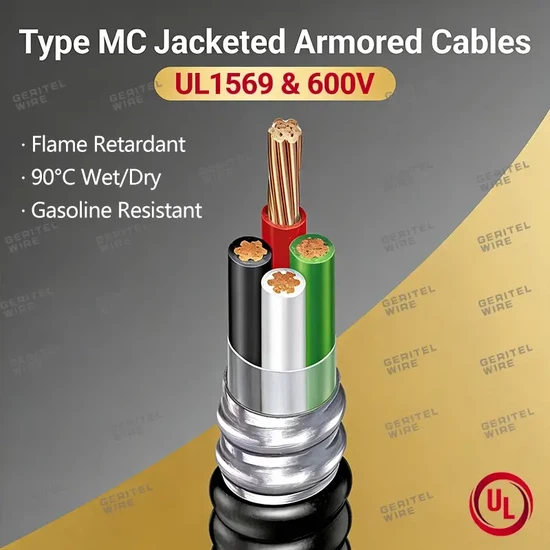
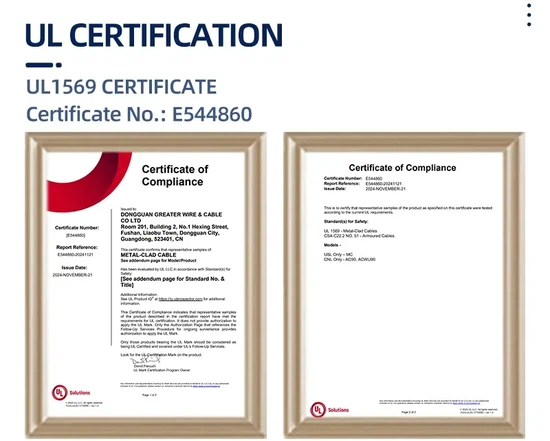
- UL standard – Compliant with UL 1569 (verify marking).
- Moisture resistant – PVC jacket protects against damp environments.
- Oil resistant – XHHW-2 insulation withstands oil and chemicals.
- Heat resistant – 90°C wet/dry rating (typical).
5. Alternatives If Direct Burial Is Not Allowed
Install the PVC jacketed MC cable in rigid PVC conduit underground.
Use a cable specifically marked "Direct Burial" (e.g., USE‑2, certain MC‑HL cables).
Switch to a non‑jacketed MC cable inside a conduit (cheaper but more labor).
6. FAQ – Direct Burial with PVC Jacketed MC Cable
Q1: Does a PVC jacket mean the cable can be buried?
No. It only means the jacket resists moisture above ground. Direct burial requires an explicit marking.
Q2: What should I look for on the jacket?
Look for the exact words "Direct Burial" or "Sunlight Resistant" (for UV) plus a wet location rating. Without "Direct Burial", do not bury.
Q3: Can 3/C XHHW-2 MC cable be used underground if placed in conduit?
Yes – inside a conduit, the cable does not need a direct burial rating. The conduit provides the mechanical protection.
Q4: Which is better for underground feeders: 3/C or 4/C?
If your load requires a neutral (e.g., 120V control power), choose 4/C. For pure three‑phase loads (motors, transformers), 3/C is sufficient.
Need to confirm if your project requires direct burial rated cable?
Send us your cable size (e.g., 250 kcmil, 350 kcmil), conductor count (3/C or 4/C), and the installation environment. We will check the manufacturer's datasheet and tell you whether the cable carries a direct burial marking – no guesswork, no overpromising.
Contact Us
Dongguan Greater Wire & Cable Co., Ltd.
Tel/WhatsApp/Wechat: +86 136 6257 9592
Tel/WhatsApp/Wechat: +86 135 1078 4550
Email: manager01@greaterwire.com
Website: www.greaterwire.com