























In Australia and around the world, TPS cables (thermoplastic sheathed cables) are widely used in domestic, commercial and industrial electrical systems due to their superior flexibility, durability and safety. Especially in home electrical wiring, 1.5 mm TPS cable and 2.5 mm TPS cable are the two most common specifications. They may be similar in appearance, but they are significantly different in terms of current carrying capacity, applicable environment and application occasions. This article will explore in detail the main differences between 1.5 mm TPS cable and 2.5 mm TPS cable, including their structure, application fields, load capacity, safety and other factors, and combine it with 2.5 mm 2C E TPS cable for further analysis.
1. What is TPS cable?
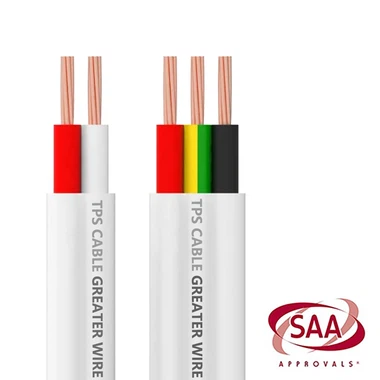
TPS cable is a cable with a thermoplastic outer sheath, which is usually made of a high-quality thermoplastic such as polyvinyl chloride or PVC. TPS cables are characterized by their exceptional flexibility and durability and their ability to withstand abrasion, moisture and chemical attack, making them ideal for domestic and commercial electrical wiring. According to the size of the conductor, TPS cables can be divided into different specifications, of which 1.5 mm TPS cable and 2.5 mm TPS cable are the two most common ones.
2. 1.5 mm TPS cable
1.5 mm TPS cable is typically used in light-duty electrical applications and is suitable for smaller power devices and circuits. It has a small wire cross-section and relatively low current carrying capacity and is commonly used in lighting, low-power appliances, and some small electrical equipment in homes and offices.
2.1 Characteristics of 1.5 mm TPS cable
Current Carrying Capacity: Typically suitable for current loads of 10 amps to 13 amps. It can support low-power devices such as home lighting circuits and small appliances.
Flexibility: Due to the thinner wires, 1.5 mm TPS cable is more flexible than 2.5 mm cable, making it easier to install and route, especially suitable for environments with limited space.
Scope of application: Widely used in home lighting systems, low-power home appliance sockets, etc.
2.2 Application of 1.5 mm TPS cable
Home lighting circuits: such as ceiling lights, chandeliers, etc.
Small household appliances: low-power electrical equipment such as electric fans, televisions, desk lamps, etc.
Socket Circuit: Suitable for low power sockets such as computer sockets or small kitchen appliances.
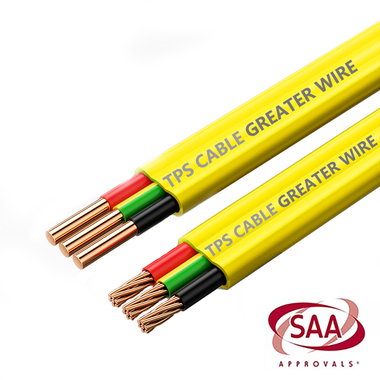
3. 2.5 mm TPS cable
2.5 mm TPS cables have larger conductor cross-sections and are therefore capable of carrying higher current loads and are commonly used in high-power household appliances and electrical systems. It is widely used in electrical environments requiring larger currents or higher safety standards.
3.1 Characteristics of 2.5 mm TPS cable
Current carrying capacity: Suitable for current loads from 16 amps to 20 amps, capable of supporting larger power electrical equipment.
Heat resistance and aging resistance: Compared with 1.5 mm cable, 2.5 mm TPS cable has stronger heat resistance and aging resistance and can adapt to more harsh environmental conditions.
Abrasion resistance: Its thicker outer sheath makes the 2.5 mm TPS cable more resistant to abrasion in daily use.
3.2 Application of 2.5 mm TPS cable
High-power home appliances: electrical equipment that requires larger currents, such as air conditioners, refrigerators, water heaters, etc.
Kitchen and bathroom circuits: Since kitchen and bathroom environments are humid, 2.5 mm TPS cable has strong moisture-proof properties and is suitable for use in these areas.
Socket circuits: In socket circuits that require higher loads, 2.5 mm TPS cables are particularly outstanding and can ensure the safe operation of electrical appliances.
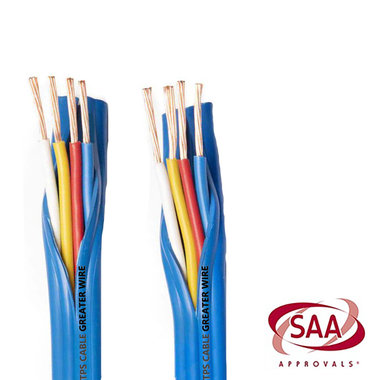
4. 2.5 mm 2C E TPS cable
2.5 mm 2C E TPS cable is a cable with a two-core design that is commonly used in electrical equipment such as dual-control switches. Its structure makes it easier to distribute and control current between multiple electrical systems, and is especially suitable for some specific circuit configurations.
4.1 Features of 2.5 mm 2C E TPS Cable
Dual-Core Design: 2.5 mm 2C E TPS cable contains two conductors, making it suitable for dual-control circuits, socket circuits, and other systems requiring two independent circuits.
Current carrying capacity: Same current carrying capacity as 2.5 mm TPS cable, suitable for current loads from 16 amps to 20 amps.
Flexibility and adaptability: Due to the dual-core design, the 2.5 mm 2C E TPS cable provides more electrical connection and control options, especially suitable for electrical wiring with multi-switch control or independent circuit control.
4.2 Application of 2.5 mm 2C E TPS cable
Double control switch circuit: such as lamps controlled by switches at both ends in the home.
Independent circuit control: suitable for kitchens, bathrooms and other environments that require multiple circuit controls.

5. Main differences between 1.5 mm TPS cable and 2.5 mm TPS cable
1.5 mm TPS cable and 2.5 mm TPS cable mainly differ in the following aspects:
5.1 Current carrying capacity
The 1.5 mm TPS cable has a maximum current carrying capacity of 10 amps to 13 amps and is suitable for low power equipment.
The current carrying capacity of 2.5 mm TPS cable is 16 amps to 20 amps, which is suitable for high-power electrical equipment, such as air conditioners, electric water heaters, etc.
5.2 Scope of application
1.5 mm TPS cable is suitable for lighter load electrical applications such as home lighting, low-power appliance sockets, etc.
2.5 mm TPS cable is suitable for higher load electrical equipment, such as high-power home appliances and kitchen, electric water heaters and other equipment.
5.3 Installation flexibility
1.5 mm TPS cable is lighter and more flexible, making it suitable for use in places with tight spaces or where frequent bends are required.
Although relatively thicker, 2.5 mm TPS cable performs more stably in high-power electrical systems.
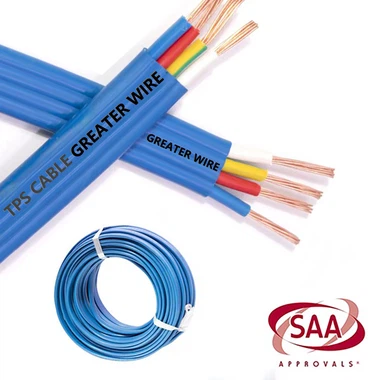
6. How to choose suitable cable specifications?
When choosing the appropriate cable size, you need to consider the following aspects:
Power requirements: For electrical systems requiring high-power equipment, it is recommended to choose 2.5 mm TPS cable; for low-power applications, 1.5 mm TPS cable is sufficient.
Electrical safety: When selecting cables, you need to consider the current load and the safe carrying capacity of the cable. Make sure to select cables with appropriate current carrying capacity to avoid overloading.
Installation environment: If the cable installation environment is humid or corrosive, you need to choose a 2.5 mm TPS cable with stronger corrosion resistance.