























In daily life, whether at home, office, or large industrial projects, cables are indispensable "lifelines." Cables not only transmit electricity but also carry signals and control commands. Choosing the right cable is like selecting a safe and reliable highway - it directly affects the stability of your equipment and overall safety.
Orange cable is widely used for critical power lines, industrial control, emergency power systems, and major infrastructure projects due to its high visibility and excellent performance. On construction sites, the bright orange color helps reduce operational mistakes and construction risks, ensuring both personnel and equipment safety.
Even if you have little knowledge of cables, this guide will help you understand the purpose of orange cables, their types, how to select the right model, and practical application examples - while introducing our professional services.
Cable Basics
What is a Cable?
A cable is a conductor covered with insulation and a protective sheath, designed to transmit electricity or signals.
- Conductor: Usually copper or aluminum, responsible for carrying current.
- Insulation: Protects the conductor, preventing leakage or short circuits.
- Sheath: Protects the cable from mechanical damage, water, and chemical corrosion.
- Analogy: Think of a cable as an "electric highway." The conductor is the lane, insulation is the guardrail, and the sheath is the road surface and protective cover.
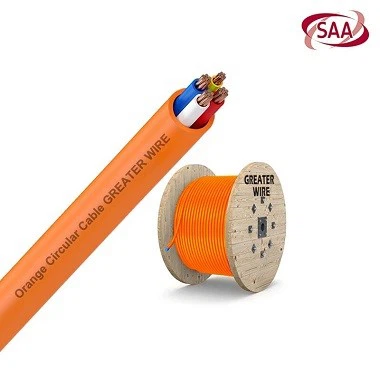
Why Are Cables Different Colors?
Different colors help identify functions and enhance safety:
- Black: Standard power lines
- Blue/Brown: Household wiring
- Orange: Critical circuits, high visibility, safety-sensitive areas
Orange cables are commonly used in underground ducts, industrial areas, mining sites, and fire protection lines, making them easy for workers to identify.
Key Parameters to Consider
Even for non-professionals, it's important to know:
- Voltage Rating: Maximum voltage the cable can safely carry.
- Current Capacity: Maximum current it can transmit without overheating.
- Temperature & Fire Resistance: Performance in high-temperature or fire conditions.
- Flexibility: Ease of installation or frequent bending.
- Durability: Resistance to wear, water, corrosion, and mechanical stress.
Understanding these parameters helps you select the right cable for your needs instead of blindly buying one.
Types and Uses of Orange Cables
Orange cables come in many types, each with specific applications. The table below summarizes main types, uses, and key features, explained in simple terms:
| Cable Type | Typical Use | Features | Easy Understanding |
|---|---|---|---|
| Orange Circular Cable | Home wiring, commercial buildings | Durable, easy to install | Works like a "durable water pipe" transmitting electricity |
| TPS Cable | Building distribution | High insulation, heat-resistant | Protects circuits from short circuits |
| Medium Voltage Cable | Factories, commercial buildings | Medium voltage transmission | Like a "high-speed power highway" |
| Fire Rated Cable | Fire safety, emergency power | Fire-resistant | Supplies power even during fire |
| VSD Cable | Variable speed drives | High flexibility, interference-resistant | Ensures smooth industrial equipment operation |
| Elastomer Cable | Drag chains, frequent bending | Flexible, durable | Used for industrial machinery |
| Heavy Duty Cable | Industrial heavy-load equipment | High mechanical strength | Withstands pull from heavy machinery |
| Ordinary Duty Cable | General building wiring | Cost-effective | For home and normal commercial buildings |
| Aerial Cable | Overhead lines | Water- and UV-resistant | Reliable for overhead power transmission |
| SWA Cable | Underground or heavy-duty | Steel wire armored, mechanically robust | Prevents digging, crushing, and damage |
| Mining Cable | Mines, power and lighting | Water-resistant, anti-corrosion, wear-resistant | Designed for harsh environments |
| SDL Cable | Communication & control | Interference-resistant, low smoke | Safe and stable signal transmission |
| Rubber Cable | Temporary construction, mobile equipment | Flexible, oil-resistant | Suitable for frequent movement and bending |
| Building Cable | Commercial and residential buildings | Safety-compliant, easy to install | Meets building standards |
| Earthing Cable | Grounding systems | High conductivity, corrosion-resistant | Ensures electrical safety |
| Neutral Screen Cable | Power distribution | Shielded design | Improves power transmission quality |
| Instrumentation Cable | Instrumentation and control | Accurate signal, interference-resistant | Reliable for control systems |
This table allows non-professionals to easily identify the right cable for their needs.
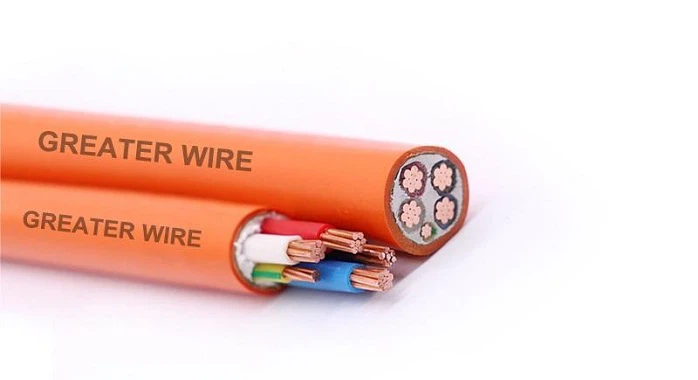
Applications of Orange Cables in Utilities
Orange cables are widely used not only in industrial and construction projects but also in public utilities. Below is a summary of typical applications:
| Utility Type | Application | Orange Cable Type | Why Use It |
|---|---|---|---|
| Power Distribution | Commercial buildings, schools, factories | Medium Voltage / TPS Cable | High safety, high voltage resistance, durability |
| Industrial Equipment | Production lines, VFDs, machinery | VSD / Elastomer / Heavy Duty | Flexible, wear-resistant, interference-resistant |
| Fire Safety | Fire circuits, emergency power | Fire Rated / Building Cable | Maintains power during fire, ensures safety |
| Communication & Control | Building automation, railways, signaling | SDL / Instrumentation Cable | Stable, interference-resistant signals |
| Mining & Heavy Industry | Mining power and lighting | Mining Cable / Rubber Cable | Water-, corrosion-, and wear-resistant |
Case Examples:
1.Airport Projects: Runway lighting and emergency power use SWA Cable + Fire Rated Cable, ensuring continuous power in fire or extreme weather.
2.University Campuses: Laboratories and teaching buildings use Instrumentation Cable + VSD Cable, ensuring equipment and signal stability.
3.Mining Applications: Rubber and Mining Cables withstand heavy mechanical stress and harsh conditions, water- and corrosion-resistant.
4.Commercial Buildings: TPS Cable for main distribution, Fire Rated Cable for emergency lines, ensuring safety and reliability.
These examples help non-professionals visualize where orange cables are used and why they matter.
How to Choose the Right Orange Cable
Even without technical knowledge, consumers can follow these steps:
Step 1: Identify Your Application
- Indoor home or office → TPS Cable, Orange Circular Cable
- Outdoor overhead → Aerial Cable
- Industrial machinery with frequent bending → Elastomer Cable, VSD Cable
- Fire protection or emergency power → Fire Rated Cable
- Mining or heavy-duty environments → Mining Cable, Heavy Duty Cable
Step 2: Select Cross-Section Based on Current Load
| Current Load (A) | Recommended Cable | Use Case |
|---|---|---|
| ≤15A | 1.5mm² - 2.5mm² Orange Circular Cable | Indoor lighting, light-load circuits |
| 16-30A | 4mm² - 6mm² TPS / VSD Cable | Office equipment, medium-load devices |
| 31-50A | 10mm² - 16mm² Medium Voltage / SWA Cable | Factories, commercial distribution |
| ≥50A | 25mm²+ Heavy Duty / Mining Cable | Industrial, mining, large infrastructure |
Step 3: Consider Environment & Flexibility
- Indoor → flexible, easy-to-install TPS Cable
- Outdoor/overhead → water- and UV-resistant Aerial Cable
- High temperature/fire risk → Fire Rated Cable
- Frequent bending → Elastomer / VSD Cable
Step 4: Ensure Certification & Standards
- Use SAA-certified cables that comply with Australian, New Zealand, and Oceania standards.

Choose Dongguan Greater Wire & Cable
- Wide Range of Types and Sizes: From 1.5mm² to industrial-grade large sizes for home, commercial, industrial, and mining projects.
- Certified and Standard-Compliant: All products SAA-certified, suitable for Oceania market.
- Rich Project Experience: Served airports, universities, railways, mines, and commercial buildings.
- Fast Delivery & Flexible Supply: Orders from small to bulk can be quickly fulfilled.
- Professional Support & Customization: Pre-sales, in-sales, and after-sales technical support. Customizable material, size, length, color, performance, labeling, and packaging.
Even if you know nothing about cables, our professional guidance ensures a safe and successful project.
Connect with Us
No matter the project size, we provide professional technical support and attentive service to ensure your electrical system is safe and reliable.
Contact Us:
- Tel / WhatsApp / WeChat: +86 135 1078 4550 / +86 136 6257 9592
- Email: manager01@greaterwire.com
- Company: Dongguan Greater Wire & Cable Co., Ltd.
Choosing us means choosing safety, reliability, and professionalism for your cable solutions.