























When you're wiring an industrial facility or an outdoor power distribution system, the cable has to do more than just carry current. It has to survive vibration, temperature swings, moisture, UV exposure, and the occasional bump from a forklift or a dropped tool. If the cable fails, the circuit fails. And in a demanding site, a failed circuit means production stops, safety systems go offline, or expensive equipment gets damaged.
That's why we sell PVC armored MC cable – not as a fancy upgrade, but as a baseline for reliable circuit protection. Here's what that actually means on the job.
1. What "Reliable Circuit Protection" Means in Industrial & Outdoor Sites
Let's be direct. In a clean, dry warehouse, almost any cable works for a while. But in a U.S. industrial facility – think auto plants, chemical blending lines, recycling centers – or an outdoor power distribution system – rooftop feeders, pad-mounted transformers, irrigation controls – the rules change.
The risks are real:
- Mechanical stress – Cables run along vibrating equipment, get stepped on, or rub against steel supports.
- Moisture and condensation – Outdoor enclosures aren't always sealed. Morning dew, rain, or washdowns find their way in.
- UV degradation – Sunlight turns ordinary PVC or nylon insulation brittle in a year or two.
- Temperature swings – From summer heat to winter freeze, materials expand and contract.
A cable that fails any of these tests is not providing reliable circuit protection. It's a liability. PVC armored MC cable is engineered to handle all four.
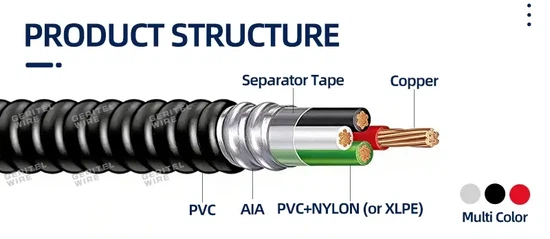
2.How the Three Layers Work Together (PVC Jacket + Armor + Insulated Conductors)
You can think of this cable as three concentric shields, each doing a specific job.
- Layer 1 – PVC outer jacket
This is the first line of defense. It's formulated to resist UV, oil, dilute chemicals, and moisture. It also adds abrasion resistance – when the cable rubs against a concrete edge or a steel tray, the jacket takes the wear, not the armor underneath.
- Layer 2 – Interlocked armor (aluminum or galvanized steel)
The armor provides mechanical strength. It resists crushing, pulling forces, and impact. If a ladder falls on the cable or a cart rolls over it, the armor protects the conductors inside. Aluminum armor is lighter and corrosion-resistant; steel armor is stronger and better for high-impact zones.
- Layer 3 – Insulated conductors (THHN/THWN-2 or XHHW-2)
These are the actual current-carrying wires. THHN/THWN-2 is rated for 90°C dry and 90°C wet – perfect for most outdoor and industrial conditions. XHHW-2 offers even better heat and chemical resistance. Both are 600V rated.
When all three layers work together, the circuit stays protected. No short circuits from crushed insulation. No ground faults from moisture wicking into the armor. No callbacks.
3.Matching the Right Spec to Your Demanding Site
Not every demanding site needs the same cable. Here's how we match common configurations to real jobs.
- 20A lighting or control circuits in a mildly harsh industrial building
Use 12/4 THHN/THWN-2 PVC jacketed MC cable. Four conductors give you either 3-phase + ground or two circuits in one cable. Lightweight, flexible, and the PVC jacket handles dust and humidity.
- 50A feeder to a rooftop HVAC unit or outdoor panel
Use 8/3 aluminum armor MC cable PVC jacket. Aluminum keeps the weight manageable for overhead runs. The PVC jacket protects against UV and rain. The third conductor gives you 120/240V single-phase or 208V three-phase.
- Large feeder in a high-impact area (forklift traffic, heavy vibration)
Use 2 AWG 4/C XHHW-2 MC cable with ground PVC jacket. Steel armor (galvanized) is recommended here. XHHW-2 insulation resists heat and chemicals better than THHN. The 4/C configuration handles three-phase loads with a neutral.
- For outdoor runs with constant moisture or chemical exposure
Choose XHHW-2 MC cable wet locations PVC jacket – the insulation is specifically rated for wet environments, and the PVC jacket adds an extra moisture barrier.
If you're not sure which spec fits your site, send us a quick description. We've seen enough industrial and outdoor jobs to point you in the right direction.

FAQ – Circuit Protection for Demanding Sites
Q: Does the PVC jacket make the cable waterproof?
No – it's water-resistant, not waterproof. For outdoor exposure (rain, snow, condensation), it's fine. For direct burial or submersion, you need a different rating.
Q: Aluminum armor or steel armor – which is better for circuit protection?
Aluminum is lighter and naturally corrosion-resistant. Steel is stronger and better for high-impact areas. For most industrial facilities, aluminum is sufficient. For sites with heavy machinery or vehicle traffic, choose steel.
Q: What's the difference between THHN/THWN-2 and XHHW-2 for reliability?
XHHW-2 has better heat and chemical resistance. If your site has high ambient temperatures (e.g., near ovens, motors) or exposure to oils/solvents, spend the extra for XHHW-2. For general outdoor and industrial use, THHN/THWN-2 is fine.
Q: Can I use this cable for temporary power on a construction site?
Yes, but temporary installations still need proper mechanical protection. The PVC jacket and armor help, but don't run it where heavy equipment will drive over it repeatedly.
Get a Quote for Your Next Project
We've supplied PVC armored MC cable for hundreds of industrial facilities and outdoor power systems across the U.S. Our cable carries UL1569 certification (Certificate No. E544860) – that's the standard for metal-clad cable construction. We can provide the certificate and file number on request.
Tell us your voltage, conductor count, and a little about the site – indoor/outdoor, risk of impact, exposure to moisture or chemicals. We'll recommend a spec that balances protection and cost.

Contact Us
Dongguan Greater Wire & Cable Co., Ltd.
Tel/WhatsApp/Wechat: +86 136 6257 9592
Tel/WhatsApp/Wechat: +86 135 1078 4550
Email: manager01@greaterwire.com
Website: www.greaterwire.com