

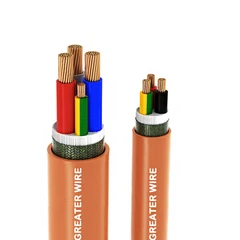
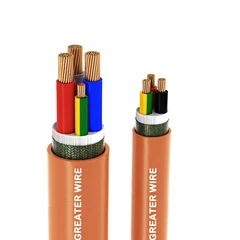

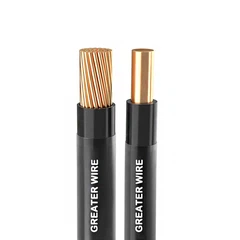
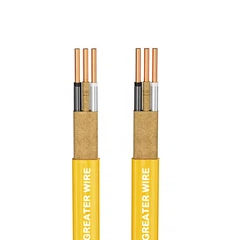

Not all MC cable armor is the same. Aluminum interlocked armor (AIA) is lightweight and flexible. But when your project demands maximum mechanical strength – think heavy impact, crushing loads, or direct burial – galvanized steel armor is the right choice.
This article answers the title question: Where does PVC jacketed MC cable with galvanized steel armor perform best? We'll compare steel vs aluminum vs no armor, list common XHHW-2 specifications, and give you real use cases.
1.What Is Galvanized Steel Armor?
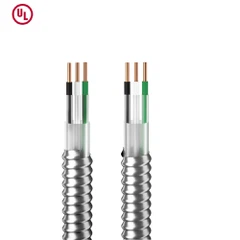
Galvanized steel armor is a continuous spiral of zinc-coated steel wrapped over the insulated conductors, then covered by a PVC jacket. The zinc coating prevents rust.
Key traits of steel armor:
- Superior impact and crush resistance – handles dropped tools, forklifts, and concrete debris.
- High tensile strength – can be pulled longer distances without stress on conductors.
- Durable – galvanized coating resists corrosion in most environments (except extreme acidic/alkaline).
- Heavier and stiffer than aluminum – but that's the trade‑off for strength.
Compared to aluminum interlocked armor (AIA):
- Steel is approximately 30–40% heavier.
- Steel is less flexible – needs larger bending radius.
- Steel may cost less in raw material but can cost more to install (slower, more labor).
Compared to no armor:
- No armor requires conduit in exposed locations. Steel armor does not – it's code‑approved for exposed runs.
2.Where Does Galvanized Steel Armor Perform Best?
Based on its strengths, here are the best applications:
Industrial facilities (factories, warehouses, manufacturing plants)
Heavy equipment, forklifts, and constant vibration. Steel armor protects against accidental impacts that would crush aluminum or damage unarmored cable.
Direct burial (where code permits)
Steel armor provides extra crush resistance against soil and rocks. (Note: Direct burial rating depends on the PVC jacket as well – check datasheet. We do not claim direct burial without verification.)
Underground feeder ducts
Pulling cables through ducts with bends creates high tension. Steel's tensile strength allows longer pulls without damaging conductors.
High‑traffic areas
Loading docks, maintenance corridors, or anywhere heavy loads roll over cable trays or exposed runs.
Harsh outdoor environments (with UV‑resistant PVC jacket)
Galvanized steel resists rust better than bare steel. Combined with a PVC jacket, it survives rain, snow, and humidity.
Where aluminum is not suitable
Aluminum armor can react with alkaline concrete or certain soils (galvanic corrosion). Steel with PVC jacket avoids that.
Bottom line: Choose galvanized steel armor when mechanical abuse is the concern – impact, crush, pull tension, or direct burial (pending rating). Choose aluminum when weight and flexibility matter more.
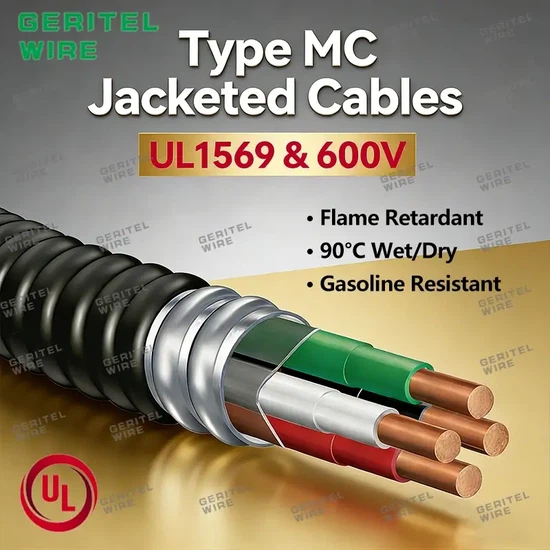
3.Common Specifications (XHHW-2 Insulation)
For galvanized steel armored MC cable, XHHW-2 is a preferred insulation because of its 90°C wet/dry rating and chemical resistance – ideal for harsh industrial and outdoor environments. Below are three common sizes with typical ampacity values (copper conductors, 90°C, free air). Actual ratings depend on installation conditions – see note after the table.
| Specification | Conductor Size (Copper) | Typical Ampacity (90°C) | Typical Best Use |
|---|---|---|---|
| 10/4 XHHW-2 galvanized steel armor PVC jacket | 10 AWG (4/C) | approximately 30A | Control circuits, small pumps, branch feeders in factories |
| 6/4 XHHW-2 galvanized steel armor PVC jacket | 6 AWG (4/C) | approximately 75–85A | Feeder to industrial control panels, moderate motor loads (15‑20HP) |
| 2/4 XHHW-2 galvanized steel armor PVC jacket | 2 AWG (4/C) | approximately 130–145A | Main feeder from transformer to distribution panel in heavy industrial plants |
Note on ampacity: All values above are typical estimates for copper conductors with 90°C insulation (XHHW-2) under standard conditions. Actual ampacity varies with ambient temperature, bundling, and installation method. For official ratings based on our UL 1569 certification (Certificate No. E544860), please contact us for the specific data sheet of each cable model.
THHN/THWN-2 is also available for dry locations, but XHHW-2 is recommended for wet or harsh environments.
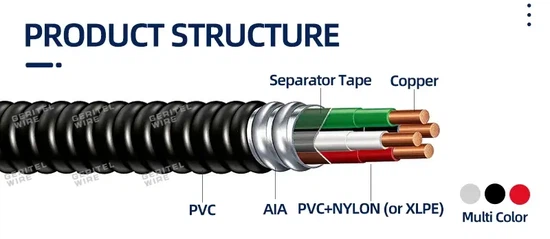
4.Two Customer Pain Points – Solved by Steel Armor
- Wall penetration and routing – Steel armor is stiffer than aluminum, so it's harder to bend around tight corners. However, for straight runs or gentle bends, it works fine. Where steel shines is resisting damage when workers accidentally hit the cable with hammers or drill through walls. Aluminum might dent and pinch insulation; steel shrugs it off.
- Mechanical damage protection – A dropped steel beam or a loaded pallet rolling over exposed cable will crush aluminum armor. Steel armor passes higher impact and crush tests (UL 1569). If your job site is rough, steel saves you from costly replacements.
5.Steel vs Aluminum vs No Armor – Quick Reference
| Feature | Galvanized Steel Armor | Aluminum Interlocked Armor | No Armor (PVC only) |
|---|---|---|---|
| Impact/crush resistance | ★★★★★ (best) | ★★★★ (good) | ★ (needs conduit) |
| Weight | Heavy | Light (approx. 30% less) | Lightest |
| Flexibility | Low | High (bends like a hose) | High |
| Corrosion resistance | Good (galvanized) | Excellent (aluminum) | Depends on jacket |
| Tensile strength | High | Moderate | Low |
| Installation labor | More (harder to bend) | Less (easy to route) | Depends on conduit |
| Best for | Industrial, direct burial, high‑traffic | Wastewater, outdoors, commercial | Indoor dry conduit |
Direct burial suitability requires additional jacket rating – verify with manufacturer.
6.What About Direct Burial and UL Certification?
We do not claim direct burial suitability without explicit datasheet verification. Some galvanized steel MC cables with special PVC jackets are rated for direct burial – ask us for the specific UL file.
All our galvanized steel armored MC cables are built under UL 1569 certification (Certificate No. E544860, issued 2024‑11‑21) – meaning they have passed impact, crush, temperature, and voltage tests required by UL. When you see our UL mark, your inspector will recognize it.

FAQ
Q1: Does galvanized steel armor rust outdoors?
The zinc coating resists rust for many years. With a PVC jacket (UV‑resistant), it's very durable outdoors. However, in constant salt spray or acidic environments, aluminum or stainless steel may be better.
Q2: Can I bend steel armor MC cable by hand?
For smaller sizes (10 AWG, 8 AWG), yes – with some effort. For larger sizes (2 AWG and up), use a bending tool or lever. Aluminum is much easier to bend.
Q3: Is steel armor more expensive than aluminum?
Raw material cost is usually lower for steel. But total installed cost can be higher because labor takes longer. For projects where mechanical strength is critical, the extra labor is worth it.
Q4: Do I need a separate ground wire?
Yes – NEC requires an equipment grounding conductor. Our 4/C steel armored cables include a full‑size insulated green/yellow ground. Do not rely on the armor alone.
Need galvanized steel armor for a tough industrial project?
If your job involves heavy impact, direct burial (pending rating), or long pulls through underground ducts, steel armor is your answer. Tell us your conductor size (10, 6, or 2 AWG), insulation (XHHW-2 recommended), and installation environment. We supply UL 1569 certified PVC jacketed MC cable with galvanized steel armor – Certificate No. E544860 – backed by real compliance.
Contact Us
Dongguan Greater Wire & Cable Co., Ltd.
Tel/WhatsApp/Wechat: +86 136 6257 9592
Tel/WhatsApp/Wechat: +86 135 1078 4550
Email: manager01@greaterwire.com
Website: www.greaterwire.com