



AC90 vs. AC90-HL: What's the Difference? A Complete Canadian Armoured Cable Selection Guide
Understanding CSA Certification, Hazardous Location Requirements, Cable Construction, Flame Performance and Industrial Applications
When selecting armoured cables for Canadian electrical installations, engineers and procurement professionals frequently encounter two similar product designations: AC90 and AC90-HL.
Although these cable types share many electrical and construction characteristics, an important difference lies in their certification and intended applications.
AC90 is an established armoured wiring solution for suitable dry-location electrical installations. AC90-HL extends this cable family into applications requiring additional hazardous-location certification.
For commercial construction, industrial facilities, energy infrastructure, and specialized engineering projects, understanding this distinction is essential.
GERITEL WIRE, the cable manufacturing brand of Dongguan Greater Wire & Cable Co.,Ltd., holds CSA certification for both AC90 and AC90-HL under Certificate of Compliance No. 80322923.
This guide explains their technical differences, applicable standards, construction features, certified ratings, installation considerations, and practical selection criteria.
1. What Is AC90 Cable?
AC90 is a Canadian armoured cable type used in suitable dry-location electrical installations.
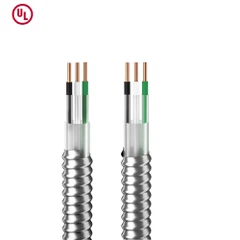
Its characteristic construction consists of insulated conductors enclosed in interlocked metallic armour without an overall nonmetallic outer jacket.
GERITEL WIRE's CSA-certified AC90 construction incorporates:
Copper or aluminum conductors
Cross-linked polyethylene (XLPE) insulation
Cable assembly materials as required by the design
Interlocked aluminum armour
The metallic armour provides mechanical protection and forms an integral part of the cable's approved construction.
AC90 is particularly relevant to electrical distribution in commercial buildings, residential developments, electrical service rooms, warehouses, and suitable dry industrial installations.
The absence of an outer PVC jacket is an important feature.
Where a dry-location armoured wiring method is permitted, the relatively straightforward construction of AC90 may provide an efficient solution without the additional jacket layers associated with other armoured cable types.
However, exposed interlocked armour does not make the cable waterproof.
GERITEL WIRE's AC90 certification specifies 90°C dry-location operation.
It should therefore not be selected for wet or underground installations simply because it contains metallic armour.
2. What Is AC90-HL Cable?
AC90-HL is a hazardous-location-certified version of the AC90 armoured cable family.
The designation HL means Hazardous Locations.
The distinction is especially relevant to industrial facilities containing classified areas where flammable gases, vapours, or other hazardous substances may be present.
Canadian electrical regulations impose particular requirements on wiring methods used in such environments.
AC90-HL must satisfy the applicable basic armoured cable requirements together with additional hazardous-location certification requirements.
GERITEL WIRE's AC90-HL is certified under:
CSA C22.2 No. 51 - Armoured Cables
CSA C22.2 No. 174 - Cables and Cable Glands for Use in Hazardous Locations
The product is listed under CSA Certification Class 5818 01 - Armoured Cables for Hazardous Locations.
This represents a significant distinction from ordinary AC90, which is listed under CSA Certification Class 5811 01.
The HL designation provides evidence of additional evaluation for hazardous-location applications.
It does not, however, mean that the cable may be installed in every classified area without further assessment.
Actual installation suitability depends on the applicable Canadian Electrical Code, area classification, approved wiring method, and associated termination equipment.
3. AC90 vs. AC90-HL: Detailed Technical Comparison
The following comparison reflects GERITEL WIRE's CSA certification.
| Technical Feature | AC90 | AC90-HL |
|---|---|---|
| CSA product standard | C22.2 No. 51 | C22.2 No. 51 |
| Additional hazardous-location standard | Not listed | C22.2 No. 174 |
| Certification class | 5811 01 | 5818 01 |
| Rated voltage | 600/1000/2000V | 600/1000/2000V |
| Maximum conductor temperature | 90°C | 90°C |
| Rated environment | Dry | Dry |
| Standard cold classification | -25°C | -25°C |
| Optional cold classification | -40°C | -40°C |
| Conductor materials | Copper / aluminum | Copper / aluminum |
| Insulation material | XLPE | XLPE |
| Armour | Interlocked aluminum | Interlocked aluminum |
| Overall PVC jacket | No | No |
| Flame rating | Optional FT4-ST1 | FT4-ST1 |
| Single/multiconductor construction | Yes | Yes |
| Additional HL evaluation | No | Yes |
| Main application | Suitable ordinary dry locations | Suitable classified dry locations requiring HL-rated wiring |
An essential point is that AC90-HL does not have a higher certified voltage or conductor operating temperature than AC90.
Both products cover 600V, 1000V, and 2000V, with a 90°C dry-location rating.
The central differentiation is the additional hazardous-location certification.
4. Why Is Hazardous-Location Certification Important?
The possibility of ignition is a major concern in classified industrial environments.
A potentially hazardous atmosphere may exist in certain parts of petroleum processing facilities, chemical plants, industrial manufacturing operations, and other facilities involving flammable substances.
In such environments, an electrical installation must be designed to reduce the risk of ignition.
The cable is only one part of that electrical system, but its mechanical integrity, construction, and certified characteristics can be particularly important.
CSA C22.2 No. 174 introduces additional requirements for hazardous-location cables beyond the basic requirements of their ordinary-location product standards.
The standard addresses performance considerations relevant to the increased risks associated with classified environments.
Industry technical literature identifies supplemental evaluations involving characteristics such as mechanical crushing, low-temperature impact, flame performance, and the integrity of interlocked-armour constructions under specified mechanical conditions.
These requirements provide an additional level of safety evaluation.
They should not be interpreted as proof that the cable is completely crush-proof, explosion-proof, or immune to mechanical damage.
A cable may have an AC90-style construction without qualifying for AC90-HL certification.
That distinction is particularly important when comparing different suppliers.
5. Are AC90 and AC90-HL Built Differently?
Not necessarily in every visible respect.
Both GERITEL WIRE cable families use XLPE insulation and interlocked aluminum armour without an overall PVC jacket.
The certifications do not establish that AC90-HL must have thicker insulation, a different conductor alloy, or a higher voltage rating simply because it carries the HL designation.
In fact, the two cable families share several fundamental ratings.
However, their certified conductor size ranges are not identical.
GERITEL WIRE AC90 Conductor Coverage
| Construction | Certified Range |
|---|---|
| Solid copper | 14 AWG–2 AWG |
| Stranded copper | 14 AWG–2000 kcmil |
| Solid aluminum | 6 AWG–2 AWG |
| Stranded aluminum | 12 AWG–2000 kcmil |
GERITEL WIRE AC90-HL Conductor Coverage
| Construction | Certified Range |
|---|---|
| Solid copper | 6 AWG–2 AWG |
| Solid aluminum | 6 AWG–2 AWG |
| Stranded copper | 6 AWG–2000 kcmil |
| Stranded aluminum | 6 AWG–2000 kcmil |
For single-conductor constructions, the certification also specifies minimum circuit conductor sizes of 6 AWG copper and 4 AWG aluminum.
These differences are important.
For example, a smaller 12 AWG copper construction may fall within the ordinary AC90 listing but not within GERITEL WIRE's AC90-HL conductor range.
Customers should never assume that every ordinary AC90 size has an equivalent AC90-HL version under the same certificate.
The requested conductor size, material, and construction must be checked against the certified scope.
6. Understanding FT4-ST1 Flame Performance
Fire performance is another important selection consideration.
GERITEL WIRE's ordinary AC90 certification lists FT4-ST1 as an optional rating.
The AC90-HL listing specifies FT4-ST1.
FT4 relates to flame-spread performance under the applicable vertical cable test.
ST1 addresses limited smoke generation under the applicable test requirements.
Together, these classifications indicate that the certified construction has been evaluated against particular flame and smoke performance criteria.
This can be relevant to engineers who must consider fire-related requirements within electrical installations.
However, FT4-ST1 does not automatically establish:
Zero-halogen material composition
Circuit integrity during fire
Fire-resistant cable classification
Compliance with every building smoke-control requirement
These properties must be evaluated separately.
For ordinary AC90, FT4-ST1 should be specified explicitly if required.
For AC90-HL, procurement teams should verify that the delivered product corresponds to the listed HL construction and carries the appropriate markings.
7. Where Is Ordinary AC90 the Better Choice?
Ordinary AC90 is often a suitable choice where the installation is dry and does not require additional hazardous-location certification.
Typical projects include:
Commercial Office Buildings
Indoor distribution circuits, electrical service areas, and suitable branch wiring systems.
Residential and Apartment Developments
Electrical wiring within dry building interiors, where the applicable installation rules permit AC90.
Warehouses and Distribution Centres
Fixed electrical circuits in ordinary dry-location areas.
Educational and Institutional Buildings
Suitable indoor electrical distribution applications where the specified armoured wiring method is permitted.
Industrial Buildings Outside Classified Areas
Indoor power distribution in non-classified areas where dry-location wiring is appropriate.
For these installations, choosing AC90 instead of AC90-HL may provide a commercially efficient solution when the additional HL certification is unnecessary.
The project specification and applicable electrical code remain the deciding factors.
8. When Should AC90-HL Be Considered?
AC90-HL becomes relevant when the electrical project requires an HL-certified armoured cable and the installation environment is compatible with its dry-location rating.
Potential project sectors include:
Oil and Gas Processing Facilities
Selected dry indoor electrical installations in appropriately classified areas of petroleum-related facilities.
Chemical Manufacturing Plants
Power distribution systems serving equipment in classified indoor environments.
Industrial Processing Facilities
Dry-location electrical installations where the area classification and installation rules require hazardous-location-approved wiring.
Specialized Energy Facilities
Fixed electrical installations involving classified industrial equipment areas.
Industrial Plant Expansion and Modernization
Replacement or new electrical circuits where approved engineering documents specify an HL-rated armoured cable.
The project type alone does not establish that every electrical circuit needs AC90-HL.
A petroleum facility, for example, may contain both classified and non-classified areas.
The wiring method must be selected according to the classification of the actual installation location.
Likewise, AC90-HL's dry-location rating remains in effect.
It should not be selected for wet outdoor installations simply because it has HL certification.
9. Can Ordinary AC90 Be Used in a Hazardous Location?
This question cannot be answered solely from the words "ordinary AC90."
Canadian Electrical Code requirements differ according to the hazardous-area classification, wiring method, and applicable provincial rules.
Some lower-risk classified installations may permit particular wiring methods under specified conditions.
However, an ordinary AC90 listing does not establish the additional hazardous-location approval represented by the AC90-HL certification.
Where an approved engineering specification requires AC90-HL, ordinary AC90 must not be substituted without a properly documented engineering and code review.
AC90-HL should be selected when the project requires the corresponding hazardous-location certification-not merely because the installation is part of an industrial facility.
10. AC90-HL Cable Glands, Sealing and Bonding
The certification of the cable does not automatically certify the complete installed electrical system.
Hazardous-location cable installations may require particular glands, fittings, sealing arrangements, and bonding methods.
The appropriate hardware depends on:
Cable type and outside diameter
Interlocked-armour construction
Hazardous-area classification
Equipment enclosure protection method
Environmental exposure
Applicable sealing requirements
Electrical grounding and bonding rules
An approved cable gland must be compatible with the cable construction and the equipment being connected.
Where a hazardous-location sealing gland is required, an ordinary AC90 connector should not be assumed acceptable.
Similarly, armour bonding and the sizing of bonding conductors must be addressed under the applicable installation rules.
Project engineers should confirm the relevant Canadian Electrical Code edition and local authority requirements.
11. AC90 or AC90-HL: Practical Project Selection
| Project Situation | Recommended Starting Point | Reason |
|---|---|---|
| Dry commercial building | AC90 | Ordinary dry-location wiring |
| Indoor residential distribution | AC90 | HL certification generally unnecessary |
| Dry industrial electrical room, non-classified | AC90 | Ordinary wiring method may be sufficient |
| Dry classified process area requiring HL cable | AC90-HL | Additional hazardous-location certification |
| Wet industrial installation | Neither as a default | Both GERITEL WIRE models are dry-rated |
| Outdoor hazardous-location feeder | Consider ACWU90-HL or TECK90-HL | Wet/outdoor requirements must also be addressed |
| Specification expressly requires FT4-ST1 | Verify AC90 option or AC90-HL construction | Confirm exact certified flame rating |
| 2000V dry-location HL requirement | AC90-HL may be considered | Certified voltage includes 2000V |
A Practical Selection Rule
Choose AC90 when the project requires an approved armoured cable for an ordinary dry-location installation.
Choose AC90-HL when the project additionally requires hazardous-location certification and the certified dry-location construction is appropriate.
12. Does AC90-HL Cost More Than AC90?
Hazardous-location-certified products may carry different manufacturing, certification, testing, and production-control costs.
However, a reliable price comparison requires matching the exact conductor size, number of conductors, conductor material, cable construction, quantity, and commercial conditions.
The HL designation alone is not sufficient to calculate a price premium.
For procurement teams, the more important question is whether the product satisfies the project's compliance requirements.
Choosing ordinary AC90 where AC90-HL is required could create costly replacement or inspection problems.
Conversely, purchasing an HL-certified product for an application where ordinary AC90 is fully suitable may introduce unnecessary cost.
The objective should be engineering compliance and total installed value, rather than selecting the highest-rated cable for every application.
13. Why Choose GERITEL WIRE?
GERITEL WIRE offers Canadian customers a valuable combination of independently verifiable certification coverage and professional cable manufacturing capability.
Our advantages include:
CSA-Certified AC90 and AC90-HL
Both families are included in CSA Certificate No. 80322923.
Certified 600V, 1000V and 2000V Options
The certification covers multiple voltage classes for both product families.
Copper and Aluminum Constructions
Customers can evaluate different conductor materials within the applicable certified ranges.
Professional Cable Manufacturing Infrastructure
GERITEL WIRE operates a manufacturing facility of approximately 30,000 square metres with around 30 production lines, dedicated engineering personnel, quality-control teams, and in-house testing resources.
Extensive Canadian Armoured Cable Coverage
Our certification also covers ACWU90, ACWU90-HL, TECK90 and TECK90-HL, supporting broader project requirements.
Technical and Project Support
We work with importers, distributors, electrical contractors, EPC companies, and industrial procurement teams to review technical specifications and coordinate production requirements.
For customers seeking a manufacturer capable of supplying both conventional and hazardous-location-certified Canadian cables, GERITEL WIRE provides a strong alternative.
14. Frequently Asked Questions
Q: Is AC90-HL rated for a higher voltage than AC90?
No. GERITEL WIRE's certification covers 600V, 1000V and 2000V for both families.
Q: Can AC90-HL be used outdoors?
Its listed rating is 90°C dry. The HL designation does not add wet-location approval.
Q: Is AC90-HL inherently explosion-proof?
No. HL certification does not mean the cable alone forms an explosion-proof installation. The complete wiring method and equipment connections must meet applicable requirements.
Q: Is AC90-HL certified to CSA C22.2 No. 174?
Yes. GERITEL WIRE's certificate includes AC90-HL under the hazardous-location armoured cable category.
Q: Does GERITEL WIRE offer aluminum AC90-HL?
Yes. Copper and aluminum conductor options are included, subject to the certified construction and size limitations.
Q: Can ordinary AC90 replace AC90-HL?
Only when the applicable electrical code, engineering specification, and approved installation method permit the proposed ordinary cable. They are not automatically interchangeable.
15. Request CSA-Certified AC90 or AC90-HL from GERITEL WIRE
Whether your project requires conventional indoor armoured wiring or a specialized HL-certified construction, GERITEL WIRE can assist with product selection and manufacturing inquiries.
Please provide the cable type, voltage, conductor material, conductor size, number of conductors, required flame rating, installation environment, total quantity, and delivery destination.
For hazardous-location projects, please also provide the area classification and applicable engineering specifications.
Our team can review the requested construction against our CSA certification scope and prepare a suitable quotation.
GERITEL WIRE - Certified Quality. Specialized Engineering. Trusted Manufacturing for Canadian Electrical Projects.
Manufacturer: Dongguan Greater Wire & Cable Co.,Ltd.
TEL/WHATSAPP/WECHAT:+86 135 1078 4550
TEL/WHATSAPP/WECHAT:+86 136 6257 9592
Brand: GERITEL WIRE
CSA Certificate: 80322923
Products: AC90 / AC90-HL
Standards: CSA C22.2 No. 51 / CSA C22.2 No. 174
Final product suitability is subject to the exact certified configuration, applicable installation rules, project engineering requirements, and approval by the authority having jurisdiction.