

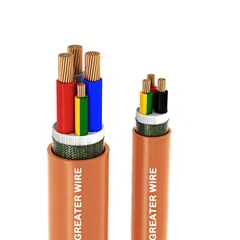
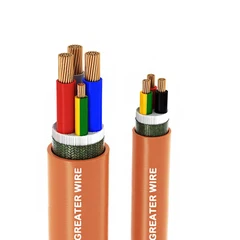

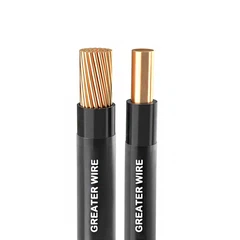
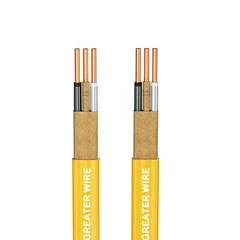

Understand the Differences in Construction, Voltage Ratings, Environmental Performance, Applications, and CSA Certification - Expert Guidance from GERITEL WIRE
Choosing the correct armoured electrical cable is one of the most important decisions in electrical system design and industrial project procurement.
In Canada's electrical industry, AC90, ACWU90, and TECK90 are three widely recognized armoured cable types. They are used in commercial buildings, residential developments, industrial facilities, mining operations, electrical infrastructure, and energy projects.
Although these cables share certain construction features, they are not interchangeable in every installation.
Their differences extend beyond the presence or absence of an outer jacket. Cable construction, moisture resistance, flame ratings, voltage classifications, installation environments, mechanical protection, and hazardous-location certification can all influence which product is most appropriate.
Selecting the wrong cable may result in installation restrictions, additional engineering work, unexpected material costs, or rejection during electrical inspection.
As a professional Canadian-standard cable manufacturer, GERITEL WIRE, the manufacturing brand of Dongguan Greater Wire & Cable Co.,Ltd., provides CSA-certified AC90, ACWU90, and TECK90 cables, including corresponding AC90-HL, ACWU90-HL, and TECK90-HL hazardous-location versions.
Our CSA Certificate of Compliance No. 80322923, issued October 27, 2026, covers all six product families.
This guide explains the technical differences between AC90, ACWU90, and TECK90 and provides practical selection advice for engineers, electrical contractors, EPC companies, distributors, and industrial procurement professionals.
1. What Are AC90, ACWU90, and TECK90 Cables?
AC90, ACWU90, and TECK90 are Canadian armoured electrical cable designations.
All three can incorporate insulated copper or aluminum conductors protected by interlocked metallic armour, but they use different cable constructions and have different environmental ratings.
AC90 - Armoured Cable for Dry Locations
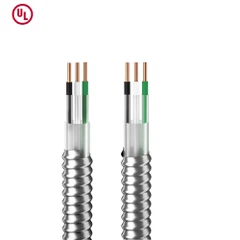
AC90 is a metallic-armoured cable typically used for indoor electrical distribution in dry environments.
Its characteristic construction consists of XLPE-insulated conductors enclosed in interlocked aluminum armour without an overall PVC outer jacket.
AC90 is commonly selected for commercial buildings, apartment complexes, indoor electrical installations, and dry-location industrial wiring.
Its relatively straightforward construction makes it an attractive option when mechanical protection is required but environmental exposure is limited.
ACWU90 - Jacketed Armoured Cable for Wet and Outdoor Locations
ACWU90 is an armoured cable with an overall protective jacket, typically PVC, covering the interlocked aluminum armour.
Unlike AC90, ACWU90 is designed for both dry and wet locations.
Its jacketed construction makes it particularly suitable for outdoor electrical distribution, underground feeders, certain concrete-encased installations, and other applications requiring additional protection against environmental exposure.
ACWU90 is frequently specified for commercial and industrial electrical projects involving larger power feeders and outdoor distribution networks.
TECK90 - Industrial Armoured Power Cable
TECK90 is an industrial armoured cable family designed for a wide variety of electrical power and control applications.
A defining construction feature is the PVC inner jacket beneath the metallic armour.
A conventional jacketed TECK90 cable typically contains XLPE-insulated conductors, an inner PVC jacket, interlocked aluminum armour, and an outer PVC jacket.
This layered construction makes TECK90 especially relevant to industrial electrical systems, process facilities, machinery power distribution, industrial cable trays, and demanding infrastructure projects.
The appropriate configuration depends on its certified construction, intended installation environment, and project specifications.
The key distinction: AC90 has no overall jacket, ACWU90 adds an outer jacket over the armour, and TECK90 incorporates an inner jacket beneath the armour, with an outer jacket available according to its certified construction.
2. AC90 vs. ACWU90 vs. TECK90: Complete Technical Comparison
The following table summarizes the three product families based on GERITEL WIRE's CSA Certificate No. 80322923.
| Technical Parameter | AC90 | ACWU90 | TECK90 |
|---|---|---|---|
| Canadian product standard | CSA C22.2 No. 51 | CSA C22.2 No. 51 | CSA C22.2 No. 131 |
| CSA certification class | 5811 01 | 5811 01 | 5811 01 |
| Certified voltage | 600V / 1000V / 2000V | 600V / 1000V / 2000V | 600V / 1000V |
| Maximum conductor temperature | 90°C | 90°C | 90°C |
| Temperature environment | Dry | Dry or wet | Dry or wet |
| Standard low-temperature classification | -25°C | -25°C | -25°C |
| Optional low-temperature classification | -40°C | -40°C | -40°C |
| Copper conductor | Yes | Yes | Yes |
| Aluminum conductor | Yes | Yes | Yes |
| Insulation material | XLPE | XLPE | XLPE |
| Metallic armour | Interlocked aluminum | Interlocked aluminum | Interlocked aluminum |
| PVC inner jacket | No | No | Yes |
| PVC outer jacket | No | Yes | Optional |
| Flame rating | Optional FT4-ST1 | FT4 | FT1; optional FT4 |
| Sunlight-resistant marking | Not listed | Included | Optional |
| Single-conductor construction | Certified | Certified | Certified |
| Multiconductor construction | Certified | Certified | Certified |
| Corresponding HL product | AC90-HL | ACWU90-HL | TECK90-HL |
| Principal selection advantage | Dry indoor armoured wiring | Wet/outdoor armoured wiring | Layered industrial cable construction |
Important: This table represents GERITEL WIRE's certified product families. Other manufacturers may offer different constructions, ratings, and optional features. Final product eligibility depends on the specific ordered configuration and certification record.
One particularly important point is that GERITEL WIRE's AC90 and ACWU90 certifications extend to 2000V, whereas its current TECK90 certification covers 600V and 1000V.
Therefore, TECK90 should not automatically be regarded as having a higher voltage rating simply because it is commonly associated with industrial applications.
3. Cable Construction: Understanding Every Layer
Cable construction is the most fundamental difference between AC90, ACWU90, and TECK90.
Although all three use XLPE insulation and metallic armour, the position and function of protective layers differ significantly.
3.1 AC90 Cable Construction
Typical layer arrangement:
Copper or aluminum conductor
XLPE insulation
Cable assembly materials, as specified
Interlocked aluminum armour
Overall PVC outer jacket: Not included.
The external surface is the metallic armour itself.
The absence of an overall jacket distinguishes AC90 from ACWU90 and conventional jacketed TECK90.
This construction is suitable for approved indoor dry-location applications where the armour provides mechanical protection without requiring an additional environmental covering.
The exposed metallic armour should not be treated as a waterproof barrier.
Interlocked metallic armour offers mechanical protection but does not, by itself, form a continuous moisture-tight enclosure.
Consequently, AC90 should not be substituted for a wet-rated cable simply because it is armoured.
3.2 ACWU90 Cable Construction
Typical layer arrangement:
Copper or aluminum conductor
XLPE insulation
Cable assembly materials, as specified
Interlocked aluminum armour
Overall PVC protective jacket
The outer jacket is the major construction difference between ACWU90 and AC90.
This layer provides an additional environmental barrier around the metallic armour and forms part of the cable's approved wet-location construction.
It is particularly valuable where the cable may encounter moisture, weather exposure, or underground installation conditions.
GERITEL WIRE's certified ACWU90 also includes a sunlight-resistant designation.
However, an outdoor or wet-location rating does not mean the jacket is automatically compatible with every chemical, solvent, petroleum product, or industrial contaminant.
Where exposure to chemicals is expected, the required resistance must be evaluated separately.
3.3 TECK90 Cable Construction
Typical jacketed construction:
Copper or aluminum conductor
XLPE insulation
Cable assembly and fillers, where required
PVC inner jacket
Interlocked aluminum armour
PVC outer jacket
For GERITEL WIRE's TECK90 certification, the PVC inner jacket is part of the listed construction, while the outer PVC jacket is optional.
This distinction is extremely important.
The inner jacket forms a separate layer between the insulated conductor assembly and the metallic armour.
It helps maintain the cable core assembly and separates the insulated conductors from the armour structure.
When an outer jacket is included, it provides another protective layer around the metallic armour.
This construction is widely associated with industrial power and control distribution, particularly where cable routing, handling, environmental conditions, and project specifications make a layered cable design desirable.
A TECK90 cable without an outer jacket must not automatically be assumed to have the same environmental suitability as a conventional fully jacketed TECK90 product. The exact approved configuration and installation conditions must be verified.
4. Voltage Ratings: Which Cable Supports 600V, 1000V, or 2000V?
Voltage classification is one of the first factors engineers should establish when selecting an armoured cable.
GERITEL WIRE's certified voltage ranges are:
| Voltage Rating | AC90 | ACWU90 | TECK90 |
|---|---|---|---|
| 600V | Certified | Certified | Certified |
| 1000V | Certified | Certified | Certified |
| 2000V | Certified | Certified | Not covered by the current TECK90 certificate |
600V Applications
600V-rated armoured cables are widely relevant to Canadian low-voltage electrical distribution.
Typical uses include building power systems, commercial electrical installations, machinery feeders, industrial auxiliary power, and electrical distribution circuits.
All three cable families can be considered when the environmental and installation requirements are compatible.
1000V Applications
1000V-rated cables may be specified for certain industrial power distribution and equipment connections.
AC90, ACWU90, and TECK90 are all included in GERITEL WIRE's 1000V certification range.
The choice between them should be driven by installation conditions, cable construction, and project requirements-not merely the voltage rating.
2000V Applications
GERITEL WIRE's AC90 and ACWU90 certification includes 2000V-rated constructions.
This provides additional flexibility for customers whose specifications call for a 2000V Canadian armoured cable.
However, GERITEL WIRE's current CSA TECK90 listing does not include 2000V.
A customer requiring 2000V TECK90 should not assume a 1000V TECK90 certification provides equivalent approval.
Selection principle: Always confirm the required rated voltage first, then evaluate the environmental and mechanical characteristics of the cable.
5. Dry Locations vs. Wet Locations: One of the Most Important Differences
Misunderstanding dry- and wet-location ratings can lead to serious cable selection errors.
AC90: Dry Locations Only
GERITEL WIRE's AC90 certification specifies 90°C dry.
Typical applications include:
Dry indoor electrical rooms
Commercial building distribution circuits
Apartment electrical wiring
Indoor lighting and power feeders
Dry industrial equipment areas
Suitable dry-location cable tray installations
AC90 is not the appropriate choice simply because a location is sheltered from direct rainfall.
An underground raceway or a location subject to persistent water exposure may be classified as wet even if the cable is physically protected.
ACWU90: Dry and Wet Locations
GERITEL WIRE's ACWU90 is rated 90°C in dry or wet locations.
This expands its range of potential uses to include outdoor electrical feeders, underground distribution, wet-location cable trays, and other applications permitted for the particular cable construction.
Its PVC jacket and sunlight-resistant rating are major advantages for installations exposed to environmental conditions.
TECK90: Dry and Wet Locations
GERITEL WIRE's TECK90 is also rated 90°C in dry or wet locations.
Jacketed TECK90 is commonly used in industrial installations that combine mechanical protection, outdoor exposure, and extensive cable routing systems.
For direct burial or outdoor exposure, the exact jacket configuration and relevant markings must be verified.
Important Engineering Distinction
The term 90°C describes a conductor temperature rating under the applicable conditions.
It does not mean a conductor can always be loaded using a 90°C ampacity value.
Actual permissible ampacity also depends on conductor size, installation method, ambient temperature, conductor grouping, terminal temperature limitations, and Canadian Electrical Code requirements.
6. Outdoor Installation, Sunlight Exposure, and Direct Burial
Three questions are commonly confused during cable selection:
Can the cable operate in a wet environment?
Can the cable be continuously exposed to sunlight?
Can the cable be installed directly underground?
These are related but distinct requirements.
Outdoor and Sunlight Exposure
ACWU90 is often an appropriate starting point for outdoor electrical distribution because GERITEL WIRE's certification includes sunlight-resistant markings.
TECK90 may also be suitable for outdoor installation, but sunlight resistance is an optional feature under GERITEL WIRE's certificate.
Therefore, the customer should confirm that the selected TECK90 configuration bears the appropriate sunlight-resistant designation.
AC90 should not be selected for exposed outdoor wet conditions based solely on its metallic armour.
Direct Burial
Jacketed ACWU90 and TECK90 cables are commonly specified for direct-burial applications in Canada.
However, suitability depends on the approved cable construction, markings, applicable electrical code, installation depth, mechanical protection, and local inspection requirements.
The cable must also be installed with appropriate methods for its intended environment.
Direct-burial suitability should never be inferred from a voltage rating or XLPE insulation alone.
Concrete-Encased Installations
Certain ACWU90 and TECK90 constructions may be used in concrete-encased wiring systems where permitted.
Engineering considerations include the jacket material, installation method, concrete exposure, physical protection, and the treatment of terminations or transitions.
Cable Trays
All three cable families may have applications in appropriate cable tray systems.
However, allowable cable type, wet/dry exposure, cable arrangement, fill, support requirements, ampacity, and bonding must be assessed according to the applicable code.
AC90 is generally associated with dry-location installations.
ACWU90 and TECK90 offer wet-location options when the actual certified construction and installation conditions are compatible.
7. Mechanical Protection: Is TECK90 Stronger Than ACWU90?
This is a common question from industrial customers.
AC90, ACWU90, and GERITEL WIRE's TECK90 all use interlocked aluminum armour.
The armour provides a protective metallic layer around the conductors, but it is important to understand what this protection does-and does not-provide.
Interlocked aluminium armour is designed to resist certain mechanical stresses and protect the conductors during suitable fixed installations.
However, the armour does not automatically make a cable crush-proof, waterproof, impact-proof, or suitable for continuous movement.
The relative mechanical performance of ACWU90 and TECK90 depends on more than the number of protective layers.
It may be influenced by:
Armour geometry and thickness
Cable diameter
Inner and outer jacket materials
Insulation construction
Conductor assembly
Impact and crush testing
Installation temperature
Minimum bending radius
Cable support and pulling conditions
TECK90's PVC inner jacket is an important construction feature, but it does not establish that every TECK90 cable will have greater crush resistance or longer service life than every ACWU90 cable.
Those conclusions require product-specific test data.
For industrial projects, procurement teams should request the relevant technical datasheets instead of relying solely on the cable type designation.
Fixed Wiring vs. Continuous Flexing
These three cable families are principally intended for suitable fixed electrical wiring installations.
They should not automatically be substituted for trailing cables, drag-chain cables, reeling cables, or other products designed for continuous dynamic movement.
When the cable will experience frequent movement, twisting, or repeated bending, a specialized flexible cable may be necessary.
8. Fire Performance: FT1, FT4, and FT4-ST1
Flame performance is another important difference.
GERITEL WIRE's CSA certificate identifies the following ratings:
| Cable Type | Certified Flame Rating |
|---|---|
| AC90 | Optional FT4-ST1 |
| ACWU90 | FT4 |
| TECK90 | FT1, optional FT4 |
FT1 - Flame Performance of an Individual Cable
FT1 concerns flame performance under the applicable individual cable test.
It is not equivalent to the FT4 vertical cable-tray flame-spread test.
FT4 - Vertical Cable Flame-Spread Performance
FT4 addresses flame propagation under a specified vertical cable test arrangement.
It is especially relevant when a project specification requires a recognized flame-spread classification for grouped cable installations.
ACWU90 includes FT4 under GERITEL WIRE's certificate.
For TECK90, FT4 is an optional listed rating and must be confirmed for the product ordered.
FT4-ST1 - Flame and Limited Smoke Performance
FT4-ST1 combines the relevant FT4 flame-spread classification with additional limited-smoke performance.
GERITEL WIRE's AC90 certificate lists FT4-ST1 as an optional rating.
Therefore, customers requiring FT4-ST1 should specify it explicitly rather than assuming every AC90 construction carries that marking.
Does FT4 or FT4-ST1 Mean LSZH?
No.
A flame rating does not, by itself, establish that a cable is low-smoke zero-halogen.
Similarly, FT4 compliance does not automatically demonstrate circuit integrity or continued operation during a fire.
Such characteristics require their own applicable standards and test evidence.
Selection recommendation: If the project requires FT4, FT4-ST1, LSZH, or fire-resistant cable performance, state the exact requirement in the RFQ and verify the corresponding certified construction.
9. Low-Temperature Performance for Canadian Projects
Canada's climate presents additional considerations for cable storage, transportation, handling, and installation.
GERITEL WIRE's certificate covers the following low-temperature classifications for AC90, ACWU90, and TECK90:
| Temperature Classification | AC90 | ACWU90 | TECK90 |
|---|---|---|---|
| -25°C | Listed | Listed | Listed |
| Optional -40°C | Available within certification | Available within certification | Available within certification |
The optional -40°C classification may be particularly relevant to projects located in colder Canadian regions.
However, there is an important distinction between:
Maximum permissible conductor operating temperature
Low-temperature cable classification
Minimum permissible installation or handling temperature
Long-term environmental exposure requirements
These values are not interchangeable.
For example, a cable with an optional -40°C classification should not automatically be assumed suitable for installation at -40°C without reviewing the applicable handling instructions and manufacturer documentation.
For winter construction projects, it is advisable to specify the required low-temperature performance before production.
10. Copper vs. Aluminum Conductors: Which Is Better?
GERITEL WIRE's AC90, ACWU90, and TECK90 certification includes both copper and aluminum conductor options.
This is particularly valuable because Canadian project customers may prefer different conductor materials depending on the application.
Copper Conductors
Copper is commonly selected for:
Commercial and residential electrical wiring
Industrial machinery connections
Equipment feeders
Installations with limited space
Applications where conductor size and termination compatibility are major considerations
Copper's relatively high electrical conductivity allows a smaller conductor cross-sectional area than aluminum for many equivalent electrical requirements.
Copper is also widely familiar to electrical installers and maintenance personnel.
Aluminum Conductors
Aluminum is frequently considered for:
Large commercial building feeders
Main distribution systems
Industrial power distribution
Long electrical feeder runs
Infrastructure projects
Cost-sensitive projects involving substantial conductor quantities
Aluminum generally offers lower conductor weight and may provide material cost advantages.
However, selecting aluminum is not simply a matter of replacing a copper conductor with the same AWG or kcmil size.
Equivalent electrical performance may require a different conductor size, and the termination system must be compatible with aluminum.
Essential Copper/Aluminum Selection Factors
Engineers should evaluate conductor ampacity, voltage drop, short-circuit performance, terminal compatibility, installation space, cable outside diameter, weight, and overall project economics.
For aluminum conductors, the relevant conductor alloy and standard requirements should also be confirmed.
GERITEL WIRE can provide copper and aluminum options within its certified product range, allowing customers to compare suitable alternatives based on project-specific engineering and commercial requirements.
11. Certified Conductor Size Range: What Can GERITEL WIRE Supply?
The certification covers substantial conductor size ranges, including large feeder applications.
AC90 and ACWU90
| Conductor Construction | Certified Size Range |
|---|---|
| Solid copper | 14 AWG to 2 AWG |
| Stranded copper | 14 AWG to 2000 kcmil |
| Solid aluminum | 6 AWG to 2 AWG |
| Stranded aluminum | 12 AWG to 2000 kcmil |
TECK90
| Conductor Construction | Certified Size Range |
|---|---|
| Stranded copper | 14 AWG to 2000 kcmil |
| Stranded aluminum | 12 AWG to 2000 kcmil |
The certificate also includes single-conductor and multiconductor round constructions, subject to the relevant standards.
For single-conductor constructions, the minimum circuit conductor size is:
Copper: 6 AWG
Aluminum: 4 AWG
These ranges represent certification coverage, not an unconditional promise that every possible conductor size, core count, voltage combination, or construction is immediately available.
Customers should confirm the exact cable configuration when requesting a quotation.
12. Grounding, Bonding, and Metallic Armour: Important Installation Considerations
Grounding and bonding deserve special attention when selecting Canadian armoured cables.
The metallic armour provides mechanical protection, but it should not automatically be treated as a substitute for a correctly designed bonding system.
Interlocked metallic armour is different from a continuous metallic sheath.
The required bonding conductor, armour bonding arrangements, and cable termination components must be determined according to the product construction and applicable Canadian Electrical Code rules.
A typical multiconductor armoured power cable may contain a dedicated bonding conductor, but its material, size, and configuration should be confirmed in the technical datasheet.
For single-conductor cables, the bonding arrangement may be different.
Why Cable Glands and Connectors Matter
A CSA-certified armoured cable still requires suitable installation accessories.
These may include:
Approved armoured cable connectors
Cable glands compatible with the specific cable construction
Appropriate armour termination systems
Grounding and bonding components
Environmental seals for wet locations
Hazardous-location-approved accessories where required
Using the wrong gland or connector may compromise the intended installation compliance even when the cable itself is certified.
For large single-conductor power cables, engineers must also evaluate cable grouping, magnetic effects, armour losses, and associated termination requirements.
These considerations can become particularly important in high-current three-phase distribution systems.
13. AC90, ACWU90, and TECK90 in Hazardous Locations
One of the most important distinctions in Canadian industrial cable procurement concerns hazardous-location certification.
Hazardous locations may include facilities where flammable gases, vapours, combustible dust, or other hazardous substances require special electrical installation measures.
Examples may include certain areas in petroleum facilities, chemical plants, processing operations, and industrial manufacturing facilities.
Does Ordinary AC90 Automatically Qualify for Hazardous Locations?
No.
The basic AC90 designation does not establish hazardous-location certification.
The same principle applies to ACWU90 and TECK90.
A project's hazardous-area classification must be reviewed together with the permitted wiring methods, the cable's actual certification, its markings, and the approved accessories.
GERITEL WIRE's HL-Certified Product Options
GERITEL WIRE's CSA Certificate No. 80322923 includes three additional product families:
| Hazardous-Location Cable | Certified Voltage | Environmental Rating | Main Construction Feature |
|---|---|---|---|
| AC90-HL | 600/1000/2000V | 90°C dry | No overall PVC jacket |
| ACWU90-HL | 600/1000/2000V | 90°C dry/wet | PVC outer jacket |
| TECK90-HL | 600/1000V | 90°C dry/wet | PVC inner jacket; optional outer jacket |
These products are listed under CSA Certification Class 5818 01 - Armoured Cables for Hazardous Locations, with CSA C22.2 No. 174 included among the applicable requirements.
This provides GERITEL WIRE with a broader certified product portfolio for customers working on industrial projects involving hazardous-location specifications.
How to Choose an HL Cable
If the project requires a hazardous-location-rated cable:
Confirm the site's hazardous-area classification.
Determine the permitted wiring method under the applicable electrical code.
Establish whether the installation is dry, wet, outdoor, or underground.
Confirm the required voltage, conductors, flame rating, and cable construction.
Select a suitable HL-certified cable and approved termination system.
The presence of HL certification does not automatically authorize every cable construction for every hazardous-location class, division, or zone.
Project engineers must verify the specific application.
14. Which Cable Should Be Selected for Different Projects?
The following examples show how AC90, ACWU90, and TECK90 can be evaluated in practical engineering situations.
Scenario 1: Residential Apartment Building
Project: A multistorey residential development requires armoured cable for indoor electrical distribution.
Conditions: Dry indoor installation, standard building power circuits, limited environmental exposure.
Recommended starting point: AC90
AC90 is often a suitable and economical choice where a dry-location armoured wiring method is permitted.
Its jacketless construction can be advantageous when no additional wet-location protection is necessary.
However, the final choice must also account for fire requirements, riser arrangements, cable routing, and the applicable building electrical specifications.
Scenario 2: Commercial Office or Shopping Centre
Project: Power distribution for lighting, electrical equipment, and tenant installations.
Conditions: Predominantly dry indoor locations.
Recommended starting point: AC90
For appropriate dry-location wiring, AC90 can meet the need for mechanical protection without the additional jacket layers of ACWU90 or TECK90.
If portions of the route extend outdoors or through wet areas, the cable type must be reconsidered.
Scenario 3: Outdoor Commercial Distribution Feeder
Project: A cable supplies outdoor electrical distribution equipment.
Conditions: Rain, sunlight, seasonal temperature variations, and possible moisture exposure.
Recommended starting point: ACWU90
ACWU90 combines a wet-location rating with an outer PVC jacket and sunlight-resistant classification under GERITEL WIRE's certificate.
This makes it a strong option for outdoor feeder applications where an approved armoured wiring method is required.
Jacketed TECK90 may also be an appropriate alternative, depending on engineering specifications.
Scenario 4: Underground Power Distribution
Project: A building requires an underground electrical feeder between electrical distribution points.
Conditions: Soil moisture, burial requirements, possible exposure to groundwater, and physical loading.
Recommended candidates: ACWU90 or appropriately certified TECK90
Both cable families may be considered for direct-burial applications when their particular construction is approved for that use.
AC90 should not be selected simply because it has metallic armour.
The final selection should include burial depth, cable protection, jacket specification, site conditions, and applicable inspection requirements.
Scenario 5: Industrial Manufacturing Plant
Project: Electrical feeders for production machinery and industrial distribution panels.
Conditions: Cable trays, machinery areas, fixed equipment connections, and potentially different environmental zones.
Recommended starting point: TECK90
TECK90 is often specified for industrial electrical distribution because of its layered construction and suitability for many industrial installation configurations.
However, AC90 may remain appropriate for certain dry indoor circuits, while ACWU90 can be an effective alternative for wet or outdoor feeders.
The correct selection depends on the actual design rather than the industry name alone.
Scenario 6: Mining and Mineral Processing
Project: Industrial power distribution within a mineral processing facility.
Conditions: Equipment rooms, outdoor installations, moisture, dust, and possible mechanical exposure.
Recommended candidates: TECK90 or ACWU90
For wet or outdoor installations, an appropriately configured TECK90 or ACWU90 cable can be evaluated.
Where enhanced chemical resistance, mechanical performance, or hazardous-location approval is required, the exact ratings must be confirmed.
Specialized trailing or mining equipment cables may be necessary for moving machinery or applications outside the scope of ordinary fixed armoured wiring.
Scenario 7: Oil and Gas Facility
Project: Electrical power distribution in a petroleum processing or industrial energy facility.
Conditions: Indoor and outdoor electrical systems, possible hazardous-location classifications, moisture exposure, and industrial operating requirements.
Recommended starting point: TECK90-HL or ACWU90-HL where HL certification is required
The selection must follow the actual hazardous-area classification and environmental conditions.
For suitable dry-location installations, AC90-HL may also be considered.
All hazardous-location applications require verification of the complete cable and termination system.
Scenario 8: Renewable Energy and Industrial Infrastructure
Project: Electrical distribution for a solar facility, energy infrastructure project, or industrial utility system.
Conditions: Outdoor cable routes, electrical equipment feeders, wet areas, and possible underground sections.
Recommended candidates: ACWU90 or TECK90
These products may serve suitable low-voltage fixed power distribution functions.
However, specialized photovoltaic DC circuits, battery energy storage connections, and medium-voltage networks may require other cable types and standards.
Customers should not assume ACWU90 or TECK90 can replace dedicated PV, battery, or medium-voltage cables without a full engineering assessment.
15. AC90 vs. ACWU90 vs. TECK90: Practical Selection Matrix
The following matrix provides a quick reference for project procurement.
| Project Requirement | AC90 | ACWU90 | TECK90 |
|---|---|---|---|
| Dry indoor building wiring | Strong candidate | Possible | Possible |
| Wet-location fixed wiring | Not suitable under listed rating | Strong candidate | Strong candidate |
| Outdoor exposed installation | Not suitable for wet exposure | Strong candidate | Suitable configuration required |
| Direct burial | Not a suitable default | Common candidate | Common candidate with appropriate construction |
| Indoor cable trays | Possible | Possible | Possible |
| Wet-location cable trays | Not suitable under listed rating | Possible | Possible |
| Industrial equipment feeders | Dry locations | Dry/wet locations | Particularly relevant |
| PVC inner jacket required | No | No | Yes |
| Outer PVC jacket required | Not available in listed construction | Yes | Optional |
| 2000V required | Certified range | Certified range | Not covered by current certificate |
| FT4 required | Confirm specific FT4-ST1 option | Listed FT4 | Confirm optional FT4 |
| FT4-ST1 required | Optional certified construction | Not listed | Not listed |
| Sunlight-resistant marking required | Not listed | Listed | Confirm optional rating |
| Hazardous-location certification required | Select AC90-HL if appropriate | Select ACWU90-HL if appropriate | Select TECK90-HL if appropriate |
Note: "Possible" and "candidate" do not mean blanket approval. Installation suitability depends on the exact cable, applicable Canadian Electrical Code requirements, and acceptance by the authority having jurisdiction.
16. How to Select the Correct Cable: A Step-by-Step Engineering Process
When specifying AC90, ACWU90, or TECK90, GERITEL WIRE recommends evaluating the following factors in sequence.
Step 1 - Identify the Installation Environment
Establish whether the complete cable route is:
Dry indoor
Damp or wet
Outdoor exposed
Underground
Concrete-encased
Industrial or chemically exposed
Hazardous-location classified
If the route includes both dry and wet sections, the wet-location requirements must be addressed for the applicable sections.
Step 2 - Confirm the Electrical System Voltage
Determine the required voltage rating.
A 2000V requirement, for example, immediately affects the choice among GERITEL WIRE's current certified products.
Step 3 - Confirm Conductor Material
Choose copper or aluminum based on engineering requirements and project economics.
Never assume copper and aluminum conductors of the same nominal size are electrically interchangeable.
Step 4 - Calculate the Required Conductor Size
Conductor selection should account for:
Design load current
Applicable ampacity
Continuous loading requirements
Ambient temperature
Cable grouping and derating
Installation method
Voltage drop
Short-circuit withstand requirements
Terminal temperature limitations
The correct conductor size must be established using the applicable Canadian Electrical Code and engineering specifications.
Step 5 - Confirm Cable Configuration
Determine the required number of circuit conductors and the grounding/bonding arrangement.
The notation used in an RFQ should clearly distinguish circuit conductors, neutrals, grounds, and any other required conductors.
Step 6 - Evaluate Environmental Protection
Decide whether the cable requires an outer jacket, wet-location approval, sunlight resistance, chemical resistance, or other environmental characteristics.
Step 7 - Confirm Flame Performance
Verify whether FT1, FT4, FT4-ST1, or additional fire-performance requirements apply.
Step 8 - Check Cold-Temperature Requirements
For projects involving low-temperature storage or installation conditions, confirm the required cold-temperature classification and handling instructions.
Step 9 - Assess Mechanical and Installation Requirements
Review:
Cable route and support method
Minimum bending radius
Pulling tension
Cable outside diameter
Cable tray arrangement
Mechanical protection
Cable glands and connectors
Grounding and bonding
These parameters require product-specific data.
Step 10 - Verify Certification and Project Acceptance
Confirm that the selected cable type, voltage rating, conductor configuration, optional markings, and installation requirements are covered by the relevant certification and applicable code.
A cable should never be selected based only on a general product family name.
17. Common Mistakes When Selecting Canadian Armoured Cables
Mistake 1: Assuming All Armoured Cables Are Waterproof
Metallic armour provides mechanical protection but does not automatically establish wet-location suitability.
Mistake 2: Assuming TECK90 Is Always Rated for Higher Voltage
Different manufacturers and certified constructions may have different voltage ranges.
GERITEL WIRE's current CSA certification includes 2000V AC90 and ACWU90 but covers TECK90 at 600V and 1000V.
Mistake 3: Treating ACWU90 and TECK90 as Identical
The two product families have different construction requirements, including the presence of a PVC inner jacket in TECK90.
Mistake 4: Assuming Every TECK90 Has FT4 and Sunlight Resistance
GERITEL WIRE's TECK90 certificate lists these as optional ratings.
They must be confirmed for the specific product ordered.
Mistake 5: Assuming 90°C Insulation Means 90°C Circuit Ampacity
Actual permissible ampacity may be limited by installation conditions and terminal temperature requirements.
Mistake 6: Assuming Standard Armoured Cable Is Automatically HL Certified
Hazardous-location applications require suitable product certification and installation methods.
Mistake 7: Ignoring Cable Glands and Bonding Requirements
The correct cable type is only one part of an approved electrical installation.
Mistake 8: Choosing Solely on Price per Metre
A lower cable price does not necessarily mean the lowest total installed cost.
Installation labour, cable weight, routing, protective accessories, termination systems, and project compliance can all affect total cost.
Mistake 9: Using a Fixed Armoured Cable for Moving Equipment
AC90, ACWU90, and TECK90 should not automatically replace specialized flexible industrial cables intended for repeated movement.
18. Cost and Procurement Considerations
For contractors and project procurement managers, cable cost is important-but cable suitability must come first.
AC90: Efficient Construction for Suitable Dry Applications
AC90 may provide a commercially attractive solution for indoor dry-location wiring when the additional environmental protection of a jacketed cable is unnecessary.
Its simpler construction can reduce material complexity.
ACWU90: A Practical Balance for Wet and Outdoor Distribution
ACWU90 offers a jacketed armoured construction suitable for numerous outdoor and wet-location applications.
For appropriately specified projects, it can provide an effective balance of environmental protection and material cost.
TECK90: Industrial Construction Flexibility
TECK90's inner-jacketed construction is especially relevant to industrial applications requiring this cable type.
Its value should be evaluated against the project's specific mechanical, environmental, installation, and compliance requirements.
TECK90 is not automatically the best technical or commercial choice for every industrial application.
Total Installed Cost Matters
A reliable comparison should consider not only the cable purchase price but also installation labour, required accessories, cable diameter, handling, termination methods, maintenance considerations, and the risk of choosing an unsuitable product.
The correct cable is not necessarily the most expensive or least expensive option. It is the cable whose certified performance and construction best match the project's actual requirements.
19. GERITEL WIRE's CSA Certification: A Broader Manufacturing Advantage
A major advantage of working with GERITEL WIRE is the breadth of our Canadian armoured cable certification portfolio.
Under CSA Certificate No. 80322923, GERITEL WIRE has certification covering:
Standard Armoured Cables:
AC90
ACWU90
TECK90
Hazardous-Location Armoured Cables:
AC90-HL
ACWU90-HL
TECK90-HL
Applicable standards include:
CSA C22.2 No. 51:20 - Armoured Cables
CSA C22.2 No. 131:25 - Type TECK90 Cable
CSA C22.2 No. 174-18, including Update No. 1 - Cables and Cable Glands for Use in Hazardous Locations
The certificate covers extensive conductor size ranges, copper and aluminum options, different voltage ratings, and multiple cable constructions.
This certification portfolio enables GERITEL WIRE to offer Canadian customers a wider selection of specialized armoured cables from one manufacturing source.
Instead of sourcing each cable family from a separate supplier, customers can work with GERITEL WIRE to evaluate multiple certified product options for their projects.
20. Why Work with GERITEL WIRE?
Dongguan Greater Wire & Cable Co.,Ltd., operating under the GERITEL WIRE brand, is a professional electrical cable manufacturer with comprehensive production facilities and extensive experience supporting international electrical markets.
Our manufacturing operations include approximately 30,000 square metres of factory space, around 30 production lines, dedicated engineering and quality-control personnel, and in-house testing facilities.
Our product capabilities extend beyond Canadian armoured cables to include building wires, industrial power cables, control and instrumentation cables, flexible cables, and specialized electrical cable constructions.
For Canadian customers, GERITEL WIRE offers:
Comprehensive CSA-Certified Armoured Cable Coverage
AC90, ACWU90, TECK90, and corresponding hazardous-location cable families.
Copper and Aluminum Manufacturing Options
Solutions for commercial, industrial, and infrastructure electrical applications.
Technical Specification Support
Assistance in reviewing conductor material, voltage rating, cable construction, environmental conditions, and certification requirements.
Professional Manufacturing and Quality Control
Structured production processes, engineering support, testing, and quality inspection.
Project-Oriented Supply Capability
Support for distributors, importers, electrical contractors, engineering companies, and EPC procurement teams.
Flexible Commercial Cooperation
Evaluation of different order quantities, production schedules, export packaging, and shipment arrangements according to the confirmed project requirements.
We recognize that a small commercial electrical project and a large industrial development have different procurement needs.
Our objective is to provide professional technical support and suitable manufacturing solutions for both.
21. Frequently Asked Questions
Q1. What is the main difference between AC90 and ACWU90?
AC90 is designed for dry-location applications and has no overall PVC jacket. ACWU90 incorporates an outer PVC jacket and is rated for dry and wet locations.
Q2. What makes TECK90 different from ACWU90?
TECK90 incorporates a PVC inner jacket beneath its metallic armour. ACWU90 does not have this same inner-jacket construction. Both can be used in suitable wet-location applications, subject to their specific ratings.
Q3. Can AC90 be used outdoors?
GERITEL WIRE's AC90 is rated for dry locations. It should not be selected for outdoor wet exposure where a wet-location-rated cable is required.
Q4. Can ACWU90 be directly buried?
ACWU90 is commonly used for direct-burial applications in Canada. The specific construction and installation must be suitable and permitted under the applicable electrical code.
Q5. Is TECK90 always better than ACWU90?
No. TECK90 has a different construction, but the preferred cable depends on the installation environment, electrical requirements, certified performance, and project specifications.
Q6. Does GERITEL WIRE manufacture both copper and aluminum versions?
Yes. GERITEL WIRE's CSA certification covers copper and aluminum conductor options across the three cable families, subject to certified conductor size and construction limitations.
Q7. Does GERITEL WIRE offer 2000V TECK90?
The current CSA certificate covers TECK90 at 600V and 1000V. Its AC90 and ACWU90 listings include 2000V.
Q8. Is ACWU90 suitable for cable trays?
ACWU90 can be used in appropriate cable tray installations where permitted by the applicable code and the specific cable construction.
Q9. Does TECK90 automatically have hazardous-location approval?
No. Hazardous-location suitability must be confirmed from the specific product certification and markings. GERITEL WIRE holds CSA certification covering TECK90-HL.
Q10. Which cable is most suitable for mining projects?
TECK90 and ACWU90 are common candidates for suitable fixed electrical distribution applications. The choice depends on environmental exposure, cable construction, hazardous-area requirements, and the equipment being supplied.
Q11. Which cable is more economical?
Cost depends on conductor material, size, number of conductors, construction, copper or aluminum market prices, and order quantity. AC90 often has a simpler construction, but a full commercial comparison is required.
Q12. What information should customers provide when requesting a quotation?
Customers should provide the cable type, conductor material, conductor size, number of cores, voltage rating, required grounding/bonding conductor, flame rating, installation environment, required certification, quantity, reel length, and delivery location.
For hazardous-location applications, the area classification and applicable technical requirements should also be provided.
22. Request a Quotation from GERITEL WIRE
Whether you are sourcing AC90 for a commercial development, ACWU90 for outdoor electrical distribution, or TECK90 for an industrial facility, selecting the correct certified cable is essential.
GERITEL WIRE understands the requirements of Canadian-standard electrical cable manufacturing and provides multiple certified armoured cable options for customers with different engineering and commercial needs.
Our team welcomes inquiries from Canadian electrical contractors, cable distributors, importers, engineering companies, energy developers, and industrial procurement specialists.
Send us your project cable schedule, specifications, drawings, or bill of materials.
Our engineering and sales teams can help review the appropriate product family, certified construction, manufacturing feasibility, quantity, and delivery requirements.
GERITEL WIRE - Your Professional CSA-Certified Armoured Cable Manufacturing Partner for Canadian Projects.
Manufacturer: Dongguan Greater Wire & Cable Co.,Ltd.
TEL/WHATSAPP/WECHAT:+86 135 1078 4550
TEL/WHATSAPP/WECHAT:+86 136 6257 9592
Brand: GERITEL WIRE
CSA Certificate: 80322923
Master Contract: 610979
Certified Products: AC90 | ACWU90 | TECK90 | AC90-HL | ACWU90-HL | TECK90-HL
Applications: Commercial Construction | Industrial Facilities | Power Distribution | Infrastructure | Mining | Oil & Gas | Energy Projects
The technical information in this guide is provided for general product selection. Final cable suitability must be verified against the specific certified construction, applicable Canadian Electrical Code requirements, project specifications, and local approval requirements.