



1. Why Comparing TC-ER Cable Data Sheets Matters
When purchasing industrial power and control cables, comparing technical data sheets is one of the most important steps in supplier evaluation. Two products may both be described as 600 V tray cables, yet differ significantly in conductor construction, insulation material, jacket performance, flame-test results, and installation approvals.
These differences can affect installation compatibility, electrical performance, service life, and compliance with project specifications.
A product description alone is not enough to establish equivalence. For example, two suppliers may both offer TC-ER Cable, but one product may use PVC/Nylon conductor insulation while another uses XLPE-based insulation. Their operating temperature ratings, cable dimensions, and environmental characteristics may also differ.
A proper comparison should answer five basic questions:
Are both products approved for the same cable application?
Do their conductor and insulation constructions meet the project requirements?
Are their voltage, temperature, and electrical ratings comparable?
Do their flame, sunlight, oil, and mechanical performance claims use equivalent test methods?
Are their certifications and installation markings appropriate for the destination market?
This guide provides a practical method for comparing cable data sheets and identifying technical differences before placing an order.
2. Start by Verifying the Cable Type and Certification
Before comparing individual technical parameters, confirm that the two products belong to the same cable category and have the required approvals.
This is the first step because similar-looking cable constructions do not necessarily have the same permitted applications.
Confirm the TC-ER Designation
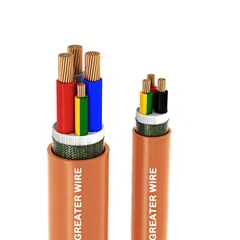
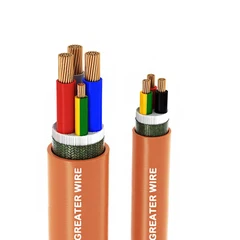
Type TC stands for Tray Cable. It is used for power and control circuits in cable trays and other permitted wiring methods under applicable electrical codes.
The "-ER" suffix means Exposed Run. Under UL 1277, cables marked "-ER" are intended for qualifying exposed runs between a cable tray and utilization equipment, provided they are continuously supported and protected against physical damage using mechanical protection such as struts, angles, or channels.
When reviewing a data sheet, check whether it clearly identifies:
UL Type TC or TC-ER.
The applicable product standard, such as UL 1277.
The rated voltage.
The conductor type and applicable temperature rating.
Any additional installation markings, such as sunlight resistance or direct-burial suitability, if required.
Do not assume that a cable described as "tray cable" automatically has an exposed-run rating. The actual product marking and certification documentation must support the claim.
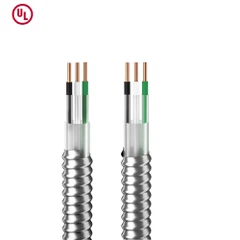
UL 1277 also distinguishes Type TC cable from Type MC cable. Type TC cables covered by this standard do not have a metal sheath or armor; cables with metal sheath or armor fall under the Type MC category addressed by UL 1569. <Cite refs={["turn487005search0","turn487005search1","turn487005search2"]}/>
Check the Certification Details, Not Just the Logo
A data sheet may display a UL, CSA, or other certification logo. However, a logo alone is not enough to establish that the exact cable construction is approved for the intended application.
Ask the supplier to confirm:
The certification body.
The applicable standard and product category.
The exact product model or catalog number covered.
The voltage and temperature ratings included in the approval.
Whether the approval covers the complete cable assembly or only a component.
Whether the product marking matches the supplied certification documentation.
For North American projects, UL 1277 is a key reference for Type TC power and control tray cables. In Canada, applicable CSA standards and certification requirements must also be checked.
For IEC-based or AS/NZS-based projects, verify the standards and approvals specified by the project. A UL listing does not automatically establish compliance with IEC or AS/NZS requirements.
Buyer tip: Compare certification scope before comparing price. A lower-priced cable that does not meet the required product category or approval is not an equivalent alternative.

3. Compare Conductor Specifications
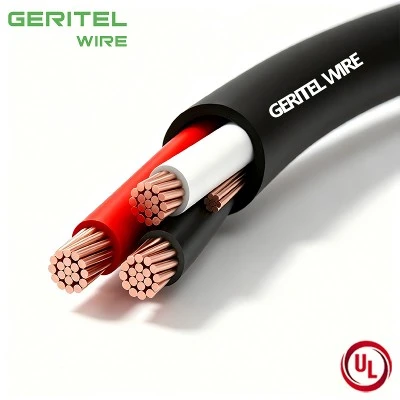
The conductor is the electrical core of the cable. Differences in conductor material, size, stranding, and construction can affect resistance, flexibility, installation, and electrical performance.
Conductor Material
Most industrial tray cables use copper conductors, although aluminum and copper-clad aluminum conductors are also covered in certain cable constructions.
When comparing data sheets, check whether the conductor is specified as:
Bare copper.
Tinned copper.
Aluminum.
Copper-clad aluminum.
Do not treat these materials as interchangeable without checking the project specification and applicable electrical requirements.
Copper and aluminum have different electrical and mechanical characteristics. Tinned copper may be selected for particular environmental or manufacturing requirements, but the presence of tin plating does not automatically establish a higher current rating.
Conductor Size
Conductor size is commonly expressed in AWG (American Wire Gauge) for North American products.
A smaller AWG number represents a larger conductor. For example, 8 AWG is larger than 12 AWG.
If two suppliers offer cables with different conductor sizes, they should not be considered equivalent simply because both products have the same voltage rating.
For an 8 AWG Tray Cable, compare:
Nominal conductor size.
Conductor material.
Solid or stranded construction.
Number of strands.
Maximum DC resistance.
Number of insulated conductors.
Grounding conductor size, if included.
A larger conductor may have lower resistance, but conductor size alone does not establish the complete cable's ampacity.
Conductor Stranding
Stranding describes how many smaller wires are combined to form one conductor.
Common descriptions include:
Solid conductor.
Stranded conductor.
Fine-stranded conductor.
Stranding can influence cable flexibility, termination requirements, and installation characteristics.
For example, two 8 AWG cables may have the same nominal conductor size but different strand configurations. If the cable will be routed through machinery or installed in a space with limited bending room, this difference may matter.
However, do not assume that a finer-stranded conductor is automatically approved for continuous flexing. A fixed-installation TC-ER cable is not necessarily suitable for continuous-motion applications. Check the manufacturer's stated application and relevant cable approvals.
Conductor Resistance
Maximum DC resistance is a useful parameter for comparing conductor quality and electrical characteristics.
The data sheet should identify:
The resistance value.
The conductor size.
The conductor material.
The reference temperature, commonly 20°C for resistance specifications.
The applicable measurement standard, where stated.
Make sure the values use the same unit, such as Ω/km or Ω/1,000 ft, and the same reference temperature before comparing them.
A lower resistance value may indicate a lower voltage drop under equivalent conditions, but the comparison is meaningful only when the conductor size, material, and test basis are consistent.
4. Compare Insulation and Jacket Materials
Insulation and jacket materials are often confused because both are polymeric layers. However, they perform different functions.
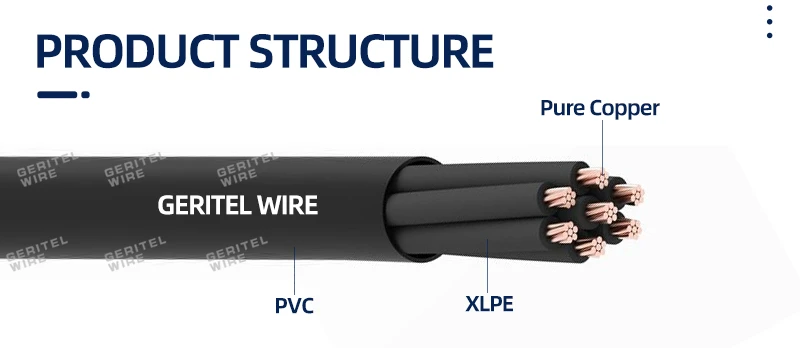
Conductor insulation surrounds each individual conductor and provides electrical insulation.
Outer jacket surrounds the assembled cable core and provides overall mechanical and environmental protection.
A data sheet should identify these materials separately.
Compare Conductor Insulation
Common insulation materials in industrial tray cables include PVC-based compounds, PVC/Nylon constructions, and XLPE-based thermoset materials.
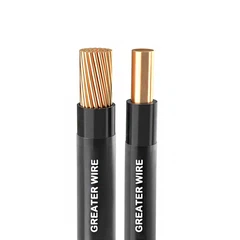
For example, an XLPE XHHW Cable may use cross-linked polyethylene insulation associated with the XHHW or XHHW-2 conductor designation.
When comparing this type of cable, check:
Insulation material.
Insulation thickness.
Conductor insulation designation.
Temperature rating.
Wet-location and dry-location suitability.
Applicable conductor standard.
XHHW and XHHW-2 are conductor insulation designations, not complete cable-type approvals. A cable containing XHHW-2 insulated conductors must still meet the applicable requirements for the complete TC-ER cable assembly.
UL 44 covers thermoset-insulated wires and cables, including XHHW and XHHW-2 types. The applicable temperature and location ratings should be verified from the product marking and current certification documentation rather than inferred from the material name alone. <Cite refs={["turn280949search49","turn280949search5"]}/>
Compare Outer Jacket Materials
The outer jacket protects the cable assembly from environmental and mechanical exposure.
Common materials include:
| Jacket Material | Typical Characteristics | What Buyers Should Check |
|---|---|---|
| PVC | Common industrial jacket material with a wide range of available formulations | Temperature range, oil resistance, sunlight resistance, and flexibility |
| CPE | Often selected for demanding industrial environments | Chemical, oil, temperature, and mechanical performance |
| TPE | Can offer flexibility and specific environmental performance | Temperature range, flexibility, and chemical compatibility |
| Other specialized compounds | Used for particular project requirements | Manufacturer's test data and application limitations |
Do not compare jacket materials by name alone. Different formulations of the same polymer can have significantly different performance characteristics.
For example, one PVC jacket may be sunlight-resistant and oil-resistant, while another may not have the same evaluated properties.
Check Insulation and Jacket Thickness
Some data sheets provide nominal insulation and jacket thicknesses.
These values can help identify construction differences between suppliers.
A thicker jacket may provide additional material around the cable core, but thickness alone does not prove superior crush resistance, impact performance, or flame performance.
Compare thickness alongside the relevant test results and product approvals.
5. Compare Voltage and Temperature Ratings
Voltage and temperature ratings are among the most important electrical parameters in a cable data sheet.
However, buyers should distinguish between the voltage rating of the complete cable, the temperature rating of its conductors, and the operating limitations of the installed circuit.
Voltage Rating
Many industrial Type TC-ER cables are rated 600 V, although the actual product rating must always be confirmed.
When comparing suppliers, verify that both products have the same voltage rating and are approved for the intended circuit.
A 600 V cable should not be treated as equivalent to a cable with a different voltage rating simply because their physical construction appears similar.
Temperature Rating
Temperature ratings indicate the maximum conductor operating temperature under the conditions established by the applicable product requirements.
A data sheet may show ratings such as:
75°C.
90°C.
105°C.
However, the number must be read together with the location designation and cable marking.
For example, a cable marked 90°C dry and 75°C wet does not have the same wet-location rating as a cable marked 90°C wet or dry.
Also, the insulation temperature rating does not automatically determine the allowable operating temperature of the complete installation. Applicable electrical code rules, ambient temperature, conductor grouping, and equipment terminal ratings may impose lower limits.
Compare Like with Like
A useful comparison table might look like this:
| Parameter | Supplier A | Supplier B | Evaluation |
|---|---|---|---|
| Voltage rating | 600 V | 600 V | Same |
| Dry temperature rating | 90°C | 90°C | Same |
| Wet temperature rating | 90°C | 75°C | Different |
| Conductor insulation | XLPE / XHHW-2 | PVC/Nylon | Different |
| Outer jacket | PVC | CPE | Different |
| Sunlight resistance | Marked | Not specified | Requires verification |
This example shows why comparing only voltage and dry temperature ratings can lead to an incomplete purchasing decision.
6. Understand Flame Ratings: VW-1 Is Not the Same as a Vertical Tray Test
Flame-performance terminology is one of the most confusing parts of industrial cable data sheets.
A supplier may list VW-1, UL 1685, FT4, or other flame-test references. These terms should not be treated as interchangeable.
What Does VW-1 Mean?
VW-1 is a vertical flame test used for individual wires and cables under the applicable test method.
When a data sheet identifies a VW-1 Tray Cable, check exactly what the marking or certification applies to.
In some cable constructions, individual insulated conductors may be VW-1 rated, while the complete multi-conductor cable assembly has a separate overall-jacket and cable flame-performance evaluation.
A VW-1 claim alone does not establish that the complete cable has passed a vertical tray flame test.
VW-1 vs. Vertical Tray Flame Testing
| Test or Rating | General Purpose | What It Evaluates |
|---|---|---|
| VW-1 | Individual wire or cable flame performance | Response of a specimen to a specified vertical flame test |
| UL 1685 | Vertical tray cable flame testing | Flame performance of cable specimens arranged in a vertical tray configuration |
| CSA FT4 | Vertical flame performance under the applicable CSA test method | Cable flame behavior under specified test conditions |
| IEEE 1202 | Vertical cable flame testing | Flame propagation performance under the specified test procedure |
These tests use different arrangements and acceptance criteria. A result from one test should not be assumed to satisfy another.
The Japan Cable Technology Center (JECTEC) also distinguishes single-wire flame testing, including VW-1, from vertical tray flame testing such as UL 1685, IEEE 1202, and CSA FT4. <Cite refs={["turn280949search2","turn487005search9"]}/>
What Should Buyers Check?
When comparing flame-performance claims, ask:
Is the rating for an individual conductor or the complete cable?
Which test standard was used?
Is the test result included in the product certification?
Does the project specification require a particular flame test?
Are the two suppliers claiming compliance with the same test method and edition?
A cable with a VW-1 claim should not automatically be considered equivalent to one with a required UL 1685 or FT4 rating.
7. Compare Environmental and Mechanical Performance
Industrial cables are often exposed to sunlight, oil, moisture, vibration, and mechanical stress.
These conditions can affect cable service life. A good data sheet should provide clear information about the environmental and mechanical properties relevant to the intended installation.
Sunlight Resistance
For outdoor installations, sunlight resistance may be an important requirement.
Check whether the cable is specifically marked "Sun Res" or "Sunlight Resistant" and whether the marking is supported by the applicable certification.
Do not assume that a black outer jacket is automatically sunlight-resistant.
Oil Resistance
Industrial machinery and manufacturing environments may expose cables to lubricants, cutting oils, and other fluids.
Some cable data sheets identify oil resistance using designations such as Oil Res I or Oil Res II.
These designations refer to evaluated performance under specified conditions. They should not be interpreted as universal resistance to every oil, chemical, or industrial fluid.
Compare the exact oil-resistance designation and the applicable exposure conditions.
Direct Burial
Some tray cables are also evaluated for direct-burial applications.
If the project requires underground installation, check whether the cable is specifically marked for direct burial.
A TC-ER designation alone should not be interpreted as approval for direct burial.
Crush and Impact Resistance
Mechanical performance is particularly important for exposed runs and industrial installations.
For TC-ER cables, the "-ER" designation is associated with additional requirements, including impact and crush performance, under the applicable product standard.
However, a TC-ER rating does not eliminate the need to follow installation requirements for continuous support and protection against physical damage.
If two suppliers offer TC-ER products, verify that both have the required exposed-run designation and compare any additional mechanical performance data that the project specification requires.
Minimum Bending Radius
Minimum bending radius indicates how tightly a cable can be bent without exceeding the manufacturer's specified installation limits.
It may be expressed as a multiple of the cable's overall diameter, such as 6 × OD or 8 × OD.
For example, a cable with a 20 mm outside diameter and a specified minimum bending radius of 6 × OD would have a calculated minimum radius of 120 mm under that stated condition.
However, bending-radius requirements may differ for fixed installation and cable pulling. Always check the manufacturer's definition and installation instructions before comparing values.

8. Compare TC-ER Cable vs. MC Cable Correctly
A common purchasing question is whether Type TC-ER cable can replace Type MC cable.
The answer depends on the application and the applicable electrical code. These are different cable categories with different constructions and installation considerations.
Main Construction Difference
Type TC-ER cable generally uses insulated conductors assembled under an overall polymeric jacket. It does not have the metal sheath or armor characteristic of Type MC cable under UL 1569.
Type MC cable contains insulated conductors enclosed in metallic armor, such as interlocked metal strip or a smooth or corrugated metal tube.
This difference affects mechanical protection, bonding considerations, cable handling, and installation methods. <Cite refs={["turn487005search0","turn487005search2","turn487005search58"]}/>
Comparison Table
| Feature | TC-ER Cable | MC Cable |
|---|---|---|
| Product standard | UL 1277 | UL 1569 |
| Basic construction | Insulated conductors with an overall cable jacket | Insulated conductors enclosed in metallic armor |
| Exposed-run designation | Available when specifically marked TC-ER | Depends on the applicable MC construction and installation rules |
| Mechanical protection | Requires compliance with applicable support and physical-protection requirements | Metallic armor provides an additional mechanical enclosure |
| Installation rules | NEC Article 336 and other applicable provisions | NEC Article 330 and other applicable provisions |
| Typical applications | Industrial power and control wiring, tray systems, and qualifying exposed runs | Power and control wiring where Type MC is permitted |
The terms should not be used interchangeably.
When comparing TC-ER Cable vs MC Cable, do not focus only on voltage rating or conductor size. Check the installation method, mechanical protection requirements, equipment connections, grounding and bonding provisions, and local code permissions.
A cable that is suitable for a tray installation is not automatically a suitable replacement for every MC cable application.
9. Understand Machine Tool Cable and Its Relationship to TC-ER Cable
Another term that may appear in industrial cable specifications is Machine Tool Cable.
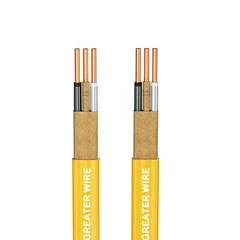
Machine-tool wiring is associated with industrial machinery and equipment wiring. In North America, Type MTW is covered by UL 1063 and is used in applications specified by the NEC and NFPA 79.
UL 1063 covers 600 V all-thermoplastic MTW wires and cables. Its scope specifies temperature limits of 90°C in dry locations and 60°C where exposed to moisture, oil, or coolants, subject to the applicable product requirements. <Cite refs={["turn280949search0","turn280949search1"]}/>
MTW and TC-ER Are Not the Same Designation
A cable may carry multiple approvals or markings, but MTW and TC-ER represent different product designations and application requirements.
When reviewing a data sheet, check whether the cable is approved for:
Type TC or TC-ER installation.
Type MTW applications.
NFPA 79 industrial machinery wiring, where required.
The specific voltage and temperature conditions of the project.
Do not assume that a cable described as machine-tool cable is automatically suitable for cable tray or exposed-run installation.
Likewise, a TC-ER cable is not automatically suitable for every internal machine wiring or continuous-flex application.
If the application involves repeated movement, drag chains, torsion, or continuous bending, check for an appropriate flexible cable design and specific motion-related ratings.
10. Use a Standardized Data Sheet Comparison Table
Once the relevant specifications have been collected, organize them in one comparison table.
This makes it easier to identify differences, missing information, and potential compliance issues.
The following template can be used when evaluating two or more suppliers.
| Category | Parameter | Supplier A | Supplier B | Result |
|---|---|---|---|---|
| Product identification | Cable type | |||
| Certification | UL / CSA approval | |||
| Standard | Applicable product standard | |||
| Electrical | Voltage rating | |||
| Electrical | Temperature rating | |||
| Conductor | Material | |||
| Conductor | Size and AWG | |||
| Conductor | Stranding | |||
| Conductor | Maximum DC resistance | |||
| Construction | Insulation material | |||
| Construction | Insulation thickness | |||
| Construction | Outer jacket material | |||
| Construction | Overall diameter | |||
| Flame performance | VW-1 / UL 1685 / FT4 | |||
| Environment | Sunlight resistance | |||
| Environment | Oil resistance | |||
| Environment | Direct-burial rating | |||
| Mechanical | Crush and impact performance | |||
| Installation | Minimum bending radius | |||
| Documentation | Data sheet revision |
Use three result categories:
Meets requirement: The specification is clearly documented and satisfies the project requirement.
Different specification: The product has a documented difference that requires engineering review.
Not confirmed: The data sheet does not provide sufficient information.
This approach prevents missing information from being mistaken for compliance.
11. Common Mistakes When Comparing TC-ER Cable Data Sheets
Even experienced buyers can make mistakes when comparing technical documents from different manufacturers.
The following issues deserve particular attention.
Mistake 1: Comparing Only the Headline Product Description
Two products may both be described as 600 V TC-ER cables, but their conductor, insulation, and jacket constructions may differ.
Better approach: Compare the complete construction and approval details.
Mistake 2: Treating VW-1 as Equivalent to a Vertical Tray Flame Rating
VW-1 and vertical tray flame tests evaluate different conditions.
Better approach: Match the exact test standard required by the project.
Mistake 3: Assuming XHHW-2 Means the Complete Cable Is TC-ER Approved
XHHW-2 identifies an insulated conductor type. It does not independently establish the listing of the finished cable assembly.
Better approach: Verify the complete cable's TC-ER marking and certification.
Mistake 4: Comparing Ampacity Without Checking Installation Conditions
Ampacity can vary with conductor size, insulation temperature rating, ambient temperature, conductor grouping, and applicable code requirements.
Better approach: Compare ampacity only when the calculation basis and installation conditions are equivalent.
Mistake 5: Ignoring the Cable's Overall Diameter
A difference in conductor count, insulation thickness, fillers, shielding, or jacket construction can change the overall cable diameter.
Better approach: Check the nominal OD and applicable tolerance, particularly when the cable must fit existing glands, connectors, or equipment entries.
Mistake 6: Overlooking the Data Sheet Revision
Manufacturers may update product construction, ratings, or certification information.
Better approach: Record the document revision and date. Make sure the quoted product matches the version approved by the engineering team.

12. A Practical Checklist Before Approving a Cable Supplier
Before approving a TC-ER Cable supplier, procurement and engineering teams should confirm the following:
Product and certification
The cable is correctly identified as Type TC-ER.
The applicable product standard is specified.
Certification documents cover the exact product.
The product markings match the approved documentation.
Electrical construction
Conductor material and size meet the project specification.
Stranding and conductor resistance are acceptable.
Voltage and temperature ratings are appropriate.
Grounding conductor requirements are satisfied.
Materials and performance
Conductor insulation and outer jacket materials are identified.
Required flame-test results are documented.
Sunlight, oil, and direct-burial ratings are verified where applicable.
Mechanical performance meets the installation requirements.
Installation and documentation
Overall diameter is compatible with the installation.
Minimum bending radius is acceptable.
The intended installation method is permitted.
The latest data sheet and supporting certification documents are available.
A supplier comparison should not be approved solely because a product meets the nominal voltage and conductor-size requirements. All critical project requirements must be checked.
Conclusion
Comparing TC-ER cable data sheets requires a structured review of product classification, certification, conductor construction, insulation, jacket material, electrical ratings, flame performance, and installation characteristics.
The most important principle is to compare equivalent specifications using the same test methods and reference conditions. A VW-1 claim is not automatically equivalent to a vertical tray flame rating, an XHHW-2 conductor designation does not establish complete cable approval, and TC-ER cable should not be treated as interchangeable with MC cable or MTW wiring without reviewing the intended application.
For distributors, contractors, OEMs, and procurement professionals, a standardized comparison table helps identify technical differences before they become installation or compliance problems.
GERITEL WIRE supports industrial buyers with power and control cable solutions designed around project-specific electrical and installation requirements. Whether you are sourcing TC-ER Cable, comparing 8 AWG constructions, or evaluating XLPE-insulated cable options, our team can help clarify conductor specifications, insulation and jacket materials, voltage ratings, and applicable product requirements. By reviewing these details before ordering, your team can make more informed purchasing decisions and reduce specification mismatches. Contact GERITEL WIRE to discuss your cable requirements and request product information for your next industrial project.
Dongguan Greater Wire & Cable Co., Ltd.
Tel/WhatsApp/Wechat: +86 136 6257 9592
Tel/WhatsApp/Wechat: +86 135 1078 4550
Email: manager01@greaterwire.com
Website: www.greaterwire.com