


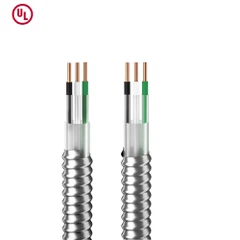
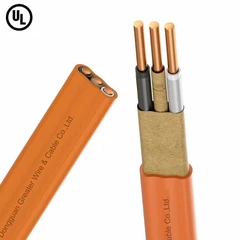
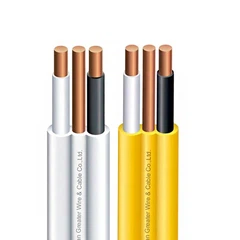

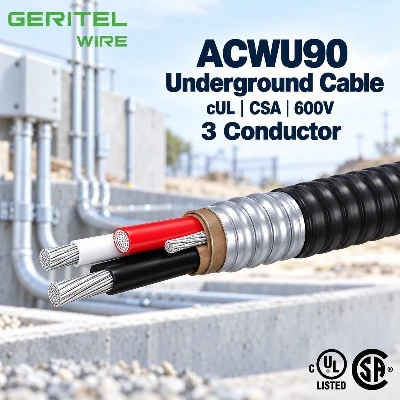
ACWU90 cable is commonly used for underground power distribution in commercial, industrial, and infrastructure projects. However, the point where the cable emerges from the ground and enters an electrical enclosure, building, or piece of equipment deserves particular attention.
This section is often exposed to mechanical damage that may not occur along the buried cable route. Vehicles, landscaping equipment, construction activities, accidental impacts, sharp edges, and cable movement can all affect the exposed cable.
Although ACWU90 has aluminum interlocked armour (AIA), this does not mean that every ground-level transition can be left unprotected.
The correct protection method depends on the cable's actual construction, installation location, potential physical hazards, manufacturer instructions, and applicable electrical code.
For electrical contractors, engineers, and procurement professionals, the objective is to protect the cable without creating additional problems such as excessive bending, water ingress, or damage to the outer jacket.
1. What Happens at an ACWU90 Ground-Level Transition?
A ground-level transition occurs when an underground cable changes from a buried route to an exposed section above finished grade.
Typical examples include:
Underground cable rising to an outdoor distribution panel.
ACWU90 entering a transformer or industrial control enclosure.
A buried feeder emerging beside a building wall.
Underground power cables connecting to outdoor equipment.
Cable risers installed near roads, driveways, or loading areas.
The transition may include several components:
Underground cable section: The portion of ACWU90 installed directly in the ground or in an approved underground raceway.
Ground emergence point: The area where the cable changes direction and rises above finished grade.
Exposed riser section: The cable section visible above ground and potentially exposed to impact or abrasion.
Equipment entry: The point where the cable enters a panel, enclosure, junction box, or other electrical equipment.
Each part has different protection considerations.
For example, the buried section may be protected by suitable backfill and burial cover, while the exposed riser may need additional protection against physical impact.
The equipment entry also requires suitable fittings and protection against abrasion, moisture, and environmental exposure.
2. What Are the Main Risks at Ground-Level Transitions?
Before choosing a protective method, it is important to understand what can damage ACWU90 at the point where it emerges from the ground.
2.1 Mechanical Impact
Mechanical impact is one of the most important risks.
A cable rising beside a driveway, parking area, loading dock, or construction zone may be struck by:
Vehicles and mobile equipment.
Forklifts and material-handling equipment.
Landscaping machinery.
Excavation tools.
Construction materials.
Accidental human contact.
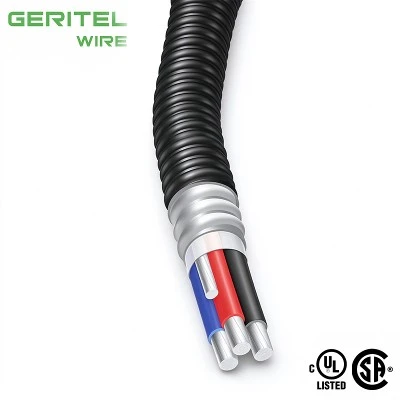
Aluminum interlocked armour provides useful mechanical protection, but it does not make the cable indestructible.
A severe impact may deform the armour, damage the PVC outer jacket, or affect the cable's internal construction.
Where the cable is exposed to a foreseeable impact hazard, additional mechanical protection should be considered or required by the applicable code.
2.2 Abrasion and Sharp Edges
The cable may rub against concrete, masonry, steel supports, enclosure edges, or other rough surfaces.
Repeated movement can wear through the outer jacket.
Damage may also occur when the cable passes through an opening with sharp or unfinished edges.
At equipment entries, suitable cable connectors, fittings, and insulating protection are important. The cable should not be forced through an opening that can cut or abrade its outer covering.
2.3 Excessive Bending
ACWU90 contains metallic interlocked armour and has a defined minimum bending radius.
A tight bend immediately above the ground can deform the armour or place excessive stress on the cable.
This problem is especially common when installers try to fit a large feeder into a small enclosure or route it around a foundation without allowing sufficient bending space.
Always check the actual cable manufacturer's minimum bending radius and installation instructions.
Do not assume that every ACWU90 cable size has the same outside diameter or bending requirement.
2.4 Water Ingress and Environmental Exposure
The transition area may be exposed to rain, snow, standing water, groundwater, or water running down the cable surface.
If the outer jacket is damaged or the equipment entry is poorly sealed, moisture may enter the cable termination or electrical enclosure.
The cable, connector, gland, and enclosure must therefore be suitable for the actual environmental conditions.
A weather-resistant cable jacket does not eliminate the need for properly selected and installed termination fittings.
2.5 Ground Movement and Cable Stress
Soil settlement, frost movement, vibration, and movement of adjacent structures can place stress on the cable near the ground line.
If the cable is tightly fixed at both the underground and equipment ends, movement may cause excessive tension or bending.
The installation should allow the cable to follow a suitable route without being pinched, stretched, or forced against structural edges.

3. Does ACWU90 Need Additional Mechanical Protection Above Ground?
The answer depends on the installation location and the potential for mechanical damage.
ACWU90 has aluminum interlocked armour, which provides a level of mechanical protection. However, the armour does not automatically satisfy every protection requirement for every exposed installation.
In Canada, the 2024 Canadian Electrical Code (CEC), CSA C22.1:24, provides relevant requirements for armoured cable installations.
3.1 CEC Rule 12-604: Protection in Lanes and Driveways
CEC Rule 12-604 specifically addresses armoured cables in lanes and driveways.
Where armoured cables are subject to mechanical damage and are not otherwise protected, the rule requires adequately secured steel guards of at least No. 10 Manufacturers' Standard Gauge (MSG) to protect cables located less than 2 m above grade in lanes and driveways.
This provision is particularly relevant to ACWU90 risers installed near vehicle-access areas.
For example, consider an underground ACWU90 feeder rising beside a commercial building driveway.
If the exposed section is vulnerable to vehicle impact, an appropriately installed steel guard may be necessary to provide additional protection.
However, Rule 12-604 should not be interpreted as a universal requirement to install steel guards around every ACWU90 riser. Its specific scope concerns lanes and driveways, and the applicable installation conditions must be assessed.
Other locations may be subject to different requirements based on their physical exposure and applicable code provisions. Source: 2024 CEC Rule 12-604
3.2 CEC Rule 12-606: Protect the Thermoplastic Outer Covering
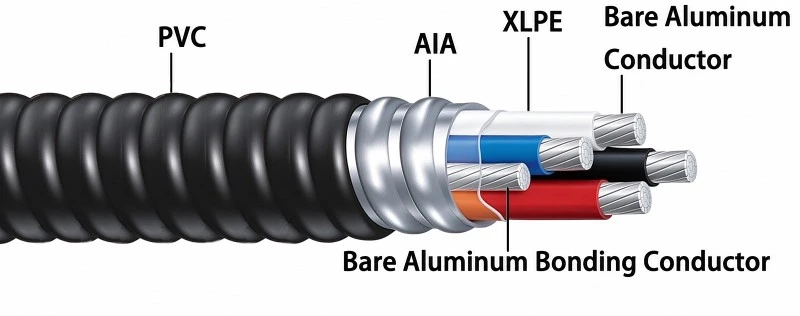
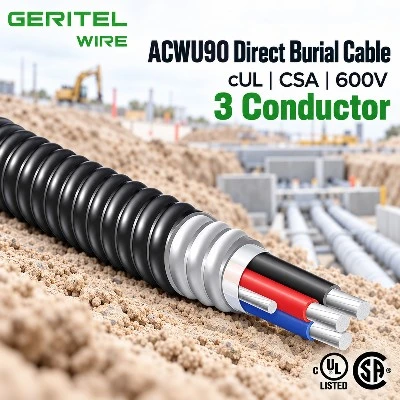
ACWU90 commonly uses a thermoplastic PVC outer jacket over its aluminum interlocked armour.
CEC Rule 12-606 addresses the use of thermoplastic-covered armoured cable suitable for direct earth burial. It requires that the outer covering not be subjected to mechanical damage.
This is important because the cable's armour and outer jacket perform different functions.
The armour provides mechanical protection, while the outer covering provides an additional protective layer.
A damaged PVC jacket should not be ignored simply because the metallic armour underneath remains visible or appears intact.
The cable must be installed and protected in a way that avoids damage to its outer covering.
3.3 Do Not Automatically Apply the Non-Armoured Cable Riser Rule
A common source of confusion is the mechanical-protection provision in CEC Rule 12-012 for cables rising from underground installations.
The 2024 CEC includes requirements for protecting underground cable risers using rigid conduit or other acceptable protection.
However, Alberta's April 2025 STANDATA bulletin 24-ECB-012 clarifies that the mechanical-protection provisions in Rule 12-012(6) are intended for cables other than armoured cable, mineral-insulated cable, and aluminum-sheathed cable. Mechanical-protection requirements for those cable categories are addressed by other rules, including Rule 12-604 and Rule 12-710.
Therefore, contractors should not automatically apply the dimensions and protection arrangement in Rule 12-012(6) to every ACWU90 installation.
The correct rule must be identified according to the cable construction and installation conditions. Source: Alberta STANDATA 24-ECB-012
4. What Protection Methods Can Be Used at ACWU90 Ground-Level Transitions?
Several methods can help protect ACWU90 where it emerges from the ground.
The appropriate solution depends on the expected physical hazards, cable size, installation geometry, and local requirements.
4.1 Install a Steel Protective Guard
A steel guard can provide additional protection where an exposed ACWU90 riser is vulnerable to impact.
Typical applications include:
Commercial driveways.
Industrial vehicle-access areas.
Loading and unloading zones.
Parking facilities.
Outdoor equipment locations exposed to mobile machinery.
The guard should be adequately secured and positioned so that it protects the exposed cable without crushing, pinching, or abrading it.
Where CEC Rule 12-604 applies, the steel guard must meet the specified material and installation requirements.
A protective guard should also be coordinated with the cable route and equipment entry so that it does not create an unnecessarily sharp bend.
4.2 Use a Suitable Rigid Conduit or Protective Raceway
A suitable rigid conduit or protective raceway can provide a physical barrier around an exposed cable section.
This approach may be appropriate where additional protection is required against impact, abrasion, or accidental contact.
Before selecting a conduit, check:
Compatibility with the cable's outside diameter.
Suitability for the intended indoor or outdoor environment.
Appropriate conduit fittings and termination accessories.
Available space for the cable's bending radius.
Raceway fill and installation requirements.
Water accumulation and drainage considerations.
Applicable bonding requirements for metallic raceways.
Do not assume that any plastic or metal conduit is automatically suitable.
The raceway, fittings, and installation method must comply with the applicable electrical code and be compatible with the cable and environment.
Also, a conduit should not be installed in a way that traps water around a cable or creates a difficult cable entry at the equipment.
4.3 Consider a Protective Sleeve or Cable Riser Assembly
A protective sleeve or purpose-designed riser assembly may be used to protect the section where the cable changes from underground to above-ground routing.
The selected product should provide sufficient mechanical protection for the expected exposure.
Important considerations include:
Suitable material strength.
Corrosion resistance.
Compatibility with the cable jacket.
Secure mounting.
Appropriate protection at the lower and upper ends.
Sufficient internal clearance for cable installation.
A short sleeve may protect a vulnerable point, but it should not be treated as a substitute for a properly designed protective system where the hazard extends over a longer section.
4.4 Route the Cable Away from High-Risk Areas
Sometimes the best protection is to avoid exposing the cable to unnecessary hazards.
During project design, consider routing the ACWU90 riser:
Away from vehicle paths.
Outside regular forklift operating zones.
Away from loading dock edges.
Clear of landscaping and excavation areas.
Along a protected building wall where appropriate.
Inside a suitable equipment or service area.
A better cable route can reduce the need for extensive additional protective structures.
However, the final routing must still meet applicable electrical installation requirements and equipment access needs.
4.5 Use Suitable Supports and Secure the Cable
The exposed section should be supported in a way that prevents excessive movement, vibration, or strain.
Use fittings and supports suitable for the cable's construction and installation environment.
Avoid:
Over-tightening clamps.
Using supports that cut into the PVC jacket.
Leaving the cable unsupported near equipment entries.
Allowing the cable to hang under excessive tension.
Fixing the cable so rigidly that normal structural or ground movement creates stress.
The support arrangement should be coordinated with the cable manufacturer's installation instructions.
5. How Should ACWU90 Be Routed from Underground to Equipment?
A properly planned transition should protect the cable while maintaining an appropriate route into the electrical enclosure.
The following sequence provides a practical installation framework.
Step 1: Plan the Cable Route Before Excavation
Identify the location where the cable will emerge from the ground.
Check the position of:
Distribution panels.
Transformers.
Junction boxes.
Equipment foundations.
Building walls.
Underground utilities.
Vehicle-access routes.
The cable should enter the equipment from a direction that avoids unnecessary bends and mechanical stress.
Step 2: Prepare the Ground-Level Emergence Area
The area around the cable emergence point should be free from sharp stones, construction debris, and other materials that could damage the outer jacket.
For direct-buried installations, follow the applicable requirements for trench preparation, bedding, and backfill.
The cable should not be forced against concrete edges, metal reinforcement, or unfinished foundation openings.
Step 3: Establish a Suitable Cable Bend
The cable should transition from the underground route to the exposed section using a smooth bend.
Check the manufacturer's minimum bending radius before installation.
For ACWU90, the required radius depends on the actual cable construction and size.
For example, Nexans' installation guidance lists different minimum bending-radius factors for ACWU90 during pulling and final positioning. Its published guidance gives 10.5 times the overall cable diameter during pulling and 7 times the diameter for final positioning. These are manufacturer-specific reference values, not universal figures for every ACWU90 product.
Always use the applicable manufacturer's instructions for the cable being installed. Source: Nexans installation guidance
Step 4: Install the Required Protective System
Determine whether the exposed section requires a steel guard, rigid conduit, protective sleeve, or another approved arrangement.
The selection should reflect the actual risk.
For example:
| Installation condition | Protection consideration |
|---|---|
| Beside a driveway | Assess vehicle impact risk and CEC Rule 12-604 |
| Near a loading dock | Consider impact protection over the exposed section |
| Along a protected building wall | Confirm whether additional mechanical protection is required |
| Near outdoor machinery | Protect against accidental contact and vibration |
| In an area exposed to excavation | Consider physical guarding and route identification |
| Entering an outdoor enclosure | Use suitable fittings and environmental sealing |
This table provides general planning guidance. The final installation must be checked against the applicable electrical code and project specifications.
Step 5: Secure the Cable Without Damaging It
Install suitable supports and maintain the manufacturer's recommended spacing and installation practices.
The cable should not be compressed or deformed by clamps, brackets, or protective fittings.
Check that the protective assembly does not introduce sharp edges or excessive pressure against the outer jacket.
Step 6: Complete the Equipment Entry
At the enclosure entry, use a connector or cable gland suitable for the actual ACWU90 construction.
Confirm that the selected fitting is compatible with:
Cable outside diameter.
Armour construction.
Outer jacket.
Enclosure material and entry thread.
Environmental exposure.
Required sealing and bonding arrangement.
Where conductors emerge from the armour, provide the required abrasion protection in accordance with CEC Rule 12-610 and the applicable fitting instructions.
Do not assume that a standard cable gland is suitable for every ACWU90 cable.
Step 7: Inspect Before Energizing
Before the electrical system is energized, inspect the transition and termination area.
Confirm that:
The cable jacket has no visible cuts or cracks.
The armour has not been excessively deformed.
The cable bend is within the permitted radius.
Protective guards and raceways are securely installed.
Cable supports do not damage the outer covering.
The equipment entry is properly fitted and sealed.
Armour continuity and bonding arrangements comply with the applicable requirements.
No unnecessary tension is present at the termination.
Any suspected internal cable damage should be evaluated by a qualified electrical professional before the circuit is placed into service.
6. How Do You Prevent Water and Corrosion Problems at the Transition?
Ground-level transitions are exposed to environmental conditions that may differ from those experienced by the buried cable.
The connection between the cable and electrical equipment is particularly important.
6.1 Select Suitable Cable Glands and Connectors
The gland or connector should be approved for the cable type and suitable for the installation environment.
Consider:
Cable diameter and armour dimensions.
Outdoor or wet-location suitability.
Required enclosure ingress protection.
Corrosion resistance.
Armour bonding requirements.
Compatibility with the enclosure material.
An unsuitable fitting may compromise the mechanical connection or allow moisture to enter the enclosure.
6.2 Seal Equipment Entries Correctly
Where cables enter buildings or electrical enclosures, the openings should be properly sealed to prevent water infiltration.
The sealing method must be compatible with the cable, fitting, and enclosure.
Avoid relying on general-purpose silicone or adhesive as a substitute for a properly selected cable gland or approved sealing system.
6.3 Consider Corrosive Environments
Outdoor installations near coastal locations, industrial chemical areas, or facilities exposed to de-icing salts may require additional attention to material compatibility.
Check the corrosion resistance of:
Steel guards.
Metallic conduits.
Cable glands.
Mounting brackets.
Fasteners.
Enclosure fittings.
The presence of aluminum armour does not eliminate corrosion risks at connections or where dissimilar metals are joined.
Suitable materials and approved fittings should be selected for the specific environment.
7. Which Standards and Codes Should Buyers and Contractors Check?
The applicable requirements depend on the destination market and the cable's product certification.
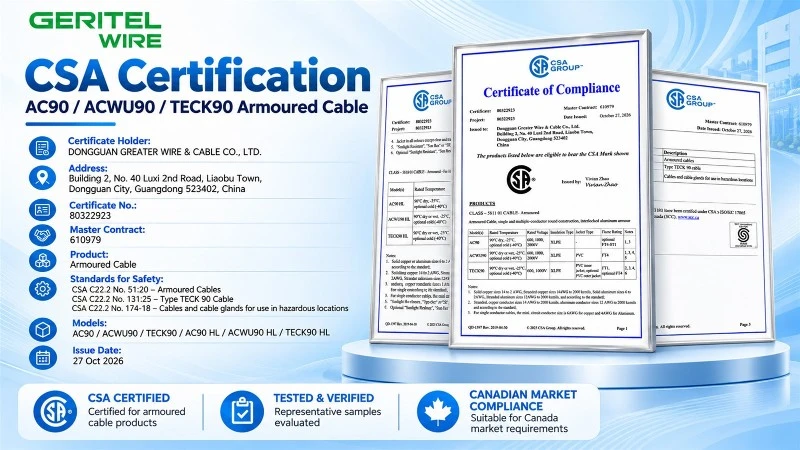
ACWU90 is a Canadian cable designation. A CSA-certified ACWU90 product should not automatically be treated as equivalent to a UL-listed, IEC-compliant, or AS/NZS-approved cable.
7.1 Canada: CSA C22.1 and CSA C22.2 No. 51
For Canadian projects, two standards have different but complementary roles.
| Standard | Main purpose |
|---|---|
| CSA C22.2 No. 51 | Product requirements for armoured cables |
| CSA C22.1, Canadian Electrical Code Part I | Electrical installation requirements |
For ground-level transitions, relevant CEC provisions include:
Rule 12-604: Protection for armoured cables in lanes.
Rule 12-606: Use of thermoplastic-covered armoured cable.
Rule 12-608: Continuity of armoured cable.
Rule 12-610: Terminating armoured cable.
Rule 12-614: Bending radius of armoured cable.
Rule 12-012: Underground installations, including relevant provisions for underground cable risers.
The 2024 CEC should be used only where that edition has been adopted by the relevant authority. Provincial and territorial adoption, amendments, and interpretations can differ.
7.2 United States: UL and NEC
For US projects, the cable must be approved for the intended application under the applicable UL product standard and installation requirements.
The National Electrical Code (NEC), NFPA 70, governs electrical installation requirements when adopted by the relevant jurisdiction.
A Canadian ACWU90 designation or CSA certification does not automatically establish UL listing or NEC acceptance.
If a project requires Type MC or another US-recognized cable type, verify the actual product listing and permitted installation method.
7.3 IEC-Based Markets
For IEC-based projects, identify the applicable cable product standard and installation requirements.
IEC standards address different aspects of cable construction and electrical installations. Compliance with a conductor standard alone does not establish that a complete armoured cable assembly is suitable for a particular outdoor or ground-level application.
Confirm the required mechanical protection, environmental suitability, termination arrangement, and accepted product certification with the project specification and local authority.
7.4 Australia and New Zealand: AS/NZS
For Australian and New Zealand projects, consider the applicable AS/NZS cable product standards and wiring installation requirements, including AS/NZS 3000 where relevant.
Verify the cable's accepted product approval, outdoor suitability, mechanical protection requirements, and equipment termination arrangements.
Do not assume that a Canadian ACWU90 product can be substituted into an AS/NZS installation solely because its construction appears similar.
8. Common Mistakes to Avoid at ACWU90 Ground-Level Transitions
Several installation mistakes can reduce the protection provided by an otherwise suitable ACWU90 cable.
| Common mistake | Why it is a problem | Better approach |
|---|---|---|
| Assuming armour eliminates all impact risks | Armour can still be deformed or damaged | Assess the actual physical hazards |
| Leaving a riser exposed beside vehicle traffic | Vehicles may strike the cable | Apply the relevant mechanical protection |
| Applying the non-armoured riser rule automatically | Different cable constructions may be governed by different rules | Identify the correct CEC provisions |
| Bending the cable too tightly | Can deform armour and damage internal components | Follow the manufacturer's bend radius |
| Using unsuitable clamps | May cut or compress the outer jacket | Select compatible cable supports |
| Using an incompatible gland | May compromise sealing and armour connection | Match the fitting to the cable construction |
| Ignoring corrosion exposure | Fittings and supports may deteriorate | Select suitable materials |
| Covering damaged cable with tape | Does not establish that the cable is safe or compliant | Obtain professional damage assessment |
| Failing to inspect before energizing | Damage may remain unnoticed | Complete a documented inspection |
The most important principle is to treat the ground-level transition as a separate installation detail that needs deliberate protection planning.
9. Buyer and Contractor Checklist for ACWU90 Ground-Level Transitions
Before approving an ACWU90 installation or purchasing cable and accessories, review the following items.
Cable specification
Confirm the ACWU90 cable designation.
Verify conductor material and size.
Confirm voltage and temperature ratings.
Check the aluminum interlocked armour and outer jacket construction.
Obtain the product-specific datasheet and certification information.
Confirm suitability for the intended underground and outdoor applications.
Transition design
Identify the exact ground emergence location.
Assess vehicle, machinery, and construction impact risks.
Determine whether a steel guard, conduit, sleeve, or other protection is required.
Confirm the cable bending radius.
Allow adequate space for equipment entry.
Avoid sharp edges and unnecessary cable tension.
Accessories and terminations
Select compatible cable glands and connectors.
Confirm outdoor and wet-location suitability.
Verify enclosure sealing requirements.
Check armour continuity and bonding arrangements.
Provide suitable protection where conductors emerge from the armour.
Confirm corrosion compatibility of metallic accessories.
Compliance and inspection
Identify the electrical code edition adopted by the project jurisdiction.
Confirm applicable local amendments and authority requirements.
Inspect the cable jacket and armour before installation.
Inspect the complete transition before energizing.
Document any damage and obtain professional assessment where necessary.
10. Frequently Asked Questions
Q1: Does ACWU90 Need Conduit Where It Emerges from the Ground?
Not necessarily. The required protection depends on the cable construction, location, and potential for mechanical damage.
ACWU90 has aluminum interlocked armour, but additional protection may still be required in exposed or high-risk locations. In Canada, CEC Rule 12-604 specifically addresses armoured cables in lanes and driveways.
Q2: Does Every ACWU90 Riser Need a Steel Guard?
No. CEC Rule 12-604 applies to armoured cables in lanes and driveways when they are subject to mechanical damage and are not otherwise protected.
It should not be interpreted as a universal requirement for all ground-level transitions.
Other installations should be assessed according to their actual hazards and applicable requirements.
Q3: Can ACWU90 Be Left Exposed Above Ground?
ACWU90 products may be approved for certain exposed installations, depending on their product certification and construction.
However, the exposed section must still be protected from mechanical damage and installed in accordance with applicable code requirements.
Verify the actual product's environmental ratings, including sunlight resistance where required.
Q4: Can PVC Conduit Be Used to Protect ACWU90?
A suitable PVC conduit or other approved raceway may be used where permitted by the applicable code and where its ratings, dimensions, fittings, and installation method are appropriate.
Do not assume that every PVC conduit is suitable for every exposed location or impact hazard.
Q5: How High Should the Protective Guard Extend?
The required protection height depends on the applicable code provision and the installation hazard.
For example, CEC Rule 12-604 addresses armoured cables less than 2 m above grade in lanes and driveways. This should not be interpreted as a universal guard-height requirement for all ACWU90 installations.
The protective arrangement should be designed for the actual exposure and checked against the applicable requirements.
Q6: What Should I Do If the ACWU90 Jacket Is Damaged Near Ground Level?
Do not assume that the cable is safe simply because the metallic armour appears intact.
A qualified electrical professional should assess the damage and determine whether an approved repair or cable replacement is necessary.
The cable should not be covered or energized until its condition and suitability have been established.
Q7: Does the Same Ground-Level Protection Rule Apply in the United States, Europe, and Australia?
No. The Canadian Electrical Code provisions for ACWU90 should not be transferred directly to other markets.
US projects must follow applicable NEC and product listing requirements. IEC-based projects and Australian/New Zealand projects must follow their respective adopted standards and local regulations.
Always verify the cable approval and installation requirements for the destination market.
Conclusion
Protecting ACWU90 cable at ground-level transitions requires more than relying on its aluminum interlocked armour. The exposed section must be assessed for impact, abrasion, bending stress, water ingress, corrosion, and movement.
For Canadian installations, CEC Rules 12-604 and 12-606 are particularly relevant to exposed armoured cable protection, while termination, bonding, and bending requirements must also be considered. Importantly, the underground riser provisions should be interpreted according to the cable construction rather than applied indiscriminately to every cable type.
By planning the cable route, selecting suitable guards or raceways, using compatible termination accessories, and inspecting the installation before energizing, contractors can reduce damage risks and improve long-term reliability.
Protect Your Electrical Projects with GERITEL WIRE
Selecting the right ACWU90 cable is only one part of building a reliable electrical installation. Cable construction, conductor size, armour, outer jacket, environmental ratings, and compatibility with installation accessories all influence long-term performance, especially at exposed ground-level transitions. GERITEL WIRE supports distributors, electrical contractors, equipment manufacturers, and project buyers seeking dependable wire and cable solutions for commercial and industrial applications. Contact our team to discuss your cable specifications, application conditions, and project requirements. We welcome technical inquiries and quotation requests to help you identify suitable cable solutions for your market.
Dongguan Greater Wire & Cable Co., Ltd.
Tel/WhatsApp/Wechat: +86 136 6257 9592
Tel/WhatsApp/Wechat: +86 135 1078 4550
Email: manager01@greaterwire.com
Website: www.greaterwire.com