

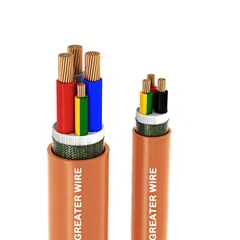
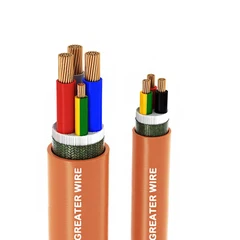

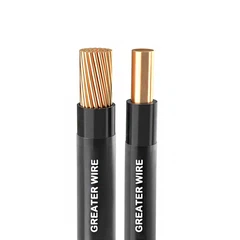
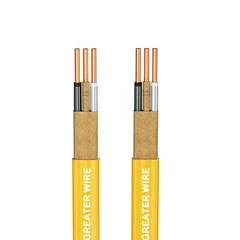
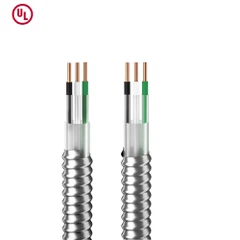
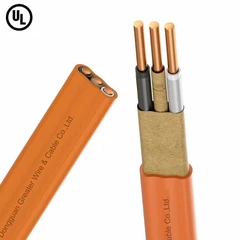
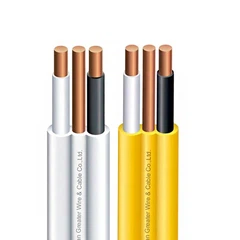

AC90 and ACWU90 are two commonly used types of armoured electrical cable in Canada, but they are designed for different installation environments. The most important difference is their suitability for moisture exposure: standard AC90 is generally intended for dry locations, while ACWU90 is designed for applications that include wet locations, provided the specific product is approved for the intended installation.
Both cable types combine insulated electrical conductors with metallic armour to provide mechanical protection. However, ACWU90 includes an additional overall moisture-resistant jacket, which helps protect the cable assembly in more demanding environmental conditions.
For electrical distributors, contractors, OEM manufacturers, and procurement managers, understanding the differences between AC90 and ACWU90 is essential when specifying cables for commercial buildings, residential projects, and industrial electrical installations in Canada.

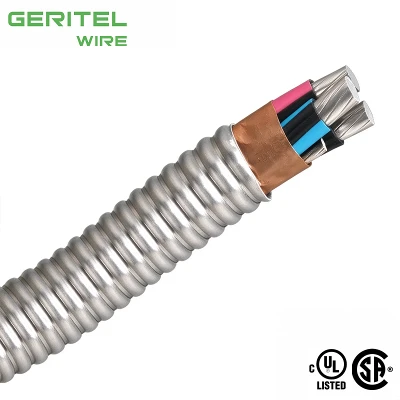
1. What Is AC90 Cable?
600V AC90-12/2 X 150m Type AC90 Armored Cable - Electric Cable and AC Bx Cable
m.made-in-china.com
AC90 is a Canadian armoured cable type commonly used for electrical wiring in commercial, residential, and certain industrial buildings.
It is generally manufactured to CSA C22.2 No. 51, which covers armoured cables.
A typical AC90 cable consists of three main components:
1.1 Insulated Conductors
AC90 commonly uses copper conductors with RW90 cross-linked polyethylene (XLPE) insulation. Depending on the product design, aluminum conductor options may also be available.
The RW90 designation indicates a Canadian conductor insulation type with a 90°C maximum conductor operating temperature under specified conditions.
1.2 Bonding Conductor
A bonding conductor is included to provide an electrical path for fault current and support the grounding and bonding arrangement of the installation.
It is typically made of bare copper or aluminum, depending on the cable construction.
1.3 Interlocked Metal Armour
The outer armour is typically made of interlocked aluminum strips.
This flexible metal construction protects the internal conductors against normal mechanical damage during handling, installation, and service.
AC90 is commonly selected for:
Commercial building branch circuits.
Residential apartment wiring.
Lighting and receptacle circuits.
Electrical distribution within suitable dry locations.
Exposed or concealed building wiring.
Its main limitation is environmental suitability. Conventional AC90 is generally intended for dry locations and should not be assumed suitable for wet or underground installations.
2. What Is ACWU90 Cable?
China CSA ACWU90 Cable 4 conductor 600V AIA Flame Retardant Manufacturers Suppliers Factory - Customized CSA ACWU90 Cable 4 conductor 600V AIA Flame Retardant Made in China
greaterwire.com
ACWU90 is another Canadian armoured cable type designed for applications requiring additional environmental protection.
The designation is commonly associated with aluminum-armoured cable with an overall moisture-resistant covering and 90°C conductor insulation.
Like AC90, ACWU90 generally uses RW90 XLPE-insulated conductors and metallic armour. The important construction difference is the additional outer jacket surrounding the armour.
A typical ACWU90 cable includes:
2.1 Insulated Conductors
The internal conductors are commonly copper or aluminum, depending on the manufacturer's product range.
RW90 XLPE insulation provides electrical insulation and supports a 90°C conductor temperature rating under specified conditions.
2.2 Bonding Conductor
A bonding conductor provides the required electrical bonding path. Its construction and size depend on the product design and applicable requirements.
2.3 Interlocked Metal Armour
Metallic armour surrounds the insulated conductors and provides mechanical protection.
Aluminum armour is commonly used because it combines mechanical strength with relatively low weight.
2.4 Overall Outer Jacket
The defining feature of typical ACWU90 construction is its additional outer jacket, commonly made from PVC-based material.
This jacket provides an additional barrier against moisture and helps protect the underlying armour and internal cable components from environmental exposure.
Depending on the specific product approval, ACWU90 can be suitable for:
Wet-location installations.
Outdoor electrical wiring.
Commercial and industrial distribution.
Certain underground applications where specifically permitted.
Exposed or concealed installations in approved environments.
However, an overall jacket does not automatically make every ACWU90 product suitable for direct burial, sunlight exposure, chemical environments, or every underground installation. These applications must be confirmed through the manufacturer's certification and installation instructions.
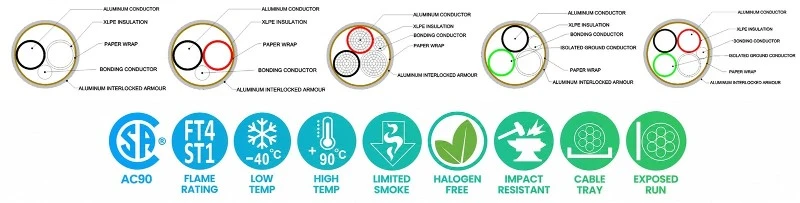
3. AC90 vs ACWU90: Key Technical Differences
Although both cable types use insulated conductors and interlocked metal armour, their construction and environmental ratings determine where they can be installed.
The following table summarizes their main differences.
|
Technical feature |
AC90 |
ACWU90 |
|---|---|---|
|
Cable construction |
Armoured cable without overall jacket |
Armoured cable with overall jacket |
|
Conductor insulation |
Typically RW90 XLPE |
Typically RW90 XLPE |
|
Conductor material |
Copper or aluminum, depending on product |
Copper or aluminum, depending on product |
|
Bonding conductor |
Included |
Included, with construction varying by design |
|
Armour |
Typically interlocked aluminum |
Typically interlocked aluminum |
|
Outer jacket |
No |
Yes, commonly PVC |
|
Conductor temperature rating |
90°C |
90°C |
|
Typical voltage rating |
600V for many products |
600V for many products |
|
Dry-location use |
Yes |
Yes |
|
Wet-location use |
Generally no |
Yes, when approved |
|
Outdoor exposure |
Not suitable for wet exposure |
Suitable when appropriately rated |
|
Direct burial |
Not a standard application |
Possible with specific product approval and installation compliance |
Important: The table describes common Canadian-market constructions, not every manufacturer's product. CSA C22.2 No. 51 covers both unjacketed Type AC90 and jacketed Type ACWU90 armoured cables, with maximum cable temperature ratings of 90°C and system voltage coverage up to 2000V, subject to the specific cable type and construction limitations. Individual products may have lower voltage ratings.
webstore.ansi.org+2
3.1 The Difference in Overall Jacket Construction
The most visible difference is the outer jacket.
AC90 has interlocked metal armour as its outer protective layer. ACWU90 adds an overall jacket over the armour.
China CSA AC90 BX Cable Aluminum Conductor PVC Or XLPE/AIA 600V Manufacturers Suppliers Factory
AC90
Metallic armour without an overall jacket.
China CSA ACWU90 Cable 4 conductor 600V AIA Flame Retardant Manufacturers Suppliers Factory - Customized CSA ACWU90 Cable 4 conductor 600V AIA Flame Retardant Made in China
ACWU90
Metallic armour covered by an overall protective jacket.
The additional jacket helps protect the cable assembly against moisture and environmental exposure. It also provides an additional protective layer around the metallic armour.
However, the jacket does not eliminate the need to consider chemical compatibility, sunlight resistance, physical damage, and installation conditions.
3.2 The Difference in Environmental Ratings
The environmental rating is usually the deciding factor when choosing between these cables.
AC90: Generally intended for dry locations.
ACWU90: Available for dry and wet locations, including specified outdoor applications.
For example, Nexans identifies its AC90 product for open and concealed wiring in dry locations only. Its ACWU90 product is identified for exposed and concealed wiring in dry or wet locations and where exposed to weather.
AC90+1
This distinction is more important than simply comparing the thickness of the armour or insulation.
4. Where Is AC90 Commonly Used?
How Do I Choose AC Cable Size? - News
greaterwire.com
AC90 is a practical choice when the installation is located in a dry environment and requires an armoured cable construction.
Common applications include:
4.1 Commercial Buildings
AC90 is frequently used for suitable indoor branch circuits, lighting systems, and power distribution in offices, retail buildings, and commercial facilities.
Its integrated armour provides mechanical protection without requiring a separate conduit for every cable run.
4.2 Residential and Apartment Buildings
In multi-unit residential buildings, AC90 can be used for suitable branch-circuit wiring, lighting connections, and electrical distribution within dry areas.
Its flexibility can simplify routing through approved building spaces.
4.3 Industrial Buildings
AC90 can also serve power and lighting circuits in dry industrial areas.
However, it should not automatically be selected for areas exposed to water, chemical substances, outdoor weather, or other conditions requiring additional environmental protection.
4.4 Suitable Cable Tray Applications
Some AC90 products are approved for use in cable troughs and ventilated flexible cableways in dry locations.
For example, Nexans specifies these applications for its AC90 product. Contractors should verify the actual cable approval and applicable CEC installation rules before using AC90 in a particular tray or cableway arrangement.
AC90
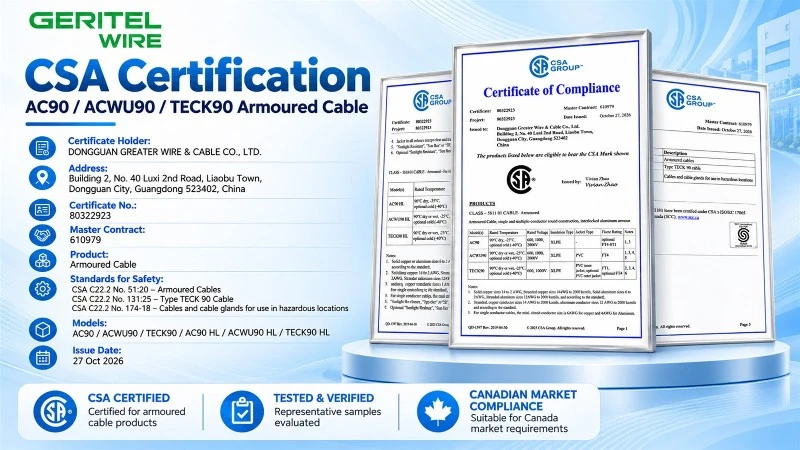
5. Where Is ACWU90 Commonly Used?
PPT - Conductors, Cables, and Raceways PowerPoint Presentation, free download - ID:1617229
slideserve.com
ACWU90 is generally preferred when an installation requires the mechanical protection of metal armour together with an overall jacket suitable for moisture exposure.
5.1 Outdoor Electrical Distribution
ACWU90 can be used for approved outdoor electrical distribution circuits where the selected product has the necessary weather and sunlight resistance.
Examples include:
Outdoor building feeders.
Electrical connections between building sections.
Exterior power distribution.
Suitable industrial outdoor wiring routes.
Sunlight resistance should be confirmed from the product markings and datasheet. Not every jacketed cable automatically has the same UV performance.
5.2 Wet Industrial Locations
China ACWU90 Cable XLPE Insulation AIA Flame-Retardant PVC 600V Manufacturers Suppliers Factory
greaterwire.com
Industrial facilities may contain areas where cables are exposed to moisture, condensation, or periodic water contact.
In these environments, ACWU90 may be more appropriate than standard AC90 because its overall jacket provides additional environmental protection.
However, facilities involving chemical exposure, frequent washdowns, or corrosive conditions should also assess jacket compatibility and the suitability of cable fittings and terminations.
5.3 Underground Electrical Distribution
ACWU90 is commonly considered for certain underground electrical distribution applications in Canada.
Its jacketed construction makes it a candidate for installations where moisture exposure is expected.
Nevertheless, buyers should distinguish between underground installation in a raceway and direct burial in soil.
Before specifying ACWU90 for direct burial, verify that the exact cable is approved for that method and that the installation meets the applicable CEC requirements, including burial depth and mechanical protection where required.
5.4 Wet-Location Cable Tray Installations
ACWU90 may also be suitable for cable tray applications involving wet-location exposure, provided the cable is specifically approved and the complete installation complies with applicable requirements.
This makes it a useful option for certain industrial power distribution systems where cables follow organized tray routes.

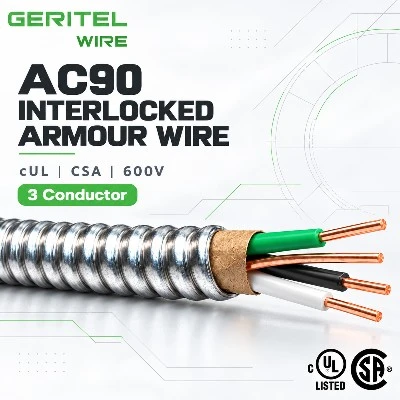
6. AC90 vs ACWU90: Which Cable Should You Choose?
The following practical comparison can help electrical contractors and procurement teams make an initial selection.
When the installation is dry
How Do You Identify AC Wires? - News
greaterwire.com
AC90 is a suitable candidate when:
The installation is in an approved dry location.
An overall moisture-resistant jacket is unnecessary.
The project requires armoured indoor building wiring.
The product's voltage, conductor, and installation ratings meet the project specification.
Choose ACWU90
When moisture protection is required
Is AC90 Cable Waterproof? - News
greaterwire.com
ACWU90 is a suitable candidate when:
The installation involves approved wet locations.
The cable is exposed to outdoor weather.
An overall protective jacket is specified.
The product has the required sunlight, underground, or other environmental approvals.
A Simple Project Example
Consider two electrical distribution projects in Canada.
Project A: Indoor commercial office
An electrical contractor needs to install branch circuits above suspended ceilings in a dry office building.
AC90 may be a suitable choice because the installation does not require wet-location protection. Its simpler construction may also help control material costs.
Project B: Outdoor industrial facility
An industrial facility needs an armoured feeder routed along an exterior building structure exposed to rain and changing weather conditions.
ACWU90 is generally the more appropriate candidate because its overall jacket provides additional environmental protection. The selected product must also have the required outdoor and sunlight-resistance ratings.
These examples illustrate why installation conditions should determine cable selection rather than price or construction appearance alone.
7. What Should Buyers Check Before Ordering AC90 or ACWU90?
For overseas cable importers, electrical distributors, EPC contractors, and project procurement managers, the following specifications should be confirmed before issuing a purchase order.
CSA certification: Verify that the cable is certified to the applicable product standard, including CSA C22.2 No. 51 where relevant.
Conductor material: Specify copper or aluminum according to electrical design and termination requirements.
Conductor size: Confirm the required AWG or kcmil size based on load calculations and applicable ampacity rules.
Number of conductors: Specify the phase, neutral, and bonding conductor configuration.
Insulation: Confirm RW90 XLPE insulation or the specified alternative.
Voltage rating: Check the actual certified voltage rating rather than assuming all AC90 and ACWU90 products have the same rating.
Temperature rating: Confirm the 90°C conductor rating and applicable termination limitations.
Environmental requirements: Identify dry or wet locations, outdoor exposure, sunlight, underground installation, and possible chemical contact.
Flame performance: Verify required FT4 or other applicable flame-test performance from the product certification and datasheet.
Cable dimensions: Request the overall diameter, approximate weight, bending requirements, and relevant installation information.
These details help prevent specification mismatches and reduce the risk of ordering a cable that cannot be used for the intended application.
8. Technical Standards and Research References
The technical distinctions in this article are supported by the following manufacturer and standards documentation:
1. CSA C22.2 No. 51:20 – Armoured Cables: Defines the scope and construction requirements for unjacketed AC90 and jacketed ACWU90 cable types, including their temperature and voltage coverage.
webstore.ansi.org
2. Nexans Canada – AC90 Product Specifications: Provides AC90 construction details, RW90 XLPE insulation, bonding conductor information, and dry-location application limitations.
AC90
3. Nexans Canada – ACWU90 Product Specifications: Describes interlocked aluminum armour, overall PVC jacket, sunlight-resistant construction, and dry/wet-location applications.
Industrial
4. Nexans – Industrial Power Cables: Provides additional application comparisons for AC90, ACWU90, and TECK90.
nexans.ca
Technical note: Cable approvals and permitted installation methods must be verified against the exact certified product, current Canadian Electrical Code requirements, provincial or territorial amendments, and the authority having jurisdiction. General cable descriptions should not replace manufacturer specifications.
GERITEL WIRE – Your Canadian Armoured Cable Manufacturing Partner
Choosing between AC90 and ACWU90 requires more than comparing cable construction. It means selecting the right combination of conductor materials, insulation, armour, and environmental protection for your project. GERITEL WIRE supports electrical distributors, contractors, OEM manufacturers, and industrial buyers sourcing armoured cable solutions for Canadian applications. Whether you need AC90 for dry-location wiring or ACWU90 for approved wet-location installations, our team can help review your technical specifications and explore suitable manufacturing options. Contact GERITEL WIRE to discuss your cable requirements, request product information, and obtain a quotation for your next project.
Dongguan Greater Wire & Cable Co., Ltd.
Tel/WhatsApp/Wechat: +86 136 6257 9592
Tel/WhatsApp/Wechat: +86 135 1078 4550
Email: manager01@greaterwire.com
Website: www.greaterwire.com