

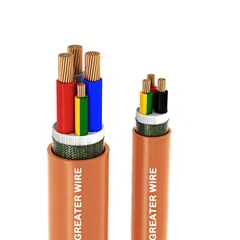
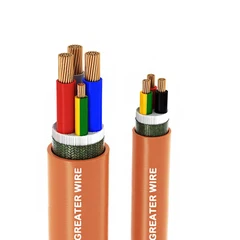

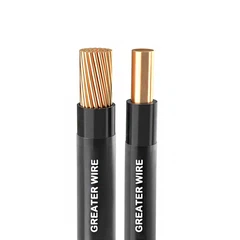
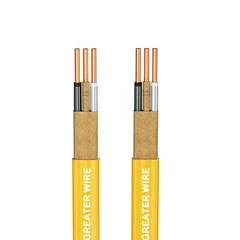

AC90 cable can be installed in many Canadian basements and mechanical rooms, but only when the actual installation environment meets the cable's approved dry-location requirements. The fact that a cable is installed below ground level or inside a mechanical room does not automatically make the location damp or wet. However, recurring condensation, water seepage, and moisture accumulation can change the environmental classification and make standard AC90 unsuitable.
In Canada, conventional AC90 armoured cable is generally approved for exposed or concealed wiring in dry locations. If a basement or mechanical room is normally or periodically subject to moisture condensation, an appropriately certified ACWU90 cable may be a better choice.
For electrical contractors, distributors, building engineers, and procurement managers, understanding this distinction helps prevent cable specification errors and ensures that the selected wiring method complies with Canadian electrical requirements.

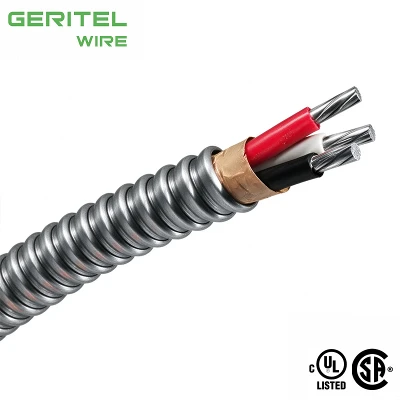
1. What Is AC90 Cable and Why Does Its Location Matter?
600V AC90-12/2 X 150m Type AC90 Armored Cable - Electric Cable and AC Bx Cable
m.made-in-china.com
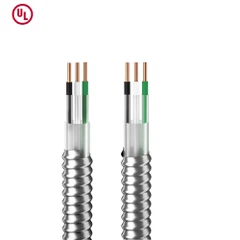
AC90 is a Canadian armoured electrical cable commonly used in commercial, residential, and industrial building installations.
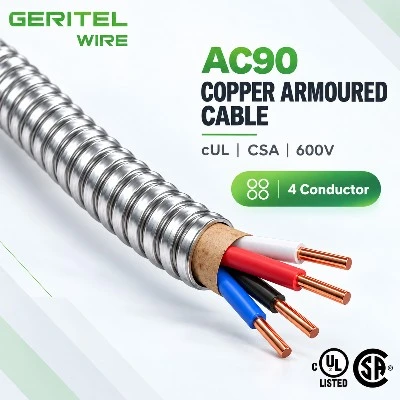
A typical AC90 cable consists of three main components:
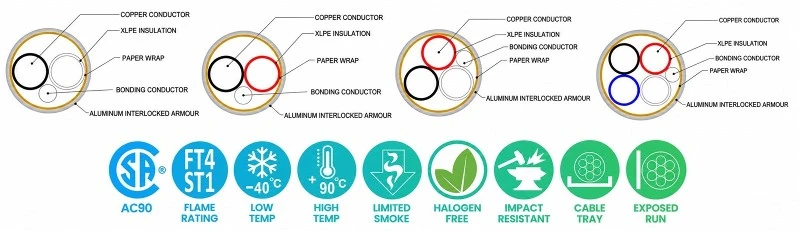
1.1 Insulated Conductors
AC90 commonly uses copper or aluminum conductors with RW90 cross-linked polyethylene (XLPE) insulation.
The RW90 designation indicates a conductor insulation type with a maximum operating temperature of 90°C under specified conditions.
1.2 Bonding Conductor
A bare copper or aluminum bonding conductor is incorporated into the cable assembly, depending on the product design.
It provides an electrical bonding path and helps establish a suitable fault-current path in the event of an electrical fault.
1.3 Interlocked Metal Armour
The outer layer typically consists of interlocked aluminum armour.
This armour provides mechanical protection for the internal conductors and allows the cable to be routed through suitable building spaces without installing a separate conduit around every cable run.
Why Does the Installation Environment Matter?
The main issue is that conventional AC90 is generally intended for dry locations.
Although RW90 insulation itself has moisture-related performance characteristics, this does not automatically make the complete AC90 cable suitable for damp or wet installations.
The overall cable construction, certification, and approved application must be considered.
For example, Nexans specifies its AC90 product for open and concealed wiring in dry locations only.
AC90+1
This distinction is especially important in basements and mechanical rooms, where moisture conditions can change throughout the year.
2. Is a Basement Considered a Damp Location Under Canadian Electrical Requirements?
Not necessarily.
A basement is a building location, not an automatic electrical environmental classification. Its suitability for AC90 depends on actual moisture conditions.
Under the Canadian Electrical Code, CSA C22.1, a damp location generally refers to an interior or exterior area that is normally or periodically subject to moisture condensation in, on, or adjacent to electrical equipment.
A dry location is one that is not normally subject to dampness, although temporary moisture during construction may be acceptable when adequate ventilation prevents moisture accumulation.
Object, scope, and definitions
2.1 When Can a Basement Be Considered a Dry Location?
Home Theatre Installation King City | Dolby Atmos | SetupTeam
setupteam.ca
A basement may be suitable for AC90 when:
The foundation and surrounding structure prevent water infiltration.
There is no recurring condensation on walls, ceilings, or electrical equipment.
Humidity is adequately controlled.
There are no regular leaks or water accumulation.
The cable installation remains within the approved dry-location conditions.
For example, a finished basement with effective waterproofing, ventilation, and moisture control may qualify as a dry location.
In this situation, AC90 may be a suitable wiring option, provided the product and installation method meet the applicable requirements.
2.2 When Should a Basement Be Treated as a Damp Location?
Condensation on Basement Walls: Causes and Fixes
basementmoistureguide.com
A basement may be considered damp when it experiences recurring or periodic moisture condensation.
Common warning signs include:
Condensation on concrete walls or ceilings.
Persistent moisture around electrical equipment.
Regular condensation on exposed metal surfaces.
Seasonal moisture accumulation.
Poor ventilation combined with recurring condensation.
The important factor is not simply whether the basement feels humid. The electrical classification depends on the actual conditions described by the applicable code definitions.
If the location is normally or periodically subject to condensation, conventional AC90's dry-location limitation becomes important.
2.3 What About a Basement With Occasional Water Leakage?
Occasional water leakage requires particular attention.
A basement that experiences water seepage, flooding, or standing water cannot automatically be treated as a dry location.
The extent of exposure, possibility of water contacting the cable, and the specific installation conditions must be evaluated.
A cable approved for wet locations may be necessary, together with appropriate fittings, terminations, and additional protection.
ACWU90 is one possible alternative, but the exact product approval and installation requirements must be verified before selection.
3. Can AC90 Cable Be Installed in a Mechanical Room?
Yes, AC90 can be used in a mechanical room if the room qualifies as a dry location and the cable is approved for the intended installation.
A mechanical room is not automatically classified as damp or wet simply because it contains plumbing, HVAC equipment, pumps, or water-related systems.
However, these installations can create conditions that require additional consideration.
3.1 Dry Mechanical Rooms
Services engineering | BAM
bam.co.uk
AC90 may be suitable for electrical wiring in a mechanical room where:
HVAC equipment operates without producing recurring condensation around the cable route.
Plumbing connections are properly maintained and do not leak.
The room has adequate ventilation.
Electrical equipment and cable routes are protected from moisture exposure.
The installation complies with applicable CEC requirements.
Typical applications may include suitable power connections, lighting circuits, and branch-circuit wiring.
3.2 Mechanical Rooms With Condensation Problems
Minimizing Condensation Through Surface Emissivity | Armacell
armacell.com
Mechanical rooms frequently contain chilled-water pipes, cooling equipment, refrigeration systems, and HVAC components.
When warm, humid air contacts sufficiently cold surfaces, condensation can form.
This creates several potential problems:
Moisture may accumulate on nearby electrical equipment.
Water droplets may contact cable surfaces.
Condensation may occur around cable supports and connections.
Persistent moisture may affect electrical fittings and terminations.
If condensation occurs normally or periodically in the cable installation area, the location may meet the CEC definition of a damp location.
In such cases, standard AC90 should not be assumed acceptable.
3.3 Mechanical Rooms With Pumps and Water Systems
Mechanical rooms containing pumps, water heaters, drainage equipment, or plumbing systems require an assessment of their actual operating conditions.
For example, a pump room with properly maintained equipment and no moisture accumulation may remain a dry location.
However, a room with recurring leaks, water splashing, or condensation around electrical installations may require a different wiring method.
The decision should be based on the environmental conditions at the cable route and connection points, not simply the name or purpose of the room.
4. AC90 vs. ACWU90: Which Cable Is Better for Damp Basements and Mechanical Rooms?
When moisture is a concern, ACWU90 is an important alternative to consider.
Both AC90 and ACWU90 are Canadian armoured cable types, but their overall construction and environmental applications differ.
China CSA AC90 BX Cable Aluminum Conductor PVC Or XLPE/AIA 600V Manufacturers Suppliers Factory
AC90
Interlocked metal armour without an overall protective jacket.
China CSA ACWU90 Cable 4 conductor 600V AIA Flame Retardant Manufacturers Suppliers Factory - Customized CSA ACWU90 Cable 4 conductor 600V AIA Flame Retardant Made in China
ACWU90
Interlocked metal armour covered by an overall protective jacket.
4.1 Construction Differences
|
Feature |
AC90 |
ACWU90 |
|---|---|---|
|
Insulated conductors |
Typically RW90 XLPE |
Typically RW90 XLPE |
|
Conductor material |
Copper or aluminum, depending on product |
Copper or aluminum, depending on product |
|
Bonding conductor |
Included according to product design |
Included according to product design |
|
Metal armour |
Typically interlocked aluminum |
Typically interlocked aluminum |
|
Overall jacket |
No |
Yes, commonly PVC |
|
Typical voltage |
600V |
600V |
|
Conductor temperature |
90°C |
90°C |
|
Dry-location use |
Yes |
Yes |
|
Damp-location use |
Standard products generally unsuitable |
Yes, when approved |
|
Wet-location use |
Standard products generally unsuitable |
Yes, when approved |
The overall jacket is the key construction difference.
ACWU90 typically incorporates a PVC jacket over the metallic armour. This provides an additional barrier against moisture and environmental exposure.
Southwire and Nexans identify their ACWU90 products for exposed and concealed wiring in dry or wet locations, with product-specific outdoor and sunlight-resistance approvals.
cabletechsupport.southwire.com+1
4.2 When Should You Choose AC90?
Suitable for approved dry locations
AC90 is a reasonable choice when:
The basement has effective moisture control.
The mechanical room does not experience recurring condensation.
There is no regular water exposure.
The cable is installed in an approved dry-location wiring arrangement.
The product specifications meet the project's electrical requirements.
For these applications, an overall moisture-resistant jacket may not be necessary.
4.3 When Should You Choose ACWU90?
Designed for approved wet-location applications
ACWU90 may be more appropriate when:
The basement is subject to recurring condensation.
The mechanical room contains equipment that creates moisture exposure.
The cable route is exposed to outdoor weather.
The installation requires an approved wet-location armoured cable.
The project specifications require an overall protective jacket.
However, ACWU90 should not be treated as a universal solution for every water-related installation. Direct burial, sunlight exposure, chemical contact, hazardous locations, and other special applications require confirmation of the exact cable approval.
5. What Happens If AC90 Is Installed in a Damp Environment?
Using a dry-location cable in an environment that does not meet its approved application requirements creates unnecessary electrical and maintenance risks.
Several issues deserve attention.
5.1 Moisture Can Affect Cable Connections
Thermal Sensor Cable IP Rating - The Rating Stops Where the Cable Does
thermalsensorcable.com
Moisture can accumulate around cable connectors, junction boxes, and electrical equipment.
If fittings and terminations are not suitable for the environment, moisture may contribute to corrosion, deterioration of connections, or reduced electrical reliability.
The cable itself is only one part of the complete wiring system.
5.2 Metal Armour and Connections May Experience Corrosion
AC90's interlocked metal armour provides mechanical protection, but it should not be assumed to offer unlimited corrosion resistance.
Persistent moisture and aggressive environmental substances can affect exposed metallic components and associated fittings.
This is another reason to select the correct cable construction and compatible accessories.
5.3 Electrical Maintenance Requirements May Increase
In damp environments, unsuitable cable installations can create additional inspection and maintenance requirements.
Problems may include:
Corroded connectors.
Deteriorated fittings.
Moisture accumulation around electrical equipment.
Unexpected electrical faults.
Premature replacement of affected components.
Selecting a cable approved for the actual environment helps reduce these risks.
Important: The presence of moisture does not mean that AC90 will immediately fail. However, using a cable outside its approved application is not an acceptable substitute for choosing the correct wiring method.
6. How to Determine Whether Your Basement or Mechanical Room Needs AC90 or ACWU90
For electrical contractors and project procurement teams, the following checklist can help identify the appropriate cable type.
|
Inspection item |
What to check |
Initial cable consideration |
|---|---|---|
|
Basement walls |
Are they dry, without recurring condensation? |
AC90 may be suitable |
|
Concrete surfaces |
Is there regular moisture accumulation? |
Consider ACWU90 |
|
HVAC equipment |
Does it produce recurring condensation near the cable route? |
Consider ACWU90 |
|
Plumbing systems |
Are there recurring leaks or water exposure? |
Consider ACWU90 or another approved wiring method |
|
Room ventilation |
Is moisture adequately controlled? |
Evaluate actual conditions |
|
Outdoor cable route |
Is the cable exposed to rain or weather? |
ACWU90 with appropriate approvals |
|
Underground installation |
Is the cable directly buried or installed in a raceway? |
Verify specific cable approval |
Five Technical Checks Before Purchasing
Before specifying AC90 or ACWU90, buyers should confirm the following information.
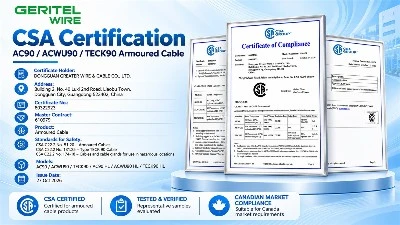
1. Cable certification: Check that the cable is certified to the applicable CSA product standard, particularly CSA C22.2 No. 51 for armoured cables.
2. Voltage rating: Confirm the actual product voltage rating. Many common Canadian AC90 and ACWU90 products are rated 600V.
3. Conductor material and size: Specify copper or aluminum conductors and the required AWG or kcmil size according to electrical load calculations.
4. Temperature rating: Verify the 90°C conductor rating and applicable termination temperature limitations.
5. Environmental approval: Confirm whether the cable is approved for dry, damp, or wet locations, and check additional requirements such as sunlight resistance, direct burial, and chemical exposure where relevant.
These checks are particularly important for electrical distributors and importers purchasing cables for Canadian construction and industrial projects.
7. Frequently Asked Questions About AC90 Cable in Basements and Mechanical Rooms
Q1: Can AC90 cable be installed in a finished basement?
Yes, provided the basement qualifies as a dry location and the specific AC90 product is approved for the installation. A finished basement with effective waterproofing, ventilation, and no recurring condensation may be suitable.
Q2: Can AC90 cable be installed near a water heater?
Potentially, yes. The presence of a water heater does not automatically make the surrounding area a damp location.
However, contractors should consider condensation, leakage, temperature exposure, and the actual cable routing conditions. The cable must also maintain the required clearances and comply with equipment installation instructions.
Q3: Can AC90 cable be installed in an HVAC room?
Yes, if the room and cable route meet the dry-location requirements.
If chilled-water pipes, refrigeration equipment, or HVAC components create recurring condensation around the cable installation, standard AC90 may not be suitable.
Q4: Is ACWU90 better than AC90 for every basement installation?
No. ACWU90 offers additional environmental protection, but it may not be necessary in a properly maintained dry basement.
The selection should reflect actual moisture conditions, product approvals, installation requirements, and project specifications rather than assuming that a more heavily protected cable is always the better option.
Q5: Can ACWU90 be directly buried outside a basement?
Some ACWU90 products are approved for direct burial. However, buyers must verify the exact product marking, manufacturer documentation, and applicable Canadian Electrical Code requirements before specifying underground installation.
Q6: Does RW90 insulation make AC90 suitable for wet locations?
No. This is an important distinction.
RW90 is a conductor insulation designation. Its moisture-related properties do not automatically determine the environmental approval of the complete AC90 cable assembly.
The cable type and its certification must be checked separately.

8. Final Recommendation: Is AC90 Suitable for Your Basement or Mechanical Room?
AC90 can be an appropriate choice for Canadian basements and mechanical rooms, but only when the actual installation environment qualifies as dry and the cable is approved for the intended wiring method.
A clean, well-ventilated basement without recurring condensation may be suitable for AC90. A mechanical room with regular moisture condensation, water exposure, or persistent dampness requires a different assessment.
When moisture protection is required, ACWU90 is often a more suitable alternative because its overall jacket provides additional environmental protection and its certified product configurations can be approved for wet-location applications.
For contractors, distributors, and procurement professionals, the most reliable approach is to evaluate the environment first, verify the cable's certification second, and select the product that meets the complete installation requirements.
GERITEL WIRE – Your Reliable Armoured Cable Supply Partner
Selecting the right armoured cable for basements, mechanical rooms, and industrial facilities requires careful consideration of moisture exposure, cable construction, and Canadian certification requirements. GERITEL WIRE supplies AC90 and ACWU90 cable solutions for commercial, residential, and industrial electrical applications. Whether your project requires conventional armoured cable for dry locations or jacketed ACWU90 for approved damp and wet environments, our team can help review conductor specifications, cable configurations, and technical requirements. Contact GERITEL WIRE to discuss your project, request product documentation, and obtain a quotation for your Canadian cable sourcing needs.
Dongguan Greater Wire & Cable Co., Ltd.
Tel/WhatsApp/Wechat: +86 136 6257 9592
Tel/WhatsApp/Wechat: +86 135 1078 4550
Email: manager01@greaterwire.com
Website: www.greaterwire.com
Technical Research References
The technical discussion is based on Canadian electrical code definitions and manufacturer documentation.
1. CSA C22.1:24 – Canadian Electrical Code, Part I, Section 0: Definitions of dry and damp locations.
Object, scope, and definitions
2. Nexans Canada – AC90 Cable: Construction, RW90 XLPE insulation, 600V rating, and dry-location application restrictions.
AC90+1
3. Nexans Canada – ACWU90 Cable: Construction, overall PVC jacket, and approved dry- and wet-location applications.
Industrial
4. Southwire Canada – ACWU90 Specifications: Jacket construction, sunlight resistance, wet-location applications, and direct-burial product information.
cabletechsupport.southwire.com+1
5. GERITEL WIRE – ACWU90 Product Information: Product construction and application details.
Greater Wire