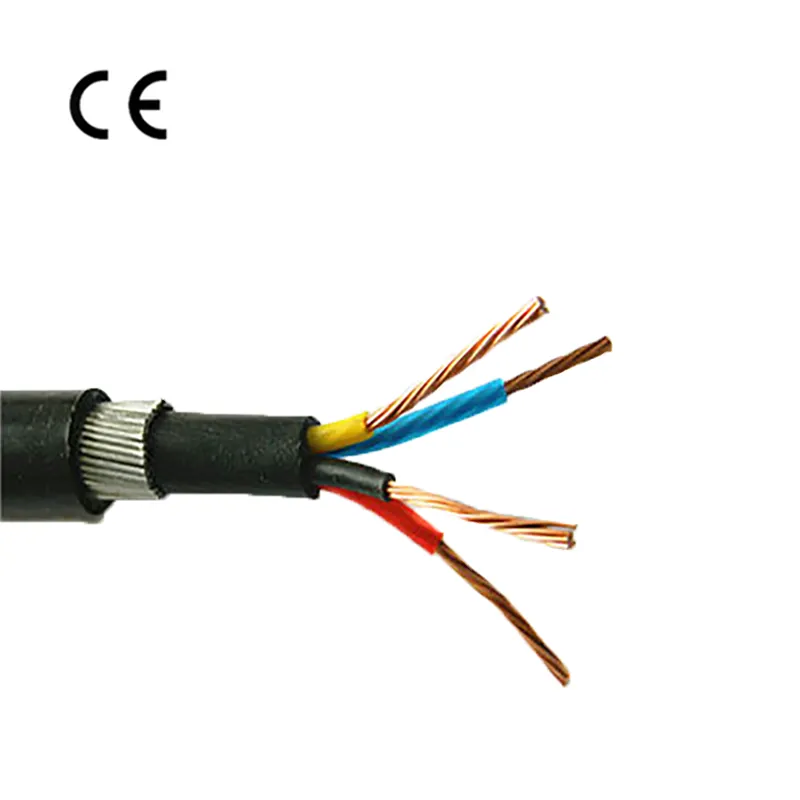
In single core medium voltage cables, aluminum wire armor is used to avoid eddy current losses and ensure that the cable can withstand a certain amount of tension. Because in the actual operation of cable installation, both armor and shielding need to be grounded. Most foreign power systems belong to Class A systems, where the neutral point is directly grounded. In such systems, a large grounding short-circuit current is required. That is, in the event of a short circuit in the cable, the shielding and armor can conduct the current to the ground through a relatively large short-circuit current, thereby protecting the cable from damage. Therefore, the calculation of short-circuit current for aluminum wire armor is an essential skill for engineering and technical personnel. In the IEC standard, there is no formula for calculating the short-circuit current of aluminum wire armor, only copper tape shielding and copper wire shielding are available. However, it is still possible to calculate and derive the short-circuit current of aluminum wire armor based on IEC standards and other domestic and foreign materials, and obtain accurate short-circuit current data that can withstand practical testing, thus playing an important role in the research, design, and manufacturing process of cables.
The calculation method for the rated short-circuit current of any current carrying part in a cable usually assumes that heat is retained inside the carrier fluid during the duration of the short circuit (i.e. adiabatic heating). In fact, during a short circuit, some heat will be transferred to adjacent materials, which means that the short-circuit current can be larger, that is, considering the non adiabatic effect. The non adiabatic method is effective throughout the entire process of a short circuit.
Compared with the adiabatic method, using the non adiabatic method for calculation allows for a significant increase in short-circuit current for shielding layers, protective layers, and conductors smaller than 10mm2 (especially used as shielding wires).
The calculation of non adiabatic short-circuit current for aluminum wire armor is as follows:
1, Calculation of correction factors considering non adiabatic effects
Due to the fact that the interior of the aluminum wire armor is a PVC protective layer, while the exterior needs to be tied with non-woven fabric before the PVC outer sheath can be extruded, the surrounding media parameters only need to consider the PVC protective layer and non-woven fabric. In the formula, σ 2, σ 3-- specific heat of the medium around the aluminum wire armor layer (J/Kom3)
Also: PVC protective layer with σ 2=1.7 × 10⁶J/Kom3
Non woven fabric fiber σ 3=2.0 × 10⁶J/Kom3
Also: Thermal resistance of the surrounding medium of the aluminum wire armor layer with ρ 2 and ρ 3 (Kom/W)
PVC protective layer ρ 2=6.0Kom/W
Non woven fabric fiber ρ 3=6.0Kom/W
F - Incomplete contact factor considering thermal imperfect contact between aluminum wire armor and surrounding non-metallic materials, F=0.5
σ 1- Specific heat of shielding layer, protective layer or armor layer, J/Kom3 Aluminum wire σ 1=2.5 × 10⁶J/Kom3
By substituting all parameters into the calculation:
ε=1.158 Non adiabatic coefficient.
2, The calculation formula for short-circuit current in adiabatic process:
Among them, the shielding cross-sectional area of S - cable, taking YJV7212/20kV1 × 500 as an example, S=60 * 2.5 ^ 2 * 0.7854=295mm2
IAD aluminum wire armor shields short-circuit current
The reciprocal of β temperature coefficient, 228
The final short-circuit temperature of θ f is 250 ℃
Initial short-circuit temperature of θ i, θ i=90 ℃
Specific heat capacity of conductor at σ c 20 ℃, 2.5 × 10⁶J/Kom3
The resistivity of the conductor at ρ 2020 ℃ is 2.8264x10⁻⁸ Ω. m. T is the short circuit time (S) taken as 1 second.
Then, the adiabatic process allows a short-circuit current (1 second) of 28.87kA
3, Calculation of Short Circuit Current for Non adiabatic Effect
According to the above calculation process,
The allowable short-circuit current (1 second) for non adiabatic processes is:=1.158 * 28.87=33.43kA
From the above calculations, it can be seen that the non adiabatic short-circuit current of aluminum wire armor has actually increased significantly compared to adiabatic short-circuit current. The IEC949 (1988) standard has already assumed the worst-case calculation conditions, which means that the margin has actually been considered in the calculation. Of course, the calculation result of the rated short-circuit current is biased towards safety. The above calculation is basically still based on the calculation formula for copper wire shielding in the IEC949 (1988) standard, except that the surrounding medium of aluminum wire armor is different from that of copper wire shielding, and the corresponding parameters of copper wire in the original formula have been replaced with those of aluminum wire.
In addition, based on foreign experience, the final short-circuit temperature of the metal shielding layer can reach 350 ℃. For safety reasons, there are also options to reach 300 ℃. To improve the safety level of China's power grid, the actual calculation is based on 300 ℃. And the above metal shields are all for copper strips or copper wires. Aluminum wire armor should be different from copper shielding because aluminum has weaker resistance to high temperatures than copper. We referred to the final short-circuit temperature of the aluminum conductor in the actual calculation, calculated at 250 ℃. This calculated short-circuit current ensures that the armored aluminum wire will not have safety issues due to overload during actual short-circuit