







Clarifying a Common Misunderstanding
In fire safety engineering and electrical system design, fireproof cables (also known as fire-resistant cables) are widely specified for critical circuits. However, a frequently misunderstood question arises during design reviews, inspections, and even procurement:
Does a fireproof cable need to be continuously powered while it is exposed to flames?
At first glance, the question may seem straightforward, but it actually touches on several deeper technical concepts, including circuit integrity, functional continuity, fire testing philosophy, system design intent, and regulatory compliance. Misunderstanding this issue can lead to improper cable selection, incorrect test interpretation, or unsafe system design.
This article provides a comprehensive and professional explanation of whether continuous power is required, why it matters, how standards address it, and how engineers should apply the concept in real projects.

What "Fireproof Cable" Really Means
Definition of a Fireproof (Fire-Resistant) Cable
A fireproof cable is not simply a cable that does not burn. Its defining characteristic is:
The ability to maintain circuit integrity and electrical functionality for a specified period when exposed to fire conditions.
This differentiates fireproof cables from ordinary flame-retardant cables, which are designed only to slow flame spread, not to remain operational during a fire.
Core Design Objective
The primary objective of a fireproof cable is:
To continue carrying current or signals
Under direct flame exposure
At very high temperatures (typically 750–950 °C)
For a defined duration (30, 60, 90, or 120 minutes)
This objective directly links the concept of fireproof cables to continuous power delivery.
Understanding "Continuous Power" in a Fire Scenario
What Does "Continuously Powered" Mean?
In the context of fireproof cables, continuous power means:
The cable remains energized
Electrical current or signals continue to flow
The circuit does not open, short, or ground-fault
Voltage and signal integrity remain within acceptable limits
It does not mean the cable generates power on its own. Power must still come from:
Emergency generators
Fire-rated power supplies
Battery backup systems
Why This Concept Matters
Fireproof cables are functional safety components. If they are not energized during a fire, their core purpose-maintaining system operation-is meaningless.
In other words:
A fireproof cable that is not carrying power during a fire is not fulfilling its intended function.

Why Fireproof Cables Are Designed to Remain Powered in Flames
Life Safety Systems Depend on Continuous Operation
Fireproof cables are primarily used in life-critical systems, such as:
Fire alarm loops
Emergency lighting
Smoke extraction fans
Fire pumps
Public address and evacuation systems
Firefighter communication lines
All these systems must remain operational during the fire, not after it.
Consequences of Power Loss During Fire
If power is lost during a fire:
Fire alarms stop transmitting signals
Emergency lighting goes dark
Smoke extraction systems fail
Fire pumps cannot deliver water
Evacuation becomes chaotic and dangerous
Therefore, continuous power delivery is not optional-it is the very reason fireproof cables exist.
How Fireproof Cable Testing Standards Address Continuous Power
Fire Resistance Testing Philosophy
International fire-resistance standards are built around one key principle:
The cable must remain electrically functional while energized during fire exposure.
This means the cable is actively carrying current throughout the test.
Examples of Key Standards
IEC 60331
Cable is energized at rated voltage
Exposed to flame at ~750–950 °C
Must maintain circuit integrity for the test duration
BS 6387
Tests include fire, fire with water spray, and fire with mechanical shock
Circuit continuity is continuously monitored
EN 50200
Cable is energized
Flame, impact, and mechanical stress are applied
Any loss of continuity is considered failure
UL Fire-Resistant Cable Tests
Measure conductor continuity during fire exposure
Focus on functional survivability under real fire conditions
Conclusion from standards:
A fireproof cable is expected to be powered during fire exposure.
Structural Reasons Fireproof Cables Can Remain Powered
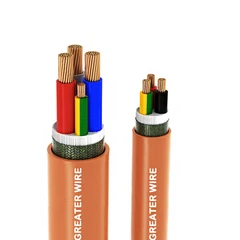
Fireproof Cable Construction
Fireproof cables use specialized structures that allow continued power transmission:
Copper conductors with stable high-temperature performance
Mica tape or ceramic-forming insulation layers
Heat-resistant primary insulation (e.g., silicone rubber)
Flame-retardant or LSZH outer sheaths
What Happens During a Fire
During a fire:
Organic insulation may char or burn away
Mica or ceramic layers remain intact
These layers maintain dielectric separation between conductors
The conductor path remains continuous
This design specifically enables safe current flow during flames.
Does the Cable Need to Be Powered for the Fireproof Property to Exist?
A Critical Clarification
A fireproof cable does not lose its fire resistance if it is temporarily unpowered.
However:
Its fireproof performance can only be verified and meaningful when energized
Fire resistance is defined in terms of functional continuity, not material survival alone.
Passive vs Functional Fire Resistance
| Concept | Flame-Retardant Cable | Fireproof Cable |
|---|---|---|
| Burns slowly | Yes | Usually |
| Stops flame spread | Yes | Yes |
| Maintains power | No | Yes |
| Requires energization to prove performance | No | Yes |
Thus, continuous power is integral to the definition, even if not physically mandatory at every moment.
Relationship Between Fireproof Cables and Power Supply Design
Fireproof Cables Do Not Replace Emergency Power
A common mistake is assuming:
"If we use fireproof cables, power will always be available."
This is incorrect.
Fireproof cables only preserve the path, not the source. Engineers must also ensure:
Fire-rated generators
Redundant feeders
Battery or UPS systems
Fire-separated routing
System-Level Fire Survivability
True fire survivability requires:
Fireproof cables
Fire-rated power sources
Fire-resistant supports and fixings
Protected routing and fire compartmentalization
Without continuous power supply, even the best fireproof cable cannot perform its function.

Common Misconceptions Clarified
Misconception 1: "Fireproof cables only need to survive fire, not work"
❌ Incorrect
✔ Fireproof cables are designed to work during fire
Misconception 2: "Fireproof cables work even without power"
❌ Incorrect
✔ They require energization to perform their safety function
Misconception 3: "Flame-retardant cables can replace fireproof cables"
❌ Incorrect
✔ Flame-retardant cables do not guarantee circuit integrity
Engineering Guidance: When Continuous Power Is Mandatory
Continuous power during fire is mandatory for:
Fire alarm and detection circuits
Emergency lighting feeders
Smoke control and pressurization systems
Fire pumps and sprinkler controllers
Firefighter communication systems
In contrast, non-critical circuits may only require flame-retardant cables.
Regulatory and Legal Perspective
Most building and fire codes specify:
"Circuits shall remain operational during fire for X minutes"
This implicitly requires continuous power
Failure to provide powered fireproof circuits can result in:
Code violations
Failed inspections
Increased liability
Insurance rejection
Final Answer to the Question
Yes-by design and intent, a fireproof cable is expected to remain continuously powered while exposed to flames.
Not because the cable needs power to exist, but because:
Its purpose is to maintain electrical functionality
Its performance is defined by circuit integrity
Its value lies in supporting life safety systems during fire
A fireproof cable without power is merely a heat-resistant material.
A fireproof cable with power is a life-saving system component.
At Dongguan Greater Wire & Cable Co., Ltd., we understand that choosing the right wire and cable solutions is critical to the success and safety of your projects.
Our experienced pre-sales and after-sales teams provide:
Professional technical consultation
Accurate product selection and application guidance
Fast and responsive support throughout the entire project lifecycle
Whether you are working on small-scale installations or large industrial projects, we are committed to delivering reliable solutions and practical support tailored to your specific requirements.
Contact Us
Dongguan Greater Wire & Cable Co., Ltd.
📞 Tel / WhatsApp / WeChat
+86 135 1078 4550
+86 136 6257 9592
📧 Email
manager01@greaterwire.com
We look forward to supporting your next project with quality products, technical expertise, and dependable service.