

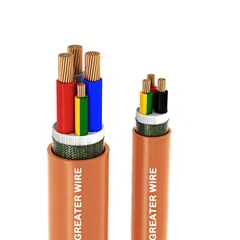
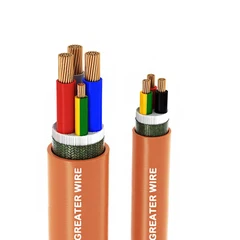

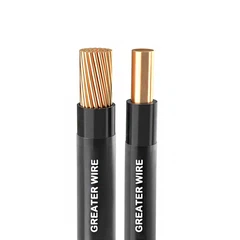
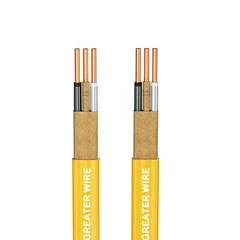
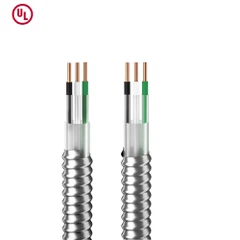

When ACWU90 cable is installed outdoors, exposed to sunlight, or routed through areas where ultraviolet (UV) radiation reaches its outer surface, sunlight resistance is an important product characteristic to verify.
Long-term exposure to sunlight can gradually degrade some non-metallic cable materials. Depending on the material formulation and exposure conditions, UV degradation may cause discoloration, surface cracking, embrittlement, or reduced mechanical performance. Damage to the outer jacket can eventually affect the cable's protective barrier.
However, not every ACWU90 product has identical sunlight-resistant properties. The cable designation, black PVC jacket, aluminum interlocked armour, and 90°C temperature rating do not independently prove that a particular product has passed the required sunlight-resistance evaluation.
So, how can you verify it?
The most reliable approach is to check the actual cable marking, review the manufacturer's technical datasheet, confirm the applicable product certification, and obtain supporting test documentation when necessary.
This guide explains how to verify sunlight resistance on ACWU90, what markings to look for, which documents to request, and how to avoid common mistakes when purchasing cable for outdoor electrical installations.
1. Why Is Sunlight Resistance Important for ACWU90 Cable?
Sunlight contains ultraviolet radiation that can affect polymer materials used in electrical cable construction.
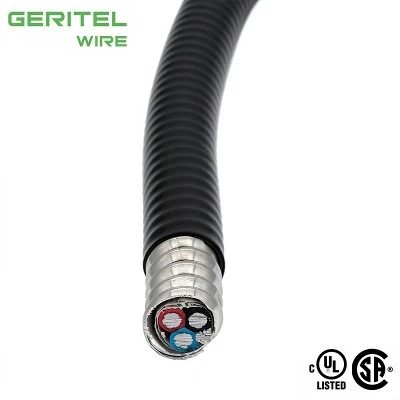
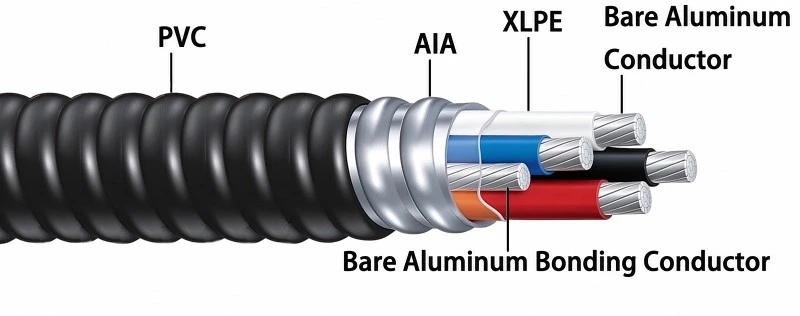
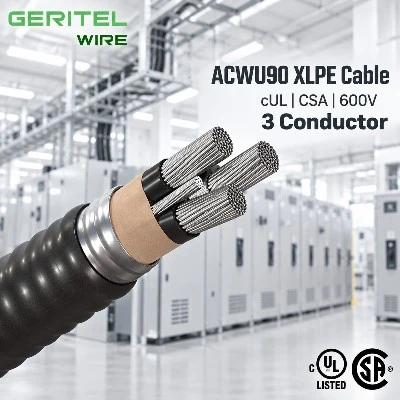
ACWU90 commonly uses cross-linked polyethylene (XLPE) insulation, aluminum interlocked armour, and an outer PVC jacket. The exact construction depends on the manufacturer and product configuration.
Although aluminum armour provides mechanical protection, it does not automatically establish the UV performance of every non-metallic component.
1.1 UV Exposure Can Degrade Cable Materials
UV radiation can initiate chemical changes in certain polymers. Over time, these changes may affect the physical properties of exposed insulation or jacket materials.
Possible signs of degradation include:
Surface discoloration or fading.
Fine cracks on the outer jacket.
Loss of flexibility.
Surface chalking or powdering.
Embrittlement and reduced resistance to mechanical stress.
These symptoms are not exclusive to UV damage. Heat, chemical exposure, abrasion, incorrect installation, and natural aging can cause similar problems.
Therefore, visual inspection alone cannot establish whether a cable has passed a recognized sunlight-resistance test.
1.2 The Outer PVC Jacket Needs Particular Attention
In typical jacketed ACWU90 construction, the outer PVC jacket is the surface most directly exposed to sunlight.
Its performance depends on the PVC formulation, stabilizers, pigments, manufacturing process, and applicable product requirements.
A black PVC jacket may contain carbon black or other additives that improve resistance to UV exposure. However, jacket colour alone is not proof of compliance.
For example, two black-jacketed ACWU90 products from different manufacturers may have different material formulations and test results.
The buyer should verify the actual product rating rather than assume that all black PVC jackets provide the same level of sunlight resistance.
1.3 Sunlight Resistance Supports Long-Term Outdoor Performance
Some ACWU90 installations may be exposed to sunlight for extended periods, including:
Outdoor cable runs on industrial buildings.
Exposed wiring between electrical equipment.
Outdoor cable tray installations.
Cable sections running along building walls.
Above-ground transitions from underground routes.
Outdoor equipment connections.
In these applications, sunlight resistance helps reduce the risk of premature deterioration of exposed non-metallic materials.
However, it does not mean that the cable is immune to all environmental damage. Water exposure, chemicals, temperature extremes, abrasion, and installation conditions must also be considered.
2. What Does Sunlight Resistant Mean on an ACWU90 Cable?
Sunlight resistance means that the relevant cable material or product has been evaluated against specified UV or weather-resistance requirements under an applicable product standard or certification program.
For cable buyers, the important distinction is between a manufacturer's general statement and a verified product rating.
A statement such as "UV-resistant PVC jacket" may describe a material feature, but it does not necessarily establish that the complete cable product has been evaluated and certified for the required application.
2.1 Understand the SR and SUN RES Markings
For Canadian ACWU90 products, common sunlight-resistance markings include:
| Marking | General meaning |
|---|---|
| SR | Sunlight resistant |
| SUN RES | Sunlight resistant |
| SUNLIGHT RESISTANT | Sunlight-resistant designation |
The exact marking depends on the applicable product standard and certification requirements.
For example, Nexans identifies its ACWU90 product as sunlight resistant and specifies that the cable is marked "SUN RES." Its product documentation also identifies sunlight-resistant XLPE insulation and a sunlight-resistant PVC outer jacket.
Southwire similarly identifies its Canadian ACWU90 product as CSA sunlight resistant and provides a sample cable legend containing "SUN. RES."
These examples demonstrate that sunlight resistance can be identified in the product documentation and cable marking.
However, they do not establish that every ACWU90 product from every manufacturer has the same rating.
2.2 Does Every ACWU90 Cable Have to Be Marked SUN RES?
No. Do not assume that the ACWU90 designation automatically guarantees a sunlight-resistant rating.
The additional rating must be supported by the applicable product certification and manufacturer documentation.
When evaluating a product, check:
Whether the cable is specifically identified as sunlight resistant.
Whether the rating applies to the complete cable or a particular material component.
Whether the actual ordered construction is covered by the certification.
Whether the cable marking matches the technical datasheet.
Whether the rating is suitable for the intended installation.
If the cable has no visible sunlight-resistance marking, do not immediately conclude that it is unsuitable. Some product standards and certification arrangements have different marking provisions.
Instead, request the manufacturer's certification documentation and confirm the rating with the relevant certification body.
3. How Do You Verify Sunlight Resistance on ACWU90 Cable?
There are four practical verification steps: inspect the cable legend, review the datasheet, verify certification, and request supporting test information when required.
Using all four steps provides a stronger basis for procurement approval than relying on a catalogue description alone.
3.1 Step 1: Check the Printed Cable Legend
Start by examining the identification printed on the actual cable.
A manufacturer's cable legend may contain information such as:
Manufacturer's name.
Conductor size and material.
Number of conductors.
ACWU90 designation.
XLPE insulation identification.
Voltage rating.
Temperature rating.
CSA certification identification.
Additional performance markings.
For a sunlight-resistant product, look for markings such as:
SR
SUN RES
SUNLIGHT RESISTANT
A simplified example of a cable legend could look like this:
MANUFACTURER 3C 4/0 AWG AL ACM ACWU90 XLPE 600V 90C CSA SUN RES
This is an illustrative example only, not an official marking format.
The actual cable legend may include additional information, different abbreviations, or a different sequence.
Important: Check the marking on the cable itself rather than relying only on a product label, quotation, or online catalogue.
Where possible, compare the marking on the delivered cable with the approved purchase specification.
3.2 Step 2: Review the Manufacturer's Technical Datasheet
The technical datasheet should provide more detailed information about the cable's construction and performance.
Look for a dedicated section covering environmental ratings, product features, or certifications.
A suitable datasheet should help you confirm:
| Datasheet information | What to verify |
|---|---|
| Cable designation | ACWU90 |
| Insulation material | XLPE, commonly RW90 |
| Armour | Aluminum interlocked armour |
| Outer jacket | PVC or the specified jacket material |
| Sunlight resistance | Explicitly identified rating |
| Voltage rating | Suitable for the electrical system |
| Temperature rating | Applicable conductor temperature rating |
| Wet-location rating | Confirmed for the intended environment |
| Product standard | Applicable CSA or other recognized standard |
| Certification information | Product and configuration covered by certification |
Pay particular attention to the wording.
There is a difference between:
"Black PVC jacket."
"UV-resistant PVC jacket."
"Sunlight resistant, marked SUN RES."
The first describes the jacket colour and material. The second describes a material performance characteristic. The third provides a specific product rating or designation that should be supported by the applicable certification.
For procurement purposes, the third type of information is more useful, provided it is consistent with the product's actual certification.
3.3 Step 3: Verify the Product Certification
A datasheet is useful, but it should not be the only source of verification when a project requires certified cable.
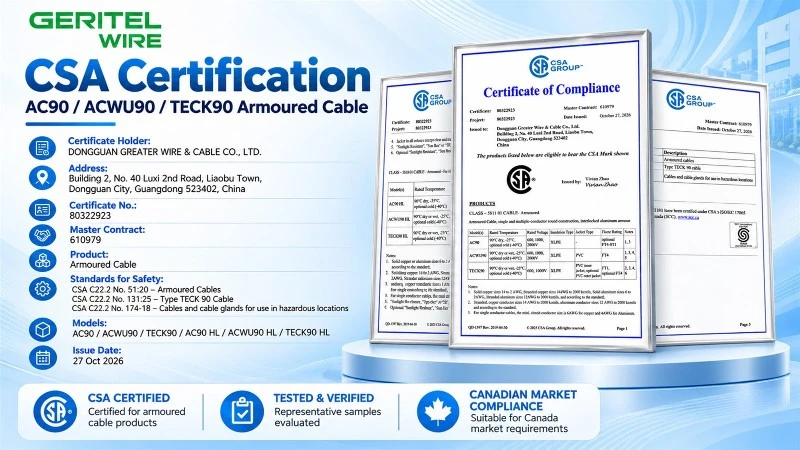
For Canadian ACWU90, CSA C22.2 No. 51 is the relevant product standard for armoured cables.
The cable's certification documentation should identify the product family and scope of approval.
When checking certification, verify:
The manufacturer's legal or registered name.
The certification organization and certification mark.
The applicable cable standard.
The ACWU90 product designation.
The approved conductor material and size range.
The voltage and temperature ratings.
Any additional sunlight-resistance designation or conditions.
Do not assume that certification of one product automatically covers every construction from the same manufacturer.
For example, a manufacturer's 600 V aluminum-conductor ACWU90 product may have a different certification scope from a copper-conductor version or a product with a different jacket construction.
The exact ordered product must fall within the relevant certification scope.
3.4 Step 4: Request Supporting Test Documentation
For projects with strict outdoor exposure requirements, a buyer may need additional evidence beyond the datasheet and cable marking.
Ask the manufacturer or supplier for supporting documentation, such as:
Product certification records.
Applicable test reports.
Sunlight-resistance or weather-resistance evaluation records.
Material identification and construction information.
Confirmation that the ordered cable configuration is covered by the rating.
The test documentation should identify the tested material or product, applicable test method, evaluation conditions, and acceptance criteria.
Avoid accepting a generic statement such as "UV tested" without knowing what was tested.
For example, a test report covering a PVC compound does not automatically prove that every finished cable construction using that compound has the same certification status.
Where the project specification requires a particular test method or exposure duration, request evidence that directly addresses that requirement.

4. Which Standards Are Relevant to ACWU90 Sunlight Resistance?
The applicable standards depend on the destination market and the specific product certification.
For a Canadian ACWU90 cable, the starting point is the relevant CSA product standard and its certification scope.
4.1 CSA C22.2 No. 51: Armoured Cables
CSA C22.2 No. 51 covers armoured cables, including ACWU cable constructions.
It addresses the complete cable product rather than simply the PVC material used for the outer jacket.
For a procurement team, the important task is to confirm that the cable's certification and product documentation support the claimed sunlight-resistant rating.
Do not assume that every ACWU90 product has identical optional ratings.
The manufacturer should be able to identify which product configurations are covered by its certification.
4.2 CSA C22.2 No. 2556: Wire and Cable Test Methods
CSA C22.2 No. 2556 provides test methods used for evaluating wire and cable properties.
Weather or sunlight resistance evaluations may involve assessing changes in material properties after controlled exposure to a specified UV source.
Depending on the applicable product requirement, the evaluation may examine physical properties such as tensile strength and elongation before and after exposure.
These tests help assess whether the material retains the required properties following the specified exposure.
However, buyers should not assume that every cable type uses an identical test procedure or acceptance criterion.
The applicable product standard and certification program determine which test requirements apply.
4.3 CSA Product Certification and Installation Code Are Different
Another important distinction is the difference between cable product certification and electrical installation requirements.
| Standard or code | Main purpose |
|---|---|
| CSA C22.2 No. 51 | Product requirements for armoured cables |
| CSA C22.2 No. 2556 | Wire and cable test methods |
| CSA C22.1, Canadian Electrical Code Part I | Electrical installation requirements |
A cable may have a verified sunlight-resistant product rating, but that does not automatically make every outdoor installation acceptable.
The installation must still comply with the applicable electrical code, local amendments, and project requirements.
For example, cable routing, mechanical protection, support, termination, wet-location suitability, and installation temperature must be evaluated separately.
5. Does Aluminum Interlocked Armour Make ACWU90 Sunlight Resistant?
This is a common misunderstanding.
Aluminum interlocked armour provides mechanical protection, but it should not be confused with the sunlight-resistance performance of non-metallic materials.
Typical ACWU90 construction includes several different components:
Aluminum or copper conductors, depending on the product.
XLPE insulation.
A bonding conductor or specified bonding arrangement.
Aluminum interlocked armour.
An overall PVC jacket.
The armour protects the internal cable assembly against certain mechanical stresses.
The outer PVC jacket provides an additional protective layer and may be specifically formulated and evaluated for sunlight resistance.
Therefore, when checking an ACWU90 product for outdoor exposure, the outer jacket's rating is particularly important.
5.1 Does the PVC Jacket Need Its Own Sunlight-Resistance Rating?
The answer depends on the applicable product standard and certification arrangement.
Some manufacturers explicitly identify both the XLPE insulation and the PVC outer jacket as sunlight resistant.
For example, Nexans describes its ACWU90 product as having sunlight-resistant RW90 XLPE insulation and a sunlight-resistant PVC outer jacket.
This is useful product-specific evidence, but it should not be generalized to every manufacturer's ACWU90 construction.
When an installation specification requires sunlight-resistant cable, confirm that the finished cable product meets the applicable requirement.
5.2 Does Black PVC Automatically Mean UV Resistant?
No.
Black PVC is common in outdoor cable applications, but colour alone is not a reliable certification indicator.
A black jacket may contain UV-stabilizing additives, but the formulation and performance can vary.
A buyer should not approve an ACWU90 product solely because its jacket is black.
Instead, verify the actual rating through the cable legend, datasheet, and certification records.
6. Sunlight Resistance vs Weather Resistance: What Is the Difference?
These terms are related, but they are not interchangeable.
Sunlight resistance focuses on the effect of solar radiation, particularly UV exposure, on cable materials.
Weather resistance is a broader concept that may involve exposure to several environmental conditions.
| Performance characteristic | What it addresses |
|---|---|
| Sunlight resistance | UV exposure from sunlight |
| Wet-location suitability | Exposure to moisture and water under specified conditions |
| Low-temperature rating | Performance under specified cold conditions |
| Heat resistance | Performance at elevated temperatures |
| Chemical resistance | Exposure to specified chemicals |
| Abrasion resistance | Resistance to surface wear |
| Flame performance | Behaviour under specified fire or flame tests |
An ACWU90 cable marked SUN RES should not automatically be considered resistant to every outdoor environmental condition.
For example:
Sunlight resistance does not establish resistance to oils or industrial chemicals.
A 90°C conductor temperature rating does not establish a 90°C outdoor ambient rating.
Wet-location suitability does not mean the cable can be submerged indefinitely.
A low-temperature marking does not automatically establish UV performance.
For outdoor projects, these characteristics should be evaluated separately.
7. How Can You Verify Sunlight Resistance in UL, IEC, and AS/NZS Markets?
ACWU90 is a Canadian cable designation. Its CSA product approval should not automatically be treated as equivalent to UL, IEC, or AS/NZS approval.
When purchasing cable for international projects, identify the destination market first.
7.1 United States: UL and NEC Requirements
For US projects, the applicable UL product standard and National Electrical Code (NEC) requirements must be considered.
UL's Wire and Cable Application Guide explains that sunlight-resistance evaluations relate to the outer non-metallic covering of a cable when it is exposed directly to ultraviolet radiation.
The guide also identifies marking conventions such as:
SUNLIGHT RESISTANT.
SUN. RES.
SR.
However, the exact marking and permitted application depend on the cable type and applicable UL requirements.
A CSA-marked ACWU90 product should not automatically be treated as a UL-listed cable.
If the project requires a UL-listed product, request the relevant UL listing or certification documentation.
7.2 IEC Markets
IEC-based projects use the applicable IEC cable product standards and installation requirements.
IEC 60228, for example, addresses conductors of insulated cables. It is not a general sunlight-resistance approval for complete armoured cable assemblies.
A buyer should identify the applicable product standard and verify whether it includes UV or weather-resistance requirements for the intended installation.
If the project specification calls for UV resistance, request supporting test evidence against the exact specified method.
Do not assume that an IEC cable with XLPE insulation or a black PVC jacket is automatically suitable for prolonged outdoor UV exposure.
7.3 Australia and New Zealand: AS/NZS Requirements
For Australian and New Zealand projects, cable selection must follow the applicable AS/NZS product standards and installation requirements.
The required cable type, outdoor exposure rating, and accepted certification depend on the intended application.
Before purchasing, confirm:
The applicable cable product standard.
The required UV or weather-resistance performance.
Whether the outer sheath is suitable for the intended exposure.
The accepted product certification.
The installation requirements under the relevant AS/NZS wiring rules.
A CSA SUN RES marking can provide useful product information, but it does not automatically establish compliance with an AS/NZS project specification.
8. What Should Buyers Check Before Purchasing Sunlight-Resistant ACWU90?
A structured purchasing checklist helps prevent incorrect cable specifications and documentation gaps.
| Verification item | What to request or confirm |
|---|---|
| Cable designation | ACWU90 |
| Manufacturer | Confirm the actual manufacturer |
| Conductor material | Aluminum or copper |
| Conductor size | Match the engineering specification |
| Insulation | Confirm XLPE/RW90 construction where specified |
| Armour | Aluminum interlocked armour |
| Outer jacket | Confirm material and construction |
| Sunlight resistance | SUN RES, SR, or equivalent supported rating |
| Voltage rating | Match the system voltage |
| Temperature rating | Confirm the conductor temperature rating |
| Wet-location suitability | Confirm for the installation |
| Certification | Verify the applicable CSA or other accepted certification |
| Datasheet | Obtain the current product-specific document |
| Test evidence | Request where project specifications require it |
| Cable marking | Compare the delivered product with the approved documents |
For large projects, it is also useful to include sunlight resistance explicitly in the purchase specification rather than relying on a general description such as "outdoor ACWU90."
A clear specification reduces the risk of receiving a product with a different jacket formulation or certification scope.
9. Common Mistakes When Verifying Sunlight Resistance
Even experienced buyers can overlook important details when comparing ACWU90 products.
The following mistakes should be avoided.
| Common mistake | Why it is incorrect | Better approach |
|---|---|---|
| Assuming all ACWU90 cables are sunlight resistant | Additional ratings may differ by product | Verify the actual product marking and certification |
| Treating black PVC as proof of UV resistance | Colour does not establish tested performance | Request the sunlight-resistance rating |
| Assuming aluminum armour provides UV protection | Armour is primarily a mechanical protection component | Check the non-metallic jacket and product rating |
| Relying only on a supplier's verbal statement | A statement is not equivalent to certification evidence | Request a datasheet and certification record |
| Treating 90°C as an outdoor UV rating | Temperature and UV performance are different characteristics | Verify each rating separately |
| Assuming wet-location approval means sunlight resistance | Moisture and UV exposure are different test considerations | Check both requirements |
| Treating CSA approval as UL approval | Certification scopes and standards differ | Verify the destination-market approval |
| Assuming a material test proves complete cable certification | A component test may not cover the finished cable | Confirm the complete product's certification scope |

10. What Should You Do If the Cable Has No SUN RES Marking?
If the cable legend does not show SUN RES, SR, or another recognized sunlight-resistance marking, do not make an immediate decision based only on appearance.
Follow these steps:
First, check the datasheet.
Some manufacturers describe sunlight resistance in the product specifications even when the available marking information is incomplete.
Second, request certification documentation.
Ask the manufacturer or supplier whether the exact cable construction is covered by a recognized sunlight-resistance evaluation.
Third, confirm the intended installation.
A cable installed entirely underground or inside an approved enclosure may have different exposure conditions from a cable routed openly along an outdoor structure.
Fourth, obtain written confirmation.
If sunlight resistance is a project requirement, request written confirmation supported by the relevant product documentation.
Finally, do not substitute an unverified product.
If the project specification explicitly requires sunlight-resistant cable and the supplier cannot demonstrate compliance, the product should not be accepted as equivalent without approval from the responsible engineer or authority.
11. Frequently Asked Questions
Is every ACWU90 cable sunlight resistant?
No. ACWU90 identifies a type of armoured cable, but additional ratings can vary between manufacturers and product configurations. Check the actual cable marking, technical datasheet, and certification documentation.
What does SUN RES mean on ACWU90 cable?
SUN RES means sunlight resistant. It identifies a product rating related to resistance against sunlight exposure, subject to the applicable product standard and certification requirements.
Is SR the same as SUN RES?
Both are commonly used to identify sunlight-resistant performance. The exact marking accepted depends on the applicable product standard and certification program.
Does a black PVC jacket mean ACWU90 is UV resistant?
No. Black colour alone does not prove sunlight resistance. The cable must have the relevant product rating supported by its documentation and certification.
Does aluminum interlocked armour protect ACWU90 from UV radiation?
Aluminum interlocked armour provides mechanical protection. It should not be treated as proof of the sunlight resistance of the cable's non-metallic materials, particularly the outer PVC jacket.
Can ACWU90 be installed outdoors?
Some ACWU90 products are approved for exposed outdoor installations. Confirm that the selected product has the required sunlight resistance, wet-location suitability, and other applicable ratings.
Is 90°C the same as a sunlight-resistance rating?
No. The 90°C rating refers to the maximum permitted conductor operating temperature under specified conditions. Sunlight resistance addresses the effect of UV exposure on relevant cable materials.
What documents should I request from an ACWU90 supplier?
Request the current technical datasheet, product certification information, sample cable marking, and supporting sunlight-resistance test documentation when required by the project specification.
Is CSA SUN RES equivalent to UL sunlight-resistant approval?
Not automatically. CSA and UL certification programs have their own applicable standards, test requirements, and product scopes. Verify the certification required by the destination market.
Conclusion
Verifying sunlight resistance on ACWU90 requires more than checking the cable colour, insulation type, or temperature rating. Buyers should examine the actual cable legend, review the manufacturer's technical datasheet, confirm the applicable CSA certification, and request supporting test documentation when the project requires it.
The key point is that not every ACWU90 product has identical environmental ratings. A specific manufacturer's product may be marked SUN RES and have documented sunlight-resistant XLPE insulation and PVC outer jacket, while another product may have a different construction or certification scope.
For electrical contractors, engineers, distributors, and procurement teams, verifying these details before ordering helps reduce the risk of unsuitable cable selection, premature jacket deterioration, and project compliance problems.
GERITEL WIRE offers cable solutions for commercial and industrial electrical distribution projects, including ACWU90 configurations with different conductor, armour, insulation, and jacket requirements. When selecting cable for outdoor or sunlight-exposed installations, our team can help review your technical specifications, discuss the required environmental ratings, and provide product information for evaluation. Contact GERITEL WIRE to discuss your project, request a quotation, and identify a suitable cable solution for your application.
Dongguan Greater Wire & Cable Co., Ltd.
Tel/WhatsApp/Wechat: +86 136 6257 9592
Tel/WhatsApp/Wechat: +86 135 1078 4550
Email: manager01@greaterwire.com
Website: www.greaterwire.com