























With the accelerating global energy transition, photovoltaic (PV) power generation systems are playing an increasingly important role in clean energy supply. In PV system design, cables are the key components of power transmission, and their reliability directly affects the safety, stability, and service life of the entire system. Compared with PV modules and inverters, cables are often overlooked, but in fact, their performance is critical to the long-term operation of the system.
Among PV cable standards, UL 4703 PV Cable, with its high design standards and dedicated application positioning, has become one of the preferred solutions in the Americas. This guide explores PV cable design requirements, the technical characteristics of UL 4703, a comparison with commonly used cables, application guidelines in PV projects, and product advantages. It aims to help system designers, engineers, and procurement specialists better understand and apply UL 4703 PV Cable in their projects.
Cable Requirements in PV Systems
Key Technical Requirements
Cables in PV systems must operate under long-term outdoor exposure, where performance requirements are far higher than those of standard building or industrial cables. Key aspects include:
- High Voltage Capacity: Modern PV DC systems often reach 1500V, with future trends toward 2000V, requiring cables with robust voltage endurance.
- Weather Resistance: Long-term exposure to UV radiation, ozone, rain, snow, and humid environments requires superior anti-aging and weather-resistant materials.
- Insulation Reliability: Prevents leakage currents and breakdowns, ensuring safe power transmission.
- Flame Retardancy & Low Smoke: Cables must resist ignition and emit minimal smoke during fire, complying with strict safety regulations.
Importance of UL Standards
- UL (Underwriters Laboratories) is the most authoritative electrical safety certification body in North America. Cables certified under UL 4703 undergo rigorous testing for electrical, mechanical, and environmental performance, ensuring long-term reliability in PV power plants across the U.S., Canada, and Latin America.
Applications in DC vs. AC Sides
- DC Side (modules to combiner box, combiner box to inverter DC input): Requires cables that can withstand high voltages, radiation, and harsh environments.
- AC Side (inverter to distribution system): Focuses on heat resistance and operational safety.
Technical Characteristics of UL 4703 PV Cable
-
Voltage and Temperature Ratings
UL 4703 cables are rated at 2000V DC, exceeding standard building wire ratings. They operate continuously at 90°C, with short-term overload capacity up to 150°C, making them suitable for high-temperature conditions.
-
Insulation and Jacket Materials
Insulation typically uses cross-linked polyethylene (XLPE) or other advanced polymers, offering excellent thermal and dielectric properties. The jacket is designed to resist UV, moisture, oil, and abrasion, ensuring long outdoor service life.
-
Flame Retardant & Low Smoke Properties
UL 4703 cables pass FT1/FT2 flame tests, limiting flame spread and producing less toxic smoke in fire scenarios.
-
Service Life and Aging Tests
Accelerated aging tests show UL 4703 cables can last 25–30 years, aligning with PV module lifespans.
-
Flexible Installation Options
UL 4703 is suitable for conduit, cable trays, and direct burial, making it versatile for different PV system layouts.
Comparison: UL 4703 vs. XHHW-2 Cables
Overview of XHHW-2
XHHW-2 is widely used in building and industrial wiring, rated at 600/1000V, insulated with XLPE, and known for good heat and moisture resistance.
Key Differences
- Weather Resistance: XHHW-2 is mainly for indoor/industrial use, while UL 4703 is designed for outdoor PV applications with superior UV and environmental durability.
- Voltage Rating: UL 4703 supports 2000V DC, while XHHW-2 is typically limited to 600/1000V.
- Certification & Applications: UL 4703 is specifically approved for PV DC circuits, while XHHW-2 is used in general distribution wiring.
Engineering Recommendations
- For PV DC wiring, UL 4703 PV Cable is strongly recommended.
- For standard building or industrial wiring, XHHW-2 remains cost-effective.

Application Guidelines for UL 4703 in PV System Design
-
Module to Combiner Box
Use single-core UL 4703 cables to endure long-term UV exposure and temperature fluctuations.
-
Combiner Box to Inverter
Larger cross-section UL 4703 cables ensure low-loss transmission of high currents.
-
Direct Burial and Conduit Installation
The jacket of UL 4703 resists moisture, oil, and abrasion, making it suitable for both direct burial and conduit installation.
-
Ensuring System Reliability
Using UL 4703 ensures a service life of over 25 years, minimizing cable failures and reducing O&M costs.
Product Advantages of UL 4703 PV Cable
Wide Product Range
We manufacture a complete line of UL-certified cables, including THHN, THW, MC Cable, AC Cable, and more. A full UL Wire catalog is available for flexible project selection.
Compliance with the Americas Market
All cables comply with UL, NEC, and IEEE standards, supporting projects across the U.S., Canada, Mexico, Brazil, and other regions.
Full Range of Specifications
We supply sizes from 4mm² to 500mm², covering all PV system needs. Standard models are in stock.
Strong Delivery Capability
With robust production and inventory, we provide fast delivery and flexible order volumes, supporting both small and large projects.
Outstanding Service Support
Our technical team provides design assistance, installation guidance, and troubleshooting. Customers benefit from comprehensive pre-sales and after-sales support.
Rich International Experience
With years of manufacturing and export experience, we have built partnerships across North America, Europe, Asia, and Oceania, with global recognition of product quality.
Certified Quality Assurance
All cables are UL-certified, ensuring compliance with electrical safety and reliability standards for PV systems in North America.
Flexible Customization Options
We offer a variety of colors (red, black, blue, green, yellow, etc.) and can customize materials, sizes, lengths, colors, performance, markings, and packaging according to customer requirements.
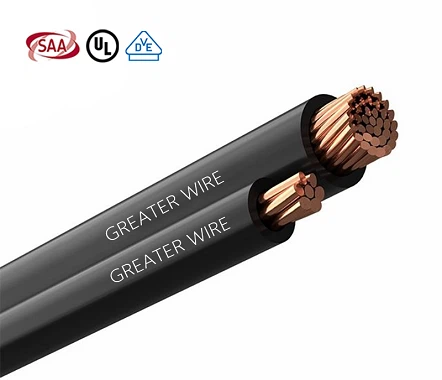
Application Cases and Design References
-
Utility-Scale Ground-Mounted PV Plants
UL 4703 cables provide reliable DC connections between modules and inverters, ensuring 25+ years of stability.
-
Rooftop Commercial PV Systems
UL 4703 demonstrates excellent UV resistance and flexible installation performance in commercial rooftop PV projects.
-
Market Adoption in North America
In large PV projects over 100MW in the U.S. and Canada, UL 4703 has become the specified cable choice.
-
Cable Selection Reference
| System Capacity | Recommended Size (mm²) | Application |
|---|---|---|
| 10–50kW | 4–10 | Module to Combiner Box |
| 50–500kW | 16–35 | Combiner Box to Inverter |
| 500kW–2MW | 50–120 | DC Main Line |
| 2MW+ | 150–500 | Utility Main DC Feeder |
Future Trends in PV Cables
- Higher Voltage Ratings: As PV systems evolve, 1500V DC has become mainstream, with 2000V-rated cables expected to expand.
- Eco-Friendly Materials: New recyclable insulation and jacket materials will reduce environmental impact.
- Global Standardization: Convergence of UL and IEC standards will simplify design and procurement for international projects.
Company Information
Dongguan Greater Wire & Cable Co., Ltd.
- Tel/WhatsApp/Wechat: +86 135 1078 4550 / +86 136 6257 9592
- Email: manager01@greaterwire.com