

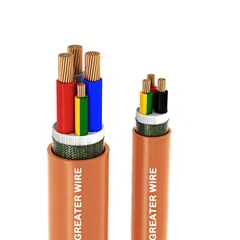
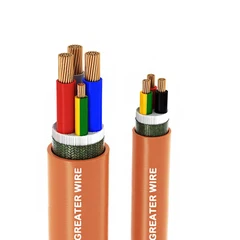

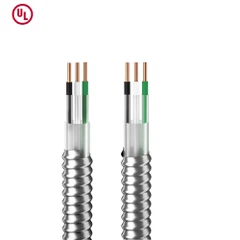
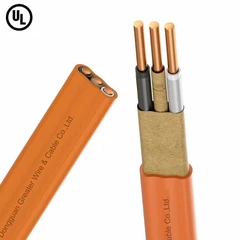
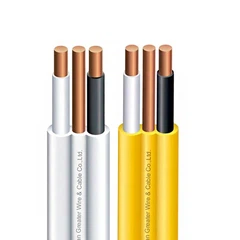

The 2026 edition of CSA C22.2 No. 51, Armoured Cables is the fourteenth edition of this Canadian product standard. Published on January 1, 2026, it supersedes the 2020 edition. The published revision summary identifies six main areas of change: cable lay length, PCS construction for ACWU90, electrical resistance testing, FT4 and halogen-free markings, conductor colour coding, and mechanical properties after aging and oil immersion. These are specific updates to construction, testing, marking, and performance requirements-not a wholesale replacement of the AC90 and ACWU90 cable framework.
Armoured cables+1
A key point for contractors and buyers: the standard's revision does not automatically mean every existing cable design is obsolete, nor does a product's reference to CSA C22.2 No. 51 alone confirm that it has been evaluated to the 2026 edition. The exact product certification, construction, markings, and project requirements still need to be checked.

1. What Is CSA C22.2 No. 51:2026?
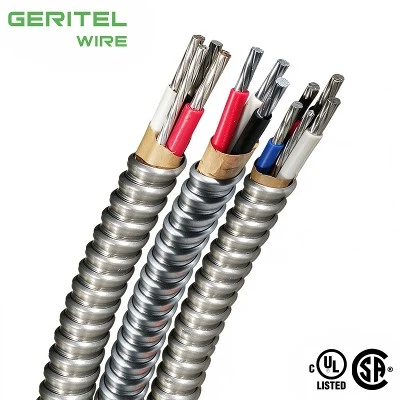
CSA C22.2 No. 51 is a Canadian product safety standard titled Armoured Cables. It is part of the Canadian Electrical Code, Part II, standards series and establishes requirements for covered armoured cable constructions.
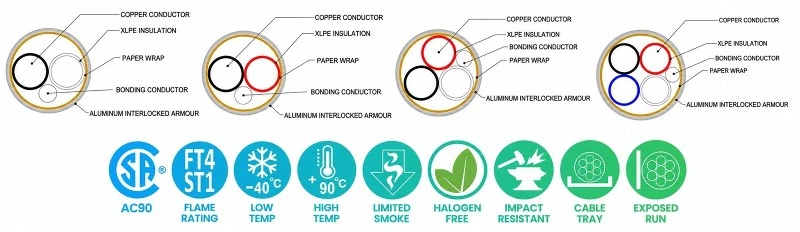
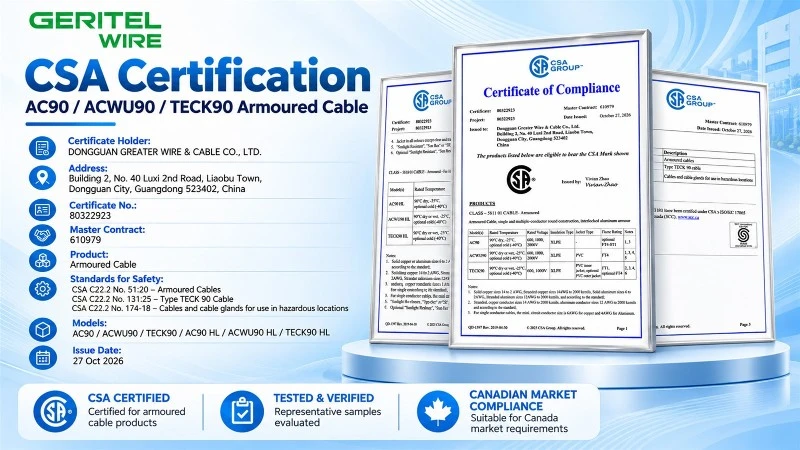
The 2026 edition is the fourteenth edition. It supersedes CSA C22.2 No. 51:20, the thirteenth edition. The standard covers insulated cables with metallic interlocked armour, including cable types such as AC90, ACG90, ACWU90, and ACGWU90. Its published scope covers insulated conductor sizes from 18 AWG to 2000 kcmil, with a maximum cable temperature rating of 90°C. The exact construction and permitted ratings depend on the cable type.
Armoured cables+1
It is important to distinguish this product standard from CSA C22.1, the Canadian Electrical Code, Part I. CSA C22.2 No. 51 addresses the cable itself-its construction, testing, and identification. The Canadian Electrical Code governs how electrical equipment and cables are installed. A cable meeting the product standard must still be installed in accordance with the applicable electrical code and local requirements.
2. The Six Main Changes in the 2026 Edition
The published preface identifies six principal revisions compared with the 2020 edition. The table below summarizes what each change concerns and why it matters to cable manufacturers, contractors, and procurement teams.
|
Area updated |
Relevant provision |
Practical significance |
|---|---|---|
|
Cable assembly lay length |
Clause 5.3.1 and Table 15 |
Updates requirements for the lay of assembled cable components |
|
PCS construction for ACWU90 |
Clauses 5.1.1.2, 5.1.1.3, 5.1.4.3, 7.1.3, and 7.2 |
Adds requirements for this construction in Type ACWU90 |
|
Electrical resistance testing |
Clause 6.1.1.1 |
Revises test requirements and compliance criteria |
|
FT4 and halogen-free markings |
Clauses 7.1.2, 7.1.3, and 7.2 |
Updates marking requirements on finished cables, coils, and reels |
|
Insulated conductor colour coding |
Table 8 |
Updates conductor identification requirements |
|
Mechanical properties after aging and oil immersion |
Table 18 |
Revises tensile strength and elongation retention values |
These changes are stated in the published preface to CSA C22.2 No. 51:26. The public revision summary identifies the affected clauses and tables, but does not provide all revised test limits or detailed acceptance criteria. Those values should be checked in the full 2026 standard rather than inferred from the summary.
Armoured cables+1
3. What Changed in Cable Assembly Lay-Length Requirements?
The 2026 edition updates the requirements for cable assembly lay length in Clause 5.3.1 and Table 15.
In a multi-conductor armoured cable, insulated conductors and other cable components are assembled together in a defined arrangement. The lay length describes the length over which a component or group of components completes one full turn around the cable assembly's axis.
Lay length is a manufacturing parameter. It affects the geometry and consistency of the assembled cable, so the standard specifies requirements to control this aspect of construction.
For cable manufacturers, the revision means that assembly processes and product evaluations need to account for the updated requirements. For buyers, it is a reminder that compliance involves more than conductor material, insulation thickness, and armour type.
What should contractors and buyers check?
Confirm that the manufacturer's product documentation identifies the applicable edition of CSA C22.2 No. 51.
Request confirmation that the cable construction is covered by the relevant certification.
For a project with specific construction requirements, ask the manufacturer to confirm that the proposed cable meets the applicable standard edition.
The revision does not, by itself, mean that every cable will have a visibly different lay or that its installation flexibility has changed by a specified amount. Those conclusions require the actual requirements and product data.
4. What Is New for PCS Construction in ACWU90?
One of the notable changes is the addition of requirements for PCS construction in Type ACWU90.
PCS construction was already addressed in the 2020 edition for certain armoured cable constructions. The 2020 revision history describes the "-PCS" suffix as identifying a construction that includes control and signal insulated copper conductors. The 2026 edition adds specific provisions for PCS construction in ACWU90.
Intertek Inform+1
This distinction matters: the 2026 revision is not simply the first introduction of PCS construction across the entire standard. It specifically extends the requirements to Type ACWU90.
Why does PCS construction matter?
Conventional ACWU90 cables are commonly specified for power distribution. A PCS construction can incorporate additional insulated control and signal conductors within the cable assembly, depending on the certified design.
This may be relevant where a project needs power conductors together with control or signal wiring in a coordinated cable construction.
However, buyers should not assume that every ACWU90 cable can include control or signal conductors, or that any custom arrangement automatically qualifies as PCS construction under the standard.
The cable must meet the applicable construction requirements and be covered by the relevant product certification.
Procurement checks for PCS ACWU90:
Confirm that the cable is specifically identified as the required PCS construction.
Check the number, size, and material of the power, control, and signal conductors.
Confirm conductor insulation and colour identification.
Verify that the complete cable construction-not merely its individual conductors-is covered by the certification.
Check that the cable's voltage, temperature, and installation ratings meet the project specification.
5. How Have Electrical Resistance Test Requirements Changed?
The 2026 edition updates the requirements and compliance criteria for the electrical resistance test in Clause 6.1.1.1.
Electrical resistance is an important characteristic of a conductor. It affects the voltage drop and power loss associated with current flowing through the conductor. Resistance is influenced by factors such as conductor material, cross-sectional area, length, and temperature.
A cable standard uses resistance testing to evaluate whether conductors meet the applicable electrical requirements.
The 2026 revision changes the test requirements and the criteria used to determine compliance. This is relevant to manufacturers because conductor quality control and product evaluation must follow the revised provisions.
For buyers, the important point is that a conductor size or material description alone does not establish compliance with the standard.
What should buyers verify?
When evaluating AC90 or ACWU90 cable, procurement teams should confirm:
Conductor material: copper or aluminum, as specified.
Conductor size: the required AWG or kcmil designation.
Product certification: the exact cable type and conductor configuration are within the certified scope.
Test documentation: available where required by the project specification or customer quality requirements.
The revision summary does not publish the new numerical resistance limits or detailed test procedure. Buyers and manufacturers should refer to Clause 6.1.1.1 of the full 2026 edition for those details.
6. What Changed for FT4 and Halogen-Free Cable Markings?
The 2026 edition updates requirements for FT4 and halogen-free markings on finished products, coils, and reels. The affected provisions are Clauses 7.1.2, 7.1.3, and 7.2.
Armoured cables+1
This is particularly relevant to product identification, packaging, warehousing, and project documentation.
FT4 marking
FT4 is a flame-propagation classification associated with a specific cable flame test used in Canadian cable standards. It is not a general statement that a cable is fireproof or will maintain circuit operation during a fire.
When a cable is required to carry an FT4 marking, the marking must be supported by the applicable product evaluation and comply with the standard's identification requirements.
Halogen-free marking
Halogen-free describes a material characteristic relating to the absence or limitation of specified halogen elements in the relevant cable materials, according to the applicable requirements.
It is not interchangeable with FT4. A halogen-free cable is not automatically FT4-rated, and an FT4-rated cable is not automatically halogen-free.
The 2026 revision updates how these claims are identified on the finished cable and its coils or reels. Buyers should therefore check both the cable legend and the packaging or reel identification where the project specification requires these characteristics.
Practical purchasing advice: If a project specification requires FT4 or halogen-free cable, ask the supplier to provide the relevant certification or test evidence and confirm that the actual cable marking matches the approved product documentation.
7. What Changed in Insulated Conductor Colour Coding?
The 2026 edition updates the requirements for colour coding of insulated conductors in Table 8.
Armoured cables+1
Conductor colour identification helps electricians distinguish circuit conductors during installation, termination, inspection, and maintenance.
In multi-conductor cables, colour coding can help identify individual conductors and reduce the risk of wiring errors. It is especially important when a cable contains several power, control, or signal conductors.
For manufacturers, the updated Table 8 requirements need to be considered when selecting insulation colours and preparing cable constructions.
For contractors and buyers, the key issue is whether the supplied cable's conductor identification is suitable for the intended circuit and complies with the applicable requirements.
Before ordering, confirm:
The required conductor identification scheme.
The number of insulated conductors.
Any project-specific colour requirements.
Whether the proposed cable construction is covered by the applicable certification.
Do not assume that a familiar colour arrangement automatically satisfies every project. The applicable standard, electrical code, and project specification should all be checked.
8. What Changed in Mechanical Performance After Aging and Oil Immersion?
The 2026 edition revises the tensile strength and elongation retention values after aging and oil immersion in Table 18.
Armoured cables+1
These properties relate to the mechanical performance of cable materials after exposure to specified conditioning processes.
Tensile strength describes the force a material can withstand when pulled before breaking.
Elongation describes how much a material can stretch before breaking.
Retention refers to the amount of a property maintained after a specified conditioning process, compared with its original value.
Aging and oil immersion tests help evaluate how relevant cable materials perform after exposure to defined environmental or chemical conditions.
These tests do not mean that every AC90 or ACWU90 cable is suitable for every oil-exposed environment. The test conditions in a product standard are controlled conditions; they should not be interpreted as universal approval for any industrial chemical, lubricant, fuel, or oil.
What does this mean for cable selection?
For industrial projects, buyers should distinguish between:
Compliance with the mechanical performance requirements in CSA C22.2 No. 51.
A manufacturer's specific claim about oil resistance or chemical compatibility.
Suitability for the actual installation environment.
If a cable will be exposed to oils, lubricants, or industrial chemicals, request product-specific compatibility information. Do not rely on the revised aging and oil-immersion test requirements alone to establish suitability for a particular chemical exposure.
9. Does the 2026 Edition Change the Basic AC90 and ACWU90 Applications?
The published revision summary identifies targeted updates to construction, testing, marking, and performance requirements. It does not announce a wholesale change to the basic cable type framework.
AC90 and ACWU90 remain distinct cable designations:
|
Cable type |
General construction distinction |
|---|---|
|
AC90 |
Insulated conductors with metallic interlocked armour, without an overall jacket |
|
ACWU90 |
Insulated conductors with metallic interlocked armour and an overall jacket |
The exact construction, ratings, and permitted installation conditions must be confirmed against the applicable standard, certification, manufacturer's datasheet, and Canadian Electrical Code.
The 2026 revision should not be interpreted as automatically changing the permitted installation methods for every AC90 or ACWU90 product. Product requirements under CSA C22.2 No. 51 and installation rules under CSA C22.1 serve different purposes.
For example, a cable's certification to a product standard does not by itself authorize direct burial, wet-location use, hazardous-location use, or any other specific installation. Those applications depend on the cable type, product ratings, certification scope, and applicable installation rules.

10. What Should Manufacturers, Contractors, and Buyers Do Now?
The 2026 edition is relevant to different stakeholders in different ways.
|
Stakeholder |
Recommended action |
|---|---|
|
Cable manufacturers |
Review construction, assembly, testing, marking, colour coding, and material performance against the revised clauses |
|
Electrical contractors |
Check that the specified cable type and product certification match the project requirements |
|
Distributors |
Update product descriptions and technical documentation where applicable |
|
OEM manufacturers |
Confirm that cable construction and conductor identification meet equipment specifications |
|
Procurement managers |
Request current datasheets and certification evidence, and clarify which standard edition is required |
A practical procurement checklist
Before approving an armoured cable for a Canadian project, verify the following:
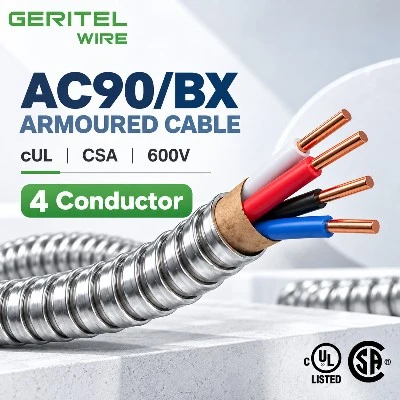
Correct cable type: AC90, ACG90, ACWU90, or ACGWU90.
Applicable standard edition: CSA C22.2 No. 51:26, where required.
Conductor material, size, and quantity.
Insulation and armour construction.
PCS construction details, if specified for ACWU90.
Required FT4 or halogen-free markings and supporting evidence.
Conductor colour identification.
Voltage and temperature ratings.
Required environmental and installation ratings.
Product certification and its scope.
Datasheet and cable markings consistent with the purchase specification.
The most important step is to confirm the edition required by the project and the edition covered by the product's certification. A datasheet that refers to CSA C22.2 No. 51 without identifying the edition may not provide enough information for a specification review.
Conclusion
CSA C22.2 No. 51:2026 introduces six principal updates affecting armoured cable assembly, PCS construction for ACWU90, electrical resistance testing, FT4 and halogen-free markings, conductor colour coding, and mechanical performance after aging and oil immersion. These revisions matter to manufacturers because they affect product construction and evaluation, and to buyers because they influence product identification and specification checks.
However, the revision summary should not be treated as a substitute for the full standard. For technical approval, manufacturers and project teams should review the relevant clauses and tables, verify the product's certification scope, and apply the installation rules in the locally adopted Canadian Electrical Code.
How GERITEL WIRE Supports Armoured Cable Procurement
Selecting armoured cable for Canadian projects requires more than matching a cable designation to a purchase order. Conductor configuration, insulation, armour, jacket construction, product markings, and certification all need to align with the project specification. GERITEL WIRE supports electrical distributors, contractors, OEM manufacturers, and industrial procurement teams with armoured cable solutions for a range of application requirements. Whether you are reviewing AC90 or ACWU90 specifications, comparing cable constructions, or sourcing products for a new project, our team can help you discuss technical requirements and available options. Contact GERITEL WIRE to share your cable specifications and request further product information or a quotation.
Dongguan Greater Wire & Cable Co., Ltd.
Tel/WhatsApp/Wechat: +86 136 6257 9592
Tel/WhatsApp/Wechat: +86 135 1078 4550
Email: manager01@greaterwire.com
Website: www.greaterwire.com