

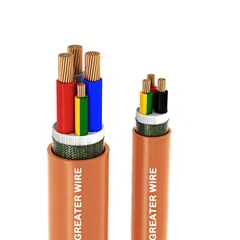
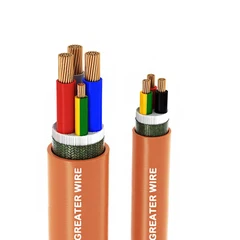

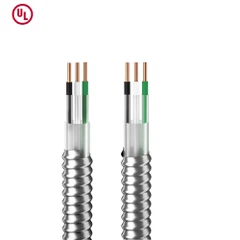
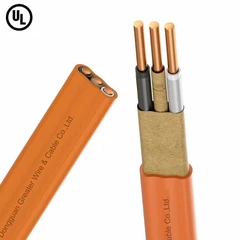
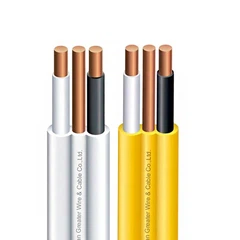

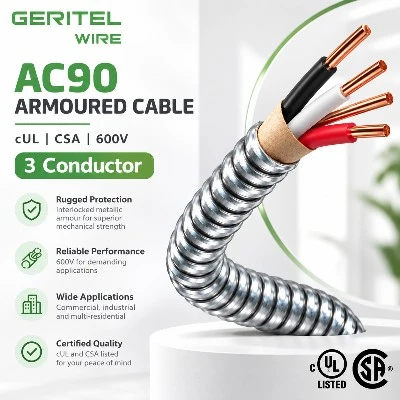
AC90 cable must be properly supported and secured to prevent sagging, excessive movement, and strain on cable terminations. In Canadian electrical installations, the support requirements are governed by the applicable Canadian Electrical Code (CEC), together with the cable manufacturer's installation instructions.
For contractors and procurement teams, the important point is that support spacing is not simply a matter of choosing a convenient distance between clips. The cable type, installation arrangement, support method, and applicable code requirements all matter. Incorrect support can damage the armour, place stress on connectors, and lead to installation or inspection problems.

1. The Main AC90 Support Spacing Rule: CEC Rule 12-618
For ordinary horizontal or exposed runs of AC90 cable between boxes and fittings, the key requirement is CEC Rule 12-618, "Running of cable between boxes, fittings, etc."
Under the 2024 Canadian Electrical Code (CSA C22.1:24), armoured cable must be installed without undue strain on the armour and supported using straps, Type 2S or 21S cable ties, or other suitable devices. The rule establishes two spacing requirements:
Along the cable run: Supports must be no more than 1.5 m apart.
Near termination points: The first support must be located within a distance determined by the connector trade size.
The termination distances are:
|
Connector trade size |
Maximum distance from termination point to support |
|---|---|
|
Not more than 35 |
300 mm |
|
More than 35 and not more than 78 |
600 mm |
|
More than 78 |
900 mm |
These distances apply to the relevant termination point described in Rule 12-618(1), including a box using a clamp to secure the cable. They are not interchangeable with the general 1.5 m interval.
Wiring methods+1
For example, if a typical AC90 cable run uses a connector with a trade size of 27, the support nearest the termination must be within 300 mm. Further supports along the run must not be more than 1.5 m apart.
2. Why Proper AC90 Cable Support Matters
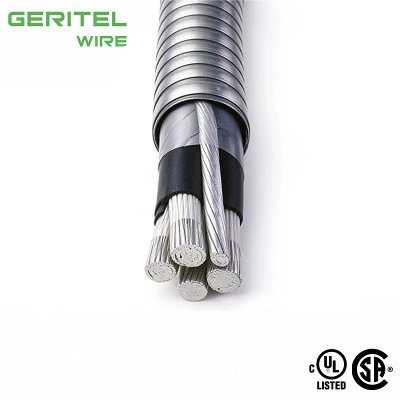
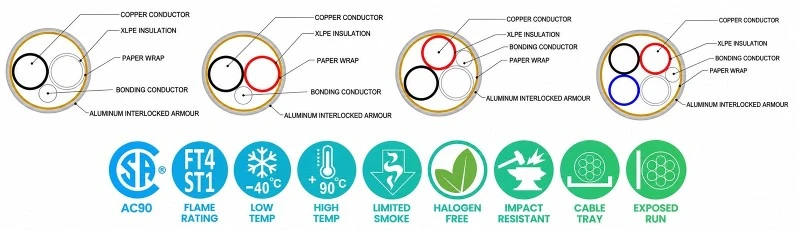
AC90 cable has interlocked metal armour surrounding its insulated conductors and bonding conductor. Although the armour provides mechanical protection, it does not mean the cable can be left unsupported over long distances.
Incorrect support can cause several problems:
Excessive sagging: Long unsupported sections can hang or move more than intended.
Strain on connectors: Cable weight or movement can place stress on terminations and their connections to electrical boxes.
Armour damage: Poorly selected or excessively tight supports can deform or damage the interlocked armour.
Insulation damage: Sharp edges, unsuitable clips, or rough handling can damage the insulated conductors.
Inspection concerns: Incorrect support spacing or damaged cable can result in installation deficiencies.
CEC Rule 12-508 also requires that cable not be bent, handled, or supported in a way that damages its insulated conductors or outer covering. Rule 12-608 addresses the mechanical and electrical continuity of armoured cable throughout the run.
Wiring methods+1
3. Do All AC90 Cable Installations Use the Same Support Spacing?
No. The 1.5 m requirement is a general maximum for the horizontal or other runs covered by Rule 12-618. Certain installation arrangements have additional requirements or specific exceptions.
Horizontal and exposed cable runs
For a typical exposed run between electrical boxes or fittings, follow the 1.5 m maximum interval and the applicable termination-distance requirement. Additional supports may be appropriate where the cable route, weight, vibration, or site conditions make them necessary.
Cable passing through joists or studs
Under Rule 12-618(2), AC90 cable run through holes in joists or studs is considered supported. This means that a cable properly routed through structural framing does not need a separate strap at every point where it passes through a hole.
However, the cable must still be protected from mechanical damage. The hole must be suitable for the cable route, and protective measures may be needed where the cable could be damaged by sharp edges or fasteners.
Wiring methods+1
Concealed cable runs
Rule 12-618(3) permits cable installed as concealed wiring to be fished without intermediate supports where providing the required supports is impracticable.
This is a specific allowance, not a general exemption for every concealed installation. The cable route and building construction must meet the conditions in the rule. The electrician should also check applicable protection requirements, particularly where metal framing or cladding is present.
Vertical cable runs
Vertical AC90 installations require special attention. The weight of the internal conductor assembly can place significant strain on the cable terminations because the cable construction does not necessarily provide internal support between the conductors and the armour.
CEC Rule 12-120(4) specifically addresses vertical runs of armoured and sheathed cables, including AC90. It requires the internal conductor assembly to be supported at intervals not exceeding those in Table 21, or by one of the permitted alternative arrangements:
Incorporating bends totalling at least 90° at intervals not exceeding the Table 21 distances.
Providing a horizontal cable run at least as long as the vertical run.
Using cable specifically designed for vertical runs.
The correct solution depends on the conductor size, material, cable construction, and installation arrangement. The 1.5 m horizontal support rule must not be mistaken for the internal conductor support requirements for long vertical runs.
Wiring methods+1
4. What Types of Supports Can Be Used for AC90 Cable?
CEC Rule 12-618 permits straps, Type 2S or 21S cable ties, and other suitable support devices. The selected support must secure the cable without damaging its armour or placing excessive pressure on it.
Złącza ciesielskie, łączniki do drewna, kątowniki | Domax
Commercial Electric 3#3 to 3#2 Service Entrance (SE) 2-Hole Service Cable Strap (6-Pack) FSS2S-2-6 - The Home Depot
Cable Trays for Healthcare Facilities in UAE | Bonngulf
Armored Cable Gland: Protection for Armored Cable Installation
SWA Cable Installation | Lewin Electrical Services | Electrician Leicester
Electrical Cable Cleat Types and Installation: A Comprehensive Guide
How to Cut a Cable Tie: A Detailed Guide | Dingdong Electrical
Common support options include:
|
Support method |
Typical use |
Important consideration |
|---|---|---|
|
Metal cable straps |
Securing AC90 to walls, framing, or other solid surfaces |
Must be suitable for the cable diameter and must not crush the armour |
|
Approved cable ties |
Securing cable to suitable support structures |
Use the specified cable tie type and avoid excessive tightening |
|
Cable clips or clamps |
Supporting individual cable runs |
Must be compatible with the cable construction and installation |
|
Cable support brackets |
Organizing multiple cable runs |
Check the bracket's load capacity and suitability for the installation |
Do not assume that an ordinary plastic cable tie, plumbing strap, or general-purpose clip is automatically acceptable. The support device must be suitable for the application and must not damage the cable during installation or service.
5. How to Calculate AC90 Cable Support Locations
A simple layout calculation can help installation teams plan support locations before installing the cable.
Consider a hypothetical horizontal AC90 run that is 6 m long, with a connector trade size of 27 at each end.
The first support must be within 300 mm of the first termination.
Intermediate supports must be no more than 1.5 m apart.
The final support must be within 300 mm of the second termination.
One possible layout is:
Example: 6 m AC90 cable run
Illustrative support positions only. Actual positions must be checked against the applicable termination distances and maximum spacing.
The example demonstrates how the end supports and intermediate supports can be arranged to satisfy the spacing limits. It is not a mandatory fixed pattern: installers can use different positions as long as the applicable maximum distances are respected.
6. Common AC90 Cable Support Mistakes to Avoid
Electrical contractors and installation teams should watch for these frequent problems:
Using 1.5 m as the termination distance: The first support may need to be much closer to the box or fitting, depending on connector trade size.
Applying the 300 mm distance to every connector: Rule 12-618 specifies different termination distances for different connector trade sizes.
Confusing AC90 with non-metallic-sheathed cable: Rule 12-510 covers general cable support requirements, while Rule 12-618 specifically addresses armoured cable.
Ignoring vertical conductor support: Supporting the outside of the cable does not necessarily support its internal conductor assembly.
Over-tightening straps or cable ties: Excessive pressure can deform the armour or damage the cable.
Leaving excessive weight on terminations: Cable support should prevent undue strain on connectors and electrical equipment.
Using unsuitable support accessories: Support devices should be appropriate for the cable type, size, and installation environment.

7. AC90 Cable Support Inspection Checklist
Before an installation is energized, a qualified electrician or inspector can review the following items:
|
Inspection item |
What to verify |
|---|---|
|
Support spacing |
No more than 1.5 m between supports where Rule 12-618 applies |
|
Termination support |
Within 300, 600, or 900 mm, depending on connector trade size |
|
Support devices |
Suitable straps, ties, or other approved devices |
|
Cable condition |
No crushed armour, damaged insulation, or visible deformation |
|
Cable routing |
No excessive bending or strain |
|
Vertical runs |
Internal conductor assembly supported as required by Rule 12-120 |
|
Cable protection |
Protected from mechanical damage where required |
|
Terminations |
Connectors secure and compatible with the cable |
The applicable CEC edition, local amendments, and manufacturer instructions should always be checked before final inspection.
Conclusion
For typical AC90 cable runs between boxes and fittings, the 2024 Canadian Electrical Code Rule 12-618 establishes a maximum support interval of 1.5 m. It also requires the support nearest each termination to be within 300 mm, 600 mm, or 900 mm, depending on the connector trade size. Vertical installations require additional consideration under Rule 12-120 because the internal conductor assembly may need independent support.
Correct support spacing helps protect the cable armour, reduce strain on connectors, and maintain a reliable electrical installation. Contractors should select suitable support devices, follow the applicable code requirements, and verify the cable manufacturer's installation instructions rather than relying on a single spacing measurement for every installation.
Source References
CSA C22.1:24 – Canadian Electrical Code, Part I - 2024 edition, Section 12.
CEC Rule 12-618 – Running of Cable Between Boxes, Fittings, etc. - support intervals and termination distances for armoured cable.
CEC Rule 12-120 and Table 21 - internal conductor support requirements for vertical cable runs.
IAEI – 2021 Canadian Electrical Code, Part I Updates - background on changes to armoured cable support requirements.
GERITEL WIRE: AC90 Cable Solutions for Reliable Installations
Proper cable support starts with selecting AC90 cable that matches the project's electrical and installation requirements. GERITEL WIRE supplies AC90 armoured cable solutions for Canadian commercial and industrial applications, supporting the needs of electrical distributors, contractors, OEM manufacturers, and procurement teams. Whether you require specific conductor sizes, copper or aluminum conductors, or particular cable configurations, our team can help you review product specifications for your project. Contact GERITEL WIRE with your technical requirements, order quantity, and application details to discuss suitable cable options and request a quotation.
Dongguan Greater Wire & Cable Co., Ltd.
Tel/WhatsApp/Wechat: +86 136 6257 9592
Tel/WhatsApp/Wechat: +86 135 1078 4550
Email: manager01@greaterwire.com
Website: www.greaterwire.com