























1. What is RoHS certification?
RoHS certification is a regulation developed by the European Union with the main objective of restricting the use of certain harmful substances in electronic and electrical products to reduce their impact on the environment and human health. The main hazardous substances currently covered by RoHS certification include:
Lead (Pb)
Mercury (Hg)
Cadmium (Cd)
Hexavalent chromium (Cr6+)
Polybrominated biphenyls (PBBs)
Polybrominated diphenyl ethers (PBDEs)
Phthalates (DEHP, BBP, DBP, DIBP)
Since July 1, 2006, the European Union has been enforcing RoHS certification, requiring all electronic and electrical products entering the EU market to comply with this standard, otherwise they cannot be sold.

2. Does MC cable fall under the jurisdiction of RoHS certification?
To determine whether MC cables need to comply with RoHS certification, it is first necessary to clarify which product categories RoHS applies to. According to the definition of RoHS 2.0 (Directive 2011/65/EU), RoHS applies to all electronic and electrical equipment (EEE), including the following 11 main categories:
1. Large household appliances
2. Small household appliances
3. Information Technology (IT) and Telecommunications Equipment
4. Consumer electronics products
5. Lighting equipment
6. Electric tools (excluding fixed industrial tools)
7. Toys, entertainment and sports equipment
8. Medical equipment
9. Monitoring and control equipment
10. Vending machine
11. Other electronic and electrical equipment
MC cables are mainly used for power distribution lines in buildings, factories, and commercial facilities, connecting with lighting, power, and control systems. Although it is an electrical product, it itself does not belong to typical electronic and electrical equipment (EEE) because MC cables are essentially passive components and do not involve electronic signal processing. However, the scope of application of the RoHS directive is not limited to complete electrical equipment. If MC cables become part of electronic and electrical equipment, they must comply with RoHS certification requirements. For example:
MC cables used in data centers or smart buildings may need to comply with RoHS if they are connected to electronic control equipment. MC cables integrated into LED lighting systems or industrial automation equipment may also need to comply with RoHS if they are part of product components. In other words, if MC cables are used as a component of electronic devices and enter the EU market, they must comply with RoHS requirements; But if it is only used for building wiring purposes, it is usually not necessary.

3. The material composition of MC cables and the impact of RoHS certification
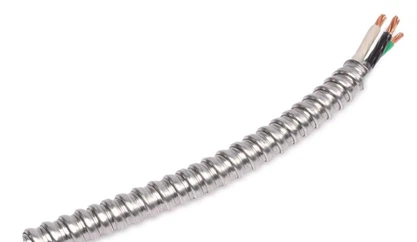
MC cables are typically composed of the following main materials:
1.Conductor (copper or aluminum)
Copper and aluminum themselves do not contain harmful substances restricted by RoHS, so they are usually not affected.
2.Insulation layer (PVC, XLPE)
Traditional PVC (polyvinyl chloride) may contain lead (Pb) or phthalates (DEHP) and must comply with RoHS restrictions.
3.Sheath (aluminum alloy or steel sheath)
Metal sheaths typically do not contain restricted substances, but some coatings may contain hexavalent chromium (Cr6+).
For common 12 gauge MC cables and 10 2 MC cables, the structure and materials of these cables typically include:
12 gauge MC cable: Typically used for lighting and power distribution in commercial buildings, it has high flexibility and durability.
10 2 MC cable: Used for applications with higher current loads, typically in HVAC systems or industrial power distribution.
Among these MC cables, the most important thing to pay attention to is whether the insulation layer and sheath contain RoHS restricted substances. Therefore, many MC cable manufacturers have adopted lead-free PVC or XLPE insulation materials to ensure compliance with RoHS certification.

4. Global market requirements for RoHS certification
Although RoHS certification was initially proposed by the European Union, many countries and regions around the world have now implemented similar environmental regulations:
The United States: Although there is no nationwide RoHS regulation, places such as California Proposition 65 have restrictions on certain hazardous substances. Many MC cable manufacturers still produce products that comply with RoHS requirements to adapt to the global market.
China: China has implemented RoHS (Management Measures for Pollution Control of Electronic Information Products), which requires electronic products to comply with similar hazardous substance restrictions.
Japan: J-Moss (Japanese version of RoHS) also imposes restrictions on harmful substances in electronic products.
Both South Korea and India have environmental regulations similar to RoHS, requiring electronic devices to limit harmful substances.
If MC cable manufacturers wish to export their products to different countries and regions, compliance with RoHS certification can increase market acceptance.


In summary, whether MC cables need to comply with RoHS certification depends on their specific use:
If MC cables are used for ordinary building wiring, they usually do not need to comply with RoHS certification.
If MC cables become part of electronic devices such as LED lighting, automation systems, smart home devices, etc., they need to comply with RoHS certification.
In order to meet the global market demand, many manufacturers take the initiative to make MC cables compliant with RoHS certification to enhance competitiveness.
