

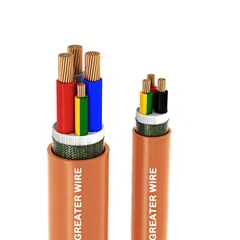
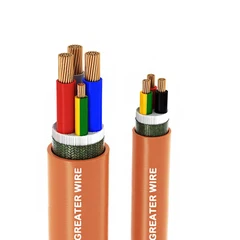

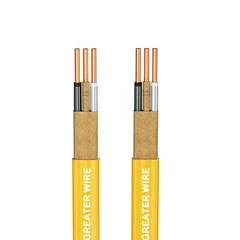

The minimum bend radius of AC90 cable is determined by the cable's overall outside diameter, construction, installation conditions, and the applicable manufacturer's instructions and electrical code requirements. Bending an armoured cable too tightly can distort its interlocked metal armour, damage the cable's internal components, or make installation less reliable.
For AC90 cable, there is no single bend-radius value that should be applied to every manufacturer's product and every installation situation. The required radius may be different when the cable is being pulled under tension compared with when it is being positioned into its final installed shape.
To determine the correct bend radius, first identify the cable's actual outside diameter, then check the manufacturer's specified bending factor and the relevant Canadian installation requirements. This guide explains the calculation, the difference between pulling and final positioning, and the practical precautions contractors and cable buyers should consider.

1. What Is the Minimum Bend Radius of AC90 Cable?
The minimum bend radius is the smallest radius through which a cable can be bent without exceeding the permitted mechanical stress on its construction.
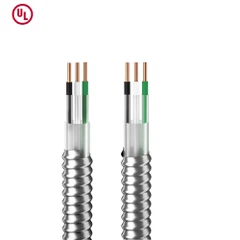
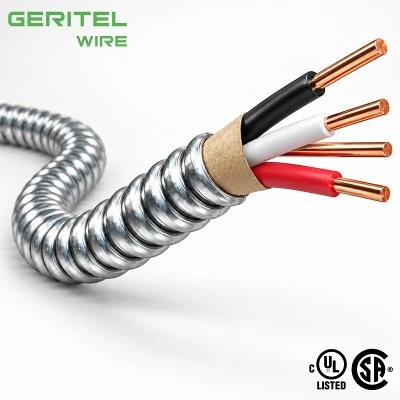
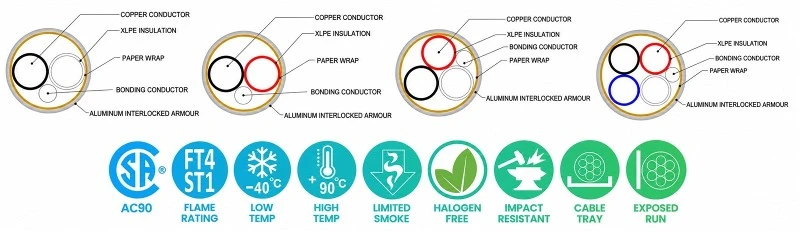
AC90 is an armoured cable. A typical construction includes insulated conductors, a bonding conductor, a binder, and an interlocking metal armour layer. The armour provides mechanical protection, but it can also be distorted if the cable is forced around a curve that is too tight. Southwire's AC90 product specification illustrates these construction layers and identifies the cable as a 600 V product with RW90 XLPE-insulated copper conductors and aluminum interlocking armour. Actual constructions vary by product.
326 (18-03) Rev6+1
cUL Certification RW90 Xhhw-2 PVC Jacket Teck90 Acwu90 Cable 14/3 12/3 600V - Teck 90 Cable and AC90 Cable
huatongcables.en.made-in-china.com
A minimum bend radius is expressed as a distance, such as millimetres or inches. It is not the same as the bend diameter.
For example, a specified bend radius of 100 mm means the radius of the curve is 100 mm-not that the cable can be bent around a 100 mm diameter object. Confusing radius and diameter can lead to an installation bend that is much tighter than intended.
2. What Bend Radius Should You Use for AC90 Cable?
The required bend radius depends on the installation stage and the specific AC90 product.
Nexans Canada's installation guidance provides the following reference values for AC90 and ISO-BX armoured cables:
|
Installation condition |
Reference bend-radius factor |
|---|---|
|
Cable being installed under tension |
10.5 × overall cable diameter |
|
Final positioning (final training) |
7 × overall cable diameter |
These values are from Nexans' installation guidance and should be treated as manufacturer-specific reference values, not universal requirements for every AC90 product.
nexans.ca
Why are there two different values?
Under tension: When cable is being pulled around a corner, through a cable route, or over a guide, additional mechanical forces act on the cable. A larger bend radius helps reduce stress on the armour and internal components.
Final positioning: After the cable has been installed and pulling tension has been removed, it can generally be formed into its final route using a smaller radius, provided the manufacturer's requirements are met.
Southwire also distinguishes between minimum bending radius and final training radius in its cable installation guidance. It warns that limits for final positioning should not be applied to cables being pulled under tension.
southwire.com
The important point is to use the correct value for the actual installation activity. A final-positioning radius should not be used to plan a cable-pulling operation.
3. How to Calculate the Minimum Bend Radius of AC90 Cable
The basic calculation is:
Where:
Cable OD means the overall outside diameter of the finished AC90 cable, including its armour.
Bend-radius factor is the multiplier specified by the cable manufacturer or applicable installation requirement.
Calculation example
Assume an AC90 cable has an overall outside diameter of 15 mm. Using the Nexans reference factors:
|
Installation condition |
Calculation |
Result |
|---|---|---|
|
Under tension |
15 mm × 10.5 |
157.5 mm |
|
Final positioning |
15 mm × 7 |
105 mm |
Illustrative calculation only. The 15 mm cable diameter is an example, not a specification for every AC90 cable.
This example shows why the installation stage matters. A cable that can be positioned at a 105 mm radius after pulling may require a larger radius during the pulling operation.
Which cable diameter should you use?
Always use the overall outside diameter of the finished cable, not the diameter of an individual insulated conductor or the diameter of the bonding conductor.
For AC90, the outside diameter can vary according to:
Conductor size and number of conductors.
Conductor material.
Insulation thickness.
Armour material and construction.
Manufacturer-specific design.
For example, a larger multi-conductor AC90 cable generally has a different overall diameter from a smaller two-conductor product. Therefore, the bend-radius calculation should be based on the exact cable part number or datasheet, not just the AWG conductor size.
4. What Does the Canadian Electrical Code Say About AC90 Bend Radius?
For projects in Canada, the Canadian Electrical Code (CEC), CSA C22.1, is an important reference for electrical installation requirements.
CEC Rule 12-614 addresses the bending of armoured cables. The 2024 edition specifies that the radius of the curve at the inner edge of the bend must be at least six times the external diameter of the armoured cable. It also requires bends to be made without undue distortion of the armour or damage to its inner or outer surfaces.
StudyLib+1
This wording matters because the CEC rule describes the radius at the inner edge, while manufacturer guidance may express its bending factor using the overall cable diameter. These measurement references should not be treated as interchangeable without checking the applicable definitions and instructions.
For practical installation planning:
Identify the CEC edition adopted by the relevant jurisdiction.
Check the manufacturer's AC90 installation instructions.
Confirm how the specified radius is measured.
Follow the applicable requirement that governs the installation.
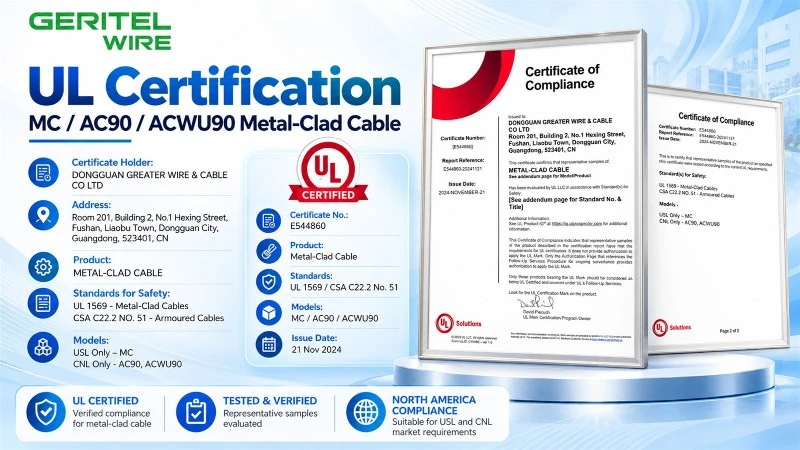
CSA C22.2 No. 51 is a product standard for armoured cables, whereas CSA C22.1 is the Canadian Electrical Code governing electrical installations. They serve different purposes. A cable's product certification does not remove the need to follow installation requirements.
The CEC is a Canadian standard. Installations in the United States, Europe, Australia, or New Zealand must follow the electrical codes and product approval requirements applicable in those markets. Do not automatically apply a Canadian AC90 bend-radius rule to a cable carrying a different UL, IEC, or AS/NZS designation.
5. What Can Happen If AC90 Cable Is Bent Too Tightly?
Bending AC90 cable below its permitted radius can cause mechanical problems that may not be obvious immediately.
Armour distortion
AC90 uses interlocking metal armour. A sharp bend can cause the armour to flatten, buckle, separate, or become locally distorted. This can reduce the cable's intended mechanical protection.
Damage to conductor insulation
Excessive bending stress can affect the insulated conductors inside the armour. If insulation is cut, crushed, or otherwise damaged, the cable's electrical reliability may be compromised.
Internal movement or deformation
The cable's internal components may shift or experience uneven mechanical stress when the cable is forced into a tight curve. This can affect the cable's condition even if the outer surface appears acceptable.
Installation and termination difficulties
An excessively tight bend can make it difficult to position the cable correctly at electrical boxes, panels, and equipment connections. It may also place unnecessary stress on cable connectors and terminations.
Southwire's cable installation guidance explains that excessive bending can damage metallic cable components and that the risk depends on cable construction. Its recommendations reinforce the need to observe the correct bend-radius limits rather than relying on how flexible a cable appears.
southwire.com+1
If armour deformation, deep cuts, or suspected internal damage occurs, the cable should be assessed by qualified personnel before it is accepted for installation. Do not assume that covering the damaged area with electrical tape restores the cable's original mechanical or electrical performance.
6. Practical Tips for Maintaining the Correct AC90 Bend Radius
Correct bend-radius calculations are only part of good installation practice. How the cable is handled and routed also matters.
Plan the cable route before installation
Identify corners, changes in direction, cable tray transitions, and entry points into panels or enclosures before pulling the cable. Check that the available space can accommodate the required bend radius.
Use suitable cable guides and rollers
When pulling AC90 through a route, suitable rollers, sheaves, or cable guides can help maintain a smooth curve and reduce friction. Their dimensions should be appropriate for the cable and installation conditions.
Avoid sudden direction changes
Do not force AC90 around sharp edges or narrow corners. Plan gradual transitions and provide enough room for the cable to follow its intended route without kinking.
Avoid repeated bending and straightening
Repeatedly bending and reversing a cable's direction can place additional stress on its armour and internal components. Plan the installation route carefully to reduce unnecessary handling.
Consider temperature during installation
Low temperatures can affect the flexibility and handling characteristics of cable materials. Although some AC90 products carry a -40°C cold-temperature rating, this does not mean that every product can be bent or handled in any way at that temperature. Follow the manufacturer's minimum installation-temperature and cold-bending instructions.
326 (18-03) Rev6
Inspect the cable after installation
Check for visible flattening, buckling, separated armour sections, deep scratches, or other signs of damage. Pay particular attention to bends and cable entry points.
7. What Should Buyers Check When Specifying AC90 Cable?
For electrical distributors, contractors, OEM manufacturers, and procurement managers, bend radius is an important specification when evaluating whether an AC90 cable will fit the intended installation route.
Before placing an order, confirm the following information with the cable supplier:
|
Specification |
Why it matters |
|---|---|
|
Conductor size and number |
Determines the cable configuration and influences overall dimensions |
|
Conductor material |
Confirms whether copper or aluminum conductors are required |
|
Overall cable diameter |
Provides the measurement needed for bend-radius calculations |
|
Armour material and construction |
Helps identify the cable's mechanical construction |
|
Minimum bend radius |
Establishes the permitted bending limits for the product |
|
Maximum pulling tension |
Helps plan installation without exceeding mechanical limits |
|
Voltage and insulation ratings |
Confirms suitability for the electrical application |
|
CSA certification and product markings |
Verifies the required Canadian product approval |
Buyers should request the actual manufacturer's datasheet rather than relying on a generic AC90 specification. Two products carrying the same cable type designation may have different overall diameters, weights, and installation limits.
For projects with restricted installation space, it is particularly useful to confirm the minimum bend radius before finalizing cable tray layouts, panel dimensions, or equipment connection arrangements.

8. Final Checklist: How to Determine the Correct AC90 Bend Radius
Before installing or specifying AC90 cable, follow these steps:
Identify the exact cable: Confirm the manufacturer, product type, conductor configuration, and cable part number.
Find the overall outside diameter: Use the manufacturer's datasheet for the exact product.
Check the bending factor: Identify the manufacturer's specified minimum bend radius for the relevant installation stage.
Calculate the required radius: Multiply the cable OD by the specified factor.
Check applicable code requirements: Confirm the adopted CEC edition or the installation code governing the project.
Plan the cable route: Allow sufficient space for pulling, positioning, and termination.
Inspect after installation: Confirm that the armour and cable construction have not been visibly damaged.
The minimum bend radius of AC90 cable is not simply a number to memorize. It is a product-specific installation limit that must be calculated using the correct cable diameter and the correct bending requirement. By checking these details before installation, contractors and buyers can reduce the risk of armour damage, avoid routing problems, and improve installation reliability.
GERITEL WIRE: AC90 Cable Solutions for Reliable Installation
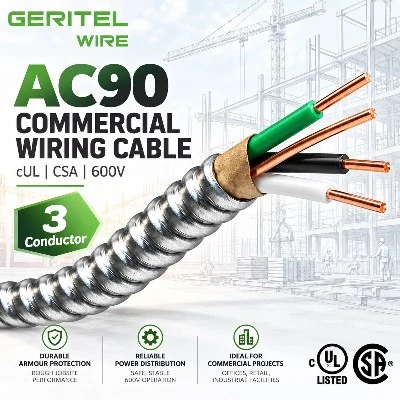
GERITEL WIRE supplies AC90 armoured cables for commercial, industrial, and building wiring projects. Understanding cable dimensions and minimum bend-radius requirements is essential when planning cable routes, selecting installation accessories, and coordinating electrical equipment connections. Whether your project requires copper or aluminum conductors, different conductor configurations, or specific cable construction details, our team can help you review product specifications and identify suitable supply options. Contact GERITEL WIRE to discuss your AC90 cable requirements, request technical information, and find a cable solution aligned with your project and market needs.
Dongguan Greater Wire & Cable Co., Ltd.
Tel/WhatsApp/Wechat: +86 136 6257 9592
Tel/WhatsApp/Wechat: +86 135 1078 4550
Email: manager01@greaterwire.com
Website: www.greaterwire.com