


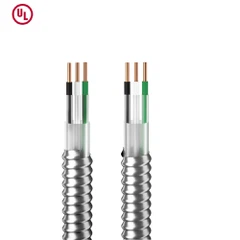
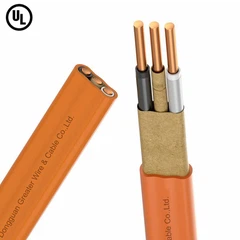
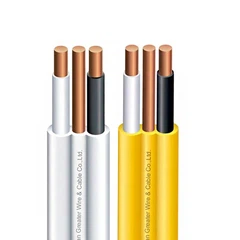

When you walk onto a construction site or into a power control room, you'll often see shiny, metallic, spiral-wrapped cables running along the walls or ceilings.
At first glance, they all look alike - but are they really?
Those armored cables could be AC (Armored Cable) or MC (Metal-Clad Cable).
Their outer appearance may seem almost identical, yet what's inside makes all the difference - in safety, performance, and compliance.
Choosing the right cable isn't just a technical decision - it's about protecting your project, ensuring code compliance, and guaranteeing long-term reliability.
So, what exactly is the "shape" of AC and MC cables? How do they differ in structure and function? And which one fits your next project best?
Let's dive in - and discover why more and more professionals worldwide trust Dongguan Greater Wire & Cable Co., Ltd. for premium-grade AC cables.
What Are AC and MC Cables?
Before we compare their shapes and functions, let's start with what these two names really mean.
AC Cable (Armored Cable)
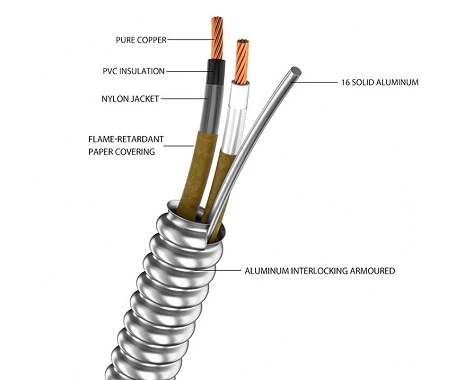
AC cable - short for Armored Cable - is a type of electrical cable wrapped in an interlocked or helical metallic armor.
Inside the armor are insulated conductors and a bonding strip that maintains electrical continuity with the metal sheath, forming part of the grounding path.
According to the U.S. National Electrical Code (NEC) Article 320, AC cable is defined as a flexible armored cable with an internal bonding strip. It's often referred to as BX cable in older installations.
Typically, AC cable includes up to four insulated conductors (plus one neutral) ranging from 14 AWG to 1 AWG.
Its metal sheath and bonding strip together act as the grounding path.
MC Cable (Metal-Clad Cable)
MC cable stands for Metal-Clad Cable, defined under NEC Article 330.
It also features insulated conductors enclosed within a metallic armor, which can be interlocked tape, corrugated, or smooth metal tubing.
Unlike AC cable, MC always contains a dedicated grounding conductor - a bare copper or green insulated wire - separate from the armor itself.
Because of this design, MC cable offers greater flexibility in conductor combinations and grounding reliability.
It can include signal, control, or communication wires alongside power conductors, and it's approved for use in dry, damp, and even outdoor or direct-burial environments (when properly rated).
The "Shape" and Structure of AC and MC
Now that we know what they are, let's explore their shape - both in outward appearance and internal structure.
External Shape
At first glance, AC and MC look nearly identical:
- Both have a flexible, round metallic armor, usually made of interlocked aluminum or steel tape.
- This armor provides mechanical protection, guarding against impact, abrasion, and crushing.
- Both are bendable, allowing installation through walls and structures without rigid conduit.
- The overall diameter varies depending on conductor count and armor thickness.
However, beneath that shiny armor lies the real difference.
Internal Structure
Here's a simplified comparison of their internal "shape":
| Layer / Component | AC Cable | MC Cable |
|---|---|---|
| Outer Armor | Interlocked aluminum or steel tape | Interlocked, corrugated, or smooth metal sheath |
| Wrapping Layer | Paper or thin assembly wrap | Polypropylene wrap or protective film |
| Insulated Conductors | Two or more insulated conductors | Two or more insulated conductors |
| Grounding Element | Bonding strip in contact with armor (no separate ground wire) | Dedicated grounding conductor (bare or green wire) |
| Conductor Limit | Max. 4 insulated conductors + neutral | No specific limit - can include control or signal wires |
| Ground Path | Armor + bonding strip | Internal ground wire (armor not primary path) |
In short, while their external shape is nearly identical, the inner design defines their unique electrical and mechanical behaviors.

Functional and Physical Differences
Mechanical Protection & Installation Flexibility
- Both AC and MC provide strong mechanical protection and eliminate the need for additional conduit in many applications.
- They are flexible, yet each must be installed within its minimum bending radius to avoid damaging the armor.
- MC's armor types (especially smooth or corrugated) allow even tighter bends - ideal for compact installations.
- MC can be used in more environments - including outdoor, damp, and hazardous areas - while AC is typically limited to dry indoor use.
Electrical & Safety Performance
- AC cable uses its bonding strip and armor together as a grounding path. This is acceptable but less robust under high-fault conditions.
- MC cable, by contrast, includes a full-sized ground conductor, ensuring a low-impedance, dedicated fault path.
- In critical facilities such as hospitals, industrial plants, and data centers, MC's design provides a higher safety margin.
- The armor on both cables also serves as a basic electromagnetic shield, but MC's internal ground enhances EMI control for sensitive electronic circuits.
Installation Efficiency & Cost
- Both are factory-assembled, meaning you don't need to pull individual wires through conduit - saving time and labor.
- While MC may cost slightly more per meter, its broader applications, better grounding, and long-term reliability often make it more economical overall.
- In maintenance or system upgrades, MC's separate ground and flexible conductor combinations make expansion easier.
Compliance and Safety Requirements
NEC Standards
- AC Cable - NEC Article 320
- MC Cable - NEC Article 330
Both are code-approved wiring methods, but each has specific limits and conditions of use.
Usage Restrictions
- AC Cable: Not allowed in wet or corrosive locations, outdoors, or where physical damage is likely.
- MC Cable: Permitted in dry, damp, and even direct-buried applications (if jacketed accordingly).
Grounding, Connections, and Marking
- AC cable requires connectors that maintain bonding continuity between the armor and bonding strip.
- MC cable's ground conductor must be properly terminated; the armor alone cannot serve as the primary grounding path.
- Both must display clear markings - including type, voltage rating, manufacturer, and certification (UL/cUL).
Best-Practice Safety Tips
- Never over-bend or strike armored cable - it may damage insulation or the armor itself.
- Ensure all ground connections are secure and low-resistance.
- In harsh or corrosive environments, use PVC-jacketed or coated armor for additional protection.
- Perform routine inspections for armor integrity and ground continuity.
Why Choose Greater Wire & Cable?
By now, you know that AC and MC cables may look alike, but their inner structures and functions serve very different purposes.
Selecting the right one is essential for safety, compliance, and efficiency.
And when it comes to high-quality AC cables, Dongguan Greater Wire & Cable Co., Ltd. stands out as your trusted global partner.
Our Key Advantages
✅ Full UL & cUL Certification
All our AC cables are rigorously tested and certified to UL and cUL standards - ensuring safety, compliance, and performance across North America and beyond.
✅ Comprehensive Product Range
From small residential jobs to large commercial and industrial projects, we provide a full range of sizes, conductor types, and armor configurations.
✅ 24/7 Professional Support
Our dedicated pre-sales and after-sales teams are available 24 hours a day to answer your questions, offer technical guidance, and provide tailored wiring solutions.
✅ Quality You Can Trust
We maintain strict quality control from raw materials to final testing - guaranteeing reliable delivery, consistent quality, and long service life.
Contact Us Today
If you're looking for reliable, certified, and high-performance AC cables, we're here to help.
- Dongguan Greater Wire & Cable Co., Ltd.
- Tel / WhatsApp / WeChat: +86 135 1078 4550 / +86 136 6257 9592
- Email: manager01@greaterwire.com
Whether you're managing a small-scale installation or a large infrastructure project, Greater Wire & Cable provides the products and expertise you can count on.