

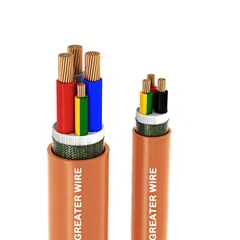
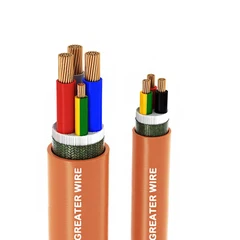

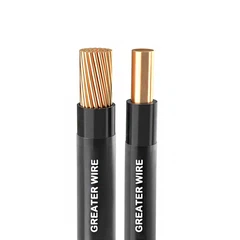
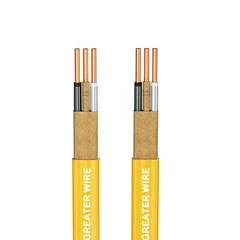
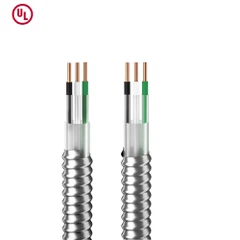
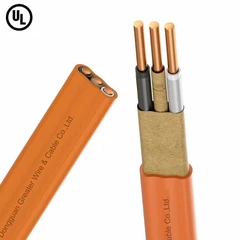

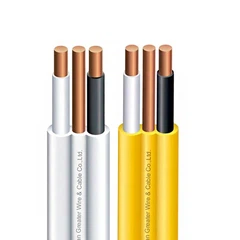
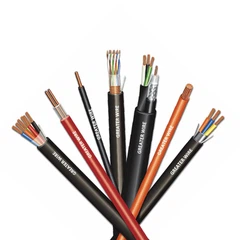
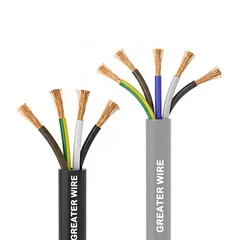
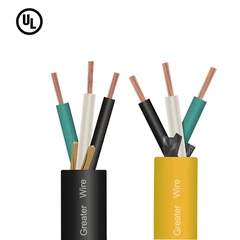
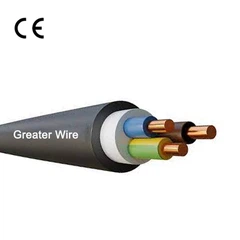


Choosing between 12/2 and 12/3 AC90 cable is mainly a matter of how many insulated conductors the circuit requires, not simply how much power the cable can carry. In a typical Canadian AC90 configuration, both options use 12 AWG conductors, but 12/3 includes one additional insulated conductor. That extra conductor can support circuit arrangements such as certain three-way switching applications or other wiring configurations that require an additional current-carrying path.
The correct choice depends on the circuit design, the function of each conductor, the applicable Canadian Electrical Code requirements, and the cable manufacturer's certified construction. It is not safe to assume that 12/3 is automatically a higher-capacity version of 12/2.

1. What Do 12/2 and 12/3 Mean?
The numbers describe the cable's conductor size and the number of insulated circuit conductors:
12 means the insulated circuit conductors are 12 AWG.
/2 means the cable contains two insulated circuit conductors.
/3 means the cable contains three insulated circuit conductors.
For standard AC90 constructions, the bare bonding conductor is separate from this count. It is not counted as one of the two or three insulated circuit conductors.
|
Configuration |
Typical insulated conductor colours |
Separate bonding conductor |
|---|---|---|
|
12/2 AC90 |
Black and white |
Yes |
|
12/3 AC90 |
Black, red, and white |
Yes |
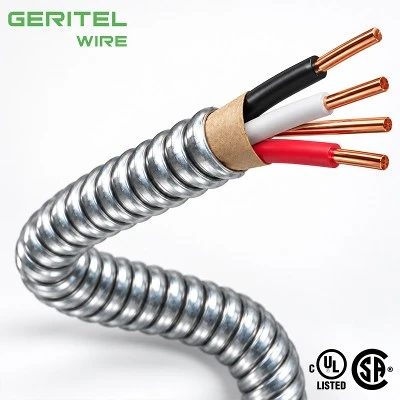
The exact colour coding and bonding arrangement should always be confirmed against the manufacturer's datasheet. For example, Southwire identifies 12/2 AC90 with black and white circuit conductors, and 12/3 with black, red, and white conductors, plus a bare copper bonding conductor.
326 (18-03) Rev6+1
2. The Main Difference Between 12/2 and 12/3 AC90
The most important difference is the number of insulated conductors available for the circuit.
12/2 AC90 is generally suitable when the circuit design needs two insulated conductors, such as a typical line-and-neutral arrangement.
12/3 AC90 provides one additional insulated conductor. Depending on the wiring design, that conductor may be used as a traveler in a multi-location switching circuit, or as another line conductor in an appropriately designed circuit.
However, 12/3 does not automatically provide a higher ampacity than 12/2. Both use 12 AWG conductors, and the permitted circuit rating depends on the applicable electrical code, installation conditions, terminal ratings, and other design factors-not simply the conductor count. Manufacturer data also lists 12 AWG 2-conductor and 3-conductor AC90 products separately, with their own construction details.
AC90 ISO-BX+1
3. When Should You Choose 12/2 AC90?
12/2 AC90 is usually the straightforward choice when a circuit requires only two insulated conductors.
Typical applications
General lighting circuits: For a basic lighting circuit with a line conductor and neutral.
Standard receptacle circuits: For receptacle branch circuits that require one line conductor and one neutral.
Dedicated equipment circuits: Where the equipment wiring diagram specifies two insulated circuit conductors, in addition to the bonding path.
Simple power distribution: For installations where the circuit design does not require an additional insulated conductor.
For example, a typical 120 V branch circuit uses one ungrounded conductor to supply power and one identified conductor to provide the return path. The bonding conductor provides a separate protective path and is not a substitute for the neutral.
The actual suitability of 12/2 AC90 depends on the equipment requirements, circuit design, and applicable electrical installation rules.
4. When Should You Choose 12/3 AC90?
12/3 AC90 is appropriate when the circuit needs three insulated conductors. The additional conductor gives an electrician more wiring options, but it must have a defined electrical purpose.
Three-way and multi-location switching
One common application is lighting controlled from two or more locations.
A typical three-way switching arrangement uses two traveler conductors between the switches. Depending on where the power supply and lighting load are located, additional conductors may be needed for the line, switched line, or neutral.
A 12/3 cable can provide three insulated conductors for an appropriate section of this wiring arrangement. It may also allow a neutral to be present at a switch location where the circuit design requires one, including for certain electronic lighting controls.
The precise conductor allocation depends on the wiring layout. A 12/3 cable is not automatically sufficient for every multi-location switching arrangement.
2018 Canadian Electrical Code+1
Multi-wire branch circuits
Another possible application is a multi-wire branch circuit, in which two ungrounded conductors share an identified neutral conductor.
For example, a properly designed 120/240 V system may use the black and red conductors as separate line conductors and the white conductor as a shared neutral. This arrangement can supply separate 120 V loads through one cable.
However, shared-neutral circuits require careful design. The conductors must be connected to the correct supply phases, and the circuit must have the required simultaneous disconnecting arrangement. Neutral continuity and overcurrent protection are also important safety considerations.
Do not assume that any 12/3 cable installation can be used as a multi-wire branch circuit. The applicable Canadian Electrical Code requirements and local authority rules must be followed.
philtech.ca+1
Equipment and control wiring
Some equipment designs require three insulated conductors for their power or control connections. In these cases, 12/3 AC90 may be suitable if the conductor size, voltage rating, insulation, cable certification, and installation conditions match the equipment manufacturer's requirements.
The wiring diagram should determine the required configuration-not the assumption that an extra conductor is always useful.
5. 12/2 vs 12/3 AC90: Side-by-Side Comparison
|
Comparison factor |
12/2 AC90 |
12/3 AC90 |
|---|---|---|
|
Conductor size |
12 AWG |
12 AWG |
|
Insulated circuit conductors |
2 |
3 |
|
Typical colour coding |
Black, white |
Black, red, white |
|
Bonding conductor |
Separate |
Separate |
|
Typical wiring use |
Basic line-and-neutral circuits |
Circuits requiring an additional insulated conductor |
|
Three-way switching |
May be insufficient, depending on layout |
Often suitable for particular switch-to-switch runs |
|
Multi-wire branch circuit |
Not normally the three-conductor configuration required |
May be suitable when properly designed |
|
Cable dimensions and weight |
Generally smaller and lighter |
Generally larger and heavier |
|
Material requirement |
Less conductor material |
More conductor material |
The physical dimensions and weight vary by manufacturer and product construction. For example, Nexans publishes separate construction data for 12 AWG two-conductor and three-conductor AC90 products. Its data shows that the three-conductor versions have a larger nominal cable diameter and greater weight than the corresponding two-conductor versions.
AC90 ISO-BX+1
6. Does 12/3 AC90 Have a Higher Ampacity Than 12/2?
Not simply because it contains one additional conductor.
Both configurations use 12 AWG conductors, but the allowable circuit loading must be determined using the applicable electrical code and the actual installation conditions.
Relevant factors include:
Conductor material and insulation type.
Number of current-carrying conductors in the cable.
Ambient temperature and installation conditions.
Terminal temperature ratings.
Applicable overcurrent protection requirements.
Whether the circuit uses a shared neutral or another special arrangement.
A manufacturer's published ampacity figure should not be interpreted as automatic permission to use a particular breaker size. The permitted circuit rating must be established under the applicable code and installation requirements.
For B2B buyers, this distinction matters: specifying 12/3 instead of 12/2 does not automatically increase the current capacity of the circuit. It provides an additional insulated conductor for the required wiring arrangement.
7. What Should Buyers Check Before Ordering 12/2 or 12/3 AC90?
For electrical distributors, contractors, OEM manufacturers, and procurement teams, checking the following details helps avoid ordering the wrong cable configuration.
Confirm the conductor count
Specify whether the project requires two or three insulated circuit conductors. Make sure the bonding conductor is included in the product construction as required.
Verify conductor size and material
Confirm that the cable uses 12 AWG conductors and identify whether they are copper or aluminum. Do not assume all AC90 products have identical conductor materials.
Check insulation and voltage ratings
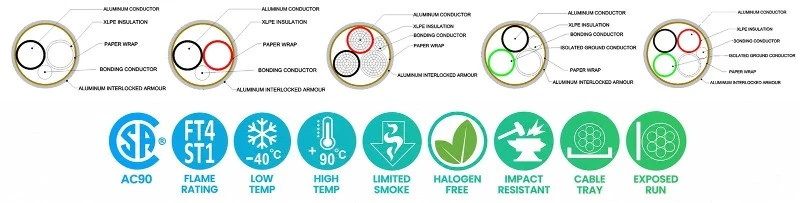
Typical Canadian AC90 products use RW90 XLPE-insulated conductors and are rated 600 V, but the exact product datasheet should confirm these details.
326 (18-03) Rev6+1
Verify CSA certification
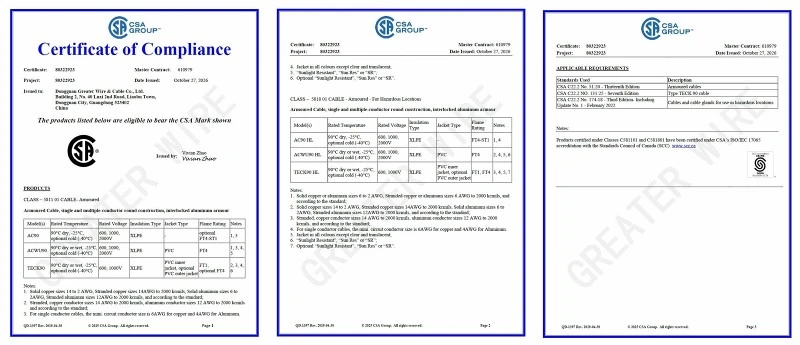
For Canadian AC90 applications, check the product's certification and compliance with the applicable CSA standards, including CSA C22.2 No. 51 for armoured cables. RW90 conductor insulation is covered by CSA C22.2 No. 38.
These are Canadian product standards. A CSA AC90 designation should not be treated as automatically equivalent to a US UL Type AC classification or an IEC cable designation. Buyers supplying multiple markets should verify the certification required by the destination jurisdiction.
Confirm the installation environment
Standard AC90 products are commonly specified for open or concealed wiring in dry locations. Do not assume that a particular AC90 product is approved for wet locations, direct burial, or outdoor exposure. Check the manufacturer's stated applications and certification before specifying it.
AC90+1
Review project quantities and cable dimensions
12/3 AC90 generally requires more conductor material and has a larger outside diameter than comparable 12/2 cable. This can affect purchasing cost, storage, handling, and cable routing. Confirm the exact dimensions and weight with the supplier before finalizing the order.

8. Final Recommendation: Which AC90 Configuration Does Your Circuit Need?
The choice between 12/2 and 12/3 AC90 should begin with the circuit wiring diagram.
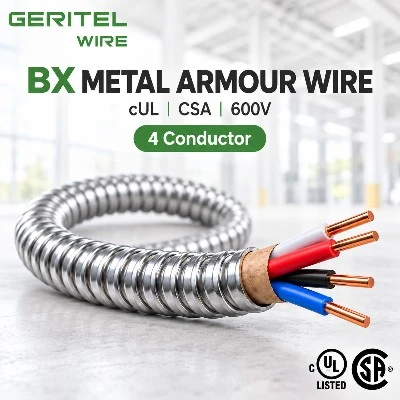
Choose 12/2 AC90 when the design requires two insulated circuit conductors and a separate bonding conductor. It is commonly used for straightforward lighting, receptacle, and other branch-circuit applications.
Choose 12/3 AC90 when the design requires three insulated circuit conductors. It can support certain three-way switching arrangements, properly designed multi-wire branch circuits, and equipment connections that need an additional conductor.
Neither configuration is universally better. The correct cable is the one that meets the circuit's conductor requirements, electrical ratings, installation conditions, and applicable code requirements.
For contractors and procurement teams, confirming the wiring diagram and cable specification before ordering is the most reliable way to avoid unnecessary material costs and installation delays.
GERITEL WIRE: AC90 Cable Solutions for Canadian Electrical Projects
GERITEL WIRE supplies AC90 armoured cables for commercial, industrial, and building wiring applications. Whether your project requires 12/2 or 12/3 AC90, selecting the correct conductor configuration, insulation, bonding conductor, and armour construction is essential for reliable installation and code-compliant procurement. Our team supports distributors, electrical contractors, OEM manufacturers, and project buyers with cable specifications and supply solutions tailored to their requirements. Contact GERITEL WIRE to discuss your AC90 cable needs, request product details, or explore supply options for your next electrical project.
Dongguan Greater Wire & Cable Co., Ltd.
Tel/WhatsApp/Wechat: +86 136 6257 9592
Tel/WhatsApp/Wechat: +86 135 1078 4550
Email: manager01@greaterwire.com
Website: www.greaterwire.com