

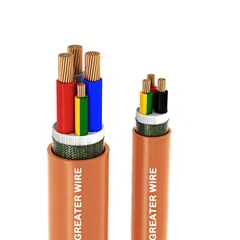
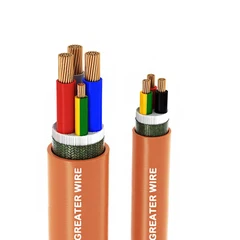

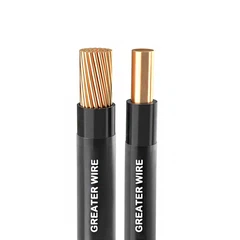
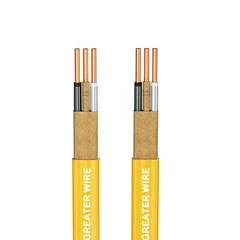
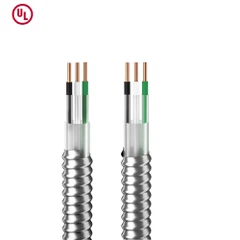
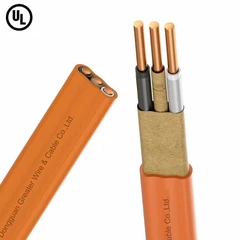
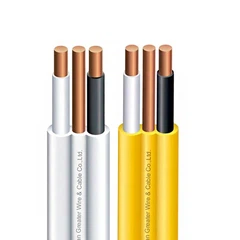

Outdoor industrial cable installations face more than ordinary electrical requirements. Cables may be exposed to rain, moisture, sunlight, temperature changes, mechanical impact, chemicals, and demanding installation conditions. Choosing the wrong cable can increase installation costs, create maintenance problems, or lead to compliance issues.
Two common options in Canadian industrial electrical systems are ACWU90 cable and TECK90 cable. Both are armoured cable types designed for demanding electrical installations, and both can be manufactured with 90°C-rated insulation and protective metallic armour.
However, their construction and certification requirements are different. ACWU90 generally features a simpler armoured construction with an overall protective jacket, while TECK90 incorporates an inner jacket beneath the armour, providing an additional protective layer.
So, which cable is better for outdoor industrial runs?
The answer depends on the installation environment, required mechanical protection, electrical specifications, and applicable electrical codes. This guide compares their construction, outdoor performance, installation considerations, and typical applications to help engineers, contractors, distributors, and procurement professionals make an informed decision.
1. What Are ACWU90 and TECK90 Cables?
Before comparing their outdoor performance, it is important to understand what each cable is designed for.
Although ACWU90 and TECK90 share some characteristics, they belong to different Canadian cable classifications and are evaluated under different CSA standards.
1.1 What Is ACWU90 Cable?
ACWU90 is a Canadian armoured cable type covered by CSA C22.2 No. 51. It is designed for electrical installations requiring insulated conductors, interlocked metallic armour, and an overall protective jacket.
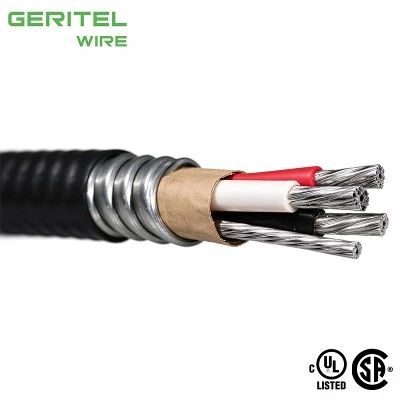
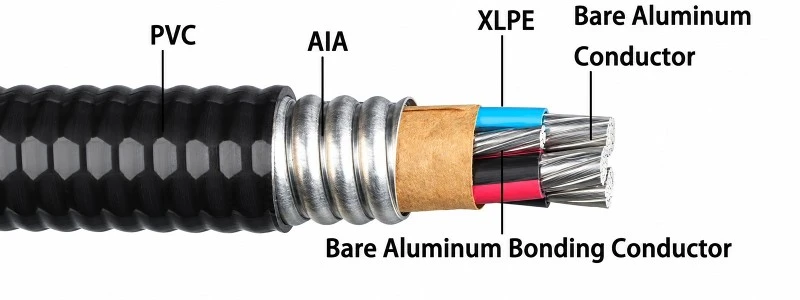
A typical ACWU90 cable consists of:
Conductor: Stranded copper or aluminum, depending on the specified product.
Insulation: Cross-linked polyethylene (XLPE), commonly rated RW90.
Bonding conductor: Provided according to the cable design and applicable requirements.
Armour: Interlocked aluminum armour (AIA) in common constructions.
Outer jacket: PVC, providing additional protection against moisture and environmental exposure.
ACWU90 is commonly used in commercial and industrial power distribution, including outdoor feeders, cable trays, and underground installations where the specific cable is approved for the intended installation method.
One of its main advantages is its relatively straightforward construction. The interlocked armour provides mechanical protection, while the outer PVC jacket helps protect the cable from moisture and environmental exposure.
1.2 What Is TECK90 Cable?
TECK90 is an industrial armoured cable type covered by CSA C22.2 No. 131. It is widely used in Canadian industrial facilities, including manufacturing plants, mines, processing facilities, and other demanding electrical environments.
A typical TECK90 cable consists of:
Conductor: Stranded copper or aluminum, depending on the product specification.
Insulation: Cross-linked polyethylene (XLPE), commonly rated RW90.
Bonding conductor: Included according to the cable design and applicable requirements.
Inner jacket: Typically PVC, surrounding the insulated conductor assembly.
Armour: Interlocked aluminum armour or, in certain constructions, galvanized steel interlocked armour.
Outer jacket: Commonly PVC, providing additional environmental protection.
The additional inner jacket is an important structural distinction between conventional TECK90 and ACWU90 constructions.
It provides another protective layer between the insulated conductor assembly and the metallic armour. This layered construction is particularly useful in industrial installations where mechanical protection, moisture resistance, and environmental durability are important considerations.
TECK90 is also available in different conductor configurations, armour materials, voltage ratings, and jacket compounds. Buyers should therefore check the exact manufacturer's datasheet rather than assume that every TECK90 product has identical characteristics.
2. ACWU90 vs TECK90: Key Technical Differences
Although both cable types can be suitable for outdoor industrial installations, their construction and product requirements are not identical.
The following table provides a general comparison based on common CSA-certified product constructions.
| Technical Parameter | ACWU90 Cable | TECK90 Cable |
|---|---|---|
| Canadian product standard | CSA C22.2 No. 51 | CSA C22.2 No. 131 |
| Conductor material | Copper or aluminum, depending on product | Copper or aluminum, depending on product |
| Insulation | XLPE, commonly RW90 | XLPE, commonly RW90 |
| Typical insulation temperature rating | 90°C | 90°C |
| Inner jacket | Generally not included | Typically included |
| Armour construction | Commonly interlocked aluminum armour | Interlocked aluminum or galvanized steel armour |
| Outer jacket | PVC or other approved construction | Commonly PVC; other approved options may be available |
| Wet-location suitability | Yes, when specifically approved and marked | Yes, when specifically approved and marked |
| Outdoor applications | Suitable for approved outdoor installations | Suitable for approved outdoor installations |
| Cable tray applications | Permitted when installation requirements are met | Permitted when installation requirements are met |
| Direct burial | Depends on product approval and installation requirements | Depends on product approval and installation requirements |
| Mechanical protection | Provided by interlocked metallic armour | Provided by interlocked metallic armour |
| Typical application | Commercial and industrial power distribution | Industrial power and control distribution |
Important: This table describes typical constructions, not universal specifications for every manufacturer's product. Conductor material, voltage rating, armour material, jacket composition, sunlight resistance, flame performance, and installation approvals must be verified against the exact cable datasheet and certification.
2.1 Cable Construction: Inner Jacket Makes a Difference
The most noticeable structural difference is the inner jacket.
ACWU90 generally uses XLPE-insulated conductors protected by interlocked metallic armour and an overall PVC jacket.
TECK90 typically adds an inner PVC jacket between the insulated conductors and the metallic armour.
This additional layer provides another barrier against physical contact with the armour and helps protect the conductor assembly during manufacturing, installation, and service.
For industrial installations involving equipment connections, cable routing through busy production areas, or exposure to mechanical handling, this layered construction can be advantageous.
However, an inner jacket does not automatically make every TECK90 cable mechanically stronger than every ACWU90 cable. Actual performance depends on armour material, armour dimensions, cable diameter, jacket properties, and the manufacturer's tested construction.
2.2 Armour Material: Aluminum or Steel?
Armour material is another important consideration.
ACWU90 commonly uses interlocked aluminum armour, which offers a useful balance of mechanical protection and relatively low cable weight.
TECK90 can also use aluminum interlocked armour. Certain TECK90 constructions offer galvanized steel interlocked armour as an alternative.
The practical differences include:
Aluminum armour: Generally lighter and easier to handle during transportation, pulling, and installation. It is also naturally resistant to atmospheric corrosion.
Galvanized steel armour: Generally offers higher resistance to certain mechanical impacts and crushing conditions, although its actual performance depends on construction and testing.
Steel armour can be worth considering in industrial areas where the cable is more exposed to mechanical abuse.
However, it should not be assumed that all TECK90 cables have steel armour or that all ACWU90 cables are less mechanically protective.
For an accurate comparison, buyers should request the armour material and relevant mechanical performance data for both products.
2.3 Voltage and Temperature Ratings
Both ACWU90 and TECK90 commonly use XLPE insulation with a 90°C conductor temperature rating.
This makes them suitable for many industrial power distribution applications, provided the cable is correctly sized and installed.
However, their voltage ratings should not be treated as identical.
CSA C22.2 No. 51 covers ACWU90 constructions within its defined scope, including systems up to 2,000 V. CSA C22.2 No. 131 covers TECK90 constructions, including products within a wider voltage range.
In actual purchasing, the available voltage rating depends on the certified product configuration. Many commonly stocked ACWU90 and TECK90 products are rated 600 V or 1,000 V.
The 90°C marking also requires careful interpretation. It represents the maximum conductor operating temperature under specified conditions, not an automatic permission to use the 90°C ampacity column for every installation.
Allowable current depends on conductor size, ambient temperature, installation method, grouping, and equipment terminal temperature limitations.

3. Which Cable Performs Better in Outdoor Industrial Environments?
Outdoor installations expose electrical cables to environmental conditions that may be less predictable than those found inside buildings.
Rain, standing water, sunlight, temperature changes, and mechanical damage can all affect long-term cable performance.
Both ACWU90 and TECK90 can be suitable for outdoor industrial runs, but the exact product construction matters.
3.1 Moisture and Wet-Location Performance
Moisture resistance is essential for outdoor industrial cables.
Rainwater, condensation, wet cable trays, and underground exposure can create conditions in which moisture protection becomes particularly important.
Both ACWU90 and TECK90 are available in constructions rated for wet locations.
ACWU90 uses an overall protective jacket to help prevent moisture from reaching the insulated conductor assembly.
TECK90 typically incorporates both an inner jacket and an overall jacket, providing additional protective layers around the cable components.
For projects involving frequent water exposure, either cable may be appropriate when the selected product is specifically approved for wet locations.
The important purchasing considerations include:
Wet-location rating.
Outer jacket material and thickness.
Moisture resistance of the complete cable construction.
Approved cable glands and connectors.
Installation method and applicable code requirements.
A cable's jacket alone does not establish its suitability for every underground or submerged application.
3.2 UV and Sunlight Resistance
Outdoor industrial cable runs are often exposed to direct sunlight for extended periods.
Ultraviolet radiation can gradually degrade unsuitable polymer materials, potentially causing jacket cracking, discoloration, or reduced service life.
Both ACWU90 and TECK90 can be supplied with sunlight-resistant jacket constructions.
However, sunlight resistance should be confirmed through the manufacturer's markings and certification documentation.
Do not assume that every black PVC jacket is automatically sunlight resistant.
For exposed outdoor installations, specify the required sunlight-resistant rating in the purchasing documents and verify that it applies to the exact cable construction being supplied.
3.3 Mechanical Protection in Industrial Areas
Mechanical protection becomes particularly important when cables are installed near production equipment, vehicle routes, maintenance areas, or outdoor machinery.
Both ACWU90 and TECK90 use metallic armour to provide protection against certain forms of mechanical damage.
ACWU90 is often a practical option where aluminum interlocked armour provides sufficient protection for the installation.
TECK90 may be preferable where the additional inner jacket and an available steel-armoured construction provide benefits for the project's mechanical protection requirements.
Nevertheless, neither cable should be treated as indestructible.
Severe impact, repeated crushing, excessive bending, or improper installation can damage armoured cables.
Where the installation involves forklift traffic, heavy machinery, or significant impact risks, additional physical protection may be necessary.
3.4 Temperature and Outdoor Climate Conditions
Industrial cables may experience substantial temperature variations depending on their geographical location and installation environment.
Both cable families are available with 90°C-rated insulation.
However, the permitted minimum installation temperature and low-temperature performance depend on the exact product construction.
Some manufacturers offer cable constructions tested for cold bending and impact at -40°C, while other products may have different limits.
For projects in cold climates, check:
Minimum recommended installation temperature.
Minimum operating temperature.
Cold-bend and cold-impact test classifications.
Required bending radius during installation.
A 90°C operating temperature rating does not automatically establish a cable's suitability for extremely cold installation conditions.
4. ACWU90 vs TECK90: Installation and Application Considerations
The best cable is not necessarily the one with the most protective layers. It is the one that meets the electrical and mechanical requirements without introducing unnecessary installation costs.
4.1 Outdoor Cable Runs on Industrial Sites
For outdoor industrial cable runs, both ACWU90 and TECK90 can be appropriate choices.
ACWU90 is worth considering when the project requires:
Aluminum interlocked armour.
An overall protective jacket.
A wet-location-rated cable.
Sunlight-resistant construction.
A relatively lightweight armoured cable.
TECK90 is worth considering when the project requires:
A layered cable construction with an inner jacket.
Additional protection around the insulated conductor assembly.
Aluminum or galvanized steel interlocked armour options.
A cable commonly specified for industrial power and control installations.
For example, an outdoor feeder supplying a distribution panel in a manufacturing facility may be suitable for either type.
The final decision should be based on the cable's approved construction, load requirements, environmental exposure, and installation specifications.
4.2 Cable Tray Installations
Industrial cable trays are widely used to organize power and control cables across production buildings and outdoor equipment areas.
Both ACWU90 and TECK90 are available in products approved for cable tray applications.
However, the applicable requirements depend on the specific cable listing, tray type, conductor arrangement, support spacing, and Canadian Electrical Code provisions.
When selecting a cable for an outdoor tray, consider:
Cable tray loading and support requirements.
Cable weight and overall diameter.
Minimum bending radius.
Ambient temperature and conductor grouping.
Sunlight and wet-location ratings.
Flame-test requirements where applicable.
ACWU90 may offer a practical weight advantage in some aluminum-armoured configurations.
TECK90 may be preferred when its construction and specified mechanical characteristics better match the project's requirements.
4.3 Underground and Direct-Burial Installations
Underground installations require particular attention because cables may encounter soil moisture, water accumulation, soil movement, and mechanical damage during backfilling.
Both cable families are available in constructions approved for certain underground applications, including direct burial where specifically permitted.
However, not every ACWU90 or TECK90 product is automatically approved for direct burial.
Before ordering, verify:
Whether the exact cable is marked or documented for direct burial.
Whether additional mechanical protection is required.
Whether the cable is suitable for the expected soil and moisture conditions.
Whether the installation complies with the applicable electrical code.
Whether the selected connectors and terminations are suitable for the environment.
For installations involving particularly aggressive soil or chemical exposure, additional jacket compatibility information may be necessary.
4.4 Industrial Equipment Connections
Industrial equipment often requires cables that can withstand vibration, movement, moisture, and repeated maintenance activities.
ACWU90 and TECK90 are both used in industrial power distribution, but the correct choice depends on the connection design.
For example, a fixed outdoor feeder and a cable connected to equipment subject to continuous movement are not necessarily governed by the same requirements.
Neither cable should automatically be treated as a flexible cable for continuous-motion applications.
Always check the manufacturer's bending instructions, permitted installation conditions, and equipment connection requirements.
5. Cost, Weight, and Procurement Considerations
For electrical distributors, EPC contractors, and industrial procurement teams, technical performance is only one part of cable selection.
Cable weight, material costs, installation labor, availability, and long-term maintenance can all affect the total project cost.
5.1 Cable Weight and Handling
Aluminum conductors and aluminum interlocked armour can help reduce cable weight compared with certain copper-conductor or steel-armoured alternatives.
This may simplify transportation, cable pulling, and installation.
However, comparing ACWU90 and TECK90 by cable type alone is not sufficient.
A large TECK90 cable with aluminum conductors may be lighter than a smaller or differently configured ACWU90 cable.
The most reliable comparison uses the actual cable diameter and weight per unit length provided in the manufacturer's datasheets.
5.2 Material and Installation Costs
ACWU90 may provide a cost-effective solution for projects that do not require the specific construction features of TECK90.
TECK90 may involve higher material costs in certain configurations because of its additional inner jacket, armour options, or more demanding product specifications.
However, the actual price difference depends on:
Conductor material and cross-sectional area.
Number of conductors.
Armour material.
Jacket composition.
Voltage rating.
Certification requirements.
Order quantity and production lead time.
A lower purchase price does not necessarily mean a lower installed cost.
Cable weight, termination accessories, labor requirements, installation time, and maintenance should all be considered when evaluating the total project budget.
6. When Should You Choose ACWU90 or TECK90?
The following recommendations provide a practical starting point for industrial cable selection.
| Project Requirement | Recommended Starting Point | Reason |
|---|---|---|
| Outdoor industrial feeders | ACWU90 or TECK90 | Both are available in suitable outdoor-rated constructions |
| Wet-location installations | ACWU90 or TECK90 | Both have wet-location-rated product options |
| Lightweight armoured cable | ACWU90 with aluminum armour | Commonly offers a practical weight advantage |
| Additional conductor assembly protection | TECK90 | Typically includes an inner jacket |
| Higher mechanical protection requirements | TECK90 with suitable steel armour | Steel armour may provide improved resistance to certain mechanical stresses |
| Industrial cable tray systems | ACWU90 or TECK90 | Subject to cable approval and installation requirements |
| Direct-burial applications | Either, if approved | Verify the exact product's direct-burial suitability |
| Industrial power and control distribution | TECK90 or ACWU90 | Select according to the project specification and cable configuration |
Choose ACWU90 When:
The project requires a CSA-compliant armoured cable with an overall protective jacket.
Aluminum interlocked armour meets the required mechanical protection level.
The cable must be suitable for approved wet and outdoor locations.
Reducing cable weight and simplifying handling are important considerations.
The application does not require the additional inner-jacket construction commonly associated with TECK90.
Choose TECK90 When:
The project specification explicitly calls for TECK90.
An additional inner jacket is desirable for the installation.
The project requires a choice between aluminum and galvanized steel interlocked armour.
The cable will be used in demanding industrial power or control distribution systems.
The selected construction provides the mechanical and environmental characteristics required by the application.
Neither recommendation replaces engineering review or local electrical code requirements.
7. CSA Certification and Compliance: What Should Buyers Check?
One of the most important purchasing considerations is the difference between a cable's product classification and its actual installation approval.
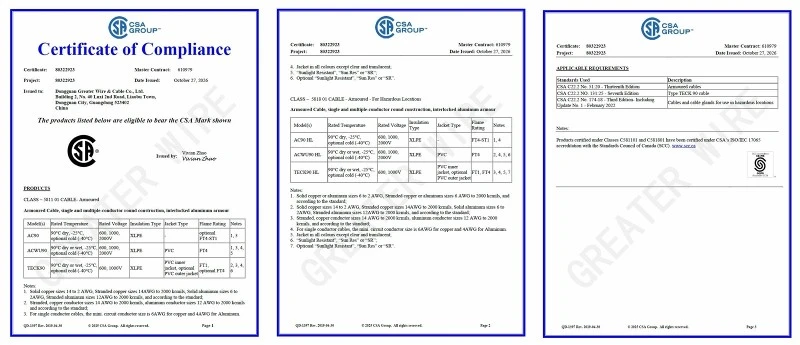
ACWU90 and TECK90 are Canadian cable designations covered by different CSA standards.
7.1 CSA Standards
The principal standards to consider are:
CSA C22.2 No. 51: Covers armoured cable constructions, including ACWU90.
CSA C22.2 No. 131: Covers TECK90 armoured cable constructions.
CSA C22.2 No. 38: Covers thermoset-insulated wires and cables, relevant to commonly used RW90 insulation.
CSA C22.2 No. 174: Applies to cables and cable glands for use in hazardous locations where the relevant certification is required.
The applicable standards and certification scope should be checked against the actual product.
7.2 CSA Certification Does Not Mean Every Installation Is Automatically Permitted
A CSA-certified cable is not automatically suitable for every outdoor application.
For example, a product may have a wet-location rating but still require specific installation conditions, approved connectors, or additional protection for direct burial.
Hazardous-location installations also require special attention.
The cable must have the appropriate hazardous-location certification, and the associated cable glands and installation methods must meet the applicable requirements.
Similarly, a standard ACWU90 or TECK90 product should not be assumed to have hazardous-location approval simply because it has metallic armour.
7.3 Do Not Confuse CSA Cable Types with UL or IEC Equivalents
International buyers should pay particular attention to the certification system required by the project.
TECK90 is a Canadian cable designation. It is not automatically interchangeable with UL Type MC cable.
Likewise, ACWU90 should not be treated as a universal equivalent to every North American or international armoured cable.
UL Type MC, CSA TECK90, IEC armoured cables, and AS/NZS cable types are governed by different product standards and installation requirements.
If the project is located in the United States, Canada, Australia, or another international market, confirm the required certification and applicable electrical code before selecting a cable.
8. Final Verdict: Which Is Better for Outdoor Industrial Runs?
There is no universal winner between ACWU90 and TECK90.
Both cable types can provide reliable performance in outdoor industrial environments when the selected construction is correctly specified, certified, and installed.
ACWU90 is often a practical choice for outdoor feeders and industrial distribution systems where aluminum interlocked armour, an overall protective jacket, and a relatively straightforward cable construction meet the project requirements.
TECK90 is often a strong choice for industrial installations that specify a layered cable construction, require an inner jacket, or benefit from the availability of different armour materials, including galvanized steel.
For most purchasing decisions, the most important factors are not simply the cable name or its 90°C rating. Buyers should compare the conductor material, voltage rating, armour type, jacket construction, sunlight resistance, wet-location approval, and direct-burial suitability.
The best cable is the one that meets the project's electrical, environmental, mechanical, and regulatory requirements while delivering an appropriate balance between installation cost and long-term reliability.

Need ACWU90 or TECK90 Cable for Your Next Industrial Project?
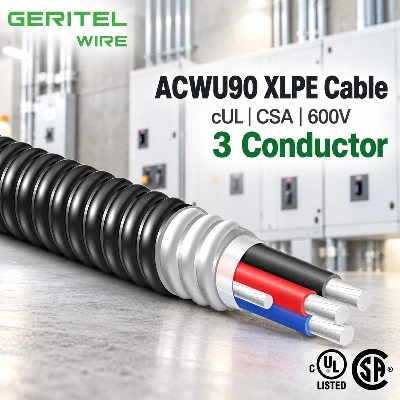
Selecting the right armoured cable is essential for safe and reliable outdoor industrial installations. GERITEL WIRE, manufactured by Dongguan Greater Wire & Cable Co., Ltd., supplies cable solutions for international distributors, electrical contractors, OEMs, and industrial projects. Whether your specification calls for ACWU90 or TECK90, our team can help you review conductor options, insulation, armour construction, voltage ratings, and certification requirements. Contact GERITEL WIRE to discuss your application, request product specifications, and obtain a quotation tailored to your project requirements.
Dongguan Greater Wire & Cable Co., Ltd.
Tel/WhatsApp/Wechat: +86 136 6257 9592
Tel/WhatsApp/Wechat: +86 135 1078 4550
Email: manager01@greaterwire.com
Website: www.greaterwire.com