























1. Overview of AS/NZS 5000.1 Mechanical Requirements
The AS/NZS 5000.1 standard specifies rigorous mechanical performance criteria to ensure cables withstand environmental stresses, installation forces, and long-term operational loads. Key components of mechanical strength include:
a) Conductor Requirements
Material and Class: Conductors must comply with AS/NZS 1125, which categorizes copper conductors into Class 1 (solid), Class 2 (stranded), or Class 5 (flexible stranded). For high-current applications like 50mm² XLPE cables, Class 2 or 5 stranded conductors are preferred due to their superior flexibility and tensile strength16.
Stranding: Stranded conductors reduce brittleness and improve resistance to mechanical fatigue, essential for cables installed in dynamic environments (e.g., industrial machinery).
b) Insulation and Sheath Properties
Insulation Material: Cross-linked polyethylene (XLPE) is widely used for its excellent mechanical and thermal properties. For example, orange-colored XLPE insulation in 50mm power cables offers high resistance to abrasion, cuts, and deformation14.
Sheath Durability: PVC (V-90 or 5V-90) sheathing, as specified in AS/NZS 3808, provides mechanical protection against impact, moisture, and chemical exposure. The sheath thickness is proportional to cable diameter, ensuring robustness in 4-core 25mm cables.

c) Bending Radius
AS/NZS 5000.1 mandates minimum bending radii to prevent insulation damage:
Fixed Installation: 4× cable outer diameter (e.g., a 50mm² cable with 20mm diameter requires an 80mm bending radius).
Mobile Installation: 15× cable outer diameter, critical for applications like temporary power supplies or mobile machinery.
d) Temperature and Environmental Resistance
Operational Range:
Fixed installations: -40°C to +90°C.
Mobile installations: -5°C to +90°C.
XLPE's thermal stability ensures minimal degradation under extreme temperatures.
Flame Retardancy: Compliance with IEC 60332.1 ensures limited flame propagation, a vital safety feature for multi-core cables in confined spaces.
2. Case Studies: Key Cable Types
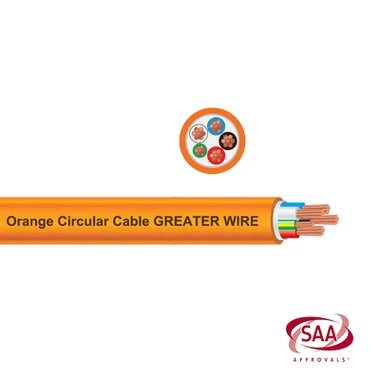
a) 50mm² XLPE Orange Power Cable
Application: Ideal for heavy-duty power transmission in mining, construction, and renewable energy systems.
Mechanical Design:
Conductor: Class 5 stranded copper for flexibility and high tensile strength.
Insulation: Orange XLPE (V-90) with a nominal thickness of 1.8mm, tested per AS 1660.2.3 for halogen-free properties.
Sheath: Black PVC (5V-90) with a minimum thickness of 1.5mm, offering crush resistance up to 3,500 N/m.
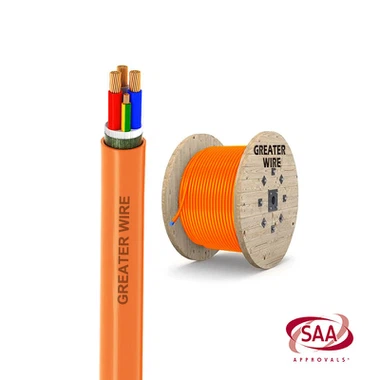
b) SAA 4-Core 25mm Cable
Compliance: Meets SAA certification for use in Australia and New Zealand.
Structural Integrity:
Cores: Four XLPE-insulated conductors (25mm² each), color-coded for phase identification.
Mechanical Protection: Steel wire armoring (optional) enhances crush resistance in underground installations.
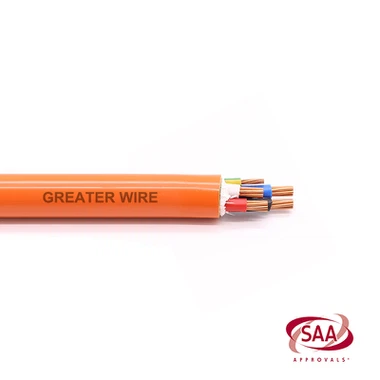
c) AS/NZS 5000.1 4-Core XLPE Orange Cable
Customization: Orange sheath/insulation for easy identification in complex installations.
Testing: Subjected to AS/NZS 1660.5.6 vertical flame tests and tensile strength evaluations (≥12.5 MPa for XLPE).
3. Testing and Certification
AS/NZS 5000.1 cables undergo rigorous mechanical testing to ensure compliance:
Tensile Strength: Conductors and insulation are tested for elongation and rupture points per AS 1660.1.
Crush Resistance: Sheath integrity is evaluated under compressive loads simulating trench backfilling or vehicular traffic6.
Bend Testing: Repeated bending cycles validate flexibility and insulation durability1.
Flame Propagation: IEC 60332.1 certification ensures fire safety in multi-core configurations1.
Certification bodies like NATA (National Association of Testing Authorities) provide third-party validation, essential for SAA approva.
4. Installation Best Practices
To maintain mechanical integrity:
Avoid Overbending: Adhere to minimum bending radii during routing.
Use Conduits: Protect cables from physical damage in high-traffic areas.
Secure Fixing: Use clamps spaced ≤1m apart to prevent sagging or stress concentrations.
5. Market Trends and Innovations
Eco-Friendly Materials: RoHS-compliant sheaths reduce environmental impact.
Smart Cables: Integration of fiber optics for real-time mechanical stress monitoring.
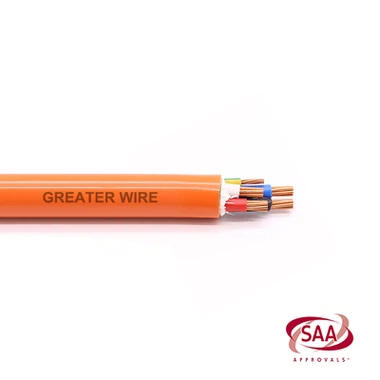
Dongguan Greater Wire & Cable Co., Ltd. specializes in producing Australian SAA certified wires, which have won wide recognition in the market for their excellent quality and stable performance. Our wires are designed with full consideration of safety and durability, and adopt world-class processes and materials to ensure that the products can maintain excellent performance in high temperature, humid and corrosive environments. Choosing our Australian SAA certified wires, you will get first-class product quality and efficient after-sales service, providing solid power support and long-term guarantee for your engineering projects.