























1. Introduction: The Regulatory Framework of AS/NZS 5000.1
In Australia, fire safety in electrical installations is governed by stringent standards, with AS/NZS 5000.1:2021 Electric Cables-Polymeric Insulated-For Working Voltages Up to and Including 0.6/1 kV serving as the cornerstone for cable design, materials, and performance. This standard not only outlines mechanical and electrical requirements but also mandates fire-resistant properties to ensure cables maintain functionality during fires, minimizing risks to life and infrastructure. For high-capacity cables like the Australia 185mm XLPE cable, 300sqmm XLPE cable, and SAA 1CX630sqmm power cable, compliance with AS/NZS 5000.1 is critical, particularly in applications such as urban high-rises, industrial complexes, and energy grids where fire resilience is non-negotiable.
2. Core Requirements for Fire-Resistant Materials in AS/NZS 5000.1
2.1 Material Classification and Thermal Performance
AS/NZS 5000.1 categorizes cables by insulation and sheath materials, with fire resistance primarily determined by their thermal stability. For XLPE-insulated cables (e.g., 185mm and 300sqmm XLPE variants), the standard specifies cross-linked polyethylene (XLPE X-90) as the insulation material, capable of sustaining continuous operation at 90°C (Clause 4.2). Under fire conditions, XLPE must resist melting and flame propagation, adhering to IEC 60331-1 (AS/NZS 1660.5.6) for circuit integrity testing at 750°C for 90 minutes-a benchmark for ensuring power supply continuity during emergencies.
The SAA 1CX630sqmm power cable, designed for heavy-duty applications, incorporates low-smoke zero-halogen (LSZH) sheaths in addition to XLPE insulation. AS/NZS 5000.1 mandates LSZH materials (Clause 5.3) to reduce toxic fume emissions, aligning with Australia's emphasis on safe evacuation during fires. These sheaths must pass AS/NZS 1660.5.1 (IEC 60332-3-24) for flame spread, ensuring beyond the cable's immediate vicinity.
2.2 Environmental and Mechanical Resilience
Beyond fire resistance, AS/NZS 5000.1 imposes strict environmental limits. For instance, XLPE cables must operate at low temperatures down to -40°C (fixed ) and withstand installation temperatures ≥0°C (Clause 3.3). This is particularly relevant for Australia's 185mm XLPE cable, often used in outdoor or underground settings where thermal stress is high. The standard also specifies bending radii-6× for non-armoured XLPE cables (e.g., 300sqmm) and 12× for variants like the SAA 1CX630sqmm-to prevent insulation damage during installation, which could compromise fire performance.
2.3 Fire Test Protocols
AS/NZS 5000.1 references two critical fire tests:
Circuit Integrity (CI) Test: Cables must maintain electrical continuity for 90 minutes at 750°C (Clause 7.3). The 185mm XLPE cable, tested under AS/NZS 1660.5.6, demonstrates this by using mica tape reinforcements beneath the XLPE insulation, a technique borrowed from IEC 60331 but adapted for Australian climatic conditions.
Flame Propagation Test: Sheaths must self-extinguish within 60 seconds post-ignition (AS/NZS 1660.5.1). The SAA 1CX630sqmm cable's LSZH sheath, compliant with this standard, ensures minimal smoke density (≤70% obscuration) and zero halogen acid gas release, aligning with Australia's Building Code (BCA) requirements for life safety.

3. Application-Specific Compliance: Case Studies of Australian Cables
3.1 Australia 185mm XLPE Cable: Urban Power Distribution
Used in substation feeders and high-rise risers, the 185mm XLPE cable under AS/NZS 5000.1 features:
XLPE X-90 insulation (90°C rating) with a 1.4mm thickness (Clause 4.3), ensuring thermal stability during overloads.
PVC 5V-90 sheath (Clause 5.2), compliant with flame retardancy (Class C of AS/NZS 3013), suitable for indoor/outdoor use.
Conductor design: Stranded copper (Class 2) for flexibility, meeting AS/NZS 1125 for current-carrying capacity (370A at 90°C), critical for maintaining power during fires.
3.2 Australia 300sqmm XLPE Cable: Industrial and Infrastructure Projects
In mining and renewable energy installations, the 300sqmm XLPE cable must withstand harsh environments:
XLPE insulation with mica tape (non-mandatory under AS/NZS 5000.1 but common in Australian designs) to enhance CI performance beyond the standard's 90-minute requirement.
Steel wire armour (SWA): Optional but recommended for underground use (Clause 6.2), providing mechanical protection and radiating heat away from the insulation during fires.
LSZH sheath variant: Increasingly adopted in Western Australia's coastal regions to resist salt corrosion while meeting low-smoke standards.
3.3 SAA 1CX630sqmm Power Cable: High-Voltage Substations
As Australia's largest single-core power cable, the 1CX630sqmm SAA-certified variant adheres to:
XLPE insulation (1.8mm thickness) for 1kV applications, tested under AS/NZS 1660.2.1 for dielectric strength (6.5kV DC for 15 minutes).
Aluminium conductor (Class 2) with a 630sqmm cross-section, compliant with AS/NZS 1125 for low resistance (≤0.03Ω/km), reducing heat generation during normal operation.
Fire retardant PVC sheath (Clause 5.2), meeting AS/NZS 3013's Flame Class C, ensuring compliance with Australia's National Construction Code (NCC) for critical infrastructure.

4. Regulatory Compliance and Certification in Australia
To bear the SAA mark, cables like the 1CX630sqmm must undergo third-party testing by entities such as the Australian Electrical and Electronic Manufacturers Association (AEEMA). Key compliance steps include:
Material Verification: XLPE must meet AS/NZS 3808 for thermal oxidative stability (2000 hours at 135°C).
Fire Testing: CI and flame propagation tests at NATA-accredited labs, with results lodged in the National Certification Body (NCB) database.
Labeling: Mandatory markings (e.g., "AS/NZS 5000.1 SAA 1CX630") to enable traceability, as required by the Electrical Safety (General) Regulations 2013.
For exporters, compliance with AS/NZS 5000.1 is non-negotiable. For example, the 185mm XLPE cable's PVC sheath must pass AS/NZS 1660.3.1 for ozone resistance (critical for Queensland's tropical climates), while the 300sqmm variant's armour plating must meet AS 1163 Grade C for corrosion resistance in Western Australia's mining zones.

5. Challenges and Innovations in Fire-Resistant Cable Design
Despite AS/NZS 5000.1's prescriptive rules, Australian engineers face unique challenges:
Bushfire-prone regions: Cables in NSW and Victoria must withstand radiant heat up to 1000°C (beyond standard CI tests), leading to innovations like ceramicized XLPE (e.g., the "FireCure" technology in some 300sqmm cables), which forms a protective ceramic layer at 800°C.
Aging infrastructure: Retrofitting older buildings with 185mm XLPE cables requires balancing fire safety with space constraints, prompting the development of compact designs that meet AS/NZS 5000.1's bending radius limits.
Sustainability: LSZH materials, while fire-safe, are costlier than PVC. Australia's push for greener grids has spurred research into bio-based flame retardants for XLPE, currently under trial in 1CX630sqmm prototypes.

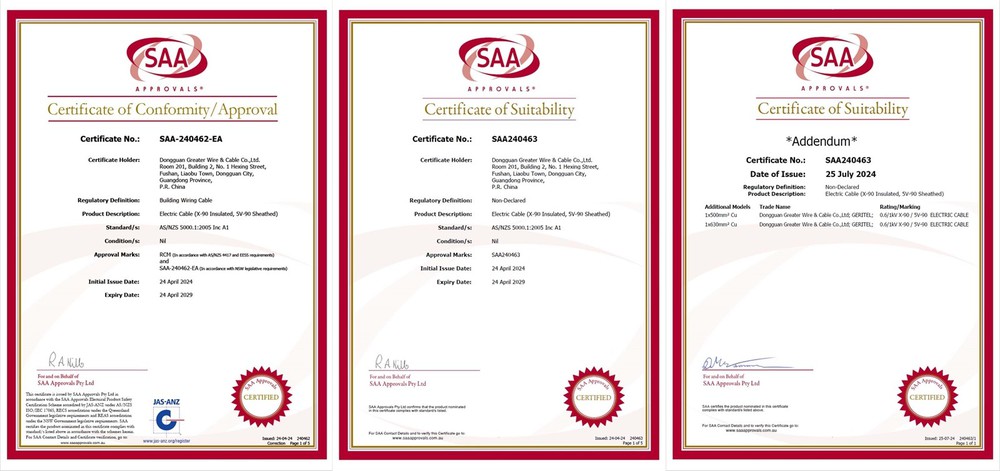
Dongguan Greater Wire & Cable Co., Ltd. is proud to produce high-quality Australian SAA certified wires. Our products use advanced cross-linked polyethylene insulation technology and are rigorously tested to ensure that they are far more resistant to high temperatures, water and chemical corrosion than ordinary wires. Whether indoors or outdoors, underground or in high humidity environments, Australian SAA certified wires can perform well and meet the needs of various complex projects. They are your ideal wire choice.