


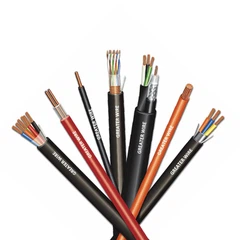
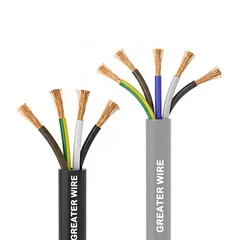
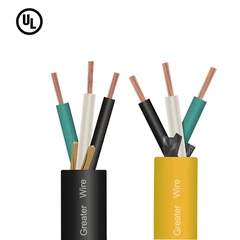
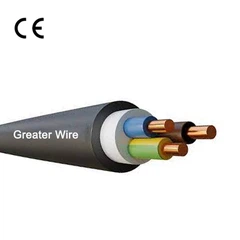

What Is ACWU90 Cable?
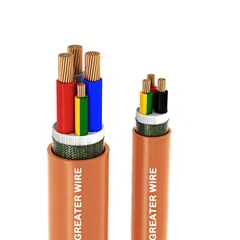
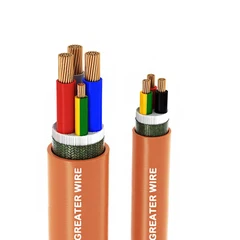
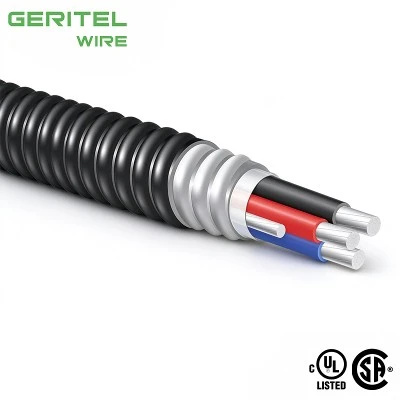
ACWU90 cable is a Canadian-designated type of armoured electrical cable featuring insulated conductors, metallic interlocked armour, and an overall protective jacket. It is commonly used in commercial, industrial, and infrastructure electrical installations where mechanical protection and environmental resistance are important.
The designation is covered by CSA C22.2 No. 51, which addresses armoured cables intended for installation in accordance with the Canadian Electrical Code (CEC), Part I. The standard covers several armoured cable types, including AC90 and ACWU90, with different construction requirements.
Armoured cables+1
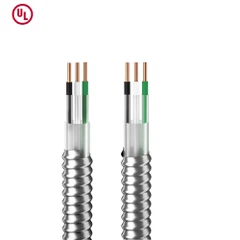
The main feature distinguishing ACWU90 from unjacketed AC90 is its overall outer jacket. This additional layer helps protect the armoured cable assembly against moisture and environmental exposure, making suitable ACWU90 constructions useful in a wider range of installation conditions.
Typical ACWU90 products are rated 600 V and have a maximum conductor operating temperature of 90°C. However, these values must always be confirmed against the specific manufacturer's product specifications rather than assumed from the cable designation alone.
Industrial+1
ACWU90 Cable Construction and Key Components
China CSA ACWU90 Cable 4 conductor 600V AIA Flame Retardant Manufacturers Suppliers Factory - Customized CSA ACWU90 Cable 4 conductor 600V AIA Flame Retardant Made in China
greaterwire.com
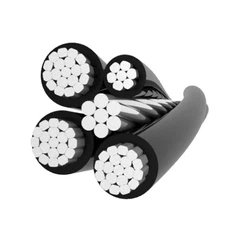
Understanding the construction of ACWU90 aluminum cable helps electrical contractors and purchasing teams evaluate its suitability for different Canadian projects.
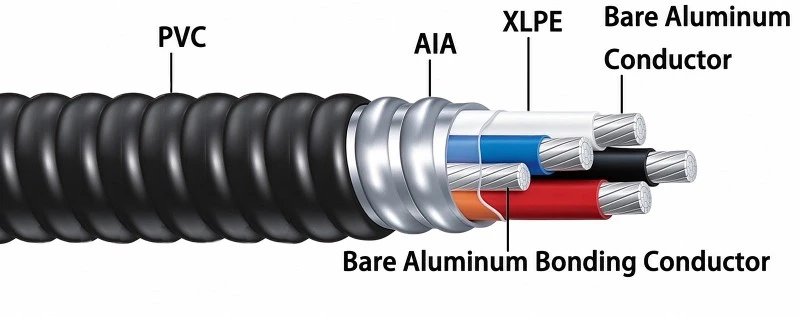
A typical multi-conductor ACWU90 cable consists of the following components:
|
Component |
Typical material |
Primary function |
|---|---|---|
|
Conductor |
AA-8000 series aluminum alloy |
Carries electrical current |
|
Insulation |
XLPE, CSA Type RW90 |
Provides electrical insulation |
|
Bonding conductor |
Bare aluminum alloy |
Provides an electrical bonding path |
|
Inner wrapping |
Protective wrapping material |
Holds and separates the conductor assembly |
|
Armour |
Aluminum interlocked armour (AIA) |
Provides mechanical protection |
|
Outer jacket |
PVC |
Adds environmental and physical protection |
The precise construction can vary according to conductor size, number of cores, manufacturer design, and applicable certification requirements.
nexans.ca+2
1. Aluminum Conductors
Many ACWU90 products use stranded AA-8000 series aluminum alloy conductors, commonly supplied in compact or compressed Class B stranding.
Aluminum is widely used in Canadian power distribution because it offers a practical balance of electrical performance, weight, and material cost.
Compared with copper conductors of equivalent electrical resistance, aluminum conductors generally require a larger cross-sectional area. Consequently, cable selection must consider conductor size, ampacity, voltage drop, terminal compatibility, and installation conditions rather than relying on a simple copper-to-aluminum size substitution.
2. XLPE RW90 Insulation
The insulated conductors in typical ACWU90 products use cross-linked polyethylene (XLPE) insulation meeting the applicable CSA Type RW90 requirements.
XLPE provides electrical insulation and good thermal performance. The 90°C designation refers to the maximum conductor operating temperature rating under the applicable conditions.
Some important characteristics include:
Suitable thermal performance for 90°C-rated applications.
Electrical insulation for power distribution circuits.
Resistance to moisture in appropriately rated constructions.
Good mechanical and electrical properties.
However, a 90°C insulation rating does not automatically mean that every installation can use the 90°C ampacity column. Equipment termination temperature ratings, conductor size, installation conditions, and CEC requirements must also be considered.
3. Aluminum Interlocked Armour
Building Wire
htcablewire.com
The aluminum interlocked armour (AIA) is one of the defining features of ACWU90 cable.
It consists of an interlocking metallic strip wrapped around the internal conductor assembly. This construction provides mechanical protection while maintaining the flexibility needed for cable routing and installation.
Its main benefits include:
Protection against certain forms of mechanical damage.
Additional structural support during installation.
A flexible alternative to some rigid raceway arrangements.
A protective metallic layer surrounding the insulated conductors.
Although interlocked armour provides mechanical protection, it should not be regarded as protection against every type of impact, crushing force, or physical hazard. Project-specific mechanical protection requirements still apply.
4. Bonding Conductor and PVC Outer Jacket
The bonding conductor provides an electrical bonding path for the cable installation. Its material and arrangement depend on the cable construction.
In typical multi-conductor aluminum ACWU90 products, a bare aluminum bonding conductor is incorporated into the cable assembly. Single-conductor constructions may use concentric bonding wires.
The overall PVC jacket covers the interlocked armour and provides additional protection against moisture, weather exposure, and other environmental conditions, depending on its tested properties.
Some manufacturers offer jackets with additional characteristics, such as sunlight resistance, flame performance, and low-acid-gas properties. These features should be verified through the product markings and certification documentation rather than assumed for every ACWU90 cable.
Industrial+2
Key Electrical and Mechanical Characteristics of ACWU90 Cable
The following table summarizes typical characteristics found in Canadian-market ACWU90 aluminum cable products.
|
Characteristic |
Typical specification |
|---|---|
|
Conductor material |
AA-8000 series aluminum alloy |
|
Conductor stranding |
Class B stranded |
|
Insulation |
XLPE, CSA Type RW90 |
|
Armour |
Aluminum interlocked armour |
|
Outer jacket |
PVC |
|
Rated voltage |
Commonly 600 V |
|
Maximum conductor temperature |
90°C |
|
Installation temperature |
Product-dependent; some products are rated to -40°C |
|
Flame performance |
FT4 on appropriately certified products |
|
Sunlight resistance |
Available on products marked and certified accordingly |
|
Conductor configuration |
Single-core or multi-core, depending on product range |
These are typical product characteristics, not universal requirements for every cable carrying the ACWU90 designation. In particular, voltage rating, minimum installation temperature, conductor configuration, flame performance, and environmental approvals must be checked against the exact product datasheet.
Industrial+3
Where Is ACWU90 Cable Used in Canadian Projects?
8/3 TECK90 Armoured Copper Cable 1000V Per Meter | MarsLED Canada META – MARS LED
About Us - Welcome I Kabelmetal
Cable Installation | Prestige Environmental Inc | Saskatchwan
Cable Ladder Tray-Conduit Installation SWMS | SafetyDocs Templates
Commercial Electrical Contractor in Toronto | Ontime Electric
Private Electrical Wire & Cable Locator in Hearst | Electrical Power Solutions
One of the main reasons contractors specify ACWU90 cable in Canada is its combination of insulated conductors, metallic armour, and an overall protective jacket.
Depending on its certification and product ratings, ACWU90 can be used in various commercial, industrial, and infrastructure applications.
1. Commercial Buildings and Industrial Facilities
ACWU90 is commonly specified for electrical feeders, branch circuits, and power distribution in commercial and industrial buildings.
Typical project environments include:
Manufacturing plants and production facilities.
Warehouses and distribution centres.
Commercial office buildings.
Shopping centres and retail facilities.
Industrial equipment and electrical distribution systems.
Its armoured construction provides mechanical protection, while the outer jacket offers an additional protective layer around the cable assembly.
For contractors, this integrated construction can reduce the need for separate raceway installations in applications where the cable is permitted to be installed directly.
The final installation method must still comply with the applicable CEC requirements and local inspection authority.
2. Cable Tray Installations
JAN GROUP - Produkty Przemysłowe
jangroup.eu
ACWU90 cable is also used in ventilated, non-ventilated, and ladder-type cable tray systems, subject to the cable's certification and applicable installation requirements.
Cable trays are widely used in industrial plants and commercial facilities to organize and support electrical wiring across buildings.
ACWU90 can offer several practical advantages:
Integrated mechanical protection.
Reduced dependence on individual conduit runs where permitted.
Easier organization of power distribution cables.
Additional protection from moisture and environmental exposure through the overall jacket.
However, cable tray suitability should not be determined by the ACWU90 designation alone. Contractors need to verify the required flame rating, cable markings, tray installation conditions, support spacing, ampacity adjustments, and applicable CEC provisions.
For example, some Canadian ACWU90 products carry an FT4 flame-spread rating under CSA C22.2 No. 2556. This rating should not be assumed for products without the corresponding qualification.
Industrial+2
3. Direct Burial and Underground Electrical Installations
EST POWER OÜ - 14738399 | Story: Usaldusväärne elektrikaablite paigaldus - turvaline ja tõhus maa-aluste kaablilahendus | STORYBOOK ®
ssb.ee
Another important application is underground power distribution.
Certain ACWU90 products are approved for direct earth burial, making them suitable for specified underground electrical installations without requiring a separate continuous raceway along the entire cable route.
Potential applications include:
Underground feeders between buildings.
Industrial site power distribution.
Electrical connections to outdoor equipment.
Underground service entrance installations.
Power distribution within commercial and infrastructure developments.
However, not every ACWU90 cable is automatically suitable for direct burial.
The manufacturer's documentation must explicitly identify direct burial as an approved application. Additional mechanical protection may be required by the inspection authority, depending on the installation conditions.
Project designers should also evaluate burial depth, soil conditions, external physical damage risks, cable ampacity, and the requirements for underground electrical installations under the applicable CEC edition.
4. Outdoor and Wet-Location Installations
ACWU90's overall PVC jacket makes appropriately rated constructions suitable for certain outdoor and wet-location applications.
Typical examples include:
Outdoor electrical distribution systems.
Industrial equipment connections.
Exposed building wiring.
Electrical feeders between indoor and outdoor equipment.
Power distribution in damp or wet industrial environments.
The jacket helps protect the internal cable assembly against environmental exposure. However, the actual suitability depends on its tested and certified characteristics.
For outdoor applications, buyers should pay particular attention to sunlight resistance. A PVC jacket should not automatically be assumed to be sunlight-resistant simply because it is black or because the cable is described as ACWU90.
Look for the appropriate product markings, such as SUN RES or SR, when sunlight resistance is required.
Industrial+2
5. Hazardous Locations
防爆電纜接頭運用於工廠電氣系統安全的優勢 - asmag.com.tw
asmag.com.tw
Certain specially certified ACWU90 products can be used in hazardous locations, including specified Class I, Class II, and Class III environments.
These applications may include:
Petrochemical facilities.
Industrial processing plants.
Certain manufacturing areas.
Facilities handling combustible dust or flammable gases.
However, this application requires particular attention to certification.
A standard ACWU90 cable should not automatically be considered suitable for hazardous locations. The exact cable must have the appropriate hazardous-location approval and markings, and it must be installed using compatible approved cable glands and connectors.
For example, Nexans identifies certain ACWU90 constructions in sizes 8 AWG and larger as HL-rated for specified hazardous-location classifications. This is a product-specific approval, not a universal characteristic of every ACWU90 cable.
Industrial+1
ACWU90 vs. AC90 vs. TECK90: What Are the Differences?
Canadian electrical projects commonly use several types of armoured cables. Although ACWU90, AC90, and TECK90 may look similar, their construction and intended applications are different.
Understanding these differences helps contractors and purchasing teams avoid selecting an unsuitable cable.
PPT - Conductors, Cables, and Raceways PowerPoint Presentation, free download - ID:1617229
China CSA AC90 BX Cable Aluminum Conductor PVC Or XLPE/AIA 600V Manufacturers Suppliers Factory
Conductors Cables and Raceways Appendix A Safety standards
China ACWU90 Cable XLPE Insulation AIA Flame-Retardant PVC 600V Manufacturers Suppliers Factory
Teck 6/3c 1kv - 1000V #6 AWG 3c Teck90 Armoured Cable, Black - Teck90 Armored Cable and Teck90 Cable
Metal Clad Armored Cable Aluminium Alloy Conductor Acwu90 Cable - Electric Cable and Mc AC Bx Cable
|
Comparison |
AC90 |
ACWU90 |
TECK90 |
|---|---|---|---|
|
Metallic armour |
Yes |
Yes |
Yes |
|
Overall outer jacket |
No |
Yes |
Yes |
|
Typical armour |
Aluminum interlocked armour |
Aluminum interlocked armour |
Interlocked armour, material varies |
|
Inner jacket |
Not typical |
Not typical in common construction |
Typical |
|
Main insulation |
Product-dependent |
Commonly RW90 XLPE |
Commonly RW90 XLPE |
|
Typical applications |
Primarily dry-location wiring, subject to product approval |
Specified wet, dry, outdoor and other approved applications |
Industrial and commercial installations, subject to product approval |
Armoured cables+2
AC90 Cable
AC90 is an armoured cable without an overall outer jacket.
Its metallic armour provides mechanical protection, but it does not have the additional PVC covering found on typical ACWU90 constructions.
This distinction affects environmental suitability. For example, Nexans identifies its AC90 products for dry-location installations, while its ACWU90 products are specified for dry and wet locations and exposure to weather.
Industrial+1
ACWU90 Cable
ACWU90 adds an overall protective jacket over its metallic interlocked armour.
This construction makes it suitable for a broader range of applications when the particular product is appropriately rated, including specified wet locations, outdoor wiring, and direct burial.
Its combination of aluminium conductors, interlocked armour, and a PVC jacket makes it a practical option for many Canadian power distribution projects.
TECK90 Cable
TECK90 is another widely used Canadian armoured cable type, particularly in industrial installations.
A typical TECK90 construction includes:
Insulated conductors.
An inner jacket.
Metallic interlocked armour.
An overall outer jacket.
Compared with typical ACWU90, TECK90 has a different internal construction, including an inner jacket around the conductor assembly.
The armour material and conductor configuration can vary between product designs. Therefore, buyers should consult the specific TECK90 datasheet rather than assume that all products have identical materials or performance.
Which cable should a project choose?
Choose AC90 when an approved unjacketed armoured cable is suitable for the installation.
Consider ACWU90 when an overall protective jacket and its associated environmental ratings are required.
Consider TECK90 when the project specification calls for its particular construction and industrial cable characteristics.
The final decision must be based on the project design, product certification, environmental conditions, and applicable Canadian electrical requirements.
Canadian Standards and Installation Requirements for ACWU90 Cable
Canadian electrical projects require more than selecting a cable with suitable physical characteristics. The product must also meet the relevant Canadian standards and installation requirements.
For CSA ACWU90 cable, several standards are particularly important.
1. CSA C22.2 No. 51 – Armoured Cables
CSA C22.2 No. 51 is the primary product standard covering ACWU90 cable construction.
The 2026 edition is the fourteenth edition and supersedes the 2020 edition.
Its scope covers armoured cables with metallic interlocked armour, including:
AC90 and ACG90 without an overall jacket.
ACWU90 and ACGWU90 with an overall jacket.
The standard addresses cables intended for installation in accordance with CSA C22.1, Canadian Electrical Code, Part I.
Its scope includes nominal system voltages up to 2,000 V and a maximum cable temperature rating of 90°C, subject to the specific cable type and construction limitations. This does not mean that every commercial ACWU90 product is rated 2,000 V; many commonly available products are rated 600 V.
Armoured cables
2. CSA C22.2 No. 38 – Thermoset-Insulated Wires and Cables
CSA C22.2 No. 38 is relevant to thermoset-insulated conductors, including RW90 insulation used in typical ACWU90 constructions.
For buyers, this standard helps establish the requirements associated with the cable's XLPE insulation system.
It is important to distinguish the cable's overall ACWU90 product classification from the requirements applicable to its individual insulated conductors.
3. CSA C22.2 No. 174 – Hazardous-Location Cable Applications
CSA C22.2 No. 174 addresses cables and cable glands for use in hazardous locations.
It becomes particularly relevant when an ACWU90 product is specified for environments containing flammable gases, vapours, or combustible dust.
However, compliance with this standard should not be assumed for all ACWU90 cables. Buyers must verify the specific product's hazardous-location certification and ensure that the complete cable installation uses suitable approved components.
Industrial+1
4. CSA C22.1 – Canadian Electrical Code, Part I
The Canadian Electrical Code (CEC), Part I, governs electrical installation requirements.
While CSA C22.2 No. 51 addresses product construction, CSA C22.1 addresses how electrical products are installed and used.
For ACWU90 projects, relevant installation considerations include:
Permitted wiring methods.
Cable support and protection.
Ampacity calculations and adjustment factors.
Grounding and bonding.
Underground installation requirements.
Cable tray installation conditions.
Hazardous-location requirements.
The applicable CEC edition and local electrical authority requirements should always be confirmed for the project location.
5. CSA C22.2 No. 2556 – Flame Testing
CSA C22.2 No. 2556 covers tests for electrical wires and cables, including flame testing.
Some ACWU90 products carry an FT4 rating, which is relevant to applications where the specified vertical-tray flame performance is required.
Buyers should verify the actual FT4 marking and supporting product documentation rather than assume that all PVC-jacketed ACWU90 cables meet this requirement.
Industrial+2
Important 2026 standards update: The 2026 edition of CSA C22.2 No. 51 includes updates to ACWU90 construction requirements, including provisions for PCS construction, FT4 and halogen-free markings, conductor colour coding, and electrical resistance testing. Buyers preparing new Canadian project specifications should check the current standard edition and confirm the applicable certification requirements with their cable supplier.
Armoured cables
How to Select the Right ACWU90 Cable for Canadian Projects
Selecting the correct ACWU90 cable requires more than matching the conductor size to the electrical load. Project engineers, electrical contractors, and purchasing teams should evaluate the cable's complete construction, ratings, and installation requirements.
The following factors can help buyers specify the right product.
1. Confirm the Conductor Material and Size
Most commonly available ACWU90 products use aluminum conductors, although product configurations vary.
When selecting conductor size, consider:
Required circuit current.
Permitted ampacity under the applicable CEC requirements.
Voltage drop over the installation distance.
Ambient temperature and conductor grouping.
Equipment terminal compatibility.
For aluminum conductors, verify that the connected equipment and terminals are suitable for aluminum conductor termination.
2. Determine the Number of Conductors
ACWU90 is available in different conductor configurations, depending on the manufacturer.
Common options include:
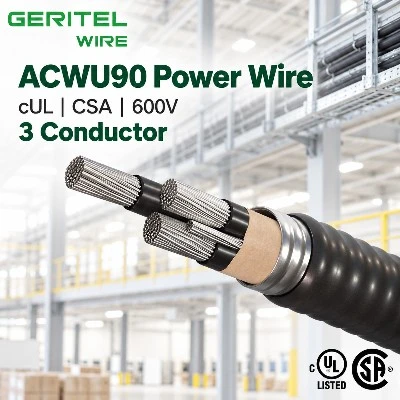
Single-conductor configurations.
Three-conductor configurations.
Four-conductor configurations.
The required configuration depends on the electrical system, circuit design, and grounding or bonding arrangement.
Buyers should also confirm whether the cable includes a separate bonding conductor and how it is incorporated into the cable construction.
3. Check the Voltage Rating
Many commercial ACWU90 products are rated 600 V.
However, the actual voltage rating must be confirmed through the manufacturer's datasheet and cable markings.
Do not assume that every cable manufactured to the same general cable type has an identical voltage rating.
4. Verify Temperature and Environmental Ratings
A typical ACWU90 product uses 90°C-rated XLPE insulation.
However, different projects may require additional environmental performance, including:
Sunlight resistance.
Wet-location suitability.
Low-temperature installation performance.
Flame-spread performance.
Low-acid-gas characteristics.
Resistance to specific environmental exposures.
These characteristics should be verified individually because they are not automatically included in every ACWU90 construction.
5. Confirm CSA Certification and Product Compliance
For Canadian projects, certification is an essential purchasing consideration.
Before placing an order, request:
CSA certification information.
Applicable product standard and edition.
Detailed cable construction specifications.
Conductor size and electrical ratings.
Environmental and flame-test information.
Product markings and identification details.
For hazardous-location applications, request the specific HL certification documentation and verify compatibility with the required cable glands and installation system.
6. Consider Project-Specific Installation Requirements
The cable must be suitable not only for the electrical load but also for the actual installation environment.
For example, a cable intended for a wet outdoor installation may require different product approvals from one used inside a dry commercial building.
Providing the manufacturer with the following project information can help reduce specification errors:
|
Information |
Example |
|---|---|
|
Application |
Industrial feeder |
|
Conductor material |
Aluminum |
|
Conductor size |
4/0 AWG |
|
Number of conductors |
3C + bonding |
|
Voltage rating |
600 V |
|
Installation method |
Cable tray or direct burial |
|
Environmental conditions |
Wet, outdoor, sunlight exposure |
|
Required certification |
CSA ACWU90 |
The more complete the project specification, the easier it is for a cable manufacturer to recommend a suitable construction.
Frequently Asked Questions About ACWU90 Cable
1. What does ACWU90 stand for?
ACWU90 is a Canadian armoured cable designation. It identifies a cable type featuring insulated conductors, metallic interlocked armour, and an overall protective jacket, with a maximum cable temperature rating of 90°C under the applicable standard.
The exact conductor and insulation materials depend on the certified product construction.
2. Is ACWU90 cable suitable for outdoor use?
Yes, appropriately rated ACWU90 products can be used in specified outdoor installations.
The overall PVC jacket provides additional environmental protection. However, sunlight resistance and other outdoor performance characteristics must be confirmed through the manufacturer's product documentation.
3. Can ACWU90 cable be directly buried?
Certain ACWU90 products are approved for direct burial.
However, buyers must confirm that direct burial is specifically included in the product's approved applications. Additional mechanical protection may be required by the local inspection authority.
4. Is ACWU90 cable rated for wet locations?
Many Canadian-market ACWU90 products are designed and approved for wet locations because they incorporate an overall protective jacket and suitable insulation.
Nevertheless, wet-location suitability must be confirmed for the exact product rather than assumed from its designation alone.
5. What is the difference between ACWU90 and AC90?
The primary difference is the overall jacket.
AC90 typically has metallic interlocked armour without an overall jacket, whereas ACWU90 includes an additional outer protective jacket.
This makes appropriately rated ACWU90 products suitable for certain wet and outdoor applications that are not permitted for standard AC90 products.
6. Is ACWU90 cable suitable for hazardous locations?
Some ACWU90 products have additional hazardous-location certification.
However, standard ACWU90 designation alone does not establish hazardous-location suitability. Buyers must verify the HL rating, applicable hazardous-location classification, and compatibility with approved cable glands and connectors.
7. What is the maximum operating temperature of ACWU90 cable?
Typical ACWU90 products have a maximum conductor operating temperature of 90°C.
Actual allowable operating conditions and ampacity depend on the cable construction, equipment terminations, installation environment, and applicable electrical code requirements.
8. What standard covers ACWU90 cable in Canada?
CSA C22.2 No. 51 is the primary Canadian product standard covering ACWU90 armoured cables.
Other standards may apply to specific insulation systems, hazardous-location applications, and flame testing. The installation itself must comply with the applicable Canadian Electrical Code and local electrical authority requirements.

Why Choose GERITEL WIRE for ACWU90 Cable Supply?
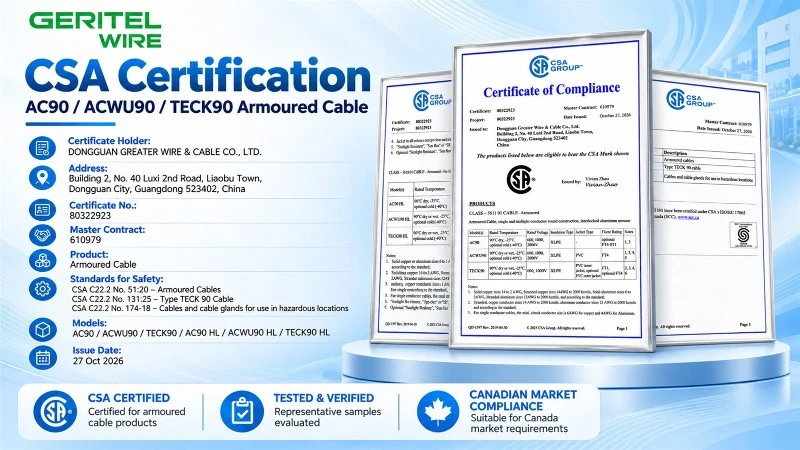
Choosing the right ACWU90 cable supplier is important for maintaining product consistency, certification compliance, and reliable project delivery. GERITEL WIRE, operated by Dongguan Greater Wire & Cable Co., Ltd., supplies Canadian-standard armoured cable solutions for commercial, industrial, and infrastructure applications. Our ACWU90 product range supports different conductor configurations and project specifications. In October 2026, the company also obtained CSA certification covering its ACWU90-HL cable family for hazardous-location applications. Whether you are an electrical distributor, contractor, or OEM buyer, contact GERITEL WIRE to discuss your technical requirements, request product documentation, and obtain a quotation for your next Canadian cable project.
Greater Wire
Dongguan Greater Wire & Cable Co., Ltd.
Tel/WhatsApp/Wechat: +86 136 6257 9592
Tel/WhatsApp/Wechat: +86 135 1078 4550
Email: manager01@greaterwire.com
Website: www.greaterwire.com