



1. Why Is ACWU90 Cable a Suitable Choice for Wet Locations?
Electrical installations in wet locations require cables that can maintain reliable electrical insulation and mechanical protection despite exposure to moisture. Examples include outdoor electrical distribution systems, commercial buildings, industrial facilities, underground wiring routes, and areas where condensation or water exposure is expected.
For projects in Canada and other markets using Canadian electrical cable specifications, ACWU90 cable is an option worth considering when a jacketed armoured cable is required for wet-location installations.
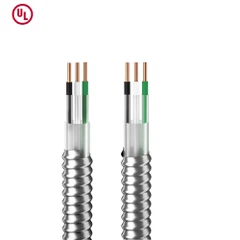
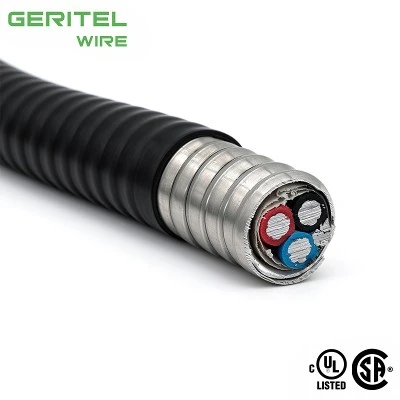
ACWU90 is a CSA-designated armoured cable type. Its typical construction combines insulated conductors, interlocked metal armour, and an overall protective jacket. Unlike conventional AC90 cable, which generally has no overall jacket, ACWU90 provides an additional protective layer around the armour.
This construction makes ACWU90 suitable for many applications involving moisture, outdoor exposure, and specified underground installations, provided that the particular cable has the necessary approvals and is installed according to applicable electrical codes.
However, choosing a cable for a wet location involves more than checking whether its insulation is rated for 90°C. Buyers and electrical contractors should also consider its wet-location approval, jacket material, sunlight resistance, installation environment, voltage rating, and termination requirements.
2. What Makes ACWU90 Cable Suitable for Wet Locations?
To understand why ACWU90 is commonly selected for wet-location applications, it helps to examine its main construction components.
2.1 XLPE Insulation for Electrical Protection
ACWU90 typically uses cross-linked polyethylene (XLPE) insulation, commonly designated RW90 under Canadian cable specifications.
XLPE provides electrical insulation around each conductor and offers good thermal and moisture-related performance when manufactured and certified for the intended application.
The RW90 designation is particularly important because it identifies a conductor insulation type rated for a maximum continuous conductor temperature of 90°C in approved wet and dry locations.
This temperature rating should not be confused with the surrounding air or water temperature. It describes the maximum permitted continuous conductor operating temperature under the applicable conditions.
For projects involving moisture exposure, buyers should verify that the cable's complete construction is approved for wet locations rather than relying on the insulation designation alone.
2.2 Interlocked Aluminum Armour for Mechanical Protection
Another important feature of ACWU90 is its interlocked aluminum armour.
The armour surrounds the insulated conductors and provides additional mechanical protection against external impacts, crushing forces, and other physical stresses encountered during installation and operation.
Aluminum armour also offers a relatively lightweight alternative to steel armour, which can make cable handling and installation more convenient.
However, armour should not be considered a substitute for appropriate mechanical protection in every installation. Where severe physical damage is likely, additional protection may be necessary.
2.3 PVC Outer Jacket for Environmental Protection
The overall outer jacket is one of the defining characteristics of ACWU90 cable.
Typically manufactured from PVC or another approved jacket compound, this layer covers the interlocked armour and provides additional protection against moisture and environmental exposure.
Depending on the manufacturer's specific construction and certification, the jacket may also provide resistance to sunlight, flame propagation, and certain chemicals.
For wet-location installations, this additional protective layer helps reduce the risk of environmental moisture affecting the cable assembly.
Nevertheless, a PVC jacket does not automatically make a cable suitable for every chemical environment, permanent immersion, or unrestricted underground installation. These conditions must be evaluated against the product's actual ratings.
Metal Clad Armored Cable Aluminium Alloy Conductor Acwu90 Cable - Electric Cable and Mc AC Bx Cable
China CSA ACWU90 Cable 4 conductor 600V AIA Flame Retardant Manufacturers Suppliers Factory - Customized CSA ACWU90 Cable 4 conductor 600V AIA Flame Retardant Made in China
600V Mc Al AA-8000 Series Aluminum Alloy Acwu90 Cable - Electric Cable and Mc AC Bx Cable
4/4C ACWU90 Aluminum Cable
China ACWU90 Cable XLPE Insulation AIA Flame-Retardant PVC 600V Manufacturers Suppliers Factory
China CSA ACWU90 Cable 4 conductor 600V AIA Flame Retardant Manufacturers Suppliers Factory - Customized CSA ACWU90 Cable 4 conductor 600V AIA Flame Retardant Made in China
Canada 250/3 Al 2AWG 3 Conductors Reel Packaging 250 Kcmil Acwu90 Cable - Acwu90 Reel Packaging and Aluminum Acwu90
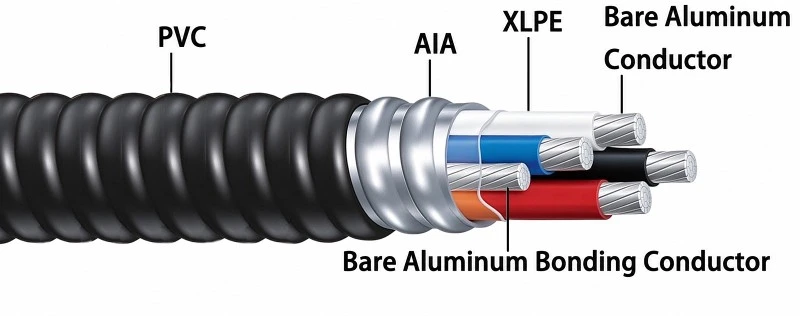
2.4 Typical ACWU90 Cable Construction
|
Component |
Typical material |
Main function |
|---|---|---|
|
Conductor |
Copper or 8000-series aluminum |
Carries electrical current |
|
Insulation |
XLPE (RW90) |
Provides electrical insulation |
|
Bonding conductor |
Bare copper or aluminum, depending on design |
Provides the required bonding path |
|
Armour |
Interlocked aluminum |
Provides mechanical protection |
|
Outer jacket |
PVC or approved equivalent |
Provides additional environmental protection |
Note: Actual construction varies by manufacturer, conductor material, cable configuration, and certification. Always consult the relevant product datasheet.

3. When Should You Choose ACWU90 Cable for a Wet Location?
ACWU90 is particularly useful when an electrical installation requires both wet-location suitability and mechanical protection. The following scenarios can help electrical contractors, engineers, and purchasing teams determine whether it is an appropriate choice.
3.1 Outdoor Electrical Installations Exposed to Rain
Outdoor electrical installations are regularly exposed to rain, humidity, temperature changes, and other environmental conditions.
Examples include:
Outdoor power distribution systems.
Electrical connections between buildings.
Commercial building exterior wiring.
Industrial equipment installed outdoors.
Outdoor electrical service installations.
In these situations, ACWU90 can be a suitable option when its specific product approval includes outdoor and wet-location use.
Its overall jacket provides an additional protective barrier against moisture, while the interlocked armour helps protect the cable from mechanical damage.
For installations exposed to direct sunlight, buyers should also verify the cable's sunlight-resistant marking, such as CSA SUN RES, rather than assuming every ACWU90 product has the same UV performance.
3.2 Underground Electrical Distribution
Underground electrical installations require particular attention to moisture protection because cables may encounter soil moisture, groundwater, and changing environmental conditions.
ACWU90 may be selected for certain underground power distribution applications, including:
Underground feeders between buildings.
Buried electrical distribution routes.
Industrial facility underground wiring.
Service entrance installations above or below ground.
However, not every ACWU90 cable is automatically approved for direct burial.
The exact cable specification must identify direct burial as an approved application. Installation must also comply with the applicable electrical code, including requirements for burial depth, physical protection, and installation conditions.
Where additional protection is required by the inspection authority, the cable must be installed accordingly.
For example, manufacturers such as Prysmian and Southwire identify direct burial as an application for their specified ACWU90 products. These approvals should not automatically be extended to products from other manufacturers.
Canadian Market+1
3.3 Commercial Buildings with Damp or Wet Areas
Commercial buildings often contain electrical routes that encounter moisture or changing environmental conditions.
Typical examples include:
Parking garages.
Building service areas.
Mechanical rooms.
Utility rooms.
Certain industrial kitchens and washdown areas.
ACWU90 can be considered when the wiring route is classified as a wet location and the installation requires an armoured cable.
Its jacketed construction offers additional environmental protection compared with an unjacketed armoured cable.
However, buyers should distinguish between occasional humidity, condensation, water splashing, and continuous water exposure. These conditions do not necessarily have identical cable requirements.
For example, a cable installed in a room with occasional condensation may have different environmental requirements from one installed in an area regularly washed down with pressurized water.
The cable's approved application and the suitability of its connectors and terminations must be evaluated together.
3.4 Industrial Facilities with Moisture Exposure
Industrial environments can expose electrical cables to moisture, vibration, mechanical stress, and other demanding operating conditions.
ACWU90 may be appropriate for certain industrial power distribution applications, such as:
Manufacturing facility feeders.
Outdoor industrial equipment connections.
Cable tray installations in wet environments.
Electrical distribution routes in utility areas.
Exposed industrial wiring.
The combination of XLPE insulation, metallic armour, and an overall protective jacket makes ACWU90 a practical option for installations requiring both electrical and mechanical protection.
Nevertheless, industrial buyers should also assess chemical exposure, oil resistance, temperature conditions, and hazardous-area requirements.
If the installation is classified as a hazardous location, the cable must have the appropriate hazardous-location approval, and compatible certified cable glands or connectors must be used where required.
4. ACWU90 vs. AC90 vs. TECK90: Which Cable Should You Choose?
ACWU90 is not the only armoured cable used in Canadian electrical installations.
AC90 and TECK90 are also common choices, but their constructions and approved applications differ.
Understanding these differences helps engineers and contractors avoid selecting a cable that does not match the installation environment.
China CSA ACWU90 Cable 4 conductor 600V AIA Flame Retardant Manufacturers Suppliers Factory - Customized CSA ACWU90 Cable 4 conductor 600V AIA Flame Retardant Made in China
China CSA AC90 BX Cable Aluminum Conductor PVC Or XLPE/AIA 600V Manufacturers Suppliers Factory
Teck 6/3c 1kv - 1000V #6 AWG 3c Teck90 Armoured Cable, Black - Teck90 Armored Cable and Teck90 Cable
Acm Canada 250 Kcmil Three 4 3 Aluminum Conductors Armoured Acwu90 Cable - 4 Conductor Acwu90 600V Aluminum and Acwu90 3c 2/0 Cable
AC90 Flexible Interlocked Aluminum Armoured Cable - Type Bx and Bx Cable
14/30 TECK90 Copper Conductor Aluminum Interlocked Armor With Ground 6
|
Comparison |
AC90 |
ACWU90 |
TECK90 |
|---|---|---|---|
|
Main construction |
Armoured cable |
Jacketed armoured cable |
Industrial armoured cable |
|
XLPE insulation |
Commonly used |
Commonly used |
Commonly used |
|
Interlocked armour |
Yes |
Yes |
Commonly used |
|
Overall outer jacket |
Generally no |
Yes |
Depends on construction |
|
Wet-location suitability |
Generally not suitable |
Yes, when approved |
Yes, when approved |
|
Outdoor applications |
Limited to approved conditions |
Yes, when approved |
Yes, when approved |
|
Mechanical protection |
Yes |
Yes |
Yes |
|
Typical applications |
Approved dry-location wiring |
Wet-location and outdoor wiring |
Industrial power and control installations |
Note: This is a general product-family comparison, not a substitute for individual manufacturer specifications. Voltage ratings, temperature classifications, conductor materials, and environmental approvals vary by product.
4.1 ACWU90 vs. AC90
The main difference is the overall jacket.
AC90 generally features insulated conductors surrounded by interlocked metal armour without an overall protective jacket.
ACWU90 adds an outer jacket over the armour, making it suitable for approved wet-location applications.
Therefore:
Choose AC90 when the installation is an approved dry location and its construction meets the project requirements.
Choose ACWU90 when wet-location suitability and an overall protective jacket are required.
If the cable route is exposed to rain, recurring condensation, or other wet-location conditions, ACWU90 is generally the more appropriate option between these two cable types.
4.2 ACWU90 vs. TECK90
TECK90 is another armoured cable commonly used in industrial installations.
It typically features XLPE-insulated conductors, metallic armour, and an inner and/or outer jacket, depending on the product design.
Both ACWU90 and TECK90 can be suitable for wet locations when appropriately certified.
The selection should therefore depend on the installation requirements rather than assuming one cable type is universally superior.
ACWU90 may be a practical choice when the project specifies a jacketed ACWU-type armoured cable.
TECK90 may be preferable when the project specifications call for TECK construction or require particular industrial cable characteristics.
Engineers should compare the actual CSA certification, voltage rating, environmental approvals, and installation requirements before making a final selection.
5. Important Factors to Check Before Purchasing ACWU90 Cable
Even when ACWU90 is suitable for wet locations, choosing the correct product requires more than confirming its cable type.
The following factors are particularly important for international B2B buyers.
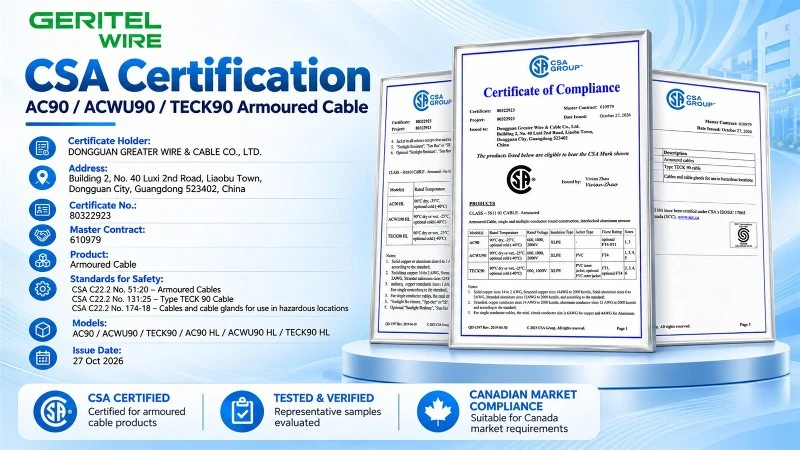
5.1 Verify the CSA Certification and Applicable Standards
For projects using Canadian electrical specifications, CSA certification is an important purchasing consideration.
Commonly relevant standards include:
CSA C22.2 No. 51: Armoured cables.
CSA C22.2 No. 38: Thermoset-insulated wires and cables.
CSA C22.2 No. 174: Cables and cable glands for use in hazardous locations, where applicable.
These standards address different aspects of cable construction and application. Their inclusion should not be interpreted as meaning that every ACWU90 product automatically carries every associated approval.
Buyers should request the manufacturer's certification information and verify that the exact product configuration is covered.
It is also important to understand that ACWU90 is a Canadian cable designation. It should not automatically be treated as equivalent to a UL-listed cable or an IEC cable type.
For projects outside Canada, including those in the United States, Europe, Australia, or New Zealand, buyers should confirm the standards and approvals required by the destination market and project specifications.
5.2 Check the Voltage Rating
ACWU90 cable is available in different voltage configurations depending on the manufacturer and certification.
Many commercially available products are rated at 600 V, while some manufacturers offer additional voltage ratings.
Before purchasing, confirm:
System operating voltage.
Cable voltage rating.
Number of conductors.
Conductor size.
Compatibility with the electrical distribution system.
Do not assume that every cable marked ACWU90 has the same voltage rating.
5.3 Confirm the 90°C Temperature Rating
The number 90 in ACWU90 refers to its 90°C conductor temperature classification.
This means the conductor can have a maximum continuous operating temperature of 90°C under the conditions specified by the applicable product standard.
However, the actual allowable current-carrying capacity (ampacity) depends on several factors, including:
Conductor material and size.
Ambient temperature.
Number of current-carrying conductors.
Installation method.
Cable grouping and surrounding conditions.
Applicable electrical code requirements.
A 90°C insulation rating does not automatically mean that the cable can always be operated at its maximum temperature or that the 90°C ampacity column can always be used for final equipment termination calculations.
The applicable code rules and terminal temperature limitations must be considered.
5.4 Select the Correct Conductor Material
ACWU90 is available with different conductor materials, depending on the manufacturer.
|
Conductor material |
Main characteristics |
Purchasing considerations |
|---|---|---|
|
Copper |
High electrical conductivity and good mechanical properties |
Often selected where compact conductor dimensions or project specifications favor copper |
|
Aluminum |
Lower weight and potentially lower material cost |
Requires appropriate conductor sizing and compatible connectors |
Aluminum conductors are frequently used in larger commercial and industrial power distribution systems because they can provide a cost-effective solution.
However, aluminum and copper conductors are not interchangeable on a one-to-one size basis.
The conductor size must be determined using the required ampacity, voltage drop, installation conditions, and applicable electrical code.
5.5 Check the Outer Jacket and Environmental Ratings
For wet-location installations, the jacket deserves particular attention.
Buyers should verify:
Jacket material and thickness.
Moisture resistance.
Sunlight resistance.
Flame performance.
Oil and chemical resistance, where required.
Low-temperature performance.
Direct-burial approval, where applicable.
These characteristics may differ between manufacturers and product configurations.
For example, a cable with a sunlight-resistant marking may be more appropriate for exposed outdoor installation than a product without that approval.
Similarly, a cable intended for ordinary wet locations should not automatically be specified for continuous immersion or aggressive chemical environments.
6. Installation Considerations for ACWU90 in Wet Locations
Selecting an appropriately rated cable is only part of ensuring a reliable electrical installation. Proper installation practices are equally important.
6.1 Use Suitable Connectors and Cable Glands
Cable connections are potential points of moisture entry.
Even when ACWU90 has a protective outer jacket, improperly selected or installed connectors can compromise the protection of the complete electrical installation.
Contractors should ensure that:
Connectors are approved for the specific cable construction.
Cable glands are compatible with the cable's outside diameter.
Fittings are suitable for the environmental conditions.
Cable entries are properly sealed where required.
Bonding and grounding connections comply with applicable electrical requirements.
A wet-location-rated cable does not automatically make an entire electrical assembly waterproof.
6.2 Follow the Manufacturer's Bending and Installation Requirements
Armoured cables have minimum bending radius requirements that help prevent damage during installation.
Excessive bending, twisting, or pulling force can damage the outer jacket, armour, or internal conductors.
Before installation, contractors should check the manufacturer's recommendations for:
Minimum bending radius.
Maximum pulling tension.
Installation temperature.
Cable support and securing methods.
Approved installation methods.
These requirements are particularly important for larger conductor sizes and long cable routes.
6.3 Consider Direct Burial Requirements Separately
When ACWU90 is used underground, the installation must meet the applicable burial and protection requirements.
Important considerations include:
Whether the exact product is approved for direct burial.
Required burial depth.
Soil and environmental conditions.
Additional mechanical protection.
Underground splices and termination methods.
Local inspection and approval requirements.
Do not assume that an overall PVC jacket alone provides sufficient protection for every underground application.
6.4 Inspect the Cable Before Installation
Before installing ACWU90, inspect the cable for visible damage.
Pay particular attention to:
Cuts or abrasions in the outer jacket.
Deformation of the interlocked armour.
Damaged cable ends.
Signs of moisture contamination.
Damage caused during transportation or storage.
Any damaged cable should be evaluated before installation rather than assuming that its original environmental rating remains unaffected.
7. Frequently Asked Questions About ACWU90 Cable in Wet Locations
7.1 Can ACWU90 Cable Be Used in Wet Locations?
Yes. ACWU90 is designed for approved wet- and dry-location applications under Canadian cable specifications.
Its typical construction combines XLPE-insulated conductors, interlocked metal armour, and an overall protective jacket.
However, the exact product must have the appropriate certification and application rating.
7.2 Can ACWU90 Cable Be Installed Outdoors?
Yes, provided that the specific cable is approved for the intended outdoor application.
For installations exposed to direct sunlight, buyers should verify its sunlight-resistant rating.
The cable's voltage, temperature, and environmental specifications must also match the project requirements.
7.3 Can ACWU90 Cable Be Directly Buried Underground?
Some ACWU90 products are approved for direct burial.
However, this is not a universal feature of every product carrying the ACWU90 designation.
Always check the manufacturer's datasheet and follow applicable electrical code requirements for underground installations.
7.4 Is ACWU90 Cable Waterproof?
ACWU90 is designed for approved wet-location applications, but it should not automatically be considered waterproof under every condition.
Its outer jacket provides additional moisture protection, but this does not necessarily mean that the complete cable assembly is suitable for permanent immersion, underwater installations, or pressurized water exposure.
Such applications require specific product approval.
7.5 What Is the Difference Between ACWU90 and RW90?
RW90 refers to a type of XLPE-insulated conductor rated for a maximum continuous operating temperature of 90°C in approved wet and dry locations.
ACWU90 is a complete armoured cable construction that typically incorporates RW90-insulated conductors, interlocked armour, and an overall protective jacket.
In simple terms, RW90 describes the insulated conductor type, while ACWU90 describes the complete armoured cable.
7.6 Is ACWU90 Suitable for Hazardous Locations?
Some ACWU90 products have additional hazardous-location certification, while others do not.
For example, products carrying the appropriate CSA C22.2 No. 174 approval may be suitable for specified hazardous-location applications when installed with compatible approved connectors and in accordance with applicable requirements.
Buyers should never assume that standard ACWU90 certification automatically includes hazardous-location approval.
8. Conclusion: When Is ACWU90 the Right Choice?
ACWU90 is a practical choice when an electrical project requires a jacketed armoured cable approved for wet-location applications.
Its combination of XLPE insulation, interlocked metallic armour, and an overall protective jacket provides electrical insulation, mechanical protection, and additional environmental protection.
It is particularly worth considering for outdoor power distribution, commercial building infrastructure, industrial facilities, and certain underground installations.
However, the final selection should always be based on the actual installation environment, voltage requirements, conductor specifications, environmental ratings, and applicable electrical codes.
For electrical distributors, contractors, and equipment manufacturers, checking the exact cable certification and datasheet before purchasing is essential to avoiding specification mismatches and installation problems.

9. Work with GERITEL WIRE for Your ACWU90 Cable Requirements
Choosing the right ACWU90 cable involves more than selecting a conductor size. It requires a reliable manufacturing partner who understands cable construction, certification requirements, and the practical demands of international electrical projects. GERITEL WIRE, the manufacturing brand of Dongguan Greater Wire & Cable Co., Ltd., supplies armoured cable solutions for commercial and industrial applications. Whether you need copper or aluminum conductors, specific voltage ratings, or customized cable configurations, our team can help you evaluate your requirements and identify suitable products. Contact GERITEL WIRE to discuss your ACWU90 cable specifications and request technical information or a quotation for your next project.
Dongguan Greater Wire & Cable Co., Ltd.
Tel/WhatsApp/Wechat: +86 136 6257 9592
Tel/WhatsApp/Wechat: +86 135 1078 4550
Email: manager01@greaterwire.com
Website: www.greaterwire.com