






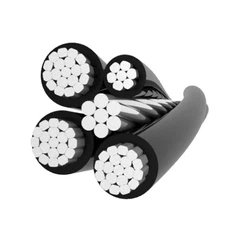
AC90 cable often has a lower installed cost than conduit wiring for suitable Canadian building installations, particularly when the route is relatively straightforward and the cable is permitted for the location. Its integrated metal armour eliminates the need to install a separate conduit system and pull individual conductors through it. This can reduce material handling and labor.
However, AC90 is not automatically the cheaper option for every project. Conduit wiring may be more economical when a route requires extensive bends, long runs, frequent changes, exposed mechanical protection, or future wiring modifications. The actual cost depends on the cable or conduit system, conductor requirements, installation conditions, labor rates, and applicable Canadian Electrical Code (CEC) requirements.
This comparison examines the cost components of both methods to help electrical contractors, distributors, OEMs, and procurement teams make a more informed decision.

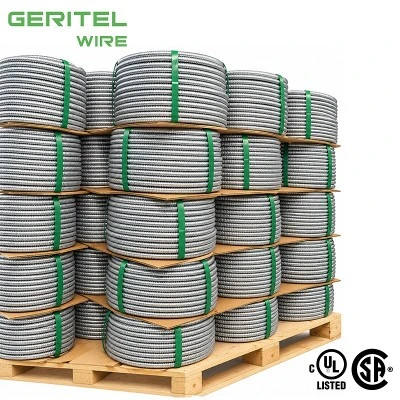
1. What Does "Installed Cost" Include?
A fair comparison must look beyond the purchase price per metre of cable or conduit. Installed cost is the total cost of supplying, installing, terminating, inspecting, and preparing the wiring system for service.
For AC90 and conduit wiring, the main cost components are:
Materials: AC90 cable or individual insulated conductors, conduit, fittings, junction boxes, connectors, supports, and accessories.
Installation labour: Measuring, routing, cutting, bending, fastening, pulling conductors, and making terminations.
Installation equipment: Cable rollers, pulling tools, bending equipment, and access equipment where required.
Inspection and compliance: Correct product selection, supports, bonding, conductor protection, and code-compliant installation.
Future work: Access for repairs, additional circuits, and changes to equipment layouts.
The cost comparison should use the same route length, circuit design, conductor material and size, number of circuits, and installation environment. Otherwise, one method may appear cheaper simply because it is being compared under easier project conditions.
2. AC90 Cable vs. Conduit Wiring: How Do the Systems Differ?
China CSA AC90 BX Cable Aluminum Conductor PVC Or XLPE/AIA 600V Manufacturers Suppliers Factory
Conduit & Fittings 101 (Canada): EMT, Connectors & Types – Maple Electric Supply
The Future of Commercial Building Wire
Commercial Electrical Service & Emergency Power Systems Maintenance | Baker Electric
How Do I Choose AC Cable Size? - News
Conduit Pathways and Equipment Integration: Early Electrical Coordination
JemTech Electrical | Learn More Today
Canada Market Hot Sale Cables AC90 Acwu90 Teck90 Nmwu 90 12/2 14/2 - AC90 12/2 and AC90 Building Wire
2.1 AC90 Cable Installation
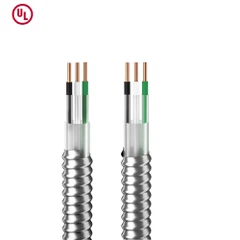
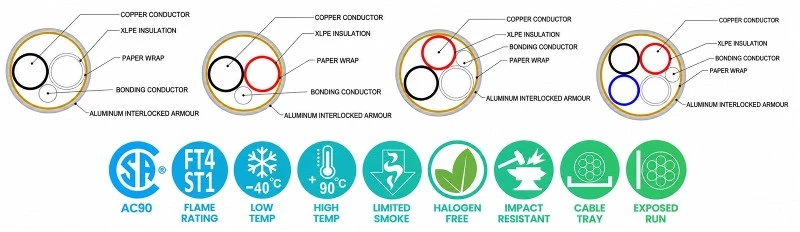
AC90 is an armoured cable with insulated conductors, a bonding conductor, and interlocked metal armour. The armour is integrated into the cable, so a separate conduit system is generally unnecessary for an installation where AC90 is approved.
Typical installation steps include:
Measure and plan the cable route.
Cut the cable to the required length.
Route and secure the cable using suitable supports.
Install approved connectors and protect conductor insulation at the armour ends.
Terminate the conductors and bonding arrangement at the equipment or enclosure.
A manufacturer identifies AC90 as suitable for exposed and concealed wiring in dry locations and describes the armour as eliminating the need for conduit, which can save installation labour.
AC90+1
2.2 Conduit Wiring Installation
In a typical conduit wiring system, individual insulated conductors are installed inside a separate raceway, such as EMT (electrical metallic tubing), or another conduit type suitable for the project.
The installation commonly involves:
Measuring and laying out the conduit route.
Cutting, bending, and joining conduit sections.
Installing boxes, couplings, connectors, and supports.
Securing and inspecting the completed raceway.
Pulling the individual conductors through the conduit.
Making conductor terminations and completing bonding.
This method requires more separate components and installation operations. However, it provides a defined raceway pathway and may be advantageous where the installation requires additional mechanical protection or future conductor changes.
Important: Conduit wiring is not one single product or construction. EMT, rigid metal conduit, PVC conduit, and other raceway systems have different material costs, installation methods, and permitted uses. The comparison must identify the actual conduit system being specified.
3. Which Installation Method Has Lower Material Cost?
The material comparison depends on the number of circuits, cable sizes, conduit type, and route design.
|
Cost item |
AC90 cable |
Conduit with individual conductors |
|---|---|---|
|
Main wiring material |
Complete AC90 cable |
Separate insulated conductors |
|
Raceway material |
Usually no separate conduit required |
EMT, PVC, or another approved conduit |
|
Connectors and fittings |
AC90 connectors and related accessories |
Conduit connectors, couplings, and fittings |
|
Supports |
Cable straps or approved supports |
Conduit straps, hangers, and support hardware |
|
Junction boxes |
Required where the design calls for them |
Required where the design calls for them |
|
Bonding components |
Depends on cable construction and termination arrangement |
Depends on raceway type and bonding design |
|
Pulling accessories |
Generally fewer for a direct cable route |
Often includes pulling lubricant, fish tape, or pulling equipment |
3.1 Why AC90 May Require Less Material
AC90 combines the insulated conductors and metallic armour into one factory-assembled cable.
For a suitable dry-location installation, this can eliminate the need to purchase and install a separate conduit system. Contractors may also need fewer separate fittings and support components.
This is one reason AC90 can be attractive for straightforward building wiring projects.
images.homedepot.ca+1
3.2 Why Conduit Wiring May Cost More in Materials
A conduit installation requires both the raceway and the individual conductors.
The material list may include:
Conduit sections.
Couplings and connectors.
Elbows and bends.
Junction or pull boxes.
Conduit supports and hangers.
Individual RW90 conductors or other approved wire types.
Pulling accessories.
However, conduit can provide an advantage when several circuits can share a properly sized raceway, subject to conductor grouping, fill, ampacity adjustment, and other code requirements.
Therefore, comparing one AC90 cable with only one conduit section is not a valid cost comparison. The complete circuit wiring system must be priced.
4. Which Installation Method Has Lower Labour Cost?
Labour is often the most important difference between the two methods.
4.1 AC90 Can Reduce Installation Steps
AC90 can save labour because the armour is already part of the cable construction.
The installer does not need to assemble a separate conduit route before installing the cable. For a straightforward exposed or concealed run, the work can involve routing, securing, cutting, connecting, and terminating the cable.
This can make AC90 especially competitive for:
Short and medium-length branch circuits.
Repetitive wiring routes in commercial buildings.
Suitable concealed wiring installations.
Dry-location power and lighting circuits.
Projects where multiple AC90 runs can be installed efficiently.
However, AC90 still requires proper support, approved connectors, suitable cable preparation, and protection of conductor insulation at the armour ends. These tasks must be included in the labour estimate.
4.2 Conduit Requires More Preparation and Installation Work
Conduit wiring involves several separate installation operations before conductors can be pulled.
For example, an EMT installation may require the electrician to:
Measure and mark the route.
Cut and ream conduit sections.
Bend conduit to match the building layout.
Join conduit sections and install fittings.
Install supports and junction boxes.
Check the raceway pathway.
Pull conductors through the completed conduit.
Terminate and identify the conductors.
Each bend, fitting, offset, and pull point can add labour.
This does not mean conduit is always slower. An experienced crew using prefabricated conduit assemblies or an established raceway system may install long, repetitive routes efficiently.
The actual labour advantage depends on the building layout and installation method.
5. When Is AC90 Usually More Cost-Effective?
Potential AC90 cost advantage
AC90 is often the more economical choice when all of the following conditions apply:
The installation is in an approved dry location.
The route is relatively straightforward.
The required circuit conductors are available in a suitable AC90 construction.
No separate conduit system is required by the project specification.
Cable support and termination locations are accessible.
The contractor can install the cable without excessive handling or routing difficulties.
Example: Commercial Lighting Branch Circuits
Consider a commercial building with several lighting branch circuits running from distribution boxes to lighting locations.
If the routes are relatively simple and the installation conditions permit AC90, the contractor may avoid installing separate conduit pathways for each circuit.
The main savings opportunities are:
Reduced conduit purchasing.
Fewer conduit fittings and supports.
Less time spent cutting and bending raceways.
Fewer separate installation operations.
In this type of project, AC90 can have a lower installed cost than an equivalent individual-conductor conduit system.
This is a comparison of installation methods, not a guaranteed price result. Actual savings must be established from project quantities and local labour rates.
6. When Can Conduit Wiring Be More Economical?
Potential conduit advantage
Conduit may be the better economic choice when the project requires a flexible or reusable raceway system, or when the installation environment makes AC90 unsuitable.
6.1 Multiple Circuits in a Shared Raceway
Where the electrical design permits several circuits to share one appropriately sized conduit, the raceway cost and installation work may be distributed across those circuits.
The contractor must still account for conduit fill, conductor ampacity adjustment, conductor arrangement, and applicable CEC requirements.
A conduit system serving multiple circuits may therefore be more economical than installing separate AC90 cables for every circuit.
6.2 Complex Routing and Frequent Equipment Changes
Conduit can be useful in facilities where equipment layouts change frequently.
If the raceway has adequate capacity and suitable access points, individual conductors may be replaced or additional conductors installed without replacing the entire wiring route.
This can reduce future modification costs.
However, spare conduit capacity is not automatically available. The raceway must have sufficient fill capacity, suitable access, and an approved installation arrangement.
6.3 Areas Requiring Additional Mechanical Protection
Some installations require a raceway to provide a particular level of physical protection.
Examples include exposed equipment connections, areas vulnerable to impact, and locations where the project specification calls for a defined conduit system.
In these cases, the cost of conduit may be necessary regardless of whether AC90 would otherwise be cheaper.
6.4 Wet or Outdoor Locations
Standard AC90 is generally intended for dry locations. Nexans, for example, specifies its AC90 product for open and concealed wiring in dry locations only.
AC90+1
If a route is exposed to weather or moisture, a suitable conduit wiring system with conductors approved for the environment may be more appropriate.
The correct choice must be based on the exact cable, conductor, raceway, fittings, and environmental approvals-not simply the presence of metal protection.
7. Important Canadian Electrical Code Considerations
A cost-saving decision must remain within the permitted wiring methods under the Canadian Electrical Code.
7.1 AC90 Is Not a Substitute for Every Conduit System
AC90 is a specific Canadian armoured cable type covered by CSA C22.2 No. 51. It typically has insulated conductors and interlocked metallic armour without an overall jacket.
ANSI 商店+1
It should not be treated as interchangeable with individual RW90 conductors installed in conduit.
There is also an important distinction when considering whether armoured cable can be pulled inside conduit. The 2024 CEC provisions in Rules 12-602 and 12-902 include a specific allowance for certain jacketed armoured cables, subject to conduit-fill, pulling-tension, sidewall-pressure, bend-radius, and route-length requirements. This is not a general permission to install any armoured cable inside conduit.
philtech.ca+1
In particular, the Quebec Régie du bâtiment's explanatory guidance identifies unjacketed AC90 as outside the jacketed-armoured-cable allowance described in that edition's Rule 12-602(6).
rbq.gouv.qc.ca
Therefore, contractors should not assume that standard AC90 can simply be pulled through a conduit to combine the two installation methods. Check the current code adopted by the relevant province or territory and confirm the exact product's approval.
7.2 Product Certification and Installation Rules Are Different
CSA C22.2 No. 51 covers armoured cable product requirements, including AC90 and other armoured cable constructions. CSA C22.1 is the Canadian Electrical Code, which governs installation requirements.
webstore.ansi.org+1
A cable's product certification does not mean it can be installed in every location or wiring arrangement.
For example, standard AC90's dry-location limitation remains relevant even when its armour provides mechanical protection.
7.3 Support, Bonding, and Termination Requirements
Both wiring methods require proper installation.
For AC90, the contractor must consider cable support, approved connectors, conductor protection at the armour ends, and the bonding arrangement.
For conduit wiring, the contractor must consider raceway support, bonding continuity, conductor protection, fill, and suitable fittings.
These are not optional details. Omitting them from the estimate may make a quotation appear cheaper while creating additional work or inspection problems later.
8. How to Calculate the Installed Cost
The most reliable way to compare AC90 with conduit wiring is to prepare a project-specific cost worksheet.
Use the following structure:
|
Cost category |
AC90 system |
Conduit system |
|---|---|---|
|
Cable or conductor purchase |
AC90 cable quantity × unit price |
Individual conductor quantities × unit prices |
|
Raceway materials |
Normally not required for an approved direct AC90 route |
Conduit quantity × unit price |
|
Fittings and accessories |
AC90 connectors, straps, bushings |
Couplings, elbows, connectors, supports |
|
Junction and pull boxes |
As required by design |
As required by design |
|
Installation labour |
Routing, supporting, cutting, terminating |
Raceway installation, conductor pulling, terminating |
|
Equipment and consumables |
Handling and cable installation tools |
Bending and pulling tools, lubricant, consumables |
|
Inspection and correction allowance |
Based on project requirements |
Based on project requirements |
The basic calculation is:
\[ \text{Installed Cost} = \text{Materials} + \text{Labour} + \text{Equipment} + \text{Other Project Costs} \]
For labour, use:
\[ \text{Labour Cost} = \text{Installation Hours} \times \text{Hourly Labour Rate} \]
Example of a Practical Comparison
Suppose a contractor is comparing two wiring methods for the same dry-location branch-circuit route.
The contractor should obtain:
The total AC90 cable length, including reasonable routing allowance.
The required AC90 connectors and support accessories.
The conduit length, fittings, supports, and box quantities.
The conductor sizes, quantities, and lengths for the conduit option.
Estimated installation hours for each method.
The applicable local labour rate.
The contractor can then compare the total installed cost rather than relying on the price of one cable or one conduit section.
Do not use an assumed percentage saving as a universal rule. Labour productivity and material prices vary by region, contractor, building type, and project scale.
9. AC90 vs. Conduit Wiring: Quick Comparison
|
Project condition |
Method worth evaluating first |
Main reason |
|---|---|---|
|
Simple dry-location branch circuit |
AC90 |
Integrated armour may reduce installation steps |
|
Repetitive commercial wiring |
AC90 |
Potentially faster cable routing and support |
|
Several circuits sharing a raceway |
Conduit |
Raceway and installation costs may be shared |
|
Frequent future circuit changes |
Conduit |
Individual conductors can be replaced if the raceway permits |
|
Exposed route requiring a specified raceway |
Conduit |
May meet the project's mechanical-protection requirements |
|
Wet or outdoor location |
Approved conduit wiring or another approved cable system |
Standard AC90 is generally dry-location only |
|
Complex route with many bends |
Compare both methods |
Routing difficulty can change labour costs |
10. Final Verdict: Which Has Lower Installed Cost?
AC90 cable often has the lower installed cost for straightforward, approved dry-location wiring in Canadian commercial, residential, and institutional buildings. Its integrated metal armour can eliminate separate conduit materials and reduce installation labour.
Conduit wiring can be more economical where multiple circuits share a raceway, future wiring changes are expected, or project conditions require a dedicated raceway system.
The best choice is not determined by cable price alone. Contractors and procurement teams should compare complete material quantities, installation hours, accessories, environmental requirements, and code compliance.
For Canadian projects, also confirm the current CEC edition adopted by the project jurisdiction and the exact product approval before making a final selection.

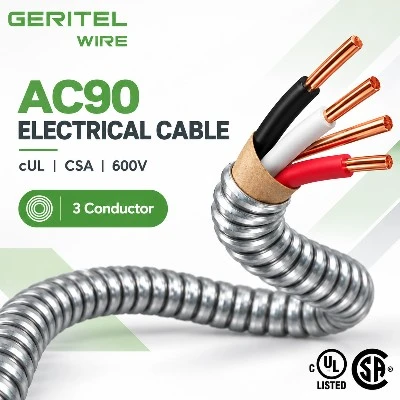
GERITEL WIRE: Supporting AC90 Cable Sourcing for Canadian Projects
Choosing between AC90 cable and conduit wiring involves more than comparing material prices. Cable construction, conductor specifications, installation conditions, and project requirements all influence the final installed cost. GERITEL WIRE supports overseas electrical distributors, contractors, OEM manufacturers, and procurement teams with wire and cable sourcing solutions for commercial and industrial applications. Whether you are evaluating AC90 cable specifications, comparing conductor options, or planning cable requirements for a Canadian project, our team can help you review product information and discuss suitable sourcing options. Contact GERITEL WIRE to request technical details and discuss your project requirements.
Dongguan Greater Wire & Cable Co., Ltd.
Tel/WhatsApp/Wechat: +86 136 6257 9592
Tel/WhatsApp/Wechat: +86 135 1078 4550
Email: manager01@greaterwire.com
Website: www.greaterwire.com