



No. A 90°C insulation rating does not automatically determine the allowable ampacity of AC90 cable. It indicates the maximum conductor operating temperature permitted by the insulation under specified conditions. The actual allowable ampacity must also account for conductor material and size, installation conditions, ambient temperature, the number of current-carrying conductors, and the temperature ratings of connected equipment terminals.
For electrical contractors, distributors, OEM manufacturers, and procurement professionals working on Canadian projects, this distinction is important. Selecting AC90 cable based only on its 90°C marking can result in an incorrect ampacity calculation or an unsuitable conductor size.
This article explains what the 90°C rating means, how allowable ampacity is determined under the Canadian Electrical Code (CEC), and what should be checked before specifying AC90 cable.

1. What Does the 90°C Rating on AC90 Cable Mean?
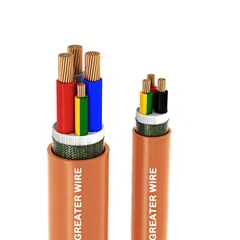
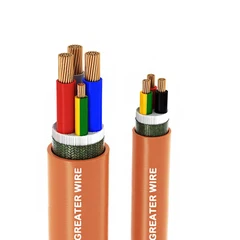
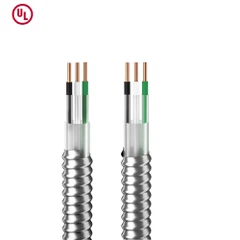
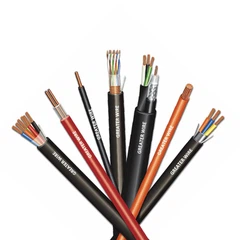
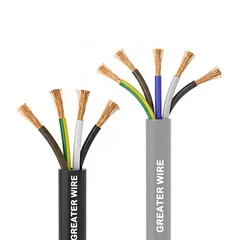
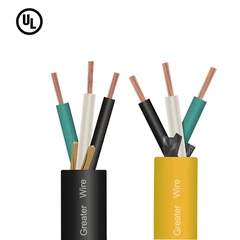
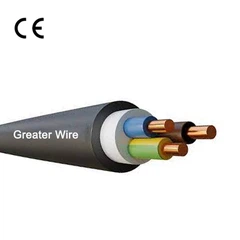
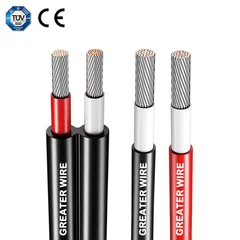
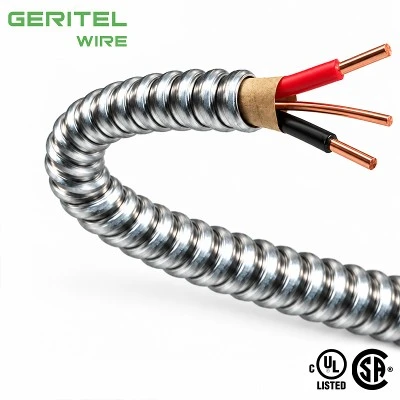
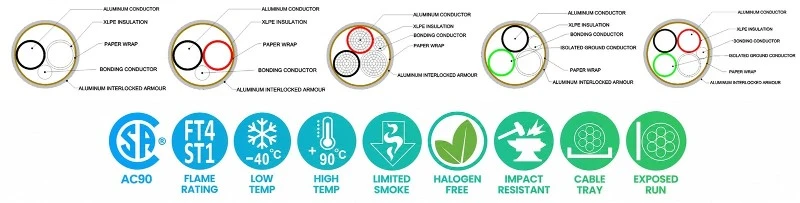
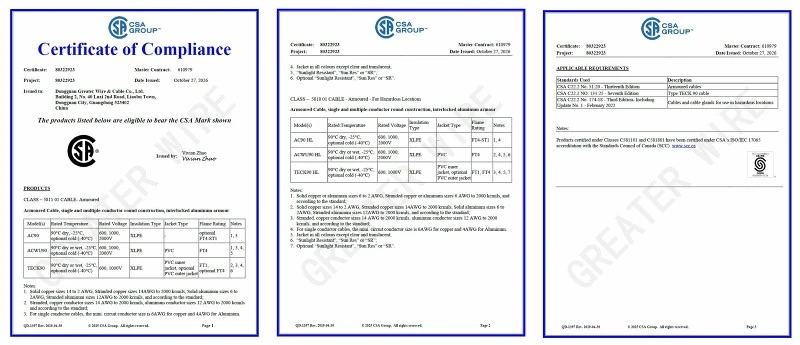
AC90 is a Canadian armoured cable type. Many products use XLPE insulation identified as RW90, with a 90°C conductor temperature rating. For example, GERITEL WIRE's published AC90 product information identifies XLPE insulation and a 90°C rating. The exact insulation designation and ratings must always be confirmed from the cable marking and product datasheet.
Greater Wire
The 90°C rating describes the maximum temperature the conductor insulation system is designed to withstand under its specified operating conditions. It is relevant to ampacity because a conductor can generally carry more current at a higher permitted operating temperature, all other conditions being equal.
However, it does not mean:
Every AC90 cable size can carry the same current.
A cable can always be sized using the 90°C ampacity column.
Connected breakers, switches, lugs, or other equipment automatically accept 90°C terminations.
The cable can carry its tabulated current under every ambient temperature or installation arrangement.
In other words, 90°C is an insulation temperature rating-not a fixed current rating in amperes.
2. What Determines the Allowable Ampacity of AC90?
Ampacity is the maximum current a conductor is permitted to carry under specified conditions without exceeding the applicable temperature limits.
Under the Canadian Electrical Code, Part I, Section 4, Rule 4-004, ampacity depends on the conductor and its installation conditions. Important factors include the following.
2.1 Conductor Material
AC90 products may use copper or aluminum conductors.
Copper and aluminum have different electrical resistance characteristics, so the same AWG size and insulation temperature rating do not necessarily have the same ampacity.
The CEC uses different ampacity tables for copper and aluminum conductors:
Tables 1 and 2: Copper conductors.
Tables 3 and 4: Aluminum conductors.
For typical AC90 cable installations, the applicable table depends on the cable construction and installation arrangement.
philtech.ca
2.2 Conductor Size
A larger conductor generally has a higher ampacity than a smaller conductor of the same material and insulation rating under comparable conditions.
For example, a 2 AWG conductor and a 10 AWG conductor with 90°C insulation do not have the same allowable ampacity.
The 90°C rating alone cannot determine the current capacity without knowing the conductor size.
2.3 Number of Insulated Conductors
The number of insulated conductors in a cable can affect heat dissipation.
When four or more insulated conductors are installed in a cable or raceway, the CEC requires applicable correction factors from Table 5C to be considered when using Tables 2 or 4.
The bonding conductor is not counted when determining ampacity under Rule 4-004(6). A neutral conductor may or may not be counted, depending on the circuit configuration and the current it carries.
philtech.ca+1
2.4 Ambient Temperature
Standard ampacity tables are generally based on an ambient temperature of 30°C.
When conductors are installed in an environment hotter than 30°C, the relevant correction factors in Table 5A must be applied.
For example, the 90°C insulation correction factor at 40°C ambient temperature is 0.91. This means the applicable tabulated ampacity is multiplied by 0.91, subject to the other applicable code requirements.
philtech.ca
2.5 Installation Method
The installation arrangement also affects ampacity.
A conductor installed in free air may have a different ampacity from one installed in a cable or raceway because heat is dissipated differently.
For AC90, the applicable CEC table and any additional correction requirements must match the actual cable construction and installation arrangement. Do not select a table simply because the cable has metal armour.
3. Why Can a 90°C AC90 Cable Be Limited by 60°C or 75°C Terminations?
This is one of the most important issues in AC90 cable sizing.
The cable insulation may be rated for 90°C, but the terminals on connected electrical equipment may have a lower temperature rating.
For example, a cable may terminate at:
A circuit breaker.
A distribution panel.
A disconnect switch.
A motor control centre.
An electrical enclosure with terminal blocks.
If the terminal is rated for 75°C, the conductor cannot simply be sized using the 90°C ampacity column at that termination.
Canadian Electrical Code Rule 4-006
CEC Rule 4-006 addresses conductor termination temperature limitations.
Under the 2024 CEC, where the equipment specifies a maximum conductor termination temperature, the minimum conductor size must be determined using the corresponding temperature column in the applicable ampacity table, together with relevant correction factors.
Where the termination temperature is not marked, the general defaults are:
|
Equipment condition |
Assumed termination temperature |
|---|---|
|
Equipment rated not more than 100 A |
60°C |
|
Equipment marked for No. 1 AWG or smaller conductors |
60°C |
|
Equipment rated more than 100 A |
75°C |
|
Equipment marked for conductors larger than No. 1 AWG |
75°C |
These are the general defaults in Rule 4-006(2), subject to other applicable Code provisions. If the equipment has a marked termination temperature, that marking governs.
philtech.ca+1
Does the lower termination rating apply to the entire cable run?
Not necessarily.
Under Rule 4-006(4), the termination temperature requirements in Subrules 1 and 2 apply only to the first 1.2 m of conductor measured from the equipment termination point.
Where a cable transition is used to meet the termination temperature requirements, Rule 4-006(5) specifies a minimum conductor length of 1.2 m.
philtech.ca
This distinction matters because the 90°C insulation rating remains relevant to ampacity calculations under Rule 4-004, while the termination temperature rule imposes a separate conductor-sizing requirement near the equipment connection.
The practical rule is to satisfy both requirements-not to assume that a 90°C cable automatically permits 90°C terminations.
4. How Do 60°C, 75°C, and 90°C Ampacity Columns Differ?
The CEC ampacity tables provide different current ratings for conductors with different allowable insulation temperature ratings.
For the same conductor material and size, the 90°C column will generally show a higher ampacity than the 75°C or 60°C column.
The following simplified comparison illustrates the principle:
*PER METER CUT* AC90 10/2 CU-150M BX ARMOURED CABLE – Covalin Electrical Supply
covalin.ca
|
Temperature column |
What it represents |
Typical application consideration |
|---|---|---|
|
60°C |
60°C conductor temperature basis |
Equipment with a 60°C termination limitation |
|
75°C |
75°C conductor temperature basis |
Equipment with a 75°C termination limitation |
|
90°C |
90°C insulation temperature basis |
Suitable 90°C-rated conductors and applicable installation conditions |
A higher temperature column does not automatically authorize a higher operating current throughout the installation. Terminal ratings and all applicable correction requirements must still be satisfied.
Example: A 90°C AC90 Cable Connected to 75°C Equipment
Suppose an AC90 cable has 90°C-rated insulation and connects to equipment with terminals marked 75°C.
The designer must:
Confirm the cable's conductor material and AWG size.
Identify the correct CEC ampacity table for the installation.
Determine the applicable 90°C ampacity and correction factors under Rule 4-004.
Apply the 75°C termination requirement under Rule 4-006 to the first 1.2 m of conductor.
Confirm that the selected conductor size satisfies both requirements.
The result is not automatically the 90°C ampacity simply because the cable insulation is rated 90°C.
For actual conductor sizing, the applicable CEC tables and equipment markings must be checked. A generic example cannot replace a project-specific calculation.
5. How Do Ambient Temperature and Conductor Grouping Affect AC90 Ampacity?
Even when the cable insulation is rated 90°C and the equipment terminals permit the intended conductor size, installation conditions may reduce allowable ampacity.
5.1 High Ambient Temperature
When AC90 is installed in an area where the ambient temperature exceeds 30°C, Table 5A correction factors may apply.
The following examples are taken from the 2024 CEC Table 5A:
|
Ambient temperature |
90°C insulation correction factor |
|---|---|
|
30°C |
1.00 |
|
35°C |
0.96 |
|
40°C |
0.91 |
|
45°C |
0.87 |
|
50°C |
0.82 |
For example, at an ambient temperature of 40°C:
\[ \text{Corrected ampacity} = \text{Applicable table ampacity}\times 0.91 \]
This calculation illustrates the ambient-temperature correction only. Other applicable requirements, including termination limitations, must also be checked.
philtech.ca
5.2 Multiple Insulated Conductors
When four or more insulated conductors are installed in a cable or raceway, Table 5C correction factors may be required.
The 2024 CEC Table 5C includes the following factors:
|
Number of insulated conductors |
Correction factor |
|---|---|
|
1–3 |
1.00 |
|
4–6 |
0.80 |
|
7–24 |
0.70 |
|
25–42 |
0.60 |
|
43 and above |
0.50 |
For a typical AC90 cable containing four insulated conductors, the applicable Table 5C factor may therefore reduce the tabulated ampacity.
Remember that the bonding conductor is not counted for this ampacity calculation. Neutral conductor treatment depends on its actual function in the circuit.
philtech.ca+1
6. How to Determine the Allowable Ampacity of AC90 Cable
For electrical contractors and engineering teams, the following process provides a practical starting point.
AC90 ampacity selection process
Identify the cable construction
Confirm whether the AC90 cable uses copper or aluminum conductors and identify the number of insulated conductors.
Confirm the insulation temperature rating
Check the cable marking and datasheet to verify the 90°C insulation rating.
Select the applicable CEC ampacity table
Use the correct table for conductor material and installation arrangement, such as Table 2 for applicable copper cable installations or Table 4 for applicable aluminum cable installations.
Apply correction factors
Check ambient temperature, conductor grouping, and other relevant installation conditions under Rule 4-004.
Check equipment termination temperatures
Verify the terminal markings and apply Rule 4-006 to the required conductor length near the equipment.
Verify the final conductor size
Confirm that the selected size meets the applicable ampacity, termination, circuit, and installation requirements.
For complex installations, such as underground cable configurations or special cable-tray arrangements, the applicable CEC provisions may require additional calculations or manufacturer information.
7. Common Mistakes When Using the 90°C AC90 Rating
|
Common mistake |
Why it is incorrect |
Correct approach |
|---|---|---|
|
Assuming 90°C means higher ampacity in every installation |
Installation conditions can reduce allowable current |
Check the applicable ampacity tables and correction factors |
|
Using the 90°C column without checking terminals |
Equipment may have a 60°C or 75°C termination limitation |
Apply Rule 4-006 |
|
Ignoring ambient temperature |
High temperatures reduce allowable ampacity |
Check Table 5A |
|
Ignoring the number of insulated conductors |
Grouping can increase heat accumulation |
Check Table 5C where applicable |
|
Treating copper and aluminum as identical |
Their ampacity values differ |
Select the correct material-specific table |
|
Counting the bonding conductor as a current-carrying conductor |
The CEC excludes bonding conductors from this calculation |
Apply Rule 4-004(6) |
|
Assuming every AC90 product has identical specifications |
Construction and ratings can vary by manufacturer |
Verify the exact product datasheet and markings |
8. Frequently Asked Questions
Does AC90 cable always have a 90°C ampacity rating?
Many AC90 products use 90°C-rated insulation, but the actual product construction and insulation designation should be verified. Even when the insulation is rated 90°C, allowable ampacity depends on conductor size, material, installation conditions, and applicable Code requirements.
Can I use the 90°C ampacity column for AC90 cable?
The 90°C insulation rating is relevant to selecting the applicable ampacity values and applying correction factors. However, the equipment termination requirements under CEC Rule 4-006 must also be satisfied. The 90°C column cannot automatically be used as the final sizing basis at every termination.
If my circuit breaker is rated 75°C, does that mean my AC90 cable is only a 75°C cable?
No. The cable insulation remains rated 90°C. The 75°C marking relates to the permitted conductor termination temperature of the equipment, which affects conductor sizing near that connection.
Does a higher insulation temperature rating always mean a smaller cable can be used?
No. A higher insulation temperature rating may provide a higher tabulated ampacity under comparable conditions, but termination limitations, ambient temperature, conductor grouping, and other applicable requirements may prevent the use of a smaller conductor.
Does the bonding conductor in AC90 affect ampacity?
The bonding conductor is not counted when determining ampacity under CEC Rule 4-004(6). However, it must still meet the applicable bonding requirements for the installation.
Are UL and NEC ampacity rules the same as Canadian CEC rules?
No. UL product standards, the US National Electrical Code (NEC), and Canadian CSA product standards and CEC installation requirements serve different purposes. A cable's UL or CSA product marking does not automatically establish its permitted ampacity or installation method in another jurisdiction.

9. Final Recommendation: Does a 90°C AC90 Insulation Rating Determine Its Allowable Ampacity?
A 90°C insulation rating is an important factor in determining AC90 cable ampacity, but it does not independently establish the allowable current.
For Canadian installations, the final conductor selection must account for conductor material, size, installation arrangement, ambient temperature, conductor grouping, and equipment termination limitations.
In particular, CEC Rule 4-004 governs ampacity determination, while Rule 4-006 addresses termination temperature limitations. Both must be considered when sizing AC90 conductors.
For contractors, distributors, OEM manufacturers, and procurement teams, the safest approach is to verify the exact cable datasheet, equipment terminal markings, and applicable CEC requirements before selecting a cable size.
GERITEL WIRE: AC90 Cable Solutions for Canadian Electrical Applications
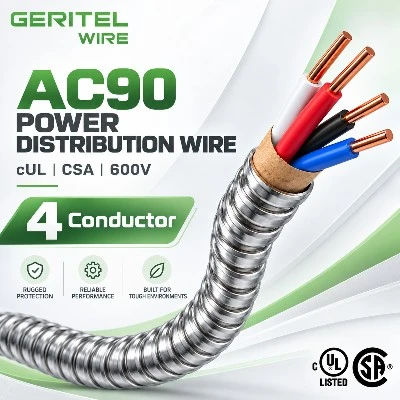
Choosing AC90 cable involves more than checking its 90°C insulation rating. Conductor material, cable size, construction, and product certification all play important roles in meeting project specifications. GERITEL WIRE provides AC90 armoured cable options for Canadian electrical applications, supporting distributors, electrical contractors, OEM manufacturers, and industrial procurement teams. Whether your project requires copper or aluminum conductors, specific conductor configurations, or technical product documentation, our team can help you review available specifications and discuss your sourcing requirements. Contact GERITEL WIRE to request product information and explore suitable AC90 cable solutions for your next project.
Dongguan Greater Wire & Cable Co., Ltd.
Tel/WhatsApp/Wechat: +86 136 6257 9592
Tel/WhatsApp/Wechat: +86 135 1078 4550
Email: manager01@greaterwire.com
Website: www.greaterwire.com