


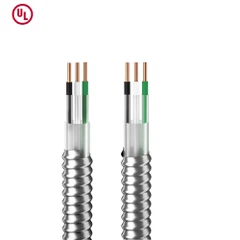

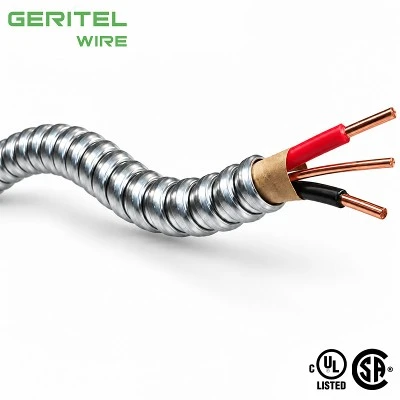
AC90 is a Canadian designation for an armoured electrical cable commonly used in commercial, residential, and certain industrial buildings. It typically contains insulated copper or aluminum conductors, a bonding conductor, and interlocked metal armour. The armour provides mechanical protection, while the insulated conductors carry electrical power.
In Canada, AC90 is commonly used for exposed or concealed wiring in approved dry locations, including suitable building wiring routes and certain cable-tray installations. However, standard AC90 is not a general-purpose wet-location or outdoor cable. Its permitted applications depend on the exact product certification, construction, and installation requirements.
For electrical contractors, distributors, OEM manufacturers, and procurement teams, understanding AC90's construction and application limits is essential when specifying armoured cable for Canadian projects.

1. What Does AC90 Mean?
AC90 is a Canadian armoured cable type covered by CSA C22.2 No. 51, Armoured Cables. The designation identifies a cable construction and product category; it is not simply a reference to a 90-amp current rating or a 90-volt cable.
The "90" is associated with the cable's 90°C conductor temperature rating in typical AC90 products. For example, Nexans and Southwire list their standard AC90 products as 600 V cables with RW90 XLPE insulation and a maximum conductor operating temperature of 90°C.
AC90+1
A typical AC90 product has these characteristics:
Cable type: Canadian Type AC90 armoured cable.
Voltage rating: Commonly 600 V, depending on the product.
Conductor insulation: Often cross-linked polyethylene (XLPE), identified as RW90.
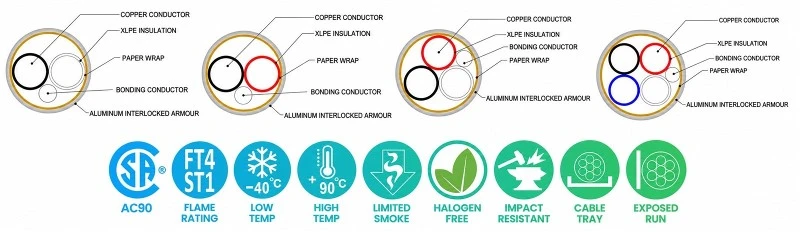
Armour: Typically interlocked aluminum armour.
Bonding conductor: Usually included in the cable construction.
Temperature rating: Commonly 90°C maximum conductor temperature.
Typical location: Approved dry locations.
These are typical product characteristics, not universal specifications for every cable sold under the AC90 designation. Buyers should confirm the manufacturer's datasheet and certification for the exact product.
2. How Is AC90 Cable Constructed?
Understanding AC90 construction helps explain why it is used in building wiring and why its application has limits.
600V AC90-12/2 X 150m Type AC90 Armored Cable - Electric Cable and AC Bx Cable
m.made-in-china.com
A typical multiconductor AC90 cable consists of the following components.
2.1 Conductors
The conductors carry electrical current from the power source to the connected equipment.
Depending on the manufacturer and product design, AC90 may be available with copper or aluminum conductors. Copper is commonly used in building-wire products, while aluminum options are also available in certain product ranges.
Conductor material and size affect electrical resistance, cable weight, termination requirements, and the overall cable diameter.
2.2 Insulation
The conductors are commonly insulated with cross-linked polyethylene (XLPE), identified as RW90 in Canadian product specifications.
RW90 insulation is designed for a maximum conductor operating temperature of 90°C under specified conditions. It provides electrical insulation and helps protect the conductors from heat during normal operation.
However, a 90°C insulation rating does not mean every AC90 installation can automatically use the ampacity associated with a 90°C conductor temperature. Terminal temperature ratings, installation conditions, conductor size, and applicable CEC requirements must also be considered.
2.3 Bonding Conductor
A typical multiconductor AC90 cable includes a bonding conductor, commonly made of bare copper or aluminum depending on the product.
Its purpose is to provide an electrical bonding path as part of the installation's fault-current protection arrangement. It is not an additional circuit conductor for carrying normal load current.
The bonding conductor must be connected in accordance with the applicable electrical code and equipment instructions.
2.4 Binder or Separator
A paper or other suitable binder is commonly wrapped around the assembled conductors.
This layer helps hold the internal cable components together and separates the conductor assembly from the armour.
2.5 Interlocked Metal Armour
The outer layer of a typical AC90 cable is interlocked metal armour, commonly made of aluminum.
The armour provides mechanical protection and helps protect the internal conductors during installation and service. Its interlocked construction also allows the cable to bend within the manufacturer's specified limits.
However, metal armour does not automatically make AC90 waterproof or suitable for wet locations. Standard AC90 products commonly have dry-location restrictions, even though their external armour is metallic.
Nexans and Southwire both describe AC90 constructions using insulated conductors, a bonding conductor, a binder, and interlocked aluminum armour.
AC90+1
3. Where Is AC90 Cable Commonly Used in Canada?
AC90 is widely used in Canadian building electrical systems where an armoured cable wiring method is suitable and the installation conditions match the product approval.
Canada Market Hot Sale Cables AC90 Acwu90 Teck90 Nmwu 90 12/2 14/2 - AC90 12/2 and AC90 Building Wire
Factory Solid Copper 14/2 12/2 RW90 Building Armoured Cable AC 90 Wire AC90 - AC90 Cable and AC90 Wire
SOUTHWIRE 20M 12/2 AC-90 Armored Cable | Home Hardware
Hot Copper Round Wire Bx 3c6 Cu 12/2 AC90 14/2 Armoured Cable - 2026 AC90 Cable, AC90 Wire price | Made-in-china.com
electrical - Bathroom fan grounding with BX and metal framing - Home Improvement Stack Exchange
3.1 Residential Buildings and Apartments
AC90 is commonly used in residential and apartment-building electrical installations, particularly where an armoured cable wiring method is specified.
Potential applications include:
Branch-circuit wiring.
Lighting circuits.
Receptacle circuits.
Wiring between electrical boxes and equipment.
Suitable concealed wiring routes.
The exact cable size, conductor count, and circuit configuration must be selected according to the electrical design and applicable code requirements.
For example, a two-conductor AC90 cable may be suitable for certain circuits requiring two insulated conductors and a bonding conductor. A three- or four-conductor version may be required where the circuit design needs additional conductors.
The number of conductors alone does not determine the cable's ampacity or suitability.
3.2 Commercial Buildings
AC90 is also used in commercial buildings such as:
Offices.
Retail stores.
Schools.
Hotels.
Apartment common areas.
Commercial service and distribution spaces.
In these projects, AC90 may be used for lighting, power distribution, and other building wiring applications where the product and installation method are approved.
Its armoured construction can be useful where cables need additional mechanical protection compared with unarmoured building wire.
3.3 Industrial Buildings
AC90 can be used in certain industrial building installations, especially in dry indoor areas.
Examples may include:
Dry production areas.
Electrical rooms.
Equipment wiring within suitable indoor environments.
Approved power and lighting circuits.
Suitable cable-tray or cableway installations.
However, industrial facilities often contain wet process areas, washdown zones, chemical exposure, outdoor equipment, and other demanding conditions. Standard AC90 should not be selected for these environments without checking its specific approval.
Where wet-location or more demanding industrial protection is required, ACWU90 or TECK90 may be more appropriate candidates, depending on the exact product and installation requirements.
3.4 Cable Trays and Ventilated Cableways
Some AC90 products are approved for use in cable trays, cable troughs, and ventilated flexible cableways in dry locations.
For example, Nexans identifies these applications for its AC90 product range. Southwire also specifies AC90 for exposed and concealed wiring, including suitable ventilated cable trays and other dry locations.
AC90+1
However, buyers should not assume that every AC90 product has identical cable-tray approval. Verify the manufacturer's installation instructions and the applicable CEC requirements before specifying the cable for a particular tray arrangement.
3.5 Ceiling Fixture Connections
Certain AC90 products are approved for use with ceiling fixtures. Nexans identifies this application in its AC90 product information.
AC90+1
This is a product-specific application statement. It should not be interpreted as blanket approval for every ceiling space, plenum, or air-handling environment.
The building code, electrical code, cable marking, and installation conditions must still be checked.
4. Where Should Standard AC90 Cable Not Be Used?
Knowing where AC90 should not be used is just as important as understanding its common applications.
Check location approval before specifying
4.1 Wet Locations
Standard AC90 products are commonly intended for dry locations only.
Examples of potentially unsuitable locations include:
Areas exposed to regular washdown.
Locations subject to water accumulation.
Damp basements or service areas where the product approval does not permit the exposure.
Outdoor areas exposed to rain or persistent moisture.
The fact that AC90 has metal armour does not establish wet-location approval.
4.2 Outdoor Installations
Standard AC90 should not automatically be used for exposed outdoor wiring.
Sunlight, rain, condensation, temperature changes, and other environmental conditions can affect cable suitability. If the installation is outdoors, select a cable specifically approved for the intended exposure.
4.3 Direct Burial
Do not assume that standard AC90 is suitable for direct burial in soil.
Underground installations may involve moisture, soil pressure, chemical exposure, and mechanical damage. A cable must have the required approval for the exact underground installation method.
4.4 Hazardous Locations
Some specialized AC90 products may have approvals for certain hazardous locations, but this must be confirmed from the exact product certification and markings.
The AC90 designation alone does not establish suitability for every Class I, Class II, or other classified area. The hazardous-area classification, wiring method, fittings, and applicable code requirements must all be considered.
4.5 Continuously Moving Equipment
Standard AC90 is generally intended for fixed wiring rather than continuous flexing.
Applications involving moving machinery, robotic equipment, drag chains, or repeated cable movement require a cable specifically designed and approved for that type of service.
For a useful comparison, see the relevant product documentation rather than assuming that metal armour makes AC90 suitable for dynamic movement.
5. What CSA Standards Apply to AC90 Cable in Canada?
For Canadian projects, it is important to distinguish between the product standard and the installation code.
|
Standard or code |
Main purpose |
Relevance |
|---|---|---|
|
CSA C22.2 No. 51 |
Armoured cable product requirements |
Covers AC90 cable construction |
|
CSA C22.2 No. 2556 |
Wire and cable test methods |
Includes relevant flame and smoke performance test methods |
|
CSA C22.1 |
Canadian Electrical Code, Part I |
Governs electrical installation methods and conditions |
CSA C22.2 No. 51
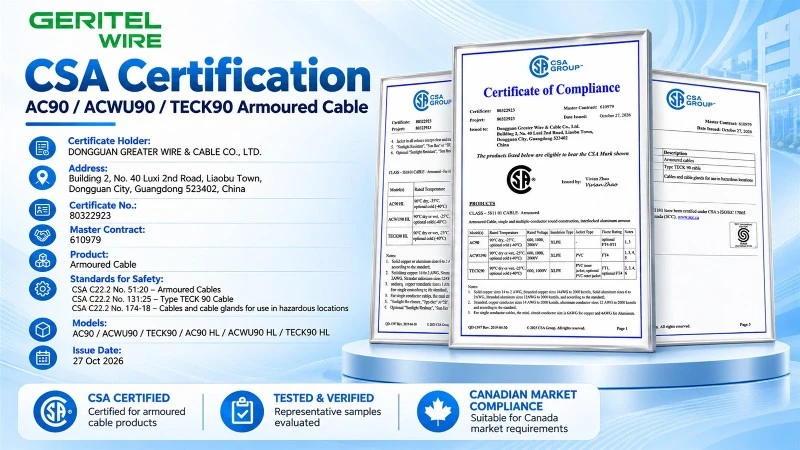
CSA C22.2 No. 51 is the product standard associated with armoured cable constructions, including AC90.
It addresses requirements for the cable as a manufactured product. A manufacturer's AC90 datasheet may identify compliance with this standard, along with a certification file number.
AC90+1
CSA C22.2 No. 2556
This standard covers test methods for wires and cables.
Some AC90 products carry additional performance classifications, such as FT4 flame spread or ST1 smoke performance. These classifications describe specific test performance and should not be interpreted as blanket approval for every building space or installation environment.
For example, Nexans identifies FT4 and ST1 performance for its cited AC90 product.
AC90+1
CSA C22.1: Canadian Electrical Code
The Canadian Electrical Code, Part I, provides the installation requirements for electrical wiring systems.
Even when an AC90 cable is certified to the relevant product standard, the installer must still follow the applicable CEC rules governing:
Permitted wiring methods.
Conductor ampacity.
Cable support and protection.
Terminations and bonding.
Installation locations.
Fire and environmental requirements.
The CEC edition adopted by the province or territory must be confirmed for the project.
6. AC90 vs. ACWU90 vs. TECK90: What Is the Difference?
AC90 is sometimes confused with other Canadian armoured cable types, particularly ACWU90 and TECK90.
All three use metal armour in typical constructions, but their overall cable designs and approved applications can differ.
600V 14/2 12/2 14/3 AWG Aluminum Interlocked Armoured AC90 AC 90 Electric Cable Building Wire - AC90 Cable and Aluminum Interlocked Armoured Wire
China ACWU90 Cable XLPE Insulation AIA Flame-Retardant PVC 600V Manufacturers Suppliers Factory
Teck 6/3c 1kv - 1000V #6 AWG 3c Teck90 Armoured Cable, Black - Teck90 Armored Cable and Teck90 Cable
How Do I Choose AC Cable Size? - News
China CSA ACWU90 Cable 4 conductor 600V AIA Flame Retardant Manufacturers Suppliers Factory - Customized CSA ACWU90 Cable 4 conductor 600V AIA Flame Retardant Made in China
TECK-90 Type Interlocked Armor Control Cables 600 Volts OnBasic Wire and Cable
|
Feature |
AC90 |
ACWU90 |
TECK90 |
|---|---|---|---|
|
Typical armour |
Interlocked metal armour |
Interlocked metal armour |
Interlocked metal armour |
|
Outer jacket |
Typically no overall jacket |
Typically PVC jacket |
Typically inner and outer jackets |
|
Common insulation |
RW90 XLPE |
RW90 XLPE |
RW90 XLPE |
|
Typical application |
Dry-location wiring |
Dry and wet locations, depending on approval |
Commercial and industrial applications |
|
Outdoor use |
Not a default approval |
Available in approved constructions |
Available in approved constructions |
|
Direct burial |
Do not assume approval |
Available in approved constructions |
Available in approved constructions |
When should you choose AC90?
Choose AC90 when the project requires an armoured cable for an approved dry-location installation and the product's voltage, conductor size, and construction meet the electrical design.
When should you consider ACWU90?
ACWU90 may be a better candidate where the cable route includes wet locations or outdoor exposure, provided the exact product is approved for those conditions.
When should you consider TECK90?
TECK90 is often considered for more demanding commercial and industrial applications where its jacketed construction and product-specific approvals are needed.
Neither ACWU90 nor TECK90 should be assumed suitable for every outdoor, underground, or hazardous-location application without checking the manufacturer's documentation.
7. How Should Buyers Select AC90 Cable?
Electrical distributors, contractors, OEM manufacturers, and procurement teams should evaluate more than the AC90 designation when sourcing cable for Canadian projects.
7.1 Conductor Material
Confirm whether the cable uses copper or aluminum conductors.
Copper and aluminum have different electrical and mechanical characteristics, and the connectors and terminals must be compatible with the selected conductor material.
7.2 Conductor Size and Number
Check the required AWG size and number of insulated conductors against the electrical drawings and circuit requirements.
Do not assume that cables with the same conductor size but different conductor counts have identical dimensions or ampacity.
7.3 Voltage and Temperature Ratings
Confirm the product's marked voltage rating and conductor temperature rating.
Many standard AC90 products are rated 600 V and 90°C, but buyers must verify the exact product specification.
7.4 Armour Construction
Confirm the armour material and construction, especially if the project has specific mechanical or corrosion-related requirements.
7.5 Certification and Product Markings
Request the manufacturer's datasheet and verify:
AC90 designation.
Applicable CSA product standard.
Certification mark and file information.
Conductor material and size.
Voltage and temperature ratings.
Approved installation locations.
Additional flame or smoke classifications, where required.
A manufacturer's quality-management certification, such as ISO 9001, is not a substitute for product certification.
7.6 Installation Accessories
Confirm that connectors, fittings, bushings, and other accessories are suitable for the selected cable.
Incorrect fittings or poor cable preparation can create installation and inspection problems even when the cable itself is properly certified.
8. Common Mistakes When Specifying AC90 Cable
Several misunderstandings can lead to incorrect product selection or installation problems.
|
Common mistake |
Why it is a problem |
Better approach |
|---|---|---|
|
Assuming AC90 means 90 amps |
The 90 refers to the typical conductor temperature rating, not current capacity |
Check conductor size, ampacity, and installation conditions |
|
Assuming all AC90 cables use copper |
Some manufacturers offer aluminum conductor versions |
Confirm conductor material in the datasheet |
|
Treating armour as waterproof |
Metal armour does not automatically provide wet-location approval |
Verify the product's location rating |
|
Assuming every AC90 product is 600 V |
Voltage ratings must be confirmed for the exact product |
Check cable markings and datasheets |
|
Treating FT4 as plenum approval |
FT4 is a flame-spread classification, not universal plenum approval |
Check the applicable building and electrical requirements |
|
Assuming AC90 and ACWU90 are interchangeable |
Their constructions and environmental approvals differ |
Match the cable type to the installation conditions |
|
Treating CSA product certification as installation approval |
Product certification does not override electrical code requirements |
Check the applicable CEC and local amendments |
9. Frequently Asked Questions About AC90 Cable
Is AC90 cable suitable for residential wiring in Canada?
Yes. AC90 is commonly used in Canadian residential and apartment-building wiring where the installation conditions and product approval permit its use. Typical applications include suitable lighting, receptacle, and other building circuits.
Is AC90 cable rated for 600 V?
Many standard AC90 products are rated 600 V. However, buyers should verify the voltage rating on the exact manufacturer's datasheet and cable markings.
Is AC90 cable suitable for wet locations?
Standard AC90 products are commonly approved for dry locations only. Do not use them in wet locations unless the exact product documentation and certification explicitly permit the application.
Does AC90 cable have a ground wire?
Typical multiconductor AC90 products include a bonding conductor. In Canadian electrical terminology, a bonding conductor provides the required bonding path; it should not automatically be described as an insulated equipment grounding conductor.
The exact construction should be confirmed from the product datasheet.
Can AC90 cable be installed in cable trays?
Some AC90 products are approved for cable trays and ventilated cableways in dry locations. The cable manufacturer's instructions and applicable CEC requirements must be checked for the specific installation.
What is the difference between AC90 and BX cable?
BX is a commonly used informal name for older or general armoured cable products. AC90 is a defined Canadian cable type with specific product construction and certification requirements. The terms should not be treated as interchangeable without checking the actual cable markings and approval.
Is AC90 the same as US Type AC cable?
No. Canadian AC90 and US NEC Type AC are separate cable designations governed by different product standards and installation rules. A cable approved as AC90 in Canada is not automatically approved as Type AC in the United States.

10. Final Recommendation: What Is AC90 Cable and Where Is It Used?
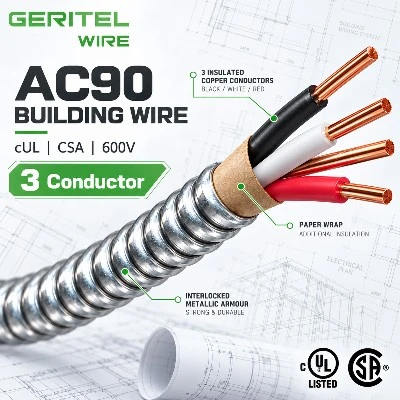
AC90 is a Canadian armoured cable type commonly used in residential, commercial, and certain industrial building installations. Its typical construction combines insulated conductors, a bonding conductor, and interlocked metal armour to provide an electrical wiring solution with mechanical protection.
Its most common applications are exposed or concealed wiring in approved dry locations, including suitable cable-tray installations and building power and lighting circuits.
However, standard AC90 should not be treated as a universal cable for wet locations, outdoor exposure, or direct burial. Where those conditions apply, other cable constructions such as ACWU90 or TECK90 may be more appropriate, subject to their specific approvals.
For successful project specification, always verify conductor material, cable size, voltage rating, temperature rating, product certification, and permitted installation conditions before purchasing or installing AC90.
GERITEL WIRE: AC90 Armoured Cable for Canadian Electrical Projects
Selecting the right AC90 cable is essential for reliable building wiring and compliant electrical installations in Canada. Conductor material, insulation, armour construction, voltage rating, and approved installation conditions all influence whether a cable meets project requirements. GERITEL WIRE supplies armoured cable solutions for commercial, residential, and industrial applications, supporting electrical distributors, contractors, OEM manufacturers, and procurement teams. Whether you are sourcing copper or aluminum conductor options or comparing AC90 with other Canadian armoured cable types, our team can provide product specifications and sourcing assistance. Contact GERITEL WIRE to discuss your application and request technical information for your next project.
Dongguan Greater Wire & Cable Co., Ltd.
Tel/WhatsApp/Wechat: +86 136 6257 9592
Tel/WhatsApp/Wechat: +86 135 1078 4550
Email: manager01@greaterwire.com
Website: www.greaterwire.com