

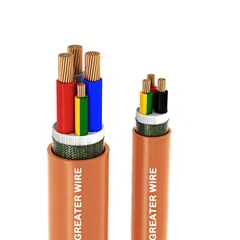
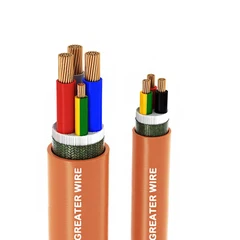


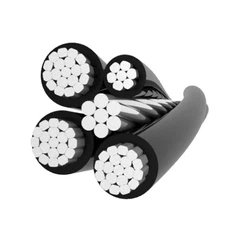
AC90 and TECK90 are both Canadian armoured cable types used in power distribution and industrial electrical installations, but their constructions are designed for different installation demands. The main difference is not simply that one cable has more protection than the other. AC90 typically uses insulated conductors assembled within an interlocked metal armour, while TECK90 generally adds an inner jacket and an outer jacket around the armoured core.
These construction differences affect moisture resistance, mechanical protection, installation flexibility, termination requirements, and suitability for different environments. For electrical contractors, distributors, OEM manufacturers, and procurement teams, selecting between AC90 and TECK90 means matching the cable's certified application to the actual installation conditions-not choosing based on appearance or assuming that a heavier construction is always better.
This comparison focuses on Canadian cable designations and installation context. AC90 and TECK90 should not be treated as direct equivalents of US NEC, IEC, or AS/NZS cable types.

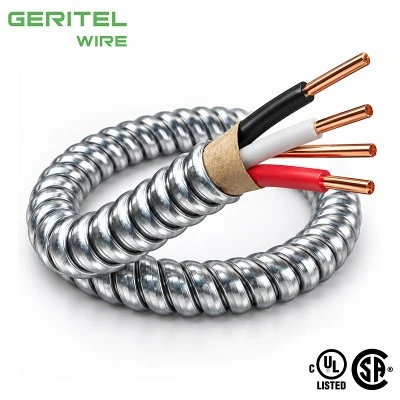
1. Understanding the Basic Construction Difference
The most important difference between AC90 and TECK90 is the way their cable cores are protected.
600V 14/2 12/2 14/3 AWG Aluminum Interlocked Armoured AC90 AC 90 Electric Cable Building Wire - AC90 Cable and Aluminum Interlocked Armoured Wire
TECK-90 Type Interlocked Armor Control Cables 600 Volts OnBasic Wire and Cable
China CSA AC90 BX Cable Aluminum Conductor PVC Or XLPE/AIA 600V Manufacturers Suppliers Factory
RW90 Cable Teck90 de Aluminio de Potencia Eléctrica Blindado 3 Núcleo Redondo 600V Cable de Construcción Eléctrico de Cobre de Potencia CSA - China Cable Teck, cable Teck 90
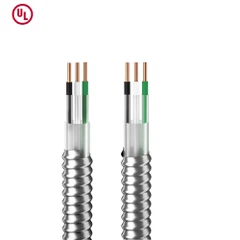
AC90 cable construction
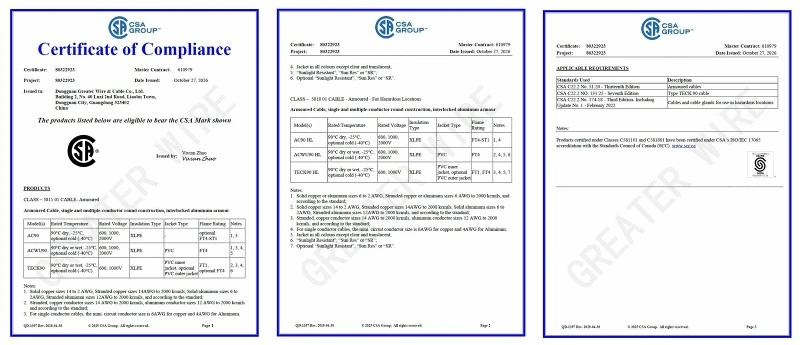
A typical AC90 cable consists of:
Conductors: Copper or aluminum conductors that carry electrical current.
Insulation: Commonly cross-linked polyethylene (XLPE), often identified as RW90.
Bonding conductor: A separate conductor that provides the bonding path.
Binder or separator: A wrapping that holds the conductor assembly together.
Interlocked metal armour: Usually aluminum armour that provides mechanical protection.
A key feature is that standard AC90 does not have the additional inner and outer jacket layers found in typical TECK90 constructions. Its interlocked armour is the visible outer protective layer. Nexans and Southwire both describe AC90 constructions using insulated conductors, a bonding conductor, and interlocked aluminum armour.
AC90+1
TECK90 cable construction
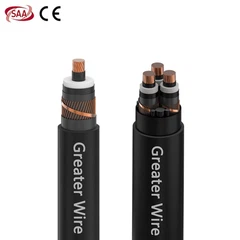
A typical TECK90 cable has a more layered construction:
Conductors: Copper or aluminum, depending on the product.
Insulation: Commonly XLPE.
Bonding conductor: Provides the bonding path.
Inner jacket: Usually a PVC or other specified jacket material surrounding the cable core.
Interlocked metal armour: Commonly aluminum, although galvanized steel options are also available.
Outer jacket: Often PVC or another specified material, providing an additional protective covering.
The inner jacket separates the conductor assembly from the armour, while the outer jacket covers the armour. This layered construction is a major reason TECK90 is commonly selected for more demanding industrial environments. Nexans product descriptions identify the inner jacket, aluminum interlocked armour, and PVC outer jacket in its TECK90 products.
4C4/0(18) TECK90 1KV+1
Important: These are typical constructions, not universal specifications for every product. TECK90 standards allow construction options, and manufacturers may offer different jacket materials, armour materials, voltage ratings, and optional features. Always check the exact product datasheet.
2. How Do the Construction Layers Affect Cable Performance?
The extra jacket layers in TECK90 are not merely cosmetic. They affect how the cable handles environmental exposure and mechanical demands.
|
Construction feature |
AC90 |
Typical TECK90 |
|---|---|---|
|
Conductor insulation |
XLPE or other certified insulation |
XLPE or other certified insulation |
|
Bonding conductor |
Typically included |
Typically included |
|
Inner jacket |
Not part of standard AC90 construction |
Typically included |
|
Interlocked armour |
Yes |
Yes |
|
Outer jacket |
No |
Typically included |
|
Additional environmental barrier |
Limited by construction and product approval |
Provided by jacket system |
|
Typical application focus |
Dry-location building wiring |
Commercial and industrial wiring, including wet-location applications when approved |
Moisture resistance
Standard AC90 products are commonly intended for dry locations. Its metal armour provides mechanical protection, but the armour itself should not be treated as a waterproof outer sheath.
TECK90's jacket system provides additional protection against environmental exposure. Many manufacturer-listed TECK90 products are approved for both wet and dry locations. For example, Nexans identifies its TECK90 range for wet and dry locations, including certain outdoor and direct-burial applications.
Data Centres+1
However, a jacket does not automatically make every TECK90 product suitable for every wet, chemical, underground, or outdoor application. The product's actual certification and markings determine its permitted uses.
Mechanical protection
Both cable types have interlocked metal armour, which provides mechanical protection.
TECK90's additional jackets can provide another protective layer around the cable core and armour. This can be useful where the cable may encounter moisture, oil, chemicals, or physical handling during industrial installation.
Prysmian describes its TECK90 products as offering crush, oil, and chemical resistance, but the degree of resistance depends on the exact product construction and test approvals.
Prysmian+1
Installation and handling
AC90 is often used for building wiring because its relatively simple construction can make it easier to handle and route in suitable dry indoor installations.
TECK90 is generally more robust in construction and may have a larger outside diameter and greater weight for a comparable conductor configuration. This can affect:
Cable tray space and fill.
Minimum bending radius.
Pulling tension and installation equipment.
Cable support spacing.
Gland and connector selection.
Do not assume that every TECK90 cable is harder to install or that every AC90 cable is more flexible. Compare the actual cable dimensions, bending requirements, and manufacturer installation instructions before planning the route.
3. Which Environments Are AC90 and TECK90 Designed For?
The construction difference becomes especially important when comparing installation environments.
How Do I Choose AC Cable Size? - News
10/3 TECK90 Armoured Copper Cable 1000V | Outdoor Feeder Wire Canada – MARS LED
6/3 TECK90 Armoured Copper Cable Canada | EV Charger & Hot Tub Wire – MARS LED
JAN GROUP - Produkty Przemysłowe
Nexans - Nexans AC90
cUL Certification RW90 Xhhw-2 PVC Jacket Teck90 Acwu90 Cable 14/3 12/3 600V - Teck 90 Cable and AC90 Cable
8/3 TECK90 Armoured Copper Cable 1000V Per Meter | MarsLED Canada META – MARS LED
IEGco Engineering Industries
Kabels aanleggen | Litran België
Where AC90 is commonly used
AC90 is commonly specified for commercial, residential, and institutional building wiring where dry-location installation is permitted.
Typical applications include:
Exposed or concealed wiring in dry indoor areas.
Branch circuits and power distribution within buildings.
Wiring in suitable dry cable trays or ventilated cableways where permitted.
Connections to electrical equipment in approved dry locations.
For example, Nexans specifies its AC90 product for open and concealed wiring in dry locations and for use in cable trays and ventilated flexible cableways in dry locations.
AC90+1
AC90 should not be selected simply because it has metal armour if the installation is exposed to water, weather, or other conditions outside the product's approved application.
Where TECK90 is commonly used
TECK90 is widely used in commercial and industrial electrical systems where a more comprehensive cable construction is required.
Typical applications may include:
Industrial power distribution.
Manufacturing plants and processing facilities.
Cable trays in approved wet or dry locations.
Outdoor equipment connections.
Certain underground and direct-burial installations.
Hazardous-location wiring when the cable and associated fittings have the required approvals.
Nexans identifies TECK90 applications in industries such as pulp and paper, chemical processing, and petroleum, as well as wet and dry locations and direct burial. Prysmian also lists wet- and dry-location use, direct earth burial subject to inspection-authority requirements, and hazardous-location applications when used with certified HL cable glands.
Data Centres+1
The important qualification is that not every TECK90 product automatically carries every one of these approvals. For example, hazardous-location use requires the appropriate HL certification and compatible cable glands. Direct burial may require additional protection under the applicable rules.
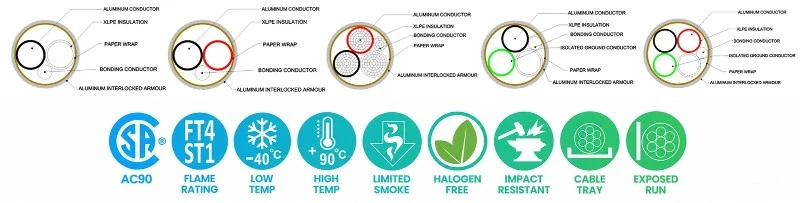
4. AC90 vs. TECK90: What Do the CSA Standards Cover?
For Canadian projects, the relevant product standards help distinguish the two cable types.
|
Cable type |
Main CSA product standard |
General scope |
|---|---|---|
|
AC90 |
CSA C22.2 No. 51 |
Armoured cables, including Type AC90 |
|
TECK90 |
CSA C22.2 No. 131 |
Type TECK 90 armoured cable |
CSA C22.2 No. 51 covers armoured cable constructions with metallic interlocked armour, including AC90 without an overall jacket and ACWU90 with an overall jacket. The cited edition specifies systems up to 2,000 V and a maximum cable temperature rating of 90°C.
ANSI 商店
CSA C22.2 No. 131 covers Type TECK 90 cable. The 2025 edition specifies single- and multiconductor TECK90 cable for Canadian Electrical Code installations, on systems with nominal voltages up to 5,000 V and a maximum temperature rating of 90°C in both dry and wet locations.
NBS+1
These standards address product construction and performance. They do not replace the Canadian Electrical Code (CEC), which governs how approved wiring methods may be installed.
What about hazardous locations?
TECK90 is frequently associated with industrial and hazardous-location applications, but the TECK90 designation alone does not establish approval for every hazardous area.
Check for the required HL marking or certification, the hazardous-area classification, and the suitability of the cable glands and other fittings. CSA C22.2 No. 174 is relevant to cables and cable glands for hazardous locations; some TECK90 products are certified to this standard.
4C4/0(18) TECK90 1KV+1
Does UL, IEC, or AS/NZS approval mean the cable is equivalent?
No. AC90 and TECK90 are Canadian cable designations. Their CSA product standards and CEC installation context should not be assumed to be interchangeable with:
US NEC Type AC or Type MC cable.
IEC cable designations and installation methods.
AS/NZS cable types and wiring rules.
A cable may carry more than one certification, but each certification must be checked against the exact product and the requirements of the destination market. A Canadian TECK90 marking does not, by itself, establish compliance with US, IEC, or Australian/New Zealand requirements.
5. Does TECK90 Always Have a Higher Voltage Rating Than AC90?
Not necessarily. The permitted voltage rating depends on the cable type, standard edition, and specific certified product.
The cited CSA C22.2 No. 51 scope covers AC90 and related armoured cable constructions on systems up to 2,000 V, while CSA C22.2 No. 131:25 covers TECK90 cable on systems up to 5,000 V. However, that does not mean every commercially available TECK90 product is rated 5 kV.
For example, Nexans offers TECK90 products identified as 600 V and 1 kV, while its broader product range includes other voltage classes.
4C4/0(18) TECK90 1KV+2
Likewise, many common AC90 building-wire products are rated 600 V.
AC90+1
For procurement, verify the voltage rating printed on the cable and listed in the manufacturer's datasheet. Do not select a cable based only on its type designation.
6. How Should You Choose Between AC90 and TECK90?
The best choice depends on the installation environment, not simply on the number of protective layers.
|
Project condition |
Cable to evaluate first |
Why |
|---|---|---|
|
Dry indoor building wiring |
AC90 |
Commonly intended for this type of application |
|
Dry commercial branch circuits |
AC90 |
Simpler construction may meet the installation requirements |
|
Industrial plant with moisture exposure |
TECK90 |
Many products are approved for wet and dry locations |
|
Outdoor cable route |
TECK90 |
Some products have weather and sunlight-resistant approvals |
|
Direct-burial installation |
TECK90 |
Certain products are approved for direct burial, subject to required protection |
|
Hazardous industrial area |
Certified TECK90-HL or another approved cable |
Requires the correct hazardous-location certification and fittings |
|
Higher voltage requirement |
Compare certified voltage ratings |
Neither designation alone guarantees the required voltage rating |
Choose AC90 when:
The installation is in an approved dry location.
The project requires an armoured building cable.
The cable's conductor size, voltage rating, and temperature rating meet the design.
The simpler construction is appropriate for the installation conditions.
Choose TECK90 when:
The cable route includes approved wet or dry locations.
Additional jacket protection is needed.
The application involves industrial environments or more demanding mechanical conditions.
The project requires a cable construction approved for specific outdoor, underground, or hazardous-location applications.
A more heavily constructed cable is not automatically the better choice. If the project only requires dry indoor wiring, TECK90 may add material cost, weight, and installation complexity without providing a necessary benefit.
7. What Should Buyers Check Before Ordering AC90 or TECK90?
A cable designation is only the starting point. Distributors, contractors, and procurement managers should verify the following details before placing an order.
1. Conductor material and size
Confirm whether the cable uses copper or aluminum conductors and whether the conductor size matches the electrical design.
Copper and aluminum have different electrical and termination characteristics. The selected connectors and equipment terminals must be compatible with the conductor material.
2. Number of conductors
Check whether the application requires two, three, four, or more insulated conductors, and confirm the bonding conductor arrangement.
Do not assume that a cable with the same conductor size but a different number of cores will have the same overall dimensions or electrical characteristics.
3. Insulation and temperature rating
Verify the insulation type, voltage rating, and temperature rating.
Although RW90 XLPE insulation is common in both AC90 and TECK90 products, the actual specification should be confirmed from the product datasheet.
A 90°C conductor insulation rating does not automatically mean that the complete circuit can operate at 90°C under every condition. Ampacity, terminal temperature limitations, installation conditions, and applicable code requirements must also be considered.
4. Armour and jacket materials
For AC90, confirm the armour material and construction.
For TECK90, check:
Inner jacket material.
Armour material, such as aluminum or galvanized steel.
Outer jacket material.
Whether the outer jacket is required or optional for the specific product.
Any additional sunlight, oil, chemical, or low-temperature ratings.
5. Environmental and installation approvals
Confirm whether the product is approved for:
Dry or wet locations.
Outdoor exposure and sunlight.
Direct burial or underground duct.
Cable tray installation.
Hazardous locations, if applicable.
These approvals should be supported by the product certification and manufacturer documentation.
6. Cable dimensions and installation accessories
Request the cable's overall diameter, approximate weight, minimum bending radius, and recommended installation conditions.
Also check the compatibility of connectors, glands, and termination accessories. AC90 and TECK90 have different cable constructions, so the same fitting should not be assumed suitable for both.

8. Common Mistakes When Comparing AC90 and TECK90
|
Mistake |
Why it is incorrect |
What to check instead |
|---|---|---|
|
Assuming TECK90 is always better |
Additional jackets may not be necessary for a dry indoor installation |
Match construction to the environment |
|
Treating AC90 armour as waterproof |
Interlocked metal armour does not automatically provide wet-location approval |
Check the product's location rating |
|
Assuming every TECK90 is direct-burial rated |
Direct-burial approval is product-specific |
Verify datasheet and certification |
|
Assuming all TECK90 is suitable for hazardous locations |
Hazardous-location use requires appropriate certification and fittings |
Check HL marking and cable gland approval |
|
Assuming both cables have identical voltage ratings |
Voltage ratings vary by product and standard |
Verify the marked voltage |
|
Comparing only conductor size |
Construction affects outside diameter, weight, bending, and installation |
Review complete cable specifications |
|
Treating CSA approval as universal international approval |
Canadian and other national requirements are not interchangeable |
Verify the destination market's standards |
9. Final Recommendation: AC90 or TECK90?
AC90 and TECK90 both use interlocked metal armour, but their different constructions make them suitable for different installation requirements.
AC90 is commonly a practical choice for approved dry-location building wiring, where its insulated conductors and interlocked armour provide the required cable construction without additional jacket layers.
TECK90 is often more suitable for demanding commercial and industrial installations, particularly where the selected product is approved for wet locations, outdoor exposure, direct burial, or specific hazardous-location applications.
The deciding factor should be the actual installation environment, required electrical performance, product certification, and applicable electrical code-not the assumption that more protective layers always mean a better cable.
For overseas buyers sourcing Canadian armoured cables, confirming the exact construction and certification before ordering helps reduce specification errors, installation problems, and unnecessary costs.
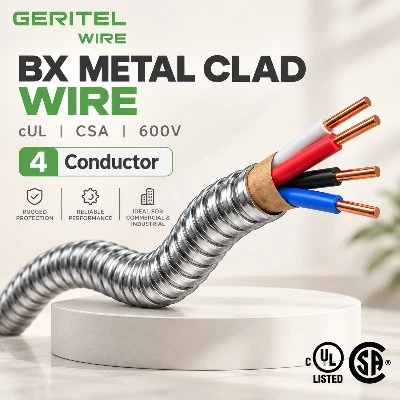
GERITEL WIRE: AC90 and TECK90 Cable Solutions
Choosing between AC90 and TECK90 requires more than comparing cable appearance or conductor size. The right selection depends on conductor material, insulation, armour construction, jacket requirements, voltage rating, and the installation environment. GERITEL WIRE supplies Canadian-standard armoured cable solutions for commercial and industrial applications, supporting electrical distributors, contractors, OEM manufacturers, and project procurement teams. Whether your project requires AC90 for dry-location building wiring or TECK90 for more demanding industrial applications, our team can provide product specifications and sourcing assistance to help you evaluate suitable options. Contact GERITEL WIRE to discuss your cable requirements and request technical information.
Dongguan Greater Wire & Cable Co., Ltd.
Tel/WhatsApp/Wechat: +86 136 6257 9592
Tel/WhatsApp/Wechat: +86 135 1078 4550
Email: manager01@greaterwire.com
Website: www.greaterwire.com