

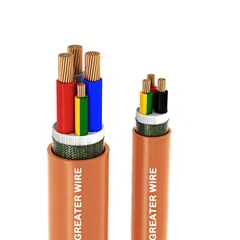
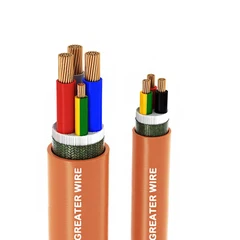

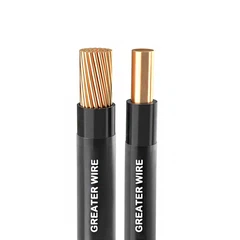
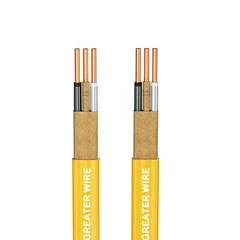
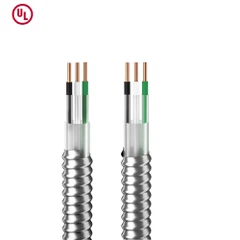
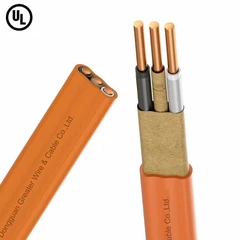
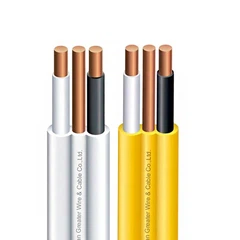

Yes, AC90 cable can be routed through certain concrete walls and floor penetrations in Canadian electrical installations, but its suitability depends on the installation conditions, the applicable Canadian Electrical Code (CEC) requirements, and the cable manufacturer's instructions. The fact that AC90 has interlocked metal armour does not automatically make every concrete penetration acceptable.
Before specifying AC90 for this purpose, electrical contractors and project designers should consider whether the penetration is dry or exposed to moisture, whether the cable needs mechanical protection, how the opening will be sealed, and whether the wall or floor is part of a fire-resistance-rated assembly.
The key point is that passing through concrete is not the same as being approved for direct burial, wet locations, or installation without additional protection. Each condition must be evaluated separately.

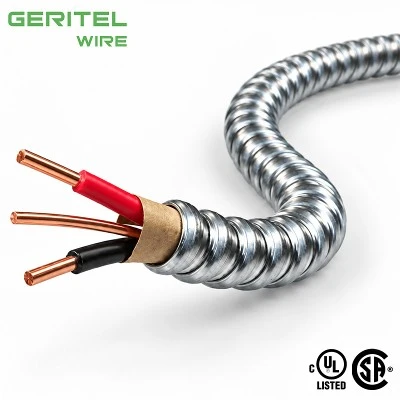
1. First, Distinguish a Concrete Wall Penetration from Concrete Encapsulation
These are two different installation situations, and they should not be treated as interchangeable.
Standard-Ringraumdichtung - HSD100 EW 1x24-44+4x7-12 b40 A2/EPDM - für Hausanschlüsse - Hauff-Technik
System No. C-AJ-3331 Cables in solid wall or floor | ZAPP-ZIMMERMANN GmbH
Kabeleinführungssysteme - Hauff-Technik
ZZ® M23-S90 | ZAPP-ZIMMERMANN GmbH
Guide pour l'installation de gaines électriques dans une dalle en béton – Mon Club Elec
CFS-T RRS Plug seals - Cable transit frames and penetration sealing systems - Hilti USA
Distribution Matériel Electrique - D.M.E. à Ehlerange, Luxembourg
System No. C-AJ-3330 Cables in solid wall or floor | ZAPP-ZIMMERMANN GmbH
Strømkabler i rør lønner seg | Tu.no
|
Installation situation |
What it means |
Key consideration |
|---|---|---|
|
Passing through a concrete wall |
A hole or sleeve allows the cable to cross the wall |
Check cable protection, environmental conditions, and firestop requirements |
|
Passing through a concrete floor |
The cable crosses a floor slab through an opening or sleeve |
Check moisture, mechanical protection, and fire separation |
|
Embedded in concrete |
The cable is surrounded by or cast into concrete |
Requires explicit confirmation that the exact cable is approved for this installation |
|
Embedded in plaster on masonry |
The cable is covered by a plaster finish on a brick or masonry surface |
Some AC90 products specifically identify this application, subject to dry-location restrictions |
This distinction is important because some AC90 product specifications permit installation embedded in plaster finish on brick or other masonry, except in damp or wet conditions. That statement does not automatically approve direct encasement in poured concrete. For example, Prysmian lists this specific application for its NUAL AC90 product.
Prysmian
Practical rule: A cable passing through a concrete opening may be acceptable under the applicable installation requirements, but do not assume that the same cable can be permanently cast into a concrete slab or wall.
2. Can AC90 Pass Through a Concrete Wall?
In many cases, yes, provided the cable and installation method are suitable for the location.
For example, AC90 may pass through a concrete wall separating two dry indoor areas. However, the installation should account for several factors:
The cable must not be damaged by sharp concrete edges.
The opening must provide adequate space for the cable and any required sleeve or protective fitting.
The cable must not be exposed to moisture beyond its approved application.
The penetration must preserve any required fire-resistance rating of the wall.
The cable must remain properly supported and protected.
Why use a sleeve or protective fitting?
A drilled concrete opening can have rough or sharp edges. If the cable armour rubs against these edges during installation or as the building moves, the cable may be damaged.
A suitable sleeve, bushing, or other approved protective arrangement can help prevent abrasion and make cable replacement or inspection easier where the installation design allows it.
The sleeve material and dimensions should be selected according to the project requirements. A sleeve is not automatically a firestop, waterproof seal, or approved raceway.
Example: Between two dry electrical rooms
Suppose an electrician needs to route AC90 from one dry electrical room through a concrete partition into another dry room.
This may be a suitable application if the cable is approved for the installation, the opening does not damage the armour, and any required firestop system is correctly installed.
However, if the wall separates a dry room from a regularly washed industrial area, the moisture exposure on the other side must also be considered. The fact that most of the cable route is dry does not make the entire installation a dry-location application.
3. Can AC90 Pass Through a Concrete Floor?
AC90 may also be routed through a concrete floor penetration, but floor installations often require more attention than wall penetrations.
A floor opening may expose the cable to:
Water from floor cleaning or equipment leaks.
Moisture accumulation around the penetration.
Damage from carts, forklifts, or other moving equipment.
Abrasion at the concrete opening.
Fire and smoke movement between building levels.
Conditions to check
1. Moisture exposure
A concrete floor does not automatically create a wet location. However, a floor penetration in a washdown area, basement, parking structure, or location subject to water accumulation may expose the cable to moisture.
Standard AC90 products are commonly restricted to dry locations. Nexans, for example, specifies its AC90 product for open and concealed wiring in dry locations only.
AC90+1
2. Mechanical protection
Where the cable passes through the floor, check whether a sleeve, guard, or other approved protection is required to prevent damage from concrete edges, traffic, or nearby equipment.
3. Fire separation
A floor slab may be part of a fire-resistance-rated assembly. If the penetration passes through such an assembly, the opening must be treated in accordance with the applicable building code and approved firestop design.
4. Cable support
The cable should be supported in accordance with the manufacturer's instructions and applicable electrical installation requirements. Do not allow the cable to hang from the penetration or place unnecessary mechanical stress on its termination.
4. Do Concrete Wall and Floor Penetrations Need Firestopping?
Important for rated assemblies
Yes, when the penetration passes through a wall or floor that is required to maintain a fire-resistance rating, the opening generally needs an appropriate firestop system under the applicable building code.
A firestop system is designed to help maintain the fire-resistance performance of the assembly where services such as electrical cables pass through it.
The National Building Code of Canada 2025, Article 3.1.9.2, addresses service equipment penetrations. It permits electrical wires and cables to penetrate fire separations when protected by a firestop conforming to the applicable requirements. Provincial and territorial building codes may adopt different editions or amendments, so the code in force at the project location must be checked.
publications.gc.ca
What should the firestop system include?
The selected system should be suitable for the actual installation, including:
The type and thickness of the concrete wall or floor.
The opening dimensions and sleeve arrangement.
The cable type, size, and number of cables.
The presence or absence of a raceway.
The required fire-resistance rating.
The tested or listed installation details.
Do not assume that ordinary expanding foam, mortar, or generic sealant provides an acceptable firestop. Use a firestop system tested and approved for the relevant assembly and penetration configuration, and follow its installation instructions.
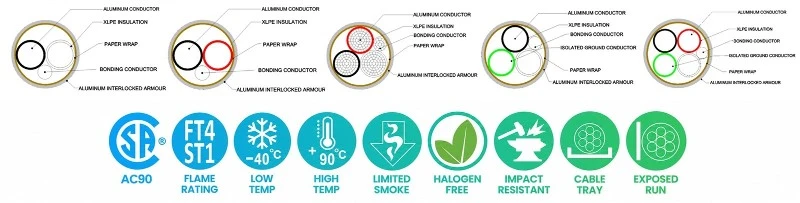
FT4 is not a substitute for firestopping
Some AC90 products carry an FT4 flame-spread rating. For example, Nexans identifies FT4 performance for its cited AC90 product.
AC90
However, FT4 is a cable flame-spread classification. It does not mean that an opening through a fire-rated concrete wall or floor can be left unsealed.
These are different requirements:
|
Requirement |
What it addresses |
|---|---|
|
Cable FT4 rating |
Flame-spread performance of the cable under the specified test |
|
Firestop system |
Fire-resistance performance at the wall or floor penetration |
|
Building assembly rating |
Required fire-resistance performance of the complete wall or floor |
The cable's flame rating does not replace the need for an approved penetration firestop.
5. What If the Concrete Penetration Is Damp or Wet?
This is one of the most important reasons to reconsider standard AC90.
Concrete itself is not necessarily wet, but the conditions around a penetration can create moisture exposure. Examples include:
Exterior walls exposed to rain.
Below-grade concrete walls.
Underground parking structures.
Floor penetrations near drains or washdown equipment.
Areas where condensation or water seepage occurs.
Standard AC90 products such as the Nexans product referenced above are specified for dry locations only.
AC90
Would ACWU90 be a better choice?
China CSA ACWU90 Cable 4 conductor 600V AIA Flame Retardant Manufacturers Suppliers Factory - Customized CSA ACWU90 Cable 4 conductor 600V AIA Flame Retardant Made in China
greaterwire.com
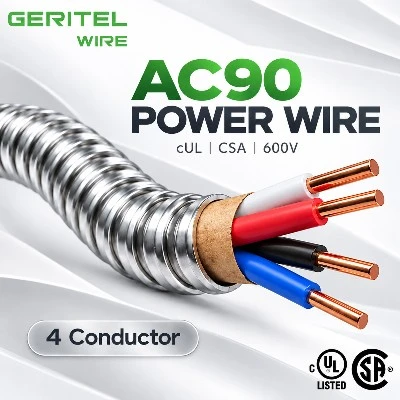
ACWU90 is worth evaluating when the installation requires wet-location protection. It typically has an outer PVC jacket over interlocked armour, providing a different environmental barrier from standard AC90.
Some ACWU90 products are approved for wet locations, outdoor applications, and direct burial. However, those approvals depend on the exact product and its certification.
Greater Wire+1
A key distinction:
AC90: Commonly intended for approved dry-location applications.
ACWU90: Available in constructions approved for dry and wet locations, with product-specific outdoor and burial ratings.
Do not assume that every ACWU90 product is approved for direct concrete encasement. Check the manufacturer's documentation for that exact installation method.
6. Can AC90 Be Directly Embedded or Cast into Concrete?
This question needs a more careful answer than simply asking whether AC90 can pass through concrete.
Do not assume standard AC90 is suitable for direct concrete encasement.
There are several reasons:
Different cable installation conditions
A cable passing through a pre-drilled opening is not subjected to the same conditions as a cable permanently surrounded by poured concrete.
Concrete encasement may involve:
Pressure and movement during concrete placement.
Contact with wet concrete and construction materials.
Mechanical stress during pouring and compaction.
Limited access for inspection or replacement after the concrete hardens.
These conditions need to be covered by the cable's intended application and the project installation design.
Manufacturer application statements matter
Prysmian's NUAL AC90 product information identifies use in dry locations and permits installation embedded in plaster finish on brick or other masonry, except in damp or wet conditions. This is a specific application statement, not blanket approval for every form of concrete encasement.
Prysmian
If a project requires a cable to be cast directly into a concrete slab or wall, obtain written confirmation from the cable manufacturer that the exact product is suitable for that method. Also confirm the applicable electrical and building code requirements with the responsible design professional or authority having jurisdiction.
If the project requires a cable specifically approved for concrete encasement, compare suitable jacketed cable products and other approved wiring methods rather than relying on the AC90 designation alone.
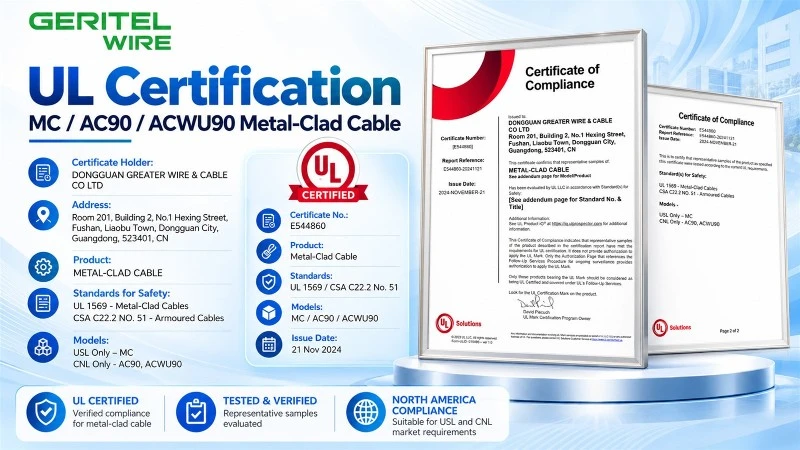
7. AC90 vs. ACWU90 vs. TECK90 for Concrete Penetrations
If standard AC90 does not match the penetration conditions, other Canadian cable types may be worth considering.
China CSA AC90 BX Cable Aluminum Conductor PVC Or XLPE/AIA 600V Manufacturers Suppliers Factory
China ACWU90 Cable XLPE Insulation AIA Flame-Retardant PVC 600V Manufacturers Suppliers Factory
Teck90 600/1000V Armored Cable & Wire Manufacturer | Zetastone Cable
600V 14/2 12/2 14/3 AWG Aluminum Interlocked Armoured AC90 AC 90 Electric Cable Building Wire - AC90 Cable and Aluminum Interlocked Armoured Wire
Acm Canada 250 Kcmil Three 4 3 Aluminum Conductors Armoured Acwu90 Cable - 4 Conductor Acwu90 600V Aluminum and Acwu90 3c 2/0 Cable
Low and Medium Voltage Teck 90 Hl Aia Armoured Cable - Teck Cable and 8 AWG 3c Teck90
|
Selection factor |
AC90 |
ACWU90 |
TECK90 |
|---|---|---|---|
|
Typical construction |
Insulated conductors, bonding conductor, interlocked armour |
Insulated conductors, bonding conductor, interlocked armour, outer jacket |
Insulated conductors, inner jacket, armour, typically outer jacket |
|
Dry concrete wall penetration |
May be suitable |
May be suitable |
May be suitable |
|
Wet-location applications |
Standard products generally unsuitable |
Available in approved constructions |
Available in approved constructions |
|
Outdoor applications |
Not a default choice |
Available in approved constructions |
Available in approved constructions |
|
Direct burial |
Do not assume approval |
Available in approved constructions |
Available in approved constructions |
|
Direct concrete encasement |
Requires product-specific confirmation |
Requires product-specific confirmation |
Requires product-specific confirmation |
The table provides general selection guidance. The actual approval depends on the manufacturer's product specifications and certification, not just the cable type name.
AC90+2
When to consider AC90
AC90 may be appropriate when the cable passes through a dry indoor concrete wall or floor, the installation method is permitted, and the penetration is correctly protected and sealed.
When to consider ACWU90
ACWU90 may be a better candidate where the cable route includes damp or wet areas, outdoor exposure, or other conditions covered by the product's specific approvals.
When to consider TECK90
TECK90 may be worth evaluating for industrial installations requiring a jacketed armoured cable construction. Check its voltage rating, environmental approvals, mechanical characteristics, and any special application requirements.
Neither ACWU90 nor TECK90 should be assumed suitable for every concrete-embedded installation without manufacturer confirmation.
8. Practical Installation Checklist for AC90 Concrete Penetrations
Before installing AC90 through a concrete wall or floor, contractors and project engineers should confirm the following:
Identify the installation method: Is the cable passing through an opening, installed in a sleeve, embedded in masonry plaster, or cast into concrete?
Check the cable datasheet: Confirm that the exact AC90 product is approved for the intended location and installation method.
Evaluate moisture conditions: Determine whether either side of the penetration is damp, wet, or exposed to water accumulation.
Check the opening: Make sure the hole or sleeve has suitable dimensions and does not expose the armour to damaging edges.
Review mechanical protection: Determine whether a sleeve, bushing, guard, or additional protection is required.
Check fire-resistance requirements: Identify whether the wall or floor is a rated fire separation.
Select an appropriate firestop: Use a tested system compatible with the actual cable and penetration configuration.
Confirm cable support: Follow the manufacturer's installation instructions and applicable electrical code.
Check the cable route: Ensure the cable is not subject to excessive bending, tension, or mechanical stress.
Obtain project approval: Resolve any uncertainty with the electrical designer, firestop system manufacturer, and authority having jurisdiction.
For procurement teams, it is also useful to include the penetration conditions in the cable specification. A request stating only "AC90 cable for concrete walls" does not provide enough information to determine whether the product is suitable.

9. Common Mistakes When Running AC90 Through Concrete
|
Common mistake |
Why it can cause problems |
Better approach |
|---|---|---|
|
Assuming all concrete penetrations are the same |
A wall opening differs from direct concrete encasement |
Define the exact installation method |
|
Treating AC90 armour as waterproof |
Interlocked armour does not automatically provide wet-location approval |
Verify the product's environmental rating |
|
Assuming AC90 can be cast into concrete |
Passing through concrete does not establish approval for concrete encasement |
Obtain manufacturer confirmation |
|
Ignoring sharp concrete edges |
Edges can damage the cable during pulling or movement |
Use suitable protection where required |
|
Filling the opening with ordinary foam |
Generic foam may not provide the required fire rating |
Use an approved firestop system |
|
Assuming FT4 eliminates firestop requirements |
Cable flame performance and penetration fire resistance are different |
Verify both requirements separately |
|
Ignoring the opposite side of the wall |
The cable may enter a wet or otherwise unsuitable location |
Evaluate the complete cable route |
10. Final Recommendation: Can AC90 Run Through Concrete Walls or Floor Penetrations?
Yes, AC90 can be suitable for certain concrete wall and floor penetrations, particularly in approved dry indoor installations. However, the installation must be evaluated as a complete system rather than judged by the cable's armour alone.
Before specifying AC90, distinguish between a cable passing through a concrete opening and one permanently embedded in concrete. Check the product's dry- or wet-location approval, protect the cable against mechanical damage, and use an appropriate firestop where a rated wall or floor is penetrated.
If the route involves moisture, outdoor exposure, or direct concrete encasement, consider ACWU90, TECK90, or another suitable cable construction-but only after confirming the exact product's certification and application requirements.
For electrical contractors, distributors, and project procurement managers, the most reliable approach is to confirm the cable specification and penetration details before installation begins.
GERITEL WIRE: AC90 and Armoured Cable Solutions for Building Projects
Selecting the right armoured cable for concrete wall and floor penetrations requires careful consideration of cable construction, environmental conditions, mechanical protection, and applicable installation requirements. GERITEL WIRE supplies AC90, ACWU90, and TECK90 cable solutions for commercial and industrial electrical projects. Whether your application involves dry indoor wiring, wet-location cable routes, or specialized building penetrations, our team can help you review product specifications and identify suitable cable options. We support electrical distributors, contractors, OEM manufacturers, and project procurement teams with technical information and sourcing assistance. Contact GERITEL WIRE to discuss your cable requirements and request product details for your next project.
Dongguan Greater Wire & Cable Co., Ltd.
Tel/WhatsApp/Wechat: +86 136 6257 9592
Tel/WhatsApp/Wechat: +86 135 1078 4550
Email: manager01@greaterwire.com
Website: www.greaterwire.com