

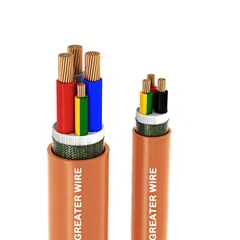
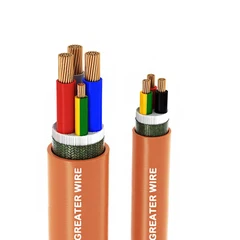

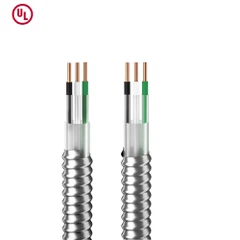
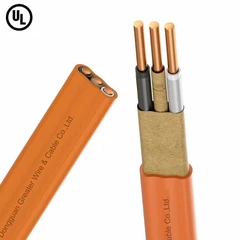
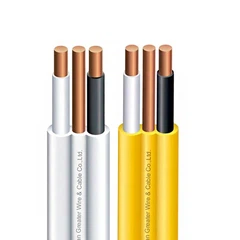

AC90 cable can be a practical option for certain Canadian electrical installations, but it is not suitable for every industrial power circuit. Its limitations become important when an installation involves moisture, outdoor exposure, corrosive environments, frequent mechanical movement, severe vibration, high mechanical stress, or special industrial operating conditions.
Although AC90 is an armoured cable designed to provide mechanical protection, its armour does not automatically make it suitable for wet locations, direct burial, chemical exposure, or every industrial application. Choosing the wrong cable can lead to installation problems, premature deterioration, additional maintenance, and compliance issues.
For electrical contractors, engineers, OEM manufacturers, and procurement managers, the key is to evaluate the actual installation environment, electrical load, mechanical conditions, and certification requirements before specifying AC90. In some situations, alternatives such as ACWU90 or TECK90 may be more appropriate, provided their product ratings and certifications match the project requirements.

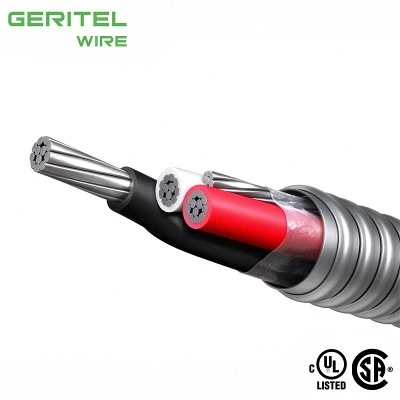
1. When Is AC90 a Poor Choice for Industrial Power Circuits?
AC90 is generally a reasonable candidate when all of the following conditions apply:
The installation is in an approved dry location.
The cable is used for fixed wiring rather than continuous movement.
Its voltage, conductor size, ampacity, and conductor configuration meet the circuit design.
The installation method is permitted by the applicable Canadian Electrical Code.
The cable's armour and construction provide the required level of mechanical protection.
For example, Nexans identifies its 600 V AC90 product family for open or concealed wiring in dry locations, including specified dry cable-tray and ventilated flexible cableway applications. Its products use RW90 XLPE-insulated conductors and interlocked aluminum armour.
AC90+1
The important distinction is that AC90 is an armoured cable for defined applications, not a universal industrial-duty cable. A factory, processing plant, or utility facility may contain several different environments, and the cable suitable for a dry electrical room may be unsuitable a short distance away.
2. Situation One: The Circuit Is Exposed to Water or Persistent Moisture
Poor choice for standard dry-rated AC90
One of the clearest reasons to avoid standard AC90 is a wet or moisture-prone installation.
Industrial facilities often have areas where cables may encounter:
Water spray from cleaning operations.
Condensation around cooling equipment.
High humidity and recurring moisture.
Outdoor rain or snow.
Water accumulation in underground or below-grade spaces.
Standard AC90 products are commonly specified for dry locations only. Their interlocked metal armour provides mechanical protection, but it should not be mistaken for a complete moisture-resistant outer jacket.
For example, Nexans explicitly limits its AC90 product to dry locations.
AC90+1
What cable may be more suitable?
ACWU90 or TECK90 may be better candidates when the project requires a cable approved for wet locations. Both cable families are available in constructions intended for dry and wet environments, but the exact product documentation must be checked.
ACWU90 commonly incorporates an outer PVC jacket over its interlocked armour. TECK90 commonly has an inner jacket and an outer jacket, although construction details vary by product.
d26zhsi0fr0ry9.cloudfront.net+1
China CSA AC90 BX Cable Aluminum Conductor PVC Or XLPE/AIA 600V Manufacturers Suppliers Factory
China CSA ACWU90 Cable 4 conductor 600V AIA Flame Retardant Manufacturers Suppliers Factory - Customized CSA ACWU90 Cable 4 conductor 600V AIA Flame Retardant Made in China
Teck90 600/1000V Armored Cable & Wire Manufacturer | Zetastone Cable
Practical example: AC90 may be suitable for a dry indoor electrical room, but it should not automatically be extended into a washdown area where equipment and cable routes are regularly exposed to water.
3. Situation Two: The Cable Must Be Installed Outdoors or Directly Buried
Standard AC90 should not be treated as a default outdoor or direct-burial cable.
An outdoor industrial power circuit may be exposed to rain, snow, sunlight, temperature changes, and physical damage. A buried circuit may encounter soil moisture, water accumulation, backfill pressure, and other underground conditions.
The fact that AC90 has metallic armour does not automatically establish approval for these environments.
Why AC90 may be unsuitable
Its standard dry-location rating may not cover wet outdoor conditions.
Bare interlocked armour is not equivalent to a continuous environmental jacket.
Direct burial requires specific product approval and compliance with installation rules.
Sunlight resistance must be established by the product's marking or documentation.
Alternatives to consider
|
Project condition |
Cable to investigate |
Important verification |
|---|---|---|
|
Outdoor exposed wiring |
ACWU90 or TECK90 |
Wet-location and sunlight-resistance ratings |
|
Underground power distribution |
ACWU90 or TECK90 |
Direct-burial approval and required protection |
|
Outdoor industrial cable tray |
ACWU90 or TECK90 |
Wet-location, sunlight, and tray requirements |
|
Dry indoor wiring |
AC90 may be suitable |
Dry-location approval and installation conditions |
Nexans identifies ACWU90 and TECK90 for broader environmental applications than its dry-location AC90 product. Its ACWU90 technical information, for example, identifies wet-location use, weather exposure, cable-tray applications, and direct burial subject to the applicable inspection requirements.
nexans.ca+1
Do not assume that every ACWU90 or TECK90 product has identical outdoor or burial approvals. Verify the exact manufacturer's datasheet, markings, and certification.
4. Situation Three: The Circuit Is in a Hazardous Location
Industrial facilities such as refineries, chemical plants, gas processing facilities, and certain manufacturing operations may contain classified hazardous locations.
These areas require special attention because flammable gases, vapours, combustible dust, or other hazardous substances may create an ignition risk.
Standard AC90 should not be assumed suitable simply because it has metal armour or is CSA-certified for its intended general applications.
What should buyers check?
Before specifying cable for a hazardous location, confirm:
The hazardous-area classification, including the applicable class, division, or zone.
The cable's specific hazardous-location certification or approval.
Whether the cable glands and connectors are approved for the application.
Whether the complete wiring method complies with the applicable Canadian Electrical Code requirements.
Whether the cable construction and installation method match the project design.
A product specifically certified for hazardous locations may be a more suitable option. Certain TECK90 and ACWU90 products are available with hazardous-location approvals, but the approval must be confirmed for the exact cable and compatible fittings. CSA C22.2 No. 174 is an important Canadian standard covering cables and cable glands for hazardous locations.
Prysmian+1
Important: A cable marked AC90 should not be treated as AC90-HL, TECK90-HL, or another hazardous-location-approved product. The suffix and certification scope matter.
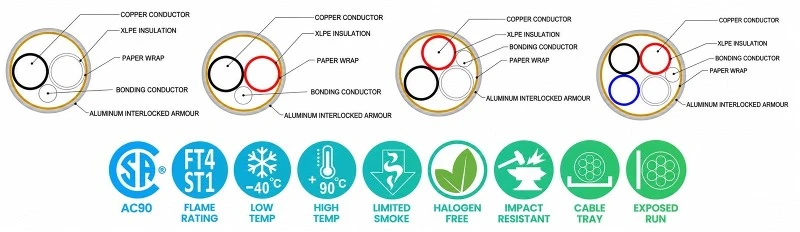
5. Situation Four: The Installation Requires Continuous Flexing or Frequent Movement
AC90 is generally intended for fixed wiring. Its interlocked armour allows it to be routed around suitable bends during installation, but that does not make it a continuous-flex cable.
Some industrial equipment requires power cables to move repeatedly during normal operation, such as:
Moving machine carriages.
Robotic arms.
Automated production equipment.
Cable carriers and drag chains.
Cranes and travelling machinery.
Portable or frequently repositioned equipment.
Repeated movement can create mechanical fatigue in conductors, insulation, armour, and terminations. A cable designed for fixed installation should not automatically be used in an application involving continuous bending, twisting, or movement.
What may be more appropriate?
Depending on the equipment and installation, consider a cable specifically designed and approved for:
Continuous flexing.
Repeated bending.
Torsional movement.
Drag-chain operation.
Industrial machinery connections.
The cable must also meet the required voltage, conductor, temperature, oil-resistance, and environmental specifications.
For equipment manufacturers and system integrators, the machine manufacturer's cable requirements and the cable supplier's published flex-life or movement specifications should be reviewed before selecting a product.
6. Situation Five: The Cable Is Exposed to Severe Mechanical or Chemical Conditions
AC90's interlocked metallic armour provides a degree of mechanical protection. However, armour should not be interpreted as unlimited protection against industrial damage.
Some industrial environments involve:
Repeated impact from tools or moving materials.
Crushing forces from equipment or storage operations.
Abrasion against sharp or rough surfaces.
Contact with oils, solvents, cleaning agents, or process chemicals.
Corrosive atmospheres or aggressive cleaning procedures.
In these situations, standard AC90 may not provide the required environmental or mechanical protection.
Mechanical protection
If a cable route is exposed to heavy impact or crushing, the project may require a cable with a different armour construction, additional guarding, conduit, or another approved protective method.
A jacketed TECK90 product may be worth evaluating where its documented construction and mechanical performance meet the project requirements. However, a jacket alone does not guarantee suitability for every impact or abrasion condition.
Chemical resistance
Chemical compatibility must be checked against the actual substances, concentrations, temperatures, and exposure duration.
For example, a cable jacket that performs well in one oil environment may not be suitable for a different solvent or cleaning chemical.
Do not assume that PVC jackets, interlocked armour, or an HL designation provide universal resistance to industrial chemicals. Verify the manufacturer's chemical-resistance data for the specific product.
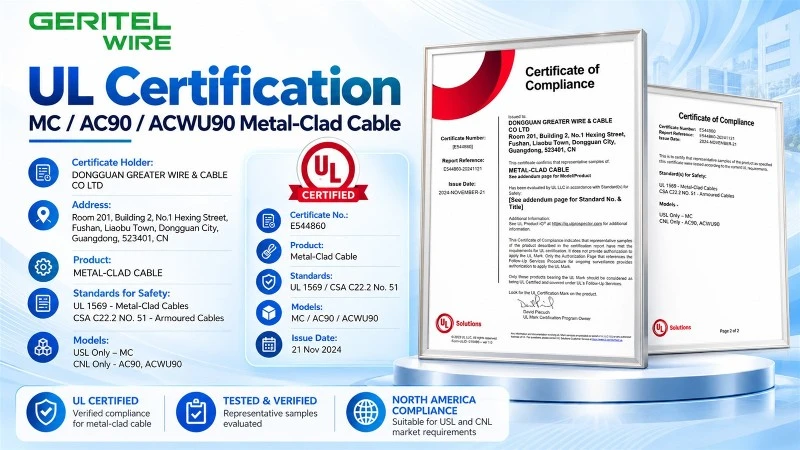
7. Situation Six: The Circuit Has Demanding Electrical Requirements
AC90 is not automatically unsuitable for high-load industrial circuits. However, it can be a poor choice when the exact product's electrical ratings or conductor configurations do not meet the circuit design.
Before selecting AC90 for an industrial power circuit, review the following factors.
Voltage rating
Many standard AC90 products are rated 600 V. For example, Nexans lists its cited AC90 product family with a maximum operating voltage of 600 V.
AC90+1
If the project requires a higher voltage rating, do not assume that an AC90 product is suitable. Verify the exact certified voltage rating and select a cable approved for the system.
Ampacity and conductor size
Industrial circuits may supply large motors, heating equipment, distribution panels, or other substantial loads.
The conductor size must be selected using the applicable code requirements and actual installation conditions, including:
Design load and overcurrent protection.
Conductor material and size.
Number of current-carrying conductors.
Ambient temperature.
Cable grouping and installation method.
Terminal temperature limitations.
Voltage drop and short-circuit requirements.
A 90°C conductor temperature rating does not automatically mean the circuit can be loaded using the 90°C ampacity value. Terminal ratings and applicable code rules must also be considered.
Motor starting and operating conditions
Motor circuits may involve starting current, voltage drop, protective-device coordination, and equipment-specific wiring requirements.
AC90 may be suitable for some fixed motor feeders in approved dry locations, but the cable should not be selected based on conductor temperature rating alone. The complete circuit design must be checked.
When should another cable be considered?
If the project requires a different voltage class, larger conductor configuration, special shielding, or a specific industrial cable construction, compare the available certified cable families rather than assuming AC90 can meet every requirement.
8. Situation Seven: The Project Requires Special Cable-Tray or Fire-Performance Ratings
Cable trays are common in industrial facilities because they provide organized routes for power and control cables. However, not every armoured cable is approved for every tray environment.
Nexans identifies its AC90 product for use in cable trays and ventilated flexible cableways in dry locations only. Its cited product information also identifies FT4 flame-spread performance and an ST1 smoke classification.
AC90+1
This means buyers need to check more than the AC90 designation.
Important questions include:
Is the tray installation dry or wet?
Does the cable's certification cover the intended tray application?
Is the required flame-spread classification satisfied?
Does the project specification require additional smoke-performance characteristics?
Are tray fill, support, spacing, and bonding requirements addressed?
FT4 and ST1 describe different performance characteristics; one should not be treated as a substitute for the other. Similarly, a cable meeting an FT4 test does not automatically qualify for every plenum, transit, or fire-rated application.
For projects with strict fire and smoke requirements, verify the exact test classification and acceptance criteria in the project specification.

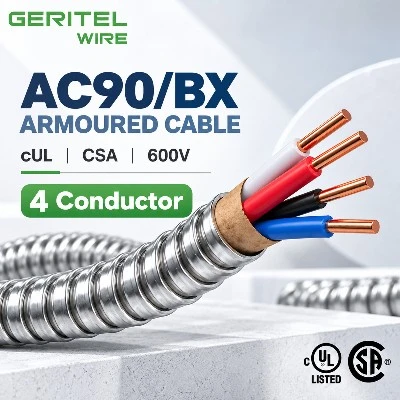
9. AC90 vs. ACWU90 vs. TECK90: Which Is More Suitable for Industrial Power Circuits?
When AC90 is unsuitable, ACWU90 and TECK90 are two common Canadian cable types worth evaluating. They have different constructions and application approvals, so neither is automatically the best choice for every industrial project.
600V AC90-12/2 X 150m Type AC90 Armored Cable - Electric Cable and AC Bx Cable
China CSA ACWU90 Cable 4 conductor 600V AIA Flame Retardant Manufacturers Suppliers Factory - Customized CSA ACWU90 Cable 4 conductor 600V AIA Flame Retardant Made in China
Wholesale Cable Teck 90 Interlocked Armoured Design | Alibaba.com
PPT - Conductors, Cables, and Raceways PowerPoint Presentation, free download - ID:1617229
14/30 TECK90 Copper Conductor Aluminum Interlocked Armor With Ground 6
Aluminum Interlocked Armour Core Four Conductor Teck 90 Mc Wire 12-2 RW90 Cable - Electric Wire and Power Cable
|
Selection factor |
AC90 |
ACWU90 |
TECK90 |
|---|---|---|---|
|
Typical construction |
Insulated conductors, bonding conductor, interlocked armour |
Insulated conductors, bonding conductor, interlocked armour, outer jacket |
Insulated conductors, inner jacket, armour, typically outer jacket |
|
Standard dry-location use |
Yes |
Yes, where approved |
Yes, where approved |
|
Wet-location use |
Generally no for standard dry-rated products |
Available in approved constructions |
Available in approved constructions |
|
Outdoor exposure |
Not a default choice |
Suitable when product is approved |
Suitable when product is approved |
|
Direct burial |
Not a default choice |
Available in approved constructions |
Available in approved constructions |
|
Industrial fixed wiring |
Suitable in approved dry conditions |
Suitable for a wider range of environments |
Suitable for a wide range of industrial applications |
|
Hazardous locations |
Requires specific approval |
Certain HL versions available |
Certain HL versions available |
The table is a general selection guide, not a substitute for product certification. Exact conductor materials, voltage ratings, jacket construction, sunlight resistance, and installation permissions vary by manufacturer and product.
AC90+2
When AC90 Makes Sense
Consider AC90 when:
The installation is in a dry indoor environment.
The circuit uses fixed wiring.
The required conductor size and voltage rating are available.
The installation method is permitted.
The project does not require an additional environmental jacket or special industrial approval.
When ACWU90 Is Worth Considering
Consider ACWU90 when:
The circuit is exposed to wet or damp conditions.
Outdoor installation requires a suitable weather-resistant construction.
The project requires an approved cable for direct burial.
An outer PVC jacket is part of the project specification.
Confirm the specific cable's sunlight, burial, wet-location, and other required ratings.
When TECK90 Is Worth Considering
Consider TECK90 when:
The installation requires a jacketed industrial armoured cable.
The circuit passes through wet or dry industrial areas.
The project requires a particular inner-jacket and outer-jacket construction.
The selected product has the necessary mechanical, environmental, and certification characteristics.
For hazardous locations, confirm the exact HL certification and approved cable glands. For chemical exposure, check the actual jacket material's compatibility with the process environment.
10. What Should Industrial Buyers Check Before Specifying AC90?
For distributors, EPC contractors, OEM manufacturers, and industrial procurement managers, the following checklist can help identify whether AC90 is appropriate before placing an order.
Installation environment: Is the cable route dry, damp, wet, or outdoors?
Installation method: Will the cable be installed exposed, concealed, in a cable tray, or underground?
Mechanical conditions: Is there a risk of impact, crushing, abrasion, or repeated movement?
Chemical exposure: Will the cable contact oils, solvents, cleaning agents, or process chemicals?
Hazardous-area classification: Does the installation require an HL-approved cable and compatible fittings?
Electrical requirements: Are voltage rating, conductor size, ampacity, and conductor configuration suitable?
Fire-performance requirements: Does the product meet the required flame and smoke classifications?
Certification: Does the exact cable construction carry the certification required by the project?
Manufacturer documentation: Are the datasheet, markings, installation instructions, and approvals available?
A cable should not be approved simply because its designation appears in the project specification. The actual product construction and installation conditions must also match.
11. Final Recommendation: When Should You Avoid AC90?
AC90 is a useful cable for many Canadian commercial and industrial wiring applications, but it is a poor choice when the installation exceeds the conditions covered by its specific product approval.
In particular, avoid treating standard AC90 as a default solution for:
Wet or regularly moisture-exposed areas.
Outdoor installations exposed to weather.
Direct-burial applications without specific approval.
Hazardous locations without the required certification.
Continuous-flex or frequently moving equipment.
Severe mechanical or chemical environments without verified protection.
Cable-tray installations that do not meet the product's location and fire-performance requirements.
Circuits whose electrical requirements exceed the exact cable's ratings.
For dry, fixed industrial wiring, AC90 may still be a practical and economical option. For more demanding conditions, evaluate ACWU90, TECK90, or another appropriately certified cable construction.
The best cable is not necessarily the one with the heaviest armour or the highest temperature rating. It is the one whose certified construction, electrical characteristics, and environmental ratings match the actual installation.
GERITEL WIRE: Choosing the Right Armoured Cable for Industrial Projects
Industrial power circuits require cable solutions that match their electrical loads, installation environments, and mechanical demands. GERITEL WIRE supplies Canadian-standard armoured cable solutions, including AC90, ACWU90, and TECK90, for commercial and industrial applications. Whether your project involves dry indoor wiring, outdoor power distribution, wet locations, or demanding industrial installations, selecting the correct cable construction and certification is essential. Our team supports electrical distributors, contractors, OEM manufacturers, and project procurement professionals with product specifications and sourcing assistance. Contact GERITEL WIRE to discuss your cable requirements and request technical information for your next project.
Dongguan Greater Wire & Cable Co., Ltd.
Tel/WhatsApp/Wechat: +86 136 6257 9592
Tel/WhatsApp/Wechat: +86 135 1078 4550
Email: manager01@greaterwire.com
Website: www.greaterwire.com