



When selecting electrical cable for commercial, industrial, or underground installations in Canada, mechanical protection is an important consideration. A cable may be exposed to impact, abrasion, crushing forces, construction activities, or accidental contact with tools and equipment. Choosing the wrong cable construction can increase the risk of insulation damage, electrical faults, and costly repairs.
Two cable types that are often considered for Canadian installations are ACWU90 and NMWU. Both can be used in certain wet-location and underground applications, but their construction and mechanical protection capabilities are significantly different.
ACWU90 generally provides better built-in mechanical protection because it incorporates interlocked aluminum armour. NMWU is a non-metallic-sheathed cable intended for applications where the cable is not exposed to mechanical injury.
However, this does not mean ACWU90 is automatically the right choice for every project. Voltage requirements, installation conditions, cable certification, cost, and the applicable Canadian Electrical Code requirements must also be considered.
This guide explains the differences and helps electrical contractors, engineers, cable distributors, and procurement professionals select the appropriate cable for their projects.
1. What Is ACWU90 Cable?
ACWU90 is a Canadian armoured cable type commonly used for power distribution in commercial, industrial, and other electrical installations.
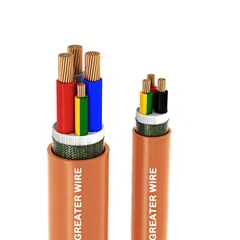
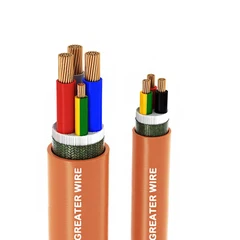
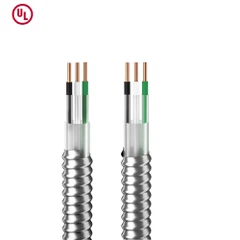
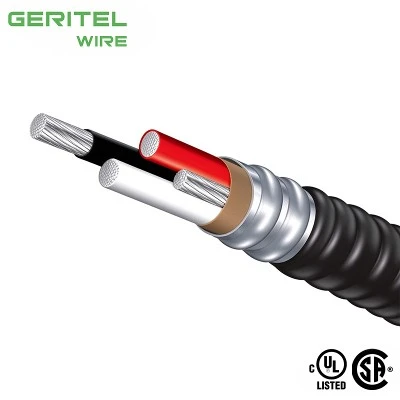
Its defining feature is the aluminum interlocked armour (AIA) surrounding the internal cable assembly. This metallic armour provides an additional mechanical barrier between the electrical conductors and external hazards.
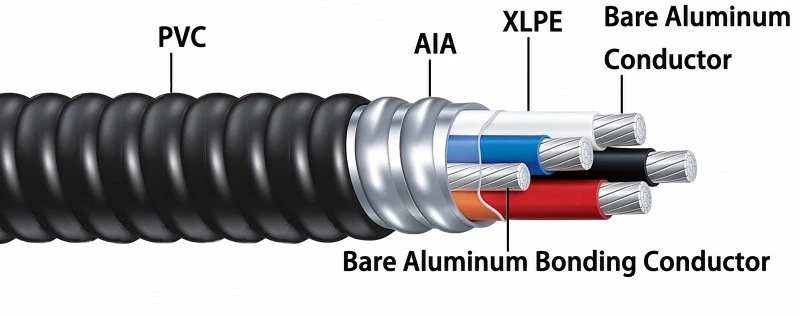
A typical ACWU90 construction includes:
| Component | Typical Material | Main Function |
|---|---|---|
| Conductor | Aluminum or copper, depending on the product | Carries electrical current |
| Insulation | Cross-linked polyethylene (XLPE) | Electrically isolates each conductor |
| Bonding conductor | Bare aluminum or another specified bonding material | Provides an electrical bonding path |
| Armour | Interlocked aluminum armour (AIA) | Adds mechanical protection |
| Outer jacket | Commonly PVC | Protects the cable assembly against moisture, weather, and environmental exposure |
The exact construction depends on the manufacturer and certified product configuration.
For example, Nexans identifies its ACWU90 product as a 600 V cable with RW90 XLPE insulation, interlocked aluminum armour, and an overall sunlight-resistant PVC jacket. Its stated applications include cable trays, raceways, direct burial, and other approved installations. Source
How Does Aluminum Interlocked Armour Work?
Interlocked aluminum armour consists of formed metallic strips that mechanically engage with one another around the cable assembly.
Unlike an ordinary PVC jacket, this armour creates a continuous metallic protective layer around the internal conductors and insulation.
It helps resist certain external mechanical stresses, including:
Accidental contact with tools during installation.
Abrasion caused by contact with surrounding materials.
Localized external impacts.
Some crushing and deformation forces.
Physical damage during cable handling and installation.
The armour also provides a defined metallic bonding path as part of the cable's approved construction and installation arrangement.
However, aluminum interlocked armour should not be considered indestructible. Severe crushing, sharp impacts, incorrect handling, or excessive pulling forces can still damage an ACWU90 cable.
The outer PVC jacket provides an additional protective covering, but it does not eliminate the need for proper installation practices.
2. What Is NMWU Cable?
NMWU is a Canadian non-metallic-sheathed cable type designed for certain wet-location and underground applications.
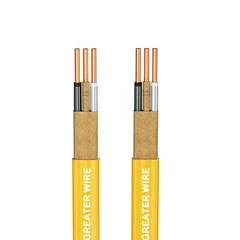
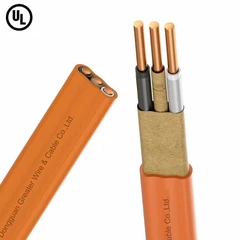
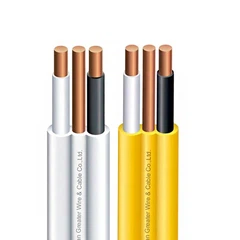
Unlike ACWU90, NMWU does not incorporate aluminum interlocked armour. Its protection mainly comes from the conductor insulation and an overall non-metallic jacket, commonly made from PVC.
A typical NMWU construction includes:
| Component | Typical Material | Main Function |
|---|---|---|
| Conductor | Copper | Carries electrical current |
| Insulation | PVC | Electrically isolates each conductor |
| Bonding conductor | Bare copper | Provides an electrical bonding path |
| Outer jacket | PVC | Protects the cable assembly against moisture and environmental exposure |
NMWU is commonly available in two- and three-conductor configurations, although available sizes and constructions depend on the manufacturer.
For example, Nexans identifies its NMWU product as a 300 V cable with copper conductors, 60°C PVC insulation, a bare bonding conductor, and an overall sunlight-resistant PVC jacket. Source
What Does NMWU Mean for Mechanical Protection?
NMWU is designed for installations where its non-metallic construction is suitable for the environment.
Its PVC jacket provides protection against moisture and ordinary environmental exposure, but it does not provide the same type of mechanical barrier as metallic armour.
This distinction is particularly important when a cable is installed in an area where it could be struck, crushed, scraped, or damaged by construction equipment.
Northern Cables explicitly identifies NMWU as suitable for wet or underground locations where it cannot be subjected to mechanical damage. Source
In practical terms, NMWU should not be selected simply because it has a relatively thick outer jacket. A non-metallic jacket and metallic armour perform different protective functions.

3. ACWU90 vs NMWU: Mechanical Protection Comparison
The most important difference between ACWU90 and NMWU is the presence or absence of metallic armour.
The following table summarizes their typical construction and application differences.
| Comparison | ACWU90 | NMWU |
|---|---|---|
| Cable construction | Armoured cable | Non-metallic-sheathed cable |
| Metallic armour | Aluminum interlocked armour | No metallic armour |
| Typical insulation | XLPE | PVC |
| Typical outer jacket | PVC | PVC |
| Mechanical protection | Higher built-in mechanical protection | Limited built-in mechanical protection |
| Typical voltage rating | 600 V | 300 V |
| Typical conductor temperature rating | 90°C | 60°C |
| Common conductor material | Aluminum or copper, depending on product | Copper |
| Wet-location applications | Yes, when certified for the application | Yes, when certified for the application |
| Direct burial | Available for approved products, subject to applicable requirements | Available for approved products, subject to applicable requirements |
| Typical application | Commercial and industrial power distribution | Suitable residential and other lower-voltage wiring applications |
Important: These are typical product characteristics, not universal specifications for every manufacturer's cable. Always confirm the actual cable markings, technical datasheet, and certification before purchasing.
3.1 Which Cable Resists External Impact Better?
ACWU90 generally has the advantage because its interlocked aluminum armour provides an additional physical barrier around the cable assembly.
If a cable is routed through an area where tools, materials, or other objects may accidentally contact it, the metallic armour offers protection that a conventional NMWU PVC jacket does not provide.
NMWU relies primarily on its non-metallic insulation and jacket. Although these materials provide electrical and environmental protection, they are not equivalent to an armoured construction.
For installations with a higher risk of accidental impact, ACWU90 is generally the more suitable choice between these two cable types.
Nevertheless, the actual impact resistance depends on the cable's construction, dimensions, and test performance. The presence of armour alone does not establish a specific impact rating or guarantee protection against every type of mechanical force.
3.2 Which Cable Has Better Abrasion Resistance?
Abrasion occurs when a cable rubs against rough surfaces during installation or operation.
ACWU90's metallic armour provides an additional protective layer beneath the outer jacket. This can reduce the risk of damage to the internal cable assembly when the cable encounters external abrasion.
NMWU has a PVC outer jacket, which provides some resistance to ordinary surface contact. However, repeated rubbing against sharp or rough materials can wear through the jacket.
For installations involving rough surroundings, frequent handling, or a greater likelihood of physical contact, ACWU90 generally offers a more robust construction.
Both cable types still require suitable cable supports, proper handling, and protection from sharp edges.
3.3 Which Cable Is Better Against Crushing Forces?
Crushing occurs when external pressure is applied to a cable, such as from heavy materials, equipment, or construction activities.
ACWU90's interlocked aluminum armour provides additional structural support around the cable assembly. This makes it generally better suited to applications where some external mechanical pressure may occur.
NMWU does not have this metallic reinforcement.
However, it is important to distinguish between improved mechanical protection and a certified crushing-load rating.
An armoured cable is not automatically approved for unrestricted exposure to heavy loads. If the installation involves vehicle traffic, heavy machinery, concrete structures, or substantial compression forces, the designer must evaluate the installation method and any additional mechanical protection required.
3.4 Which Cable Is More Suitable for Outdoor and Underground Installations?
Both cable types have products intended for certain outdoor or underground applications, but their suitability must be evaluated separately from their mechanical protection capabilities.
ACWU90 commonly combines XLPE insulation, aluminum interlocked armour, and a PVC outer jacket. Approved products may be used in direct-burial applications, cable trays, and other permitted wiring methods.
NMWU commonly uses PVC insulation and a PVC outer jacket. It is also available for direct burial and certain wet-location applications.
However, NMWU is intended for locations where it is not exposed to mechanical injury. Direct-burial suitability does not mean that the cable can be installed without considering the risk of damage from excavation, landscaping, or other underground activities.
For either cable, the applicable electrical code and inspection authority may require additional protection depending on burial conditions and the installation location.
4. When Should You Choose ACWU90 Instead of NMWU?
ACWU90 is generally the better choice when the project requires a cable with integrated metallic mechanical protection.
Consider ACWU90 for the following situations.
4.1 Commercial and Industrial Power Distribution
Commercial and industrial installations often contain electrical equipment, cable trays, service areas, and maintenance routes where cables may be exposed to physical contact.
ACWU90's armoured construction can provide an additional level of protection in these environments.
It is commonly considered for:
Commercial building feeders.
Industrial power distribution.
Electrical service installations.
Equipment connections where the approved wiring method permits ACWU90.
Cable tray installations where the specific product is approved.
For these applications, verify the required conductor size, voltage rating, bonding arrangement, and applicable certification.
4.2 Areas With a Higher Risk of Physical Damage
If cables are installed near machinery, maintenance access areas, or locations where construction activities may occur, mechanical protection becomes particularly important.
ACWU90 can reduce reliance on the cable jacket alone for protection against certain external mechanical hazards.
However, where severe impact or crushing is foreseeable, additional barriers, conduit, guards, or other protective measures may still be necessary.
4.3 Underground Power Distribution
ACWU90 is often considered for approved underground power distribution installations because its construction combines metallic armour with an overall protective jacket.
For example, Nexans identifies its ACWU90 product for direct burial, subject to protection requirements imposed by the inspection authority.
This makes it a practical option for certain commercial and industrial underground feeders.
Nevertheless, the installation must still meet applicable burial-depth, bedding, backfill, and mechanical-protection requirements.
5. When Is NMWU a Suitable Choice?
NMWU can be an appropriate choice when the installation conditions are compatible with its non-armoured construction.
It may be considered for:
Suitable residential wiring applications.
Outdoor wiring in permitted locations.
Certain underground circuits.
Wet or dry locations where the applicable code permits its use.
Installations where the cable is adequately protected from mechanical injury.
For example, NMWU may be suitable for a low-voltage outdoor circuit where the cable is installed in an approved location and the risk of mechanical damage is adequately controlled.
Its non-metallic construction can also make it easier to handle than a larger armoured cable, depending on cable size and configuration.
However, NMWU should not be used as a direct substitute for ACWU90 where the installation requires an armoured cable or where the cable would be exposed to mechanical injury.
6. Can NMWU Be Directly Buried Without Additional Protection?
Not automatically.
A common misunderstanding is that a cable marked for direct burial can be installed anywhere underground without additional protection.
Direct-burial suitability and mechanical protection are two different considerations.
NMWU products may be identified for direct burial, but manufacturers and applicable installation requirements can still specify protection conditions.
For example:
The cable must be suitable for the intended underground environment.
The installation must comply with applicable burial-depth requirements.
Additional protection may be necessary where excavation or mechanical damage is likely.
Backfill materials and installation practices must not damage the cable.
The cable must be installed in accordance with the manufacturer's instructions and the applicable electrical code.
The same principle applies to ACWU90. Although its armour provides additional mechanical protection, it does not remove all underground installation requirements.
For projects in Canada, the applicable edition of the Canadian Electrical Code (CEC), provincial or territorial amendments, and the local inspection authority must be consulted.
7. Does ACWU90 Always Eliminate the Need for Conduit or Other Protection?
No.
ACWU90 includes metallic armour, but this does not mean it can replace every form of mechanical protection.
Additional protection may still be required when:
The cable is exposed to severe physical impact.
The installation passes through areas subject to vehicle or equipment damage.
The cable is installed in locations with sharp structural edges.
The project specification requires conduit or another protective enclosure.
The applicable electrical code requires a specific wiring method.
Conduit and armoured cable serve related but different purposes.
ACWU90 provides integrated protection around the cable assembly. Conduit provides a separate enclosure or raceway for the wiring system.
The appropriate choice depends on the installation environment, accessibility, maintenance requirements, and applicable regulations.
8. What Should Buyers Check Before Ordering ACWU90 or NMWU?
For electrical distributors, contractors, and procurement teams, selecting the correct cable involves more than comparing the product names.
The following checks can help reduce purchasing and installation risks.
| Purchasing Check | What to Verify |
|---|---|
| Cable type | Confirm whether the project requires ACWU90 or NMWU |
| Voltage rating | Match the cable rating to the electrical system |
| Conductor material | Confirm copper or aluminum where applicable |
| Conductor size | Verify the required AWG or kcmil size |
| Insulation | Check the specified insulation material and temperature rating |
| Mechanical protection | Determine whether metallic armour is required |
| Outer jacket | Confirm moisture, sunlight, and environmental suitability |
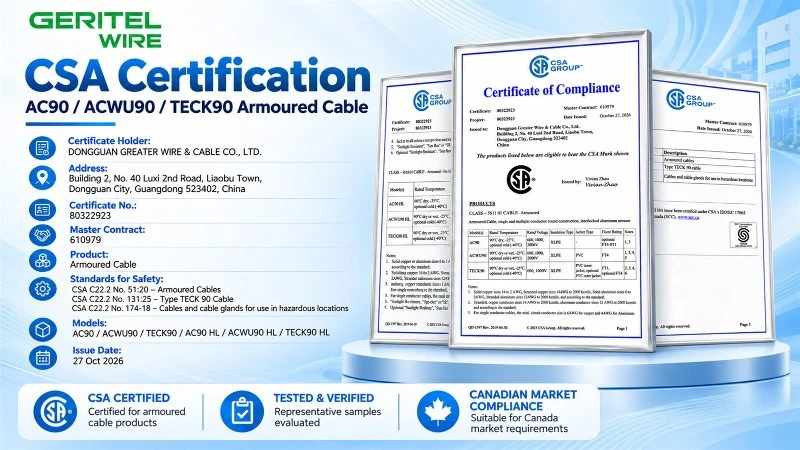
| Certification | Verify the applicable CSA certification and product identification |
| Installation method | Confirm suitability for direct burial, cable tray, raceway, or other intended methods |
| Project requirements | Review drawings, specifications, and local inspection requirements |
8.1 Check the Applicable CSA Standard
For Canadian projects, the typical product standards associated with these cable types include:
| Cable Type | Typical CSA Product Standard | Product Category |
|---|---|---|
| ACWU90 | CSA C22.2 No. 51 | Armoured cables |
| NMWU | CSA C22.2 No. 48 | Non-metallic-sheathed cable |
The exact certification and markings should be confirmed for the specific product being purchased.
Do not assume that a cable is approved simply because its construction looks similar to a CSA-certified product.
8.2 Do Not Compare Only the Temperature Rating
ACWU90 commonly has a 90°C conductor temperature rating, while typical NMWU products are rated 60°C.
This difference can affect electrical design and allowable ampacity.
However, a higher insulation temperature rating does not automatically mean that the cable can carry more current under every installation condition.
Allowable ampacity depends on the applicable code tables, conductor size, installation conditions, termination temperature ratings, and other relevant factors.
The cable's actual certified ratings and the equipment connection requirements must be checked before final selection.
8.3 Confirm That the Cable Is Certified for the Destination Market
ACWU90 and NMWU are Canadian cable designations.
A CSA-certified cable should not automatically be treated as equivalent to a UL-listed product in the United States or an IEC- or AS/NZS-compliant product in another market.
If the project is outside Canada, confirm the destination country's electrical regulations, required product certification, and acceptance by the relevant authority before specifying or importing the cable.
9. Frequently Asked Questions
Is ACWU90 mechanically stronger than NMWU?
ACWU90 generally offers better built-in mechanical protection because it contains aluminum interlocked armour. NMWU does not have metallic armour and is intended for installations where it is not exposed to mechanical injury.
However, the actual mechanical performance depends on the specific product construction and applicable test results.
Can NMWU replace ACWU90?
Not in every application.
NMWU may be suitable where non-armoured cable is permitted and the installation provides adequate protection against mechanical damage.
If the project requires armoured cable or exposes the wiring to physical hazards, NMWU should not be treated as an equivalent replacement.
Is ACWU90 suitable for direct burial?
Many ACWU90 products are identified for direct-burial applications. However, the specific manufacturer's documentation and applicable electrical code requirements must be checked.
The presence of aluminum armour does not eliminate the need to follow burial-depth, backfill, and other installation requirements.
Is NMWU suitable for wet locations?
Yes. Typical NMWU products are designed for specified wet-location applications, including certain outdoor and underground installations.
However, the exact cable rating and permitted wiring method must be verified. Wet-location suitability does not mean that the cable is suitable for locations exposed to mechanical injury.
Does ACWU90 have a PVC outer jacket?
Many common ACWU90 products have an overall PVC jacket over the aluminum interlocked armour.
This jacket provides additional environmental protection, while the metallic armour provides the additional mechanical barrier.
Always check the manufacturer's construction details because product configurations can vary.
Is ACWU90 more expensive than NMWU?
ACWU90 is generally more complex to manufacture because it includes metallic armour and additional cable construction components.
Its purchase price is therefore often higher than that of a comparable NMWU product.
However, the total project cost should also consider installation requirements, additional mechanical protection, cable size, labor, and long-term maintenance.

10. Final Verdict: ACWU90 or NMWU for Mechanical Protection?
If mechanical protection is the primary selection criterion, ACWU90 is generally the better option.
Its aluminum interlocked armour provides an additional protective layer around the internal cable assembly, making it more suitable for installations where accidental impact, abrasion, or other physical hazards are a concern.
NMWU, on the other hand, is a practical non-armoured cable for suitable residential and other permitted applications where the risk of mechanical damage is controlled.
The choice can be summarized as follows:
| Project Requirement | Recommended Cable |
|---|---|
| Higher built-in mechanical protection | ACWU90 |
| Commercial and industrial power distribution | ACWU90, where permitted |
| Armoured cable required by the project | ACWU90 |
| Suitable non-armoured wiring application | NMWU |
| Lower-voltage application compatible with NMWU ratings | NMWU |
| Underground installation | Either, if the specific product and installation method are approved |
Ultimately, the correct cable is not simply the one with the strongest construction. It is the one that satisfies the project's electrical requirements, environmental conditions, mechanical protection needs, and applicable certification rules.
For contractors and procurement professionals, confirming these requirements before ordering can help prevent unsuitable substitutions, installation problems, and unnecessary project costs.
Choose the Right ACWU90 Cable With GERITEL WIRE
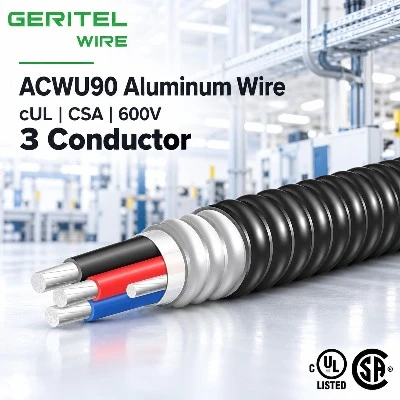
Selecting an armoured cable for commercial, industrial, or underground power distribution requires careful attention to construction, certification, conductor specifications, and installation conditions. GERITEL WIRE manufactures CSA-certified ACWU90 cable solutions designed to meet the needs of international electrical distributors, contractors, and project purchasers. Whether you require copper or aluminum conductors, specific cable sizes, or a customized cable configuration, our team can help review your technical requirements and provide suitable product information. Contact GERITEL WIRE with your project specifications, required quantities, and destination market to discuss your ACWU90 cable requirements and request a quotation.
Dongguan Greater Wire & Cable Co., Ltd.
Tel/WhatsApp/Wechat: +86 136 6257 9592
Tel/WhatsApp/Wechat: +86 135 1078 4550
Email: manager01@greaterwire.com
Website: www.greaterwire.com