

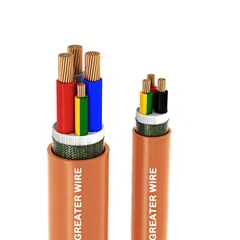
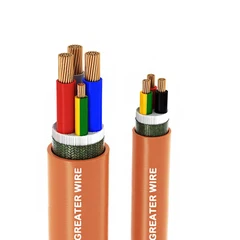

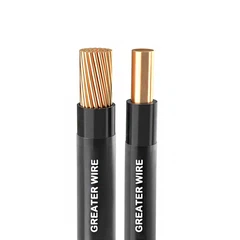
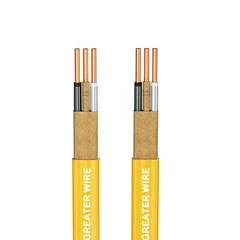
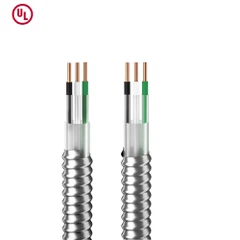
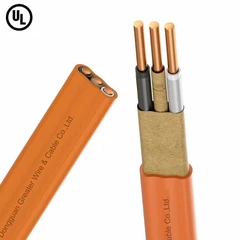
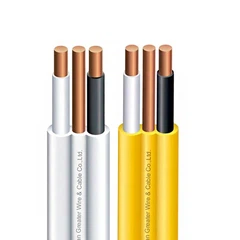
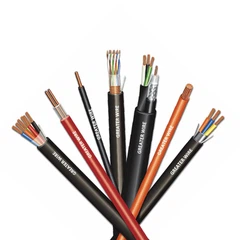
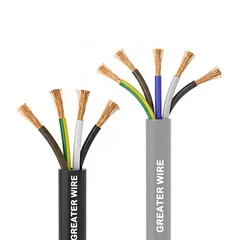
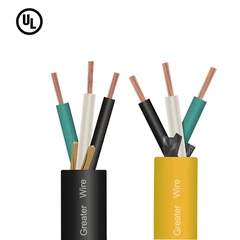
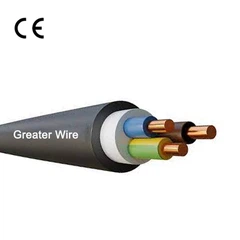
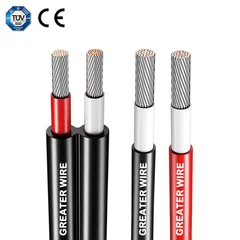

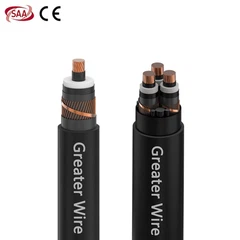
ACWU90 cable is widely used in Canadian commercial, industrial, and infrastructure electrical installations. Its insulated conductors, aluminum interlocked armour, and protective outer jacket make it suitable for a range of wiring methods, including certain underground applications.
However, when a project involves concrete encasement or an underground duct bank, an important question arises: Can ACWU90 be installed directly in concrete, or must it be pulled through a conduit?
The answer is that some ACWU90 products are approved for direct concrete encasement, while others may be specified for installation inside suitable raceways. These are different installation methods, and approval for one should not automatically be interpreted as approval for the other.
This guide explains the differences, the relevant Canadian requirements, the practical installation considerations, and what electrical contractors, engineers, and procurement professionals should verify before specifying ACWU90 for an underground project.
1. What Is ACWU90 Cable?
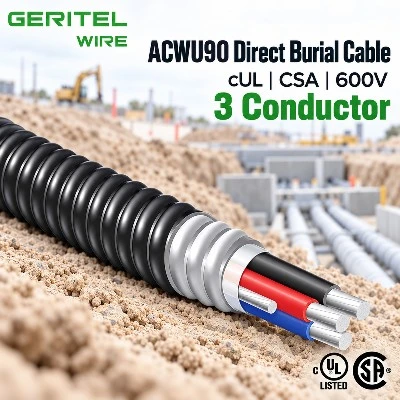
ACWU90 is a Canadian armoured cable designation commonly used for 600 V power distribution applications.
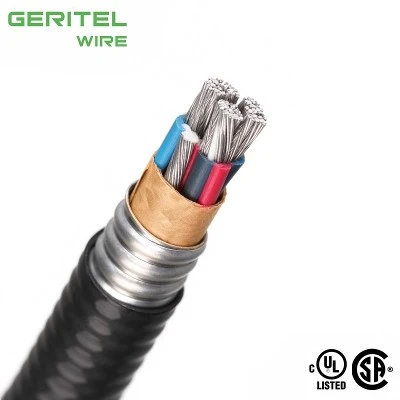
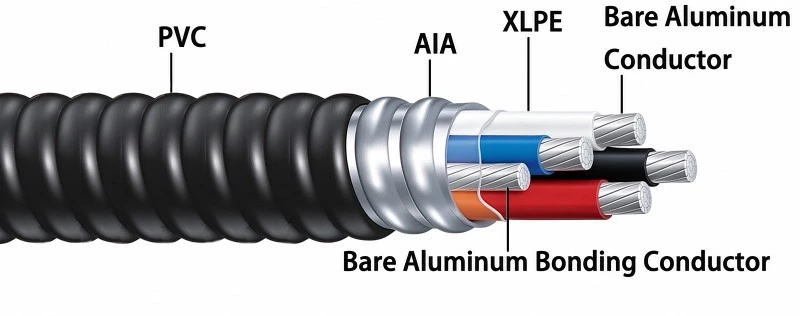
A typical ACWU90 construction includes:
Conductors: Copper or aluminum conductors, depending on the product.
Insulation: Commonly cross-linked polyethylene (XLPE), often identified as RW90.
Bonding conductor: A bonding conductor incorporated into the cable assembly according to its design.
Armour: Aluminum interlocked armour (AIA), providing additional mechanical protection.
Outer jacket: A protective thermoplastic covering, commonly PVC.
The exact materials and construction must be confirmed from the manufacturer's datasheet.
The combination of insulation, metallic armour, and an overall jacket makes ACWU90 suitable for various applications, including approved underground installations.
For example, Nexans identifies its 600 V ACWU90 product for services, feeders, branch circuits, cable trays, raceways, direct burial, and concrete encasement. Its published construction includes RW90 XLPE-insulated aluminum conductors, aluminum interlocked armour, and a sunlight-resistant PVC outer jacket.
However, not every cable sold under a similar commercial description necessarily has identical construction or application approvals. Always verify the exact product.
2. Can ACWU90 Cable Be Installed Directly in Concrete?
Yes, certain manufacturer-approved ACWU90 products can be installed directly in concrete encasement.
This means the cable itself is surrounded by concrete rather than being installed inside a separate conduit.
For example, Prysmian's NUAL brand ACWU90 product literature specifically identifies direct burial, wet locations, and concrete encasement as intended applications. Nexans also lists concrete encasement among the applications for its ACWU90 product.
These manufacturer documents demonstrate that direct concrete encasement is an established application for certain ACWU90 products. They do not establish universal approval for every manufacturer's cable.
2.1 Why Is ACWU90 Suitable for Some Concrete Applications?
Several construction features support this application:
XLPE insulation: Provides electrical insulation and is designed for the product's specified operating conditions.
Aluminum interlocked armour: Adds mechanical protection to the cable assembly.
PVC outer jacket: Provides an additional protective covering around the armour.
Factory-assembled construction: Integrates the conductors, insulation, bonding components, and armour into one cable assembly.
These features make approved ACWU90 products practical for certain installations where cables must be embedded in concrete.
However, the presence of metallic armour and a PVC jacket does not automatically establish suitability for every concrete environment or construction detail.
2.2 What Should Be Checked Before Direct Concrete Encasing?
Before specifying ACWU90 for direct concrete encasement, verify the following:
| Check | Why it matters |
|---|---|
| Manufacturer's application statement | Confirms whether the exact cable is intended for concrete encasement |
| CSA certification and product marking | Establishes the cable's certified product identity and applicable scope |
| Voltage rating | Must match the electrical system and installation requirements |
| Insulation and jacket construction | Must be suitable for the intended environmental conditions |
| Mechanical protection | Prevents damage during placement and concrete pouring |
| Cable routing and support | Helps maintain the specified position and bending radius |
| Project specifications | May impose additional requirements beyond the cable manufacturer's standard application information |
A particularly important point is that concrete encasement approval is not the same as approval for direct burial, and neither should be assumed from the cable's appearance alone.
The manufacturer's documentation and the applicable electrical installation rules must support the selected method.

3. Can ACWU90 Be Used in Underground Concrete Duct Banks?
Yes, ACWU90 may be used in a suitable underground duct or raceway system when the exact product and installation method are permitted.
However, an underground concrete duct bank is structurally different from direct concrete encasement.
A typical concrete-encased duct bank consists of multiple conduits arranged in a defined configuration and surrounded by concrete. The electrical cables are generally pulled through the conduits after the duct bank has been installed and the concrete has sufficiently cured.
In this arrangement, the cable is inside the conduit, while the concrete surrounds the conduit assembly.
3.1 How Does a Concrete Duct Bank Work?
A typical underground duct bank installation involves the following sequence:
Prepare and excavate the trench.
Install the specified conduits or ducts.
Arrange the conduits using suitable spacers.
Secure the duct assembly and install required reinforcement where specified.
Pour concrete around the conduits.
Allow the concrete to cure according to the project requirements.
Inspect, clean, and test the ducts.
Pull the approved electrical cables through the ducts.
Complete cable terminations and required electrical testing.
ACWU90 may be considered as the cable installed inside a suitable raceway, subject to its product approval, cable dimensions, pulling limitations, and applicable code requirements.
3.2 ACWU90 Inside a Duct Bank vs. ACWU90 Directly Encased in Concrete
These installation methods should not be confused.
| Comparison | Direct concrete encasement | Concrete-encased duct bank |
|---|---|---|
| Cable position | Cable is surrounded directly by concrete | Cable is installed inside a conduit |
| Concrete surrounds | The cable assembly | The conduit or duct assembly |
| Separate conduit | Not normally used for the direct-encasement method | Yes |
| Cable installation | Cable is positioned before concrete is poured | Cable is generally pulled after duct installation and concrete curing |
| Main installation concern | Cable positioning and protection during concrete placement | Duct integrity, pulling conditions, conduit fill, and cable ampacity |
| Future cable replacement | Usually difficult | May be possible if the duct remains accessible and suitable |
| Design considerations | Product approval and concrete-encasement details | Duct arrangement, cable pulling, thermal performance, and spare capacity |
For many infrastructure and utility projects, a concrete-encased duct bank is preferred because it provides a defined pathway and can make future cable replacement more practical.
However, the best choice depends on the project design, installation environment, maintenance requirements, and applicable electrical standards.
4. What Canadian Electrical Code Requirements Should You Consider?
For Canadian projects, ACWU90 selection and installation must be evaluated under the applicable edition of the Canadian Electrical Code (CEC), CSA C22.1, together with provincial or territorial amendments.
The 2024 edition is the 26th edition of the Canadian Electrical Code, but adoption and enforcement dates may differ between jurisdictions.
Several areas of the Code are particularly relevant.
4.1 CEC Section 12: Wiring Methods
Section 12 addresses wiring methods, including the installation of cables and raceways.
For ACWU90 projects, the applicable provisions should be reviewed to determine whether the selected cable is suitable for the proposed wiring method and environmental conditions.
Do not assume that a product approved for direct burial is automatically approved for every raceway, concrete, or other underground installation.
The cable's actual certification and conditions of use matter.
4.2 Rule 12-012: Underground Installations
CEC Rule 12-012 addresses underground installations, including minimum cover, mechanical protection, and requirements for direct-buried wiring.
For example, the Electrical Safety Authority of Ontario's buried-wiring information sheet explains that the applicable Table 53 cover requirements depend on the wiring method, voltage, and whether the installation is in a vehicular or non-vehicular area.
The information sheet also identifies concrete encasement as one form of mechanical protection under the rule's specified conditions.
It is important to understand that this reference to concrete encasement as mechanical protection does not mean that every cable is automatically approved for direct embedding in concrete. Product suitability and installation requirements must still be established separately.
4.3 Rule 12-602 and Table 19: Armoured Cable Applications
The applicable provisions governing armoured cable use and the conditions in CEC Table 19 should be checked when selecting ACWU90.
The purpose is to confirm that the cable type is suitable for the intended location and wiring method.
For procurement teams, this means that a supplier's statement such as "suitable for underground use" should not replace verification of the actual cable designation, certification, and permitted application.
4.4 Local Amendments and Inspection Authority Requirements
The Canadian Electrical Code is adopted and amended by provincial and territorial authorities.
Therefore, the applicable requirements for a project in Ontario may not be identical to those enforced in Alberta, British Columbia, or another jurisdiction.
Before construction, confirm:
The locally adopted CEC edition.
Applicable provincial or territorial amendments.
Project-specific engineering specifications.
Requirements of the local inspection authority.
Any utility or owner-specific duct bank construction standards.
5. Important Installation Considerations for ACWU90 in Concrete
Even when the cable is approved for concrete encasement, installation quality remains important.
Concrete placement introduces mechanical forces and construction conditions that can damage a cable if it is not properly supported and protected.
5.1 Maintain the Correct Cable Position
For direct concrete encasement, the cable should be positioned according to the approved installation drawings.
Use suitable supports or other approved positioning methods to prevent the cable from moving during concrete placement.
Avoid:
Allowing the cable to rest against sharp reinforcement edges.
Placing the cable where it can be crushed by other construction materials.
Creating excessively tight bends.
Allowing the cable to become displaced during pouring or vibration.
The required clearances and positioning details should come from the project design and applicable installation requirements rather than an assumed universal spacing.
5.2 Protect the Outer Jacket During Concrete Pouring
The aluminum interlocked armour and PVC outer jacket provide additional protection, but careless handling can still damage the cable.
Before concrete is poured:
Inspect the outer jacket for cuts and abrasion.
Remove sharp objects from the installation area.
Check cable supports and fixing points.
Confirm that the cable is not pinched or trapped.
Protect the cable from contact with sharp reinforcement edges.
During concrete placement, prevent workers, tools, and concrete-handling equipment from striking or displacing the cable.
5.3 Observe the Manufacturer's Bending Radius
ACWU90 contains interlocked metallic armour, so its permitted bending radius must be respected.
Excessively tight bends can deform the cable construction and damage the jacket or internal components.
Before installation, obtain the actual cable outside diameter and minimum bending radius from the manufacturer's datasheet.
Do not apply one bending-radius value to every ACWU90 cable size or construction.
5.4 Consider Concrete Movement and Structural Joints
Concrete structures may experience shrinkage, expansion, settlement, and movement at structural joints.
The cable route should be coordinated with the civil and structural design so that movement does not impose unacceptable tension, bending, or crushing forces on the cable.
Where a cable crosses a structural movement joint, the designer should specify an appropriate arrangement rather than allowing the cable to be rigidly trapped across the joint.
6. Important Installation Considerations for ACWU90 in Underground Duct Banks
When ACWU90 is installed inside an underground concrete duct bank, the main concerns shift from direct concrete contact to raceway suitability, cable pulling, and electrical performance.
6.1 Check Conduit Fill and Cable Dimensions
Before selecting ACWU90 for a duct bank, calculate the available conduit space.
ACWU90 is generally larger in outside diameter than an individual insulated conductor because it includes metallic armour and an overall jacket.
The calculation should consider:
Actual cable outside diameter.
Number of cables in each conduit.
Conduit internal diameter.
Applicable conduit-fill requirements.
Number of bends and total route length.
Space required for future circuits, if specified.
Do not calculate conduit fill using the conductor size alone. The relevant dimension is the complete cable outside diameter.
6.2 Check Cable Pulling Tension
Pulling armoured cable through a long underground duct can create considerable mechanical stress.
The pulling method must stay within the manufacturer's permitted pulling tension and bending limitations.
Important factors include:
Cable weight and construction.
Conduit length.
Number and angle of bends.
Pulling direction.
Friction between the cable and conduit.
Pulling equipment and accessories.
Use suitable cable lubricant only when it is compatible with the cable jacket and conduit materials and permitted by the relevant manufacturer.
A cable that is suitable for installation in a raceway is not necessarily suitable for every pulling arrangement without additional engineering checks.
6.3 Inspect and Clean the Duct Before Pulling
A duct bank must provide a clear and usable pathway before the cable is installed.
Construction debris, hardened concrete, damaged conduit joints, and sharp internal edges can obstruct the cable or damage its outer jacket.
Before pulling:
Inspect accessible duct openings.
Confirm that the ducts are correctly connected.
Clean the duct interiors.
Pass an appropriately sized mandrel or test slug where required by the project specification.
Confirm that the pulling rope and equipment are suitable.
Verify that the duct route matches the approved drawings.
For example, the University of British Columbia's underground electrical duct and manhole guidelines require duct banks to be constructed to specified standards and describe duct testing, cleaning, mandrel testing, and pulling-line installation.
This illustrates why duct bank construction quality matters even when the selected cable itself is correctly approved.
6.4 Account for Water and Moisture Inside Underground Ducts
Underground ducts can accumulate water because of groundwater infiltration, condensation, or drainage conditions.
Therefore, cables installed in underground raceways must be suitable for the environmental conditions inside those raceways.
Many ACWU90 products use RW90 insulated conductors and are designed for approved wet-location applications. Nevertheless, verify the exact product documentation and certification.
Do not assume that a duct is a dry environment simply because it is made from PVC or another non-metallic material.
Duct entries into buildings, electrical equipment, and enclosures may also require suitable sealing arrangements under the applicable installation rules.
6.5 Consider Ampacity and Heat Dissipation
This is one of the most important electrical design considerations for underground duct banks.
When multiple loaded circuits are installed in a concrete-encased duct bank, the cables generate heat during operation.
The surrounding concrete, conduit arrangement, soil conditions, and spacing between loaded circuits all influence heat dissipation.
Consequently, the allowable current-carrying capacity may differ from that of an equivalent cable installed in a different environment.
The designer should evaluate:
Number of loaded circuits.
Conductor size and material.
Cable arrangement and spacing.
Conduit dimensions.
Concrete and surrounding soil thermal properties.
Ambient and ground temperatures.
Applicable ampacity correction or calculation methods.
A 90°C conductor temperature rating does not mean the cable can always operate at its maximum tabulated ampacity inside a duct bank.
The actual allowable ampacity must be determined using the applicable electrical code and installation conditions.
7. Direct Concrete Encasement vs. Underground Duct Bank: Which Should You Choose?
Neither method is automatically better for every project.
The choice depends on construction requirements, accessibility, maintenance expectations, electrical loading, and project cost.
| Project consideration | Direct concrete encasement | Concrete-encased duct bank |
|---|---|---|
| Initial construction | May require fewer separate components | Requires conduits, spacers, concrete, and additional civil work |
| Cable replacement | Usually difficult after encasement | Potentially easier if ducts remain clear and accessible |
| Cable protection | Concrete surrounds the approved cable directly | Conduit provides a defined cable pathway, with concrete protection around the ducts |
| Installation sequence | Cable positioned before concrete placement | Duct bank constructed first; cable generally pulled later |
| Future expansion | Limited | Spare ducts can provide expansion capacity |
| Cable pulling | Not applicable to the direct-encasement method | Requires pulling calculations and suitable equipment |
| Thermal design | Requires evaluation of the concrete-embedded cable arrangement | Requires evaluation of cables inside conduits and the complete duct bank |
| Typical application | Approved cable routes within concrete structures | Underground distribution routes, utility corridors, and infrastructure projects |
When Is Direct Concrete Encasement Worth Considering?
Direct concrete encasement may be suitable when:
The exact ACWU90 product is approved for this application.
The cable route is clearly defined.
The installation does not require frequent cable replacement.
The structural design accommodates the cable installation.
The electrical and mechanical requirements are satisfied.
When Is a Concrete Duct Bank a Better Option?
A concrete-encased duct bank may be preferable when:
Several electrical circuits share an underground route.
Future expansion is expected.
Cable replacement or additional circuits may be required.
The project has utility or infrastructure duct bank specifications.
Cable routing needs to be coordinated with other underground services.
For large industrial facilities, commercial developments, and utility infrastructure, duct banks can provide a more organized underground distribution system.
However, the duct bank must be designed for the actual cable dimensions, circuit loading, and installation conditions.
8. Can ACWU90 Be Used in the United States, Europe, or Australia?
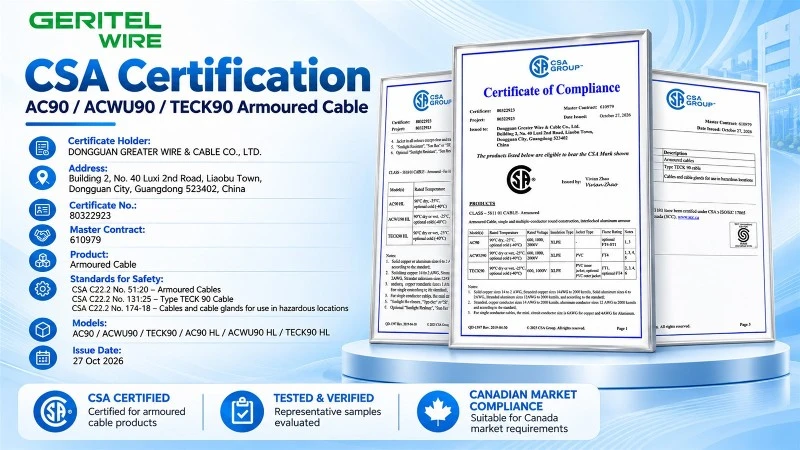
ACWU90 is a Canadian cable designation, so its Canadian product certification should not automatically be treated as approval for use in other markets.
The distinction between product standards and installation standards is important.
| Market | What should be verified? |
|---|---|
| Canada | Applicable CSA product certification, CEC requirements, and provincial or territorial amendments |
| United States | Applicable UL or other accepted product listing, NEC wiring-method requirements, and local approval |
| Europe | Applicable national product and installation requirements, including relevant EN or IEC-based standards |
| Australia and New Zealand | Applicable AS/NZS wiring rules, product approval, and local regulatory requirements |
For example, a cable certified as ACWU90 under the Canadian framework is not automatically equivalent to a US Type MC cable under UL 1569.
Likewise, compliance with an IEC or AS/NZS requirement should not be inferred from a Canadian ACWU90 marking.
For international projects, buyers should provide the destination country, voltage system, installation method, and required certification before requesting a cable quotation.
9. Common Mistakes When Specifying ACWU90 for Concrete or Duct Bank Applications
Several mistakes can lead to unsuitable cable selection, installation delays, or unexpected project costs.
| Common mistake | Why it causes problems | Recommended approach |
|---|---|---|
| Assuming every ACWU90 cable can be directly encased in concrete | Product approvals and construction details may differ | Check the exact manufacturer's application statement |
| Confusing concrete encasement with a concrete duct bank | The cable installation method is different | Identify whether the cable is embedded directly or pulled through a duct |
| Assuming direct-burial approval automatically covers every concrete application | Different installation conditions may have different approval requirements | Verify both product suitability and installation rules |
| Ignoring conduit fill | The cable may not fit the selected duct arrangement | Use actual cable and conduit dimensions |
| Ignoring pulling tension | The cable may be mechanically damaged during installation | Follow manufacturer pulling limits |
| Treating underground ducts as dry | Water may enter or accumulate inside the raceway | Confirm wet-location suitability |
| Using ordinary cable ampacity assumptions for duct banks | Group loading and thermal conditions may reduce allowable ampacity | Complete the applicable ampacity calculation |
| Assuming Canadian approval is valid worldwide | Certification systems and wiring rules differ | Confirm destination-market approval |

10. ACWU90 Concrete and Duct Bank Specification Checklist
Before purchasing or installing ACWU90 for a concrete or duct bank project, review the following items.
Product verification
Confirm the exact ACWU90 manufacturer and product reference.
Verify conductor material and size.
Confirm the voltage and temperature ratings.
Check the insulation, armour, bonding conductor, and jacket construction.
Obtain written confirmation of direct concrete-encasement suitability if this method is proposed.
Verify the applicable product certification and markings.
Installation design
Identify whether the cable will be directly encased or installed inside a duct bank.
Review the applicable electrical code and local amendments.
Confirm the cable route and required mechanical protection.
Check cable bending radius and pulling-tension limits.
Verify conduit fill and duct dimensions where raceways are used.
Evaluate moisture exposure and wet-location suitability.
Complete the required ampacity assessment.
Coordinate cable installation with structural and civil construction drawings.
Installation and inspection
Inspect cable condition before installation.
Confirm suitable cable supports and handling equipment.
Inspect and clean ducts before cable pulling.
Use compatible pulling equipment and lubricant where required.
Prevent cable movement or damage during concrete placement.
Complete the required electrical inspections and tests.
Record cable routes and installation details for future maintenance.
11. Frequently Asked Questions
Can ACWU90 Be Buried Directly in Concrete Without Conduit?
Some ACWU90 products are specifically identified by their manufacturers as suitable for concrete encasement. However, this should not be assumed for every product. Verify the exact cable's certification, manufacturer documentation, and applicable installation requirements before proceeding.
Is ACWU90 Suitable for Concrete-Encased Underground Duct Banks?
ACWU90 may be installed inside suitable raceways that form part of an underground concrete-encased duct bank when the cable and installation method are permitted. The duct bank is a concrete-surrounded conduit assembly, not necessarily a cable directly embedded in concrete.
Is ACWU90 Better Than Individual Conductors in Conduit?
The answer depends on the project. ACWU90 combines insulated conductors, bonding components, armour, and an outer jacket into one cable assembly. Individual conductors in conduit may offer different installation and replacement advantages. Compare product approvals, conduit requirements, installation labour, ampacity, and maintenance expectations.
Does Concrete Damage the PVC Jacket of ACWU90?
An ACWU90 product specifically approved for concrete encasement is designed for that application within its stated conditions. However, damage can still occur during handling, positioning, reinforcement work, or concrete placement. Follow the manufacturer's installation instructions and inspect the cable before it is covered.
Can ACWU90 Be Pulled Through an Underground PVC Conduit?
Some ACWU90 products are approved for raceway installations. Before pulling the cable through underground PVC conduit, verify conduit fill, minimum bending radius, pulling tension, moisture suitability, and the applicable electrical code requirements.
Does ACWU90 Need a Separate Equipment Grounding Conductor?
ACWU90 commonly incorporates a bonding conductor as part of its cable construction, but the exact arrangement depends on the product. The electrical designer must verify bonding and grounding requirements, including armour continuity and termination methods, under the applicable code.
Conclusion
ACWU90 can be a practical option for certain concrete and underground installations, but the correct application depends on the exact cable product and installation method.
Some manufacturer-approved products can be directly encased in concrete. ACWU90 may also be installed inside suitable conduits that form part of a concrete-encased underground duct bank, provided the cable and raceway installation meet the applicable requirements.
For project engineers and electrical contractors, the most important steps are to verify product approval, distinguish direct concrete encasement from duct bank installation, check mechanical and pulling limitations, and complete the required ampacity assessment.
Selecting the correct cable is only part of the process. Proper coordination between cable specifications, electrical design, and civil construction is essential for a reliable underground power distribution system.
GERITEL WIRE supports international electrical contractors, distributors, OEMs, and project procurement teams with cable solutions for commercial, industrial, and infrastructure applications. Whether your project requires ACWU90 for direct concrete encasement, underground raceways, or power distribution systems, our team can help review conductor sizes, cable construction, voltage ratings, and certification requirements. Contact GERITEL WIRE to discuss your technical specifications and sourcing needs. We welcome inquiries for project-based cable selection and customized supply requirements.
Dongguan Greater Wire & Cable Co., Ltd.
Tel/WhatsApp/Wechat: +86 136 6257 9592
Tel/WhatsApp/Wechat: +86 135 1078 4550
Email: manager01@greaterwire.com
Website: www.greaterwire.com