

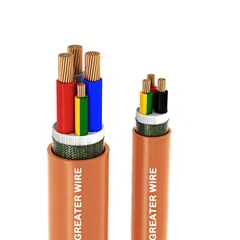
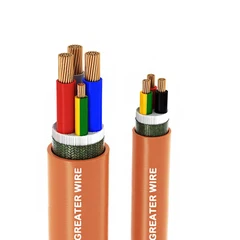

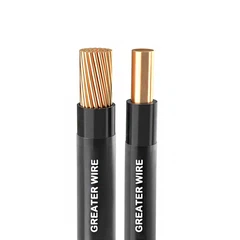
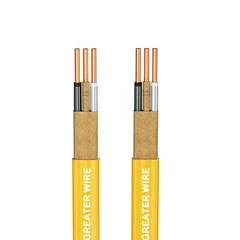
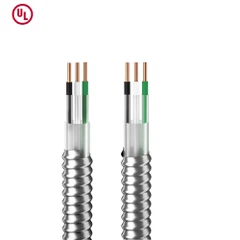
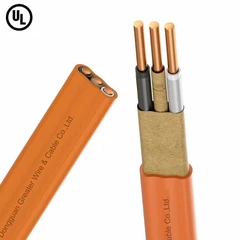

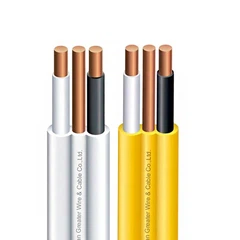
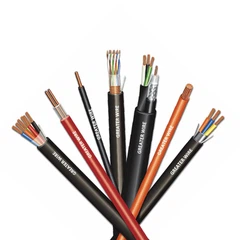


When selecting ACWU90 cable for commercial, industrial, or infrastructure projects, one important decision is whether to choose copper or aluminum conductors.
Both materials can be used in ACWU90 cable constructions, but they offer different advantages in terms of electrical conductivity, conductor size, material cost, cable weight, installation requirements, and long-term operating performance.
Copper is known for its excellent electrical conductivity, mechanical strength, and relatively compact conductor size. Aluminum, on the other hand, offers a lower material cost and significantly reduced weight, making it attractive for large-scale power distribution projects.
However, the lowest cable purchase price does not necessarily represent the best project value. Buyers must also consider conductor sizing, compatible electrical connectors, installation labor, transportation, voltage drop, and operating losses.
So, when comparing copper vs aluminum ACWU90 cable, which option provides better overall value?
This guide examines the technical and commercial differences to help electrical contractors, distributors, engineering companies, and procurement professionals make informed purchasing decisions.
1. What Is the Difference Between Copper and Aluminum ACWU90 Cable?
ACWU90 is a Canadian armored cable type commonly used in commercial and industrial electrical installations.
The designation generally describes an armored cable construction with XLPE insulation rated for a maximum conductor operating temperature of 90°C under applicable conditions.
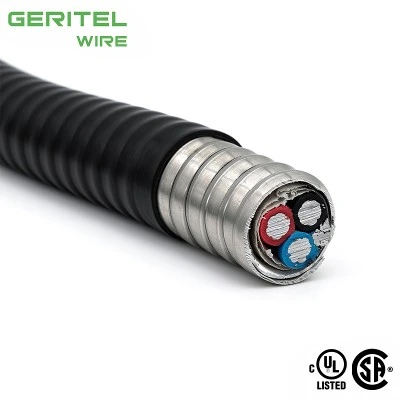
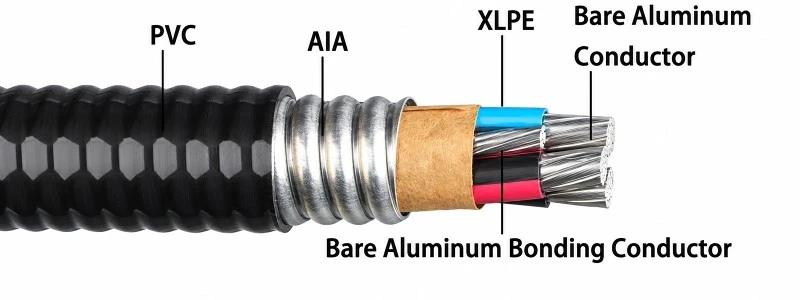
A typical ACWU90 cable includes:
Conductor: Copper or aluminum, depending on the product specification.
Insulation: Cross-linked polyethylene (XLPE), providing electrical insulation and heat resistance.
Bonding conductor: A grounding or bonding conductor selected according to the cable design and applicable electrical requirements.
Armor: Aluminum interlocked armour (AIA), providing mechanical protection.
Outer jacket: PVC, offering additional protection against moisture, abrasion, and environmental exposure.
The main difference between copper and aluminum ACWU90 cable is the material used for the electrical conductors.
The insulation, armor, and outer jacket may have similar functions, but their detailed construction can vary between manufacturers and product configurations.
It is also important to understand that aluminum interlocked armour does not mean the cable has aluminum power conductors. A copper-conductor ACWU90 cable can also use aluminum interlocked armour.
Therefore, buyers should always confirm the conductor material from the product specification and cable markings rather than judging it by the outer appearance.
2. Copper vs Aluminum ACWU90 Cable: Key Differences at a Glance
Before examining individual performance factors, the following table summarizes the main differences.
| Comparison factor | Copper ACWU90 | Aluminum ACWU90 |
|---|---|---|
| Electrical conductivity | Higher | Lower |
| Conductor size for equivalent ampacity | Generally smaller | Generally larger |
| Material cost | Generally higher | Generally lower |
| Cable weight | Generally heavier | Generally lighter |
| Installation handling | More demanding for large cables | Generally easier for large cables |
| Mechanical characteristics | Higher tensile strength and ductility | Lower tensile strength; alloy and stranding matter |
| Electrical resistance at equal conductor size | Lower | Higher |
| Termination requirements | Generally straightforward | Requires compatible aluminum-rated terminals |
| Voltage drop | Generally lower at equal size | Requires appropriate conductor sizing |
| Typical project advantage | Compactness and electrical performance | Material savings and reduced weight |
Neither conductor material is automatically better for every application.
The right choice depends on the electrical load, required conductor size, installation environment, project budget, and equipment compatibility.

3. Electrical Conductivity: Why Does Copper Require Less Conductor Area?
Electrical conductivity is one of the most important differences between copper and aluminum.
It describes how easily an electrical current flows through a material.
Copper has higher electrical conductivity than aluminum. At approximately 20°C, standard annealed copper has a resistivity of about 1.72 × 10⁻⁸ Ω·m, while electrical-grade aluminum is approximately 2.82 × 10⁻⁸ Ω·m.
This means aluminum has roughly 1.64 times the electrical resistivity of copper at the same temperature and for the same conductor cross-sectional area.
3.1 Copper Offers Higher Conductivity
Because copper has lower electrical resistance, it can generally carry a given current with a smaller conductor cross-sectional area than aluminum under comparable conditions.
For example, a copper conductor may be suitable where limited installation space makes a smaller conductor diameter desirable.
This can be particularly useful in:
Electrical distribution panels.
Compact equipment connections.
Industrial control rooms.
Installations with limited cable routing space.
Projects with strict conductor dimension requirements.
However, the final conductor size must be selected according to the applicable ampacity tables, voltage-drop calculations, and equipment termination ratings.
3.2 Aluminum Requires a Larger Conductor for Comparable Performance
Aluminum has higher electrical resistance than copper at an equivalent conductor size.
To achieve comparable current-carrying capability, aluminum conductors generally need a larger cross-sectional area.
This does not mean aluminum is electrically unsuitable.
Modern 8000-series aluminum alloy conductors are specifically designed for electrical applications and are widely used in building wire and power distribution systems.
When properly sized and installed with compatible accessories, aluminum ACWU90 cable can provide reliable electrical performance.
The important purchasing principle is to compare copper and aluminum conductors at equivalent electrical performance, not simply at the same AWG or kcmil size.
4. Ampacity Comparison: Can Copper and Aluminum Carry the Same Current?
Ampacity refers to the maximum current a conductor is permitted to carry under specified installation and temperature conditions.
For Canadian electrical installations, the Canadian Electrical Code (CEC), CSA C22.1, provides separate ampacity tables for copper and aluminum conductors.
For example:
Table 2 covers copper conductors installed in a raceway or cable.
Table 4 covers aluminum conductors installed in a raceway or cable.
Both tables account for conductor size and allowable temperature conditions.
4.1 Example: Comparing Equivalent Ampacity
The following example uses the 75°C ampacity columns in the 2024 Canadian Electrical Code.
| Conductor material | Conductor size | Ampacity |
|---|---|---|
| Copper | 4/0 AWG | 230 A |
| Aluminum | 300 kcmil | 230 A |
Under the specified Table 2 and Table 4 conditions, these two conductor sizes have the same tabulated ampacity.
This demonstrates an important difference:
A 4/0 AWG copper conductor and a 4/0 AWG aluminum conductor should not automatically be considered electrically equivalent.
The aluminum conductor generally needs a larger cross-sectional area to achieve comparable current-carrying capability.
Important: These are illustrative CEC table values, not a final cable selection or a universal ampacity rating for every ACWU90 installation. The actual allowable ampacity must account for the number of current-carrying conductors, ambient temperature, underground thermal conditions, installation configuration, and termination temperature limitations.
4.2 Why Does Ampacity Matter for Project Value?
Selecting an undersized conductor can create excessive heating, voltage drop, and potential electrical safety problems.
Selecting an unnecessarily oversized conductor can increase cable material and installation costs.
The objective is to identify the smallest conductor size that safely satisfies all applicable electrical design requirements.
Copper may achieve the required ampacity with a smaller conductor, while aluminum may provide a lower-cost solution using a larger conductor.
The better option depends on the total installed cost rather than conductor size alone.
5. Material Cost: Is Aluminum ACWU90 More Economical?
For many B2B buyers, material cost is one of the first factors considered when comparing copper and aluminum ACWU90 cable.
In general, aluminum is less expensive than copper on a per-kilogram basis.
This is one reason aluminum conductors are widely used in large feeders, service entrance cables, and industrial power distribution systems.
5.1 Why Is Copper ACWU90 Usually More Expensive?
Copper has a higher commodity value and is generally more expensive as a conductor material.
A copper-conductor ACWU90 cable may therefore have a higher purchase price than an aluminum version with comparable electrical performance.
However, the price difference depends on several factors:
Copper market prices.
Conductor size and strand construction.
Number of conductors.
Cable length.
Insulation thickness.
Armor and jacket specifications.
Manufacturing costs.
Order quantity and delivery requirements.
For large cable orders, even a relatively small difference in unit price can significantly affect the project budget.
5.2 Why Does Aluminum Offer a Cost Advantage?
Aluminum's lower material cost makes it attractive for projects requiring substantial quantities of power cables.
For example, industrial facilities, commercial buildings, and infrastructure developments may require long underground feeder routes.
In these applications, aluminum ACWU90 can reduce the initial cable procurement budget while meeting the required electrical performance through appropriate conductor sizing.
However, buyers should compare quotations using equivalent ampacity, voltage rating, cable construction, and certification requirements.
Comparing the price of a 4/0 AWG copper cable directly with a 4/0 AWG aluminum cable may produce a misleading result because their electrical performance is not identical.
6. Cable Weight: Why Is Aluminum Easier to Handle?
Cable weight is another important factor in project economics.
Aluminum has a density of approximately 2.70 g/cm³, compared with approximately 8.96 g/cm³ for copper.
This means aluminum is substantially lighter than copper by volume.
Although an aluminum conductor generally needs a larger cross-sectional area to achieve comparable electrical performance, it can still offer a considerable weight advantage.
6.1 Advantages of Lightweight Aluminum ACWU90
A lighter cable can offer several practical benefits:
Easier transportation and material handling.
Reduced lifting requirements.
Less physical effort during installation.
Easier handling of large cable reels.
Potential reductions in installation labor and equipment requirements.
These advantages become increasingly important when working with long cable runs and large conductor sizes.
For electrical contractors, reduced cable weight can improve installation efficiency, particularly on projects involving multiple large feeder cables.
6.2 When Is Copper's Smaller Size More Valuable?
Although copper is heavier, its higher conductivity can allow a smaller conductor cross-section for comparable electrical performance.
This can be useful when cable routing space is limited.
For example, a project with restricted cable tray capacity or limited equipment termination space may favor copper, depending on the complete cable dimensions and installation requirements.
The correct comparison should therefore consider both cable diameter and total cable weight rather than conductor material alone.
7. Installation and Termination: What Should Contractors Consider?
Copper and aluminum ACWU90 cables require different considerations during installation, especially at electrical connections.
This is an important factor because poor termination practices can cause overheating, increased contact resistance, and premature connection failure.
7.1 Copper ACWU90 Termination
Copper conductors are widely used in electrical installations and are compatible with a broad range of copper-rated terminals and connectors.
Their relatively high conductivity and mechanical properties make them convenient for many electrical connection applications.
However, copper conductors still require correct connector selection, preparation, stripping, and tightening torque.
The connector must be suitable for the conductor material, size, strand class, and temperature rating.
7.2 Aluminum ACWU90 Termination
Aluminum conductors require more attention to connector compatibility and installation procedures.
Aluminum forms a surface oxide layer when exposed to air. This oxide has different electrical properties from the underlying aluminum metal.
If connections are not properly designed and installed, contact resistance and connection heating can become problems.
To address these issues, contractors should:
Use connectors specifically listed or approved for aluminum conductors.
Verify that equipment terminals are marked for AL or AL/CU use, as appropriate.
Follow the connector manufacturer's stripping and preparation instructions.
Apply the specified tightening torque using suitable tools.
Use oxide-inhibiting compound where required by the connector or cable manufacturer's instructions.
Avoid direct copper-to-aluminum contact unless the connection system is specifically approved for that arrangement.
Modern electrical connectors are designed to provide reliable connections with aluminum conductors when installed correctly.
Therefore, aluminum termination requirements should be treated as an installation consideration rather than a reason to automatically reject aluminum cable.
8. Voltage Drop and Long-Term Operating Costs
The initial purchase price is only one part of the total cost of an electrical cable installation.
Voltage drop and electrical losses also affect project performance over time.
Voltage drop occurs because conductors have electrical resistance. As current flows through a conductor, some electrical energy is converted into heat.
8.1 Copper and Aluminum Voltage Drop
For conductors with the same cross-sectional area and operating temperature, copper generally has lower electrical resistance than aluminum.
This means copper can produce a lower voltage drop under otherwise comparable conditions.
However, aluminum conductors can be upsized to reduce resistance and achieve the required voltage-drop performance.
For long feeder circuits, engineers should calculate voltage drop using:
Conductor material.
Conductor size.
Circuit length.
Operating current.
System voltage.
Power factor.
Conductor operating temperature.
Circuit configuration.
The cable selected must satisfy the project's voltage-drop limits as well as its ampacity requirements.
8.2 Why Should Buyers Consider Energy Losses?
Electrical losses can accumulate over the operating life of a cable installation.
For a project operating continuously or carrying substantial loads, even relatively small differences in conductor resistance may affect long-term energy consumption.
A copper conductor may be economically attractive where lower resistance and reduced voltage drop are important.
An appropriately upsized aluminum conductor can also achieve acceptable electrical performance while maintaining a lower initial material cost.
The best solution depends on the expected operating current, annual operating hours, electricity price, project lifetime, and cable sizing.
For larger industrial installations, a lifecycle cost calculation can help determine whether the additional investment in copper is justified.
9. Copper vs Aluminum ACWU90: Which Is Better for Different Projects?
There is no universal answer to which conductor material is better.
Different projects have different technical and commercial priorities.
9.1 When Should You Choose Copper ACWU90?
Copper ACWU90 may be the better choice when:
1. Installation space is limited
Copper's higher conductivity can allow a smaller conductor cross-section for a given electrical requirement.
2. Lower conductor resistance is a priority
Copper may be preferable where minimizing voltage drop and resistive losses is particularly important.
3. Equipment connections favor copper
Some equipment or existing electrical systems may be designed around copper conductors or have termination restrictions that make copper a more convenient choice.
4. Compact cable routing is required
Where cable tray capacity, equipment dimensions, or bending space is limited, copper may offer practical advantages.
5. Project specifications explicitly require copper
Some engineering specifications, owners, or equipment manufacturers may require copper conductors regardless of the potential material savings offered by aluminum.
9.2 When Should You Choose Aluminum ACWU90?
Aluminum ACWU90 may be the better choice when:
1. Initial procurement cost is a major consideration
Aluminum generally offers a lower conductor material cost, making it attractive for budget-sensitive projects.
2. Long feeder runs are involved
Its lower weight can simplify transportation, handling, and installation.
3. Large conductor sizes are required
Aluminum can provide a cost-effective solution for large electrical distribution circuits when properly sized.
4. Cable weight needs to be minimized
For projects involving large reels, long cable routes, or demanding handling conditions, aluminum can offer practical advantages.
5. Compatible electrical equipment is available
When switchgear, distribution panels, breakers, and terminals are suitable for aluminum conductors, aluminum ACWU90 can be an economical solution.

10. How to Compare the Total Project Value of Copper and Aluminum ACWU90
For distributors, contractors, and procurement professionals, choosing between copper and aluminum should involve a complete project cost comparison.
Instead of comparing only the cable quotation, consider the following cost categories.
| Cost factor | Copper ACWU90 | Aluminum ACWU90 |
|---|---|---|
| Initial cable price | Generally higher | Generally lower |
| Conductor size | Generally smaller | Generally larger |
| Transportation | Higher weight may increase handling costs | Lower weight can reduce handling costs |
| Installation labor | Depends on size and routing conditions | Lightweight handling can provide advantages |
| Termination accessories | Copper-compatible connectors required | Aluminum-compatible connectors required |
| Voltage-drop performance | Generally favorable at equal size | May require upsizing |
| Operating losses | Generally lower at equal size | Depends on conductor sizing and load |
| Long-term project value | Strong electrical performance | Strong cost and weight advantages |
10.1 Consider the Initial Purchase Cost
Request quotations for copper and aluminum ACWU90 cables with equivalent electrical performance.
Make sure both products meet the same voltage rating, conductor configuration, certification requirements, and application conditions.
10.2 Include Installation and Accessory Costs
Compare the cost of cable pulling, handling equipment, connectors, lugs, and installation labor.
A lower-priced cable may not necessarily produce the lowest installed cost.
10.3 Evaluate Long-Term Energy Losses
For projects with substantial continuous electrical loads, calculate conductor losses over the expected operating life.
This helps determine whether the lower resistance of a copper conductor justifies its higher initial price.
10.4 Consider Project-Specific Constraints
Cable routing space, equipment compatibility, installation distance, environmental conditions, and future maintenance requirements can all affect the final decision.
The most economical solution is the one that meets the electrical and installation requirements at the lowest reasonable total lifecycle cost.
11. What Should Buyers Check Before Ordering Copper or Aluminum ACWU90 Cable?
Before placing an order, B2B buyers should confirm the following technical details.
1. Conductor material
Specify whether the project requires copper or aluminum conductors. Do not assume all ACWU90 products use the same conductor material.
2. Conductor size
Confirm the required AWG or kcmil size based on ampacity, voltage drop, short-circuit performance, and installation conditions.
3. Number of conductors
Check whether the cable requires two, three, or four insulated conductors and whether a bonding conductor is included.
4. Insulation and temperature rating
Verify the XLPE insulation construction, 90°C conductor temperature rating, and 600V voltage rating where applicable.
5. Armour and outer jacket
Confirm the aluminum interlocked armour and PVC outer jacket specifications, including environmental and mechanical protection requirements.
6. Certification and standards
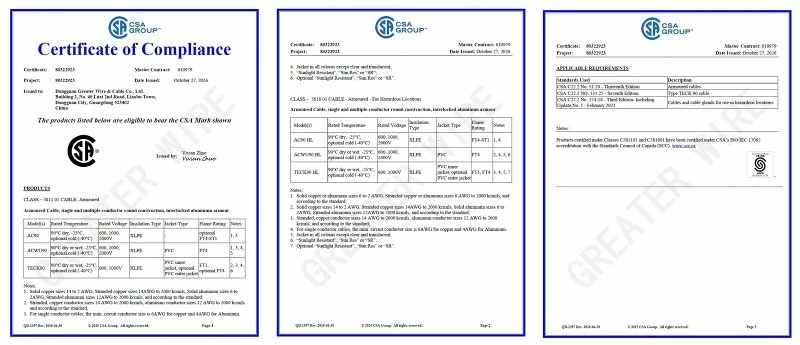
For Canadian projects, verify the applicable CSA certification and compliance with relevant standards, including CSA C22.2 No. 51.
For other markets, check the specific product approvals and installation requirements. A Canadian ACWU90 designation does not automatically establish compliance with US NEC or other international requirements.
7. Termination compatibility
Confirm that the electrical equipment and connectors are suitable for the selected conductor material and size.
8. Packaging and delivery
For large projects, check cable reel dimensions, cable lengths, shipping weight, packaging requirements, and delivery schedules.
Providing these details to the cable manufacturer before ordering can help avoid specification mismatches and unnecessary procurement costs.
12. Frequently Asked Questions About Copper vs Aluminum ACWU90 Cable
Q1: Is ACWU90 Cable Available with Both Copper and Aluminum Conductors?
Yes. ACWU90 cable is available in both copper-conductor and aluminum-conductor constructions, depending on the manufacturer and product range.
However, aluminum conductor versions are particularly common in the Canadian market.
Always verify the actual conductor material from the manufacturer's specification sheet and cable markings.
Q2: Is Aluminum ACWU90 Cable as Reliable as Copper?
Aluminum ACWU90 cable can provide reliable long-term electrical performance when correctly sized, manufactured, certified, and installed.
The conductor must be selected according to the required ampacity and voltage-drop limits, and all connections must use compatible aluminum-rated terminals.
Copper and aluminum are both established electrical conductor materials. Their suitability depends on the project requirements and installation quality.
Q3: Why Is Aluminum ACWU90 Cable Usually Cheaper?
Aluminum generally has a lower market price per kilogram than copper.
Although an aluminum conductor requires a larger cross-sectional area for comparable electrical performance, its lower material cost can still provide a significant economic advantage.
The actual price difference depends on conductor size, cable construction, metal market prices, and order quantity.
Q4: Does Aluminum ACWU90 Need Special Connectors?
Yes. Aluminum conductors must be connected using terminals and connectors specifically approved for aluminum conductors or suitable for both copper and aluminum.
The installation must follow the connector manufacturer's requirements for conductor preparation, tightening torque, and any specified oxide-inhibiting compound.
Q5: Can Copper and Aluminum ACWU90 Cables Use the Same Burial Method?
Generally, conductor material alone does not determine the burial method.
The applicable installation requirements depend on the cable's approved construction, armour, voltage rating, direct-burial suitability, and local electrical regulations.
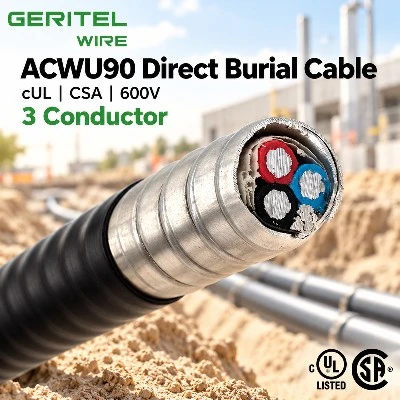
Both copper and aluminum ACWU90 products approved for direct burial may be used underground when installed according to the applicable code and manufacturer's instructions.
Q6: Which ACWU90 Cable Is Better for Long-Distance Power Distribution?
The answer depends on the electrical load, voltage-drop limits, installation conditions, and project budget.
Copper may offer advantages where lower conductor resistance and compact dimensions are important.
Aluminum may provide better overall economics for long feeder installations because of its lower material cost and reduced weight.
The final conductor size should be established through engineering calculations rather than a direct comparison of identical AWG or kcmil sizes.
13. Conclusion: Which ACWU90 Cable Offers Better Project Value?
Copper and aluminum ACWU90 cables both have important advantages in commercial and industrial electrical installations.
Copper offers higher electrical conductivity, lower resistance at equal conductor size, and potentially more compact cable dimensions. It is particularly suitable for projects where electrical performance, limited installation space, and equipment compatibility are major priorities.
Aluminum offers lower material cost and significantly reduced weight. When correctly sized and installed with compatible connectors, it can provide a reliable and economical solution for large feeders and power distribution projects.
For electrical distributors, contractors, and project purchasers, the best choice should be based on equivalent electrical performance and total project cost rather than the initial cable price alone.
Ultimately, copper is often the preferred choice when compactness and conductivity matter most, while aluminum is often the stronger value option when material savings and installation weight are major considerations.
Looking for the Right Copper or Aluminum ACWU90 Cable for Your Project?
GERITEL WIRE, backed by Dongguan Greater Wire & Cable Co., Ltd., provides cable manufacturing and supply solutions for international distributors, electrical contractors, and industrial equipment manufacturers. Whether your project requires copper or aluminum ACWU90 cable, our team can help you discuss conductor sizes, cable construction, insulation ratings, armour options, and applicable certification requirements. We understand that every project has different electrical and budget priorities. Contact GERITEL WIRE to discuss your technical specifications, request product information, or obtain a competitive quotation for your next cable procurement project.
Dongguan Greater Wire & Cable Co., Ltd.
Tel/WhatsApp/Wechat: +86 136 6257 9592
Tel/WhatsApp/Wechat: +86 135 1078 4550
Email: manager01@greaterwire.com
Website: www.greaterwire.com