























In modern commercial and industrial electrical installations, cables are often exposed to harsh environmental conditions. Oil, grease, lubricants, and cutting fluids are common in factories, mechanical rooms, parking structures, and industrial facilities. These substances can degrade cable materials over time, leading to insulation failure, safety risks, and costly maintenance.
MC cable (Metal Clad Cable) is widely used due to its mechanical protection, installation efficiency, and NEC compliance. However, many engineers, contractors, and buyers frequently ask:
Is Copper MC cable resistant to oil?
The answer is not a simple yes or no. While copper conductors themselves are not affected by oil, the overall oil resistance of an MC cable or MC wire depends largely on its insulation type, jacket materials, and compliance with UL and NEC standards.

What Is Copper MC Cable?
MC Cable Structure Overview
A standard Copper MC cable consists of the following components:
Copper conductors (solid or stranded)
Thermoplastic or thermoset insulation (THHN, THWN-2, XHHW-2, etc.)
Interlocked aluminum or steel metal armor
An equipment grounding conductor or grounding through the armor
This integrated structure allows MC cable to replace conduit and individual wires in many installations while maintaining strong mechanical protection.
Copper MC Cable vs Other MC Wire Types
Compared to aluminum MC wire, copper MC cable offers higher conductivity, smaller conductor size for the same ampacity, and greater resistance to thermal cycling. These characteristics make copper metal clad cable a preferred choice in performance-critical and industrial applications.
What Does "Oil Resistant" Mean in Electrical Cables?
Technical Definition of Oil Resistance
Oil resistance refers to a cable's ability to maintain its mechanical and electrical properties after exposure to oils or petroleum-based substances. It does not mean the cable is completely unaffected by oil under all conditions.
Key distinctions include:
Oil Resistant: Suitable for incidental or continuous contact with oil
Oil Proof: Rarely used in electrical standards and often misleading
Types of Oils Commonly Encountered
Mineral oils
Hydraulic fluids
Machine lubricants
Cutting and cooling oils
Different oils affect cable materials differently, especially insulation compounds.
Is Copper MC Cable Itself Oil Resistant?
Copper Conductors and Oil Exposure
Copper conductors are inherently resistant to oil. Oil does not chemically react with copper or significantly affect its electrical conductivity. From a conductor perspective, copper is fully compatible with oil-exposed environments.
However, conductors alone do not determine the performance of an MC cable.
Metal Clad Armor and Oil Resistance
The metal armor used in metal clad cable-typically aluminum or steel-is also resistant to oil. It provides a physical barrier that prevents direct oil contact with internal components.
That said, oil can still migrate through cable ends or fittings, which is why internal insulation performance is critical.
The Real Key Factor: Insulation Determines Oil Resistance
THHN Insulation and Oil Resistance
THHN insulation is commonly used in MC cable and offers:
Good heat resistance
Moderate oil resistance
Best performance in dry or lightly exposed environments
THHN alone may not be suitable for continuous oil exposure unless specifically marked as oil resistant per UL standards.
THWN-2 Insulation and Oil Resistance
THWN-2 insulation is designed for:
Wet locations
Enhanced oil resistance
Higher temperature ratings (90°C wet and dry)
Copper MC cable with THWN-2 insulation is widely accepted for oil-exposed industrial environments and is often the preferred choice.
XHHW-2 Insulation and Oil Resistance
XHHW-2 insulation uses cross-linked polyethylene (XLPE), offering:
Excellent oil resistance
Superior chemical stability
High mechanical strength
For demanding industrial conditions, XHHW-2 insulated MC cable provides one of the best oil-resistant solutions.
Typical Applications Requiring Oil-Resistant Copper MC Cable
Industrial Facilities
Manufacturing plants
CNC machining areas
Assembly lines with lubricated equipment
Oil-resistant MC wire ensures long-term reliability in these environments.
Commercial and Utility Areas
Parking garages
Mechanical rooms
Elevator machine rooms
These locations often experience oil drips or vapor exposure.
Heavy-Duty and Special Environments
Power generation facilities
Petrochemical plants
Steel and metal processing industries
In such settings, selecting the correct metal clad cable is critical for safety and compliance.

How to Choose the Right Oil-Resistant Copper MC Cable
Key Selection Factors
Type of oil and frequency of exposure
Ambient and operating temperature
Mechanical stress and vibration levels
NEC and UL compliance requirements
Recommended MC Cable Configurations
Copper MC cable with THWN-2 insulation
Copper metal clad cable with XHHW-2 insulation
MC cable with corrosion-resistant armor coatings
Consulting with a qualified manufacturer or supplier is strongly recommended.
Common Misunderstandings About Oil Resistance
"All MC cable is oil resistant" – Incorrect
Metal armor alone guarantees oil resistance – Incorrect
Copper conductor equals oil-resistant cable – Misleading
Oil resistance is a system property, not a single-component feature.
Maintenance and Inspection in Oil-Exposed Areas
Inspect terminations for oil ingress
Check insulation integrity periodically
Ensure proper fittings and sealing methods
Routine inspection significantly extends the service life of MC cable systems.
Copper MC Cable vs Other Cable Types in Oil Environments
MC cable vs Liquid-Tight FMC: MC cable offers better mechanical protection
MC wire vs SOOW cable: SOOW is flexible but not suitable for permanent wiring
MC cable remains the preferred choice for fixed installations requiring durability
Is Copper MC Cable Resistant to Oil?
Copper MC cable is inherently compatible with oil-exposed environments, but its actual oil resistance depends on insulation type, construction, and compliance with UL and NEC standards.
Copper conductors and metal armor are oil resistant by nature, but the insulation determines whether an MC cable is truly suitable for oil exposure. By selecting the correct insulation-such as THWN-2 or XHHW-2-and ensuring proper installation, copper metal clad cable can provide safe, reliable, and long-lasting performance in demanding industrial applications.

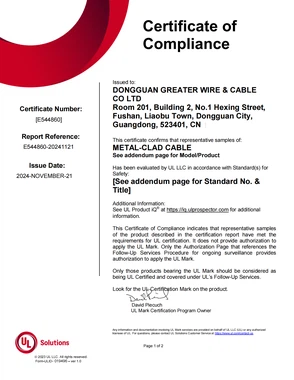
As a professional MC cable manufacturer with over two decades of experience, Dongguan Greater Wire & Cable Co., Ltd. specializes in producing premium-quality metal clad cable and MC wire for global electrical markets. Our factory covers more than 50,000 m², equipped with advanced production lines and complete testing systems to ensure industry-leading performance, reliability, and safety.
Key features of our MC cable products:
🛠️ Reliable Construction – High-quality copper conductors for efficient current transfer and reduced energy loss.
🛡️ Robust Protection – Metal clad armor shields the internal conductors against impact, moisture, and chemical exposure.
📜 UL Certified Quality – All MC cables are UL certified for safety and compliance with international electrical standards, enhancing customer trust and installation confidence.
🏭 Factory Customization – Custom lengths, packaging options, and free samples available upon request.
📞 Contact Our Sales Team Today
📱 WhatsApp / Phone: +86 135 1078 4550 | +86 136 6257 9592
📧 Email: manager01@greaterwire.com
🏢 Factory: Building 2, Huiyuanjia Science & Technology Park, Luxi 2nd Road, Liaobu Town, Dongguan City, China