























The size of solar panels plays a crucial role in the design and efficiency of a solar energy system. While larger panels can provide more power, they are not always the best choice for every application. Deciding whether bigger solar panels are better depends on factors such as installation space, system design, compatibility with inverters, and the role of solar cables and solar wires in ensuring safe and efficient power transmission.
This article explores the advantages and disadvantages of larger solar panels and explains how solar cables and wires influence the system's overall performance.
Understanding Solar Panel Size and Power Output
Solar panel size typically refers to its physical dimensions and power output. Larger panels generally have a higher wattage because they contain more photovoltaic cells. For example:
A standard residential panel may produce 300–400 watts.
Larger commercial or industrial panels can generate 500 watts or more.
The choice between smaller and larger panels impacts the system's design, including the layout, electrical configuration, and the required solar cables and wires.

Advantages of Bigger Solar Panels
Higher Power Output:
Bigger panels can produce more electricity per unit, reducing the total number of panels needed.
This minimizes installation time and costs, particularly for large systems.
Space Efficiency:
For installations with limited space, such as rooftops, larger panels maximize energy production per square meter.
Fewer panels mean less racking and fewer connections, simplifying system setup.
Reduced Maintenance:
With fewer panels, maintenance is easier, as there are fewer points of failure, such as connectors and solar wires.

Disadvantages of Bigger Solar Panels
Weight and Handling:
Larger panels are heavier and more difficult to install, potentially increasing labor costs and time.
Roof structures may require reinforcement to support the additional weight.
Compatibility Issues:
Bigger panels may not fit seamlessly into all installation areas, especially irregularly shaped rooftops.
They require careful string design to ensure compatibility with the inverter's voltage and current limits.
Cost of Replacement:
If a large panel fails, replacing it may be costlier compared to smaller panels.
Solar Cable and Wire Requirements:
Larger panels often generate higher currents, necessitating thicker solar cables and wires.
Improperly sized cables can lead to overheating, voltage drops, and inefficiencies.

The Role of Solar Cables and Solar Wires
Solar cables and wires are essential for transferring electricity from the solar panels to the inverter and, eventually, to the grid or battery storage system. The size of the panels affects the requirements for these components.
Cable Sizing for Larger Panels:
Larger panels produce higher currents, which require solar cables and wires with higher ampacity (current-carrying capacity).
Using undersized cables can cause overheating, energy loss, and safety risks.
Voltage and Current Considerations:
The voltage and current produced by larger panels must match the cable ratings to avoid insulation breakdown or power loss.
Solar cables must support system voltages, which can reach up to 1,500V in commercial systems.
Length of Cable Runs:
In larger installations, longer cable runs are common. For bigger panels producing higher power, longer cables need to be thicker to minimize voltage drops.
Durability and Insulation:
High-quality insulation is critical for solar cables and wires used with large panels, as higher power output can generate more heat.

Example of Solar Cable and Wire Sizing
Let's consider a system with 500W solar panels:
Voltage: Each panel operates at 50V.
Current: 500W÷50V=10A500W \div 50V = 10A500W÷50V=10A per panel.
If 10 panels are connected in parallel, the total current is 10A×10=100A10A \times 10 = 100A10A×10=100A. In this case:
Solar cables connecting the panels to the combiner box must be rated for at least 100A.
For a string voltage of 500V, the cables must also support this voltage.
Bigger Solar Panels vs. Smaller Panels
While bigger panels may seem better due to their higher power output, smaller panels have their own advantages. Here's a comparison:
| Aspect | Bigger Panels | Smaller Panels |
|---|---|---|
| Power Output | Higher per panel | Lower per panel |
| Space Efficiency | Requires less space | Needs more panels for same output |
| Installation Cost | Lower (fewer panels and connections) | Higher (more panels and connections) |
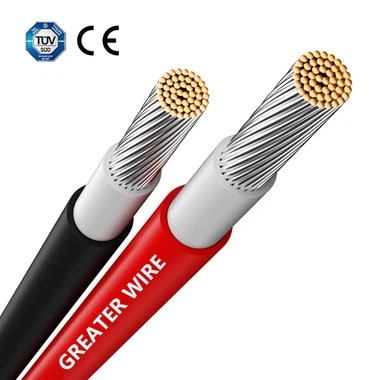
| Cable Requirements | Thicker solar cables and wires | Thinner cables may suffice |
| Flexibility | Limited (fits fewer roof designs) | More adaptable to complex layouts |
| Maintenance | Easier (fewer components) | More connections to manage |
When Are Bigger Panels Better?
Limited Space: Larger panels are ideal for installations with restricted space, such as small rooftops or areas where maximum energy production is required.
Commercial Projects: For large-scale projects, bigger panels reduce installation time and costs.
Simplified Maintenance: Fewer panels mean fewer points of failure, reducing long-term maintenance costs.

When Are Smaller Panels Better?
Flexible Installation Areas: Smaller panels work well for irregularly shaped rooftops or smaller installations.
Lower Initial Costs: They may be more affordable for homeowners who want to start small and expand later.
String Design Flexibility: Smaller panels allow for more customizable string configurations.

Impact on System Efficiency
System efficiency depends on the proper selection of solar cables and wires for the chosen panel size. Larger panels generating higher currents require careful attention to:
Minimizing Voltage Drop: Use thicker cables for long runs.
Preventing Overheating: Choose cables with appropriate ampacity.
Reducing Energy Loss: High-quality copper cables are preferred for their conductivity.

Safety Considerations
When installing larger panels, ensure that solar cables and wires are rated for:
Temperature Resistance: To handle heat generated by higher currents.
UV Protection: For outdoor installations.
Mechanical Durability: To withstand environmental stresses.
Additionally, use appropriate connectors and fuses to protect against overcurrent or short circuits.